

Microsoft’s SC-900 certification has become one of the clearest on-ramps into the modern security stack because it teaches the language of security, compliance, and identity before learners ever have to wrestle with advanced administration. For beginners, that matters: the exam is explicitly pitched at business stakeholders, students, and new or existing IT professionals, and Microsoft describes it as a Beginner-level certification with a broad foundation across Azure, Microsoft 365, and related cloud services. It is also a useful signal to employers that a candidate understands the basic architecture of cloud defense, even if they have not yet specialized in operations, engineering, or governance. In a market where cyber risk keeps rising and compliance expectations keep tightening, SC-900 is less about memorizing product names and more about learning how Microsoft frames the entire trust model.
The appeal of SC-900 is rooted in the way cloud security has changed over the last several years. Traditional perimeter-based thinking no longer fits a world where users sign in from anywhere, workloads span multiple clouds, and data moves through SaaS, devices, and collaboration tools. Microsoft’s current SC-900 study guide reflects that reality by emphasizing foundational ideas like the shared responsibility model, defense-in-depth, Zero Trust, and the shift from network perimeter thinking to identity as the new security boundary.
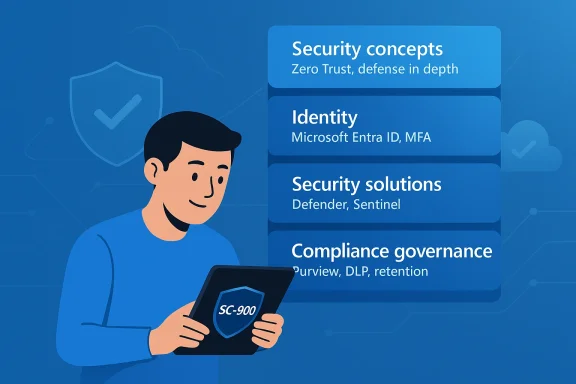
That context explains why Microsoft positions the exam as a cross-solution introduction rather than a pure Azure test. The current skills outline spans concepts, Microsoft Entra, Microsoft security solutions, and Microsoft compliance solutions, with a strong emphasis on how these areas connect across cloud-based services. In practice, SC-900 is designed to teach a learner how identity, protection, and governance work together instead of treating them as separate silos.
The certification also reflects Microsoft’s broader platform strategy. Identity is now centered on Microsoft Entra ID, security is increasingly surfaced through the Microsoft Defender portfolio, and data governance lives in Microsoft Purview. Microsoft’s own documentation shows how those pieces interact: Entra handles access control and authentication, Defender covers threat prevention and response, and Purview addresses compliance, information protection, retention, and data lifecycle management. For candidates, that means SC-900 is not simply an exam about terminology; it is a map of Microsoft’s cloud trust architecture.
There is also a practical career angle. Entry-level professionals often struggle to understand where to start in cybersecurity because the field is so fragmented. SC-900 gives them a coherent first step by teaching broad concepts before the more technical pathways such as SC-200, AZ-500, or specialized compliance roles. Microsoft’s exam page makes clear that the certification is intended for those seeking a holistic and end-to-end view of SCI solutions across Microsoft services.
The first domain builds the conceptual bedrock. Microsoft says candidates should understand defense-in-depth, Zero Trust, encryption and hashing, governance/risk/compliance ideas, authentication, authorization, identity providers, directory services, Active Directory, and federation. These are not niche details; they are the logic behind every modern security control a learner will later encounter.
The Entra portion is where identity becomes operational. Microsoft expects familiarity with Microsoft Entra ID, identity types, hybrid identity, authentication methods, and multifactor authentication, along with service trust and privacy principles and parts of Microsoft Priva and Purview. This matters because Microsoft has largely centered its identity story on Entra rather than legacy Azure AD terminology.
The security solutions section is the most execution-oriented. Microsoft references the capabilities of Defender and Sentinel-like tooling in its learning resources, and its broader Defender training materials frame the suite as one that helps organizations prevent, detect, and respond across devices, identities, apps, email, data, workloads, and clouds. In other words, SC-900 does not make you a security operator, but it does teach you how the security stack is supposed to function.
Defense-in-depth means layering controls so that if one fails, another still helps reduce risk. Zero Trust goes further by assuming no request should be trusted by default, regardless of its source, and by requiring ongoing verification based on identity, device health, location, and risk. This is the architecture that now underpins modern Microsoft cloud guidance.
Encryption and hashing are also part of this pillar, and SC-900 expects candidates to recognize their purpose rather than their implementation details. Encryption protects data in transit and at rest, while hashing supports integrity checks and password protection workflows. The distinction may seem elementary, but it is one of the most tested misunderstandings among beginners.
Authentication and authorization are foundational here. Microsoft defines authentication as the process of verifying identity before access is granted, while authorization determines what an authenticated user can do. Candidates who mix those up often struggle with exam questions because the distinction appears in nearly every identity scenario.
Microsoft Entra ID is the heart of the identity story. Microsoft’s documentation shows it handling user management, sign-in methods, role-based access control, Conditional Access, and application identity management. For SC-900, the goal is to understand what the service does and why it matters, not to memorize every portal menu.
Multifactor authentication, or MFA, is one of the most visible controls in the identity toolkit. Microsoft provides detailed guidance on enabling per-user MFA, security defaults, and Conditional Access-based enforcement depending on licensing and administrative needs. The exam frequently uses MFA as a real-world example of layered trust, so learners should understand both the concept and the business value.
Microsoft Defender for Cloud is one of the key services candidates should know at a high level. Microsoft’s documentation describes it as a cloud security posture and protection platform, and its overview emphasizes actionable insight into cloud security status and integration with the Defender portal experience. For exam purposes, the important idea is that it helps organizations assess configuration risk and improve security posture.
Microsoft Sentinel represents the SIEM/SOAR side of the house. Microsoft’s “What’s new” documentation notes that Sentinel supports relationships across users, devices, and activities, which helps security teams perform investigations and analyze incidents across complex environments. Beginners do not need to master KQL for SC-900, but they should understand that Sentinel is about centralized detection and response.
Microsoft also continues to broaden the unified security story across portals and workloads. Defender for Cloud is being integrated into the Defender portal, which underscores Microsoft’s move toward a more cohesive security experience rather than scattered admin consoles. That trend is worth watching because exam questions increasingly mirror product integration, not just isolated feature definitions.
Microsoft Purview Compliance Manager is especially important. Microsoft says it helps organizations automatically assess and manage compliance across multicloud environments, and its dashboard centers on compliance score, improvement actions, and role-based access control. That makes it a practical tool, not just a reporting dashboard.
Purview also covers information protection and lifecycle management. Microsoft’s documentation points to sensitivity labels, DLP, retention policies, records management, and data governance features as part of the platform’s scope. For SC-900, the learner’s job is to understand what these tools are for, not to administer them in detail.
The current Microsoft compliance story is broader than Microsoft 365 alone. Compliance Manager now integrates with Microsoft Defender for Cloud to assess posture across Microsoft 365, Azure, AWS, and GCP, which gives the platform a multicloud angle that many beginners may not expect. That integration is significant because it shows Microsoft’s governance model is designed for real enterprise estates, not just isolated Microsoft-only deployments.
The exam page also states that SC-900 is a Beginner certification and confirms that it is intended for people familiar with Microsoft Azure and Microsoft 365 who want a holistic view of SCI solutions. In other words, it is beginner-friendly, but not concept-free. A candidate still needs enough platform familiarity to recognize how the pieces fit together.
Microsoft also provides a practice assessment, exam sandbox, accommodations guidance, and retake policy information on the certification page and study guide. Those resources matter because they reduce uncertainty, and for many beginners uncertainty is the real barrier rather than complexity.
The exam’s language availability is another practical detail. Microsoft lists multiple languages, and it notes that localized versions may lag behind English updates by about eight weeks. That is not just administrative trivia; it affects preparation if a candidate is studying in a non-English version and wants the most current material.
A good study plan should move from general to specific. Start with the security concepts in week one, then move to identity and access, then Microsoft security and compliance tools, and only then spend serious time on practice questions. That sequence mirrors the exam structure and reduces cognitive overload.
The Microsoft Learn training path for SC-900 is particularly useful because it organizes learning around the exam’s conceptual pillars, including identity as the new perimeter and the role of directory services and federation. In practice, that means you can use Microsoft’s own content as a scaffold and only add third-party materials where they genuinely help with review.
For job seekers, SC-900 is most useful when paired with a clear learning story. It can support applications for roles such as help desk, junior security support, cloud support, technical sales, business analyst, or compliance-adjacent positions. The certification proves that the candidate understands the structure of Microsoft’s security environment and can speak intelligently about access, protection, and governance.
For enterprises, SC-900 can be a low-friction way to upskill teams. Business stakeholders, project managers, and support staff often need enough security literacy to make informed decisions without becoming engineers. Microsoft’s target audience description makes that use case explicit.
The best way to think about SC-900 is as a translation layer between beginner curiosity and professional security practice. It does not turn someone into a senior analyst, but it does teach them how Microsoft wants the world of cloud security to be understood. That makes it especially useful for people who are entering the field, moving from adjacent disciplines, or trying to build confidence before tackling more specialized certifications.
Source: Technology Org Mastering Microsoft SC-900 Certification: A Complete Beginner-to-Pro Guide - Technology Org
 Background
The appeal of SC-900 is rooted in the way cloud security has changed over the last several years. Traditional perimeter-based thinking no longer fits a world where users sign in from anywhere, workloads span multiple clouds, and data moves through SaaS, devices, and collaboration tools. Microsoft’s current SC-900 study guide reflects that reality by emphasizing foundational ideas like the shared responsibility model, defense-in-depth, Zero Trust, and the shift from network perimeter thinking to identity as the new security boundary.That context explains why Microsoft positions the exam as a cross-solution introduction rather than a pure Azure test. The current skills outline spans concepts, Microsoft Entra, Microsoft security solutions, and Microsoft compliance solutions, with a strong emphasis on how these areas connect across cloud-based services. In practice, SC-900 is designed to teach a learner how identity, protection, and governance work together instead of treating them as separate silos.
The certification also reflects Microsoft’s broader platform strategy. Identity is now centered on Microsoft Entra ID, security is increasingly surfaced through the Microsoft Defender portfolio, and data governance lives in Microsoft Purview. Microsoft’s own documentation shows how those pieces interact: Entra handles access control and authentication, Defender covers threat prevention and response, and Purview addresses compliance, information protection, retention, and data lifecycle management. For candidates, that means SC-900 is not simply an exam about terminology; it is a map of Microsoft’s cloud trust architecture.
There is also a practical career angle. Entry-level professionals often struggle to understand where to start in cybersecurity because the field is so fragmented. SC-900 gives them a coherent first step by teaching broad concepts before the more technical pathways such as SC-200, AZ-500, or specialized compliance roles. Microsoft’s exam page makes clear that the certification is intended for those seeking a holistic and end-to-end view of SCI solutions across Microsoft services.
Why the exam matters now
The timing is favorable because organizations are increasingly standardizing on cloud-native identity and compliance controls. Microsoft Entra documentation shows that access management now includes Conditional Access, multifactor authentication, role-based access control, and device identity, all of which are foundational to modern security posture. Meanwhile, Microsoft Purview has grown into a substantial governance layer with compliance score tracking, sensitivity labels, DLP, and records management. SC-900 sits at the intersection of those trends.- It teaches the vocabulary of cloud security.
- It helps candidates understand Microsoft’s platform architecture.
- It aligns with how employers now think about identity-first security.
- It creates a pathway to more advanced Microsoft certifications.
- It is designed to be accessible to non-specialists.
What SC-900 Actually Covers
At a high level, SC-900 is structured around four major domains: security, compliance, and identity concepts; Microsoft Entra capabilities; Microsoft security solutions; and Microsoft compliance solutions. Microsoft’s current skills outline assigns the greatest weight to Microsoft security solutions, followed by Entra and compliance, which is a strong hint that learners should not treat this as a purely theoretical exam.The first domain builds the conceptual bedrock. Microsoft says candidates should understand defense-in-depth, Zero Trust, encryption and hashing, governance/risk/compliance ideas, authentication, authorization, identity providers, directory services, Active Directory, and federation. These are not niche details; they are the logic behind every modern security control a learner will later encounter.
The Entra portion is where identity becomes operational. Microsoft expects familiarity with Microsoft Entra ID, identity types, hybrid identity, authentication methods, and multifactor authentication, along with service trust and privacy principles and parts of Microsoft Priva and Purview. This matters because Microsoft has largely centered its identity story on Entra rather than legacy Azure AD terminology.
The security solutions section is the most execution-oriented. Microsoft references the capabilities of Defender and Sentinel-like tooling in its learning resources, and its broader Defender training materials frame the suite as one that helps organizations prevent, detect, and respond across devices, identities, apps, email, data, workloads, and clouds. In other words, SC-900 does not make you a security operator, but it does teach you how the security stack is supposed to function.
The four domains in plain English
SC-900 is really asking a candidate to answer four practical questions. First, do you understand the security model? Second, do you know how identity is controlled? Third, can you recognize Microsoft’s threat protection tools? Fourth, do you understand how compliance and data governance are enforced? Microsoft’s study guide and exam page both reinforce that structure.- Security concepts explain the why.
- Entra explains the who.
- Microsoft security solutions explain the how of defense.
- Microsoft compliance solutions explain the how of control.
Security Concepts: The First Pillar
The most important conceptual shift in SC-900 is that security is no longer just about blocking intruders at a perimeter. Microsoft’s study guide explicitly calls out shared responsibility, defense-in-depth, and Zero Trust, all of which reflect the reality of distributed cloud services where no single control can be trusted alone. That is a major mindset change for beginners who may still think of “security” as antivirus and passwords.Defense-in-depth means layering controls so that if one fails, another still helps reduce risk. Zero Trust goes further by assuming no request should be trusted by default, regardless of its source, and by requiring ongoing verification based on identity, device health, location, and risk. This is the architecture that now underpins modern Microsoft cloud guidance.
Encryption and hashing are also part of this pillar, and SC-900 expects candidates to recognize their purpose rather than their implementation details. Encryption protects data in transit and at rest, while hashing supports integrity checks and password protection workflows. The distinction may seem elementary, but it is one of the most tested misunderstandings among beginners.
Why these basics matter for later learning
A lot of advanced cybersecurity topics become easier once these concepts are solid. Incident response, conditional access, information protection, and compliance reporting all assume that a learner understands what assets are being protected and why. SC-900 is valuable because it builds that lens early.- Shared responsibility clarifies what Microsoft handles and what customers must manage.
- Defense-in-depth encourages layered protection.
- Zero Trust frames access decisions as continuous, not one-time.
- Encryption protects confidentiality.
- Hashing supports integrity and verification.
Identity and Access: The Core of Modern Security
If one idea dominates SC-900, it is that identity is the primary security perimeter. Microsoft’s learning path on concepts explicitly teaches this message, and its Entra documentation positions identity management as the mechanism for controlling access to apps, data, and resources. That is a critical shift because it reframes cybersecurity from “protect the network” to “protect the user and the session.”Authentication and authorization are foundational here. Microsoft defines authentication as the process of verifying identity before access is granted, while authorization determines what an authenticated user can do. Candidates who mix those up often struggle with exam questions because the distinction appears in nearly every identity scenario.
Microsoft Entra ID is the heart of the identity story. Microsoft’s documentation shows it handling user management, sign-in methods, role-based access control, Conditional Access, and application identity management. For SC-900, the goal is to understand what the service does and why it matters, not to memorize every portal menu.
Multifactor authentication, or MFA, is one of the most visible controls in the identity toolkit. Microsoft provides detailed guidance on enabling per-user MFA, security defaults, and Conditional Access-based enforcement depending on licensing and administrative needs. The exam frequently uses MFA as a real-world example of layered trust, so learners should understand both the concept and the business value.
Hybrid identity and federation
SC-900 also touches on hybrid identity and federation because many organizations still run mixed environments. Microsoft describes hybrid identity as part of the Entra story, and its concept learning path explains how federation extends trust across organizational boundaries. For learners, the takeaway is simple: not every enterprise is cloud-native, and the exam reflects that operational reality.- Identity providers issue or validate identity claims.
- Federation lets organizations trust external identity systems.
- Hybrid identity bridges on-premises and cloud environments.
- MFA reduces the risk of stolen passwords.
- Conditional Access lets organizations enforce policy dynamically.
Why beginners should care
Many first-time candidates focus too heavily on product naming and too lightly on the logic of access control. That is a mistake. Once you understand identity, everything else in Microsoft security starts to feel much more coherent.Microsoft Security Solutions: Detection, Response, and Posture
The security-solutions domain is where SC-900 starts to feel more like a real platform exam. Microsoft’s broader Defender training describes Microsoft Defender as a suite that helps businesses prevent, detect, and respond to attacks across devices, identities, apps, email, data, workloads, and clouds. That framing matters because SC-900 is trying to show how security operations have become a connected workflow rather than a set of isolated tools.Microsoft Defender for Cloud is one of the key services candidates should know at a high level. Microsoft’s documentation describes it as a cloud security posture and protection platform, and its overview emphasizes actionable insight into cloud security status and integration with the Defender portal experience. For exam purposes, the important idea is that it helps organizations assess configuration risk and improve security posture.
Microsoft Sentinel represents the SIEM/SOAR side of the house. Microsoft’s “What’s new” documentation notes that Sentinel supports relationships across users, devices, and activities, which helps security teams perform investigations and analyze incidents across complex environments. Beginners do not need to master KQL for SC-900, but they should understand that Sentinel is about centralized detection and response.
Microsoft also continues to broaden the unified security story across portals and workloads. Defender for Cloud is being integrated into the Defender portal, which underscores Microsoft’s move toward a more cohesive security experience rather than scattered admin consoles. That trend is worth watching because exam questions increasingly mirror product integration, not just isolated feature definitions.
The operational story behind the branding
The key challenge for learners is not remembering that these products exist; it is understanding how they fit together. Defender covers posture and protection, Sentinel focuses on analytics and response, and Entra enforces identity control. SC-900 rewards learners who can explain that workflow in plain English.- Defender for Cloud helps assess and improve posture.
- Sentinel supports monitoring, correlation, and incident response.
- Defender spans multiple security domains.
- Entra controls access and authentication.
- Together, they form Microsoft’s cloud security narrative.
Consumer versus enterprise impact
For consumers and small organizations, the value is clarity and simplicity. For enterprises, the value is scale, policy enforcement, and integration across large estates. SC-900 does a good job of explaining why the same platform can serve both audiences without reducing security to a one-size-fits-all model.Microsoft Compliance Solutions: The Governance Layer
Compliance is often the least exciting part of cybersecurity until an organization fails an audit or mishandles data. SC-900 wisely places it alongside security and identity rather than treating it as an afterthought, because Microsoft’s compliance stack is increasingly central to enterprise governance. Microsoft Purview is the main platform learners should recognize.Microsoft Purview Compliance Manager is especially important. Microsoft says it helps organizations automatically assess and manage compliance across multicloud environments, and its dashboard centers on compliance score, improvement actions, and role-based access control. That makes it a practical tool, not just a reporting dashboard.
Purview also covers information protection and lifecycle management. Microsoft’s documentation points to sensitivity labels, DLP, retention policies, records management, and data governance features as part of the platform’s scope. For SC-900, the learner’s job is to understand what these tools are for, not to administer them in detail.
The current Microsoft compliance story is broader than Microsoft 365 alone. Compliance Manager now integrates with Microsoft Defender for Cloud to assess posture across Microsoft 365, Azure, AWS, and GCP, which gives the platform a multicloud angle that many beginners may not expect. That integration is significant because it shows Microsoft’s governance model is designed for real enterprise estates, not just isolated Microsoft-only deployments.
Why governance is not optional
A modern security strategy without data governance is incomplete. Sensitive data must be classified, labeled, retained, and protected according to legal and business requirements. SC-900 introduces that reality early so learners do not view compliance as merely a legal checklist.- Compliance Manager helps measure and track progress.
- Sensitivity labels classify and protect data.
- DLP helps prevent accidental or unauthorized sharing.
- Retention policies support lifecycle and records obligations.
- Multicloud support reflects enterprise reality.
The practical lesson
One of the most useful takeaways from SC-900 is that compliance can be operationalized. Microsoft is not teaching governance as paperwork; it is teaching governance as a set of controls embedded in the platform.How the Exam Is Structured and How to Read It
Microsoft’s official materials make the exam structure fairly transparent. The current skills measured version, effective November 7, 2025, lists four domains with approximate weightings and notes that most questions cover generally available features, though some preview features may appear if widely used. That is useful because it tells candidates not to overfocus on obscure edge cases.The exam page also states that SC-900 is a Beginner certification and confirms that it is intended for people familiar with Microsoft Azure and Microsoft 365 who want a holistic view of SCI solutions. In other words, it is beginner-friendly, but not concept-free. A candidate still needs enough platform familiarity to recognize how the pieces fit together.
Microsoft also provides a practice assessment, exam sandbox, accommodations guidance, and retake policy information on the certification page and study guide. Those resources matter because they reduce uncertainty, and for many beginners uncertainty is the real barrier rather than complexity.
The exam’s language availability is another practical detail. Microsoft lists multiple languages, and it notes that localized versions may lag behind English updates by about eight weeks. That is not just administrative trivia; it affects preparation if a candidate is studying in a non-English version and wants the most current material.
How to interpret the skills weights
The weighting gives a clear study signal. Microsoft security solutions account for the largest share, so learners should spend more time on the Defender and Sentinel side than they might expect. Compliance is also substantial, which means Purview should not be treated as a minor add-on.- Security, compliance, and identity concepts: 10–15%
- Microsoft Entra: 25–30%
- Microsoft security solutions: 35–40%
- Microsoft compliance solutions: 20–25%
Reading the exam like a product map
If you think of SC-900 as a tour of Microsoft’s trust architecture, the exam becomes much easier to study for. You are not trying to become a cloud engineer in one sitting. You are learning how Microsoft defines the core vocabulary of modern security.A Beginner Study Strategy That Actually Works
The most common mistake beginners make is overstudying in the wrong way. They memorize terms without understanding the scenarios behind them, then freeze when a question presents a business problem rather than a definition. Microsoft’s study guide and training path suggest a much better approach: learn the concepts, then reinforce them with hands-on documentation and practice assessments.A good study plan should move from general to specific. Start with the security concepts in week one, then move to identity and access, then Microsoft security and compliance tools, and only then spend serious time on practice questions. That sequence mirrors the exam structure and reduces cognitive overload.
The Microsoft Learn training path for SC-900 is particularly useful because it organizes learning around the exam’s conceptual pillars, including identity as the new perimeter and the role of directory services and federation. In practice, that means you can use Microsoft’s own content as a scaffold and only add third-party materials where they genuinely help with review.
A simple four-week plan
- Learn the core concepts of security, compliance, and identity.
- Study Microsoft Entra, with emphasis on MFA and access control.
- Review Defender, Sentinel, and basic threat response concepts.
- Finish with Purview, then take multiple practice assessments.
- Focus on concept relationships, not just definitions.
- Use Microsoft Learn as your primary reference.
- Take practice exams only after building a baseline.
- Revisit Zero Trust and identity concepts multiple times.
- Review compliance tools through real-world scenarios.
Why practice questions help
Practice exams are not just about guessing the right answer. They train you to recognize how Microsoft phrases scenarios and how exam writers separate similar concepts. The benefit is especially strong for beginners who need to learn the company’s terminology.Career Value: What SC-900 Can and Cannot Do
SC-900 is often marketed as a career booster, and there is truth to that, but it is important to be precise. The certification can strengthen an entry-level resume and help a candidate demonstrate awareness of security fundamentals, but it is not a substitute for hands-on experience or deeper technical credentials. That distinction matters because beginners sometimes expect a fundamentals exam to unlock senior roles on its own.For job seekers, SC-900 is most useful when paired with a clear learning story. It can support applications for roles such as help desk, junior security support, cloud support, technical sales, business analyst, or compliance-adjacent positions. The certification proves that the candidate understands the structure of Microsoft’s security environment and can speak intelligently about access, protection, and governance.
For enterprises, SC-900 can be a low-friction way to upskill teams. Business stakeholders, project managers, and support staff often need enough security literacy to make informed decisions without becoming engineers. Microsoft’s target audience description makes that use case explicit.
What comes after SC-900
Once someone understands the fundamentals, the logical next step is specialization. Microsoft’s security roadmap naturally branches into operations, identity management, cloud security, and compliance engineering. SC-900 is effective precisely because it shows where the next layer of depth should go.- SC-200 for security operations and analysis.
- AZ-500 for Azure security engineering.
- Role-based Entra study for identity administration.
- Purview-focused learning for compliance and governance.
- Hands-on labs to build practical confidence.
The honest value proposition
SC-900 is worth it when your goal is to understand the Microsoft security ecosystem quickly and credibly. It is less valuable if you need deep technical proof of implementation skill, because the exam is intentionally foundational.Strengths and Opportunities
SC-900’s biggest strength is that it lowers the entry barrier to one of the most in-demand areas in IT. It gives beginners a credible way to learn the vocabulary of cloud security, identity management, and compliance, while still staying connected to Microsoft’s actual product stack. It also fits well into organizational training plans because it is broad enough for mixed audiences and structured enough for self-study.- Beginner-friendly but still professionally relevant.
- Strong alignment with Microsoft’s modern identity-first model.
- Good foundation for future specialization.
- Useful for both technical and non-technical stakeholders.
- Reinforces real-world concepts like MFA, Zero Trust, and DLP.
- Backed by Microsoft Learn resources and practice tools.
- Helps candidates understand Microsoft’s cloud security ecosystem end to end.
Risks and Concerns
The main risk with SC-900 is shallow preparation. Because the exam is labeled beginner-level, some candidates underestimate it and rely too heavily on memorization or unofficial dumps, which can produce a fragile understanding that falls apart under scenario-based questions. Another concern is that Microsoft’s platform evolves quickly, so learners who use outdated study material may miss newer terminology or updated product grouping.- Memorizing definitions without scenario practice.
- Using outdated study resources.
- Overfocusing on one product area and ignoring the others.
- Underestimating compliance and governance topics.
- Assuming beginner level means easy without preparation.
- Ignoring Microsoft Learn in favor of low-quality shortcuts.
- Failing to connect identity, security, and compliance into one model.
Looking Ahead
SC-900 is likely to remain relevant because Microsoft’s security strategy is built around the very ideas the exam teaches: identity-first access, layered protection, and governance tied to data rather than just devices. As Microsoft continues integrating Entra, Defender, and Purview more tightly across portals and cloud workloads, the fundamentals will stay valuable even as the tooling evolves. That gives the certification unusual staying power for an entry-level credential.The best way to think about SC-900 is as a translation layer between beginner curiosity and professional security practice. It does not turn someone into a senior analyst, but it does teach them how Microsoft wants the world of cloud security to be understood. That makes it especially useful for people who are entering the field, moving from adjacent disciplines, or trying to build confidence before tackling more specialized certifications.
- Expect continued emphasis on identity and Zero Trust.
- Expect more integration across Microsoft security portals.
- Expect compliance tooling to remain multicloud-aware.
- Expect the exam to keep reflecting current GA services.
- Expect the fundamentals to stay relevant even as products change.
Source: Technology Org Mastering Microsoft SC-900 Certification: A Complete Beginner-to-Pro Guide - Technology Org
