

Microsoft’s latest enterprise AI message is no longer about whether AI can help employees draft faster or summarize meetings. It is about whether organizations can turn AI into a durable operating model that delivers measurable business outcomes, with governance built in from the start. That shift is the real story behind the company’s “Scaling AI with confidence” framing: the leaders moving fastest are treating AI as infrastructure, not as a side project. Microsoft’s own recent announcements around Frontier Transformation, Agent 365, and Microsoft 365 E7 reinforce that the industry has moved into a new phase where trust, security, and repeatability matter as much as model capability.
The article’s core thesis is easy to miss if you stop at the surface-level language of productivity. Microsoft is arguing that the companies pulling ahead are not simply using AI more often; they are embedding it into how work gets done, how decisions are made, and how outcomes are measured. That aligns with the company’s broader “Frontier Transformation” narrative, which describes a move beyond isolated experimentation toward AI woven into the flow of work and supported by a control plane for governance.
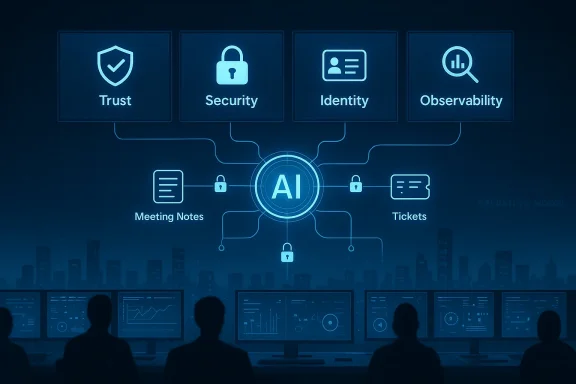
That framing matters because enterprise AI has entered a maturation stage. In 2024 and early 2025, many organizations were still asking whether Copilot-style tools worked at all. By 2026, the harder question is how to scale them securely across business units, regulated workflows, and varied employee roles without creating chaos. Microsoft’s recent blog posts and event materials repeatedly emphasize that AI adoption now depends on integrating intelligence with identity, security, compliance, and observability.
It is also significant that Microsoft is telling this story through customer conversations rather than abstract product talk. The company’s messaging around the New York AI Tour, and more recent Frontier Transformation launches, points to a market where leaders want practical proof that AI can change cycle times, improve client experience, and reduce operational friction. That is a very different conversation from the early hype cycle, when many executives were content to run pilots and collect demos.
At a strategic level, Microsoft is making a bid to become the company that normalizes enterprise AI at scale. Its new suite announcements suggest that the next battleground is not raw access to models, but the ability to package models, workflows, identity, security, and agent governance into something enterprises can actually deploy. That is why the company keeps returning to the same idea: AI has to be trusted to be adopted, and it has to be adopted to become transformative.
This is where the “pilot problem” becomes visible. A pilot is easy to justify because it is contained, reversible, and usually flattering to the sponsor. Scaling is harder because it exposes messy realities: access rights, data quality, adoption gaps, process ownership, and regulatory constraints. Microsoft’s newer guidance around Zero Trust for AI and secure agentic deployments shows that the company understands how quickly AI stops being a novelty once it touches real operations.
That is also why enterprise buyers are getting more selective. They are no longer impressed by generic prompting features alone. They want AI that understands context, respects permissions, and can be audited when things go wrong. Microsoft’s emphasis on Agent 365 as a control plane suggests that the company sees this as the next layer of the enterprise stack, not an optional add-on.
That distinction is especially relevant in industries like professional services and financial services. In those settings, AI that merely makes individuals faster is useful, but AI that shortens end-to-end cycle time or improves client response quality is strategically meaningful. Microsoft’s positioning around Frontier Transformation and the new suite is explicitly about moving from point productivity to business redesign.
In practical terms, outcome-led deployment forces discipline. It makes it easier to decide what should be automated, what should remain human-led, and what needs to be measured before scale. That is a healthier model than blanket AI enthusiasm, because it gives leaders a way to justify investment while preserving accountability. It also creates a cleaner path for enterprise procurement and compliance review.
Healthcare, insurance, and financial services all have the same structural challenge: they cannot afford AI systems that are opaque, unreliable, or poorly controlled. If the system touches protected data, decision support, or customer-facing commitments, then accuracy and auditability become essential. Microsoft’s recent Zero Trust for AI guidance suggests the company is positioning its stack around those concerns rather than treating them as edge cases.
The broader implication is that governance should be treated as a design principle, not a downstream fix. Companies that bolt on controls later often slow themselves down twice: first by creating unmanaged risk, then by retrofitting oversight. Microsoft’s latest messaging argues for the opposite sequence, where security and trust are part of the foundation from day one.
That is why skilling and change management matter so much. Even the most capable AI platform will stall if employees do not trust it, understand it, or know where it belongs in their process. Microsoft’s current materials increasingly pair technology announcements with confidence-building language, which reflects a mature view of adoption: people need to feel that AI makes their work better, not more confusing.
This is where a human-led, people-centered approach becomes practical rather than rhetorical. If employees see AI as a way to reduce overload, improve judgment, and free time for higher-value work, adoption is more likely to stick. If they see it as a surveillance layer or another burden, resistance will follow quickly. Microsoft’s own enterprise framing suggests it knows that trust at the employee level is just as important as trust at the board level.
That repeatability is what separates durable change from innovation theater. If one executive sponsor drives adoption through charisma alone, the program often fades when priorities shift. A repeatable model, by contrast, survives turnover because it lives in process, policy, and platform design. Microsoft’s emphasis on Agent 365 and the unified suite suggests that the company wants customers to institutionalize AI rather than leave it to individual champions.
Microsoft’s broader portfolio strategy reinforces this logic. By combining productivity software, identity, security, data, and agent governance, the company is pushing customers toward a more complete stack for AI operations. That is strategically smart because it reduces integration friction and makes scale more predictable. It is also a competitive move against point solutions that may be clever but are harder to govern.
That distinction explains why a great consumer experience is not enough for business adoption. A chatbot that feels delightful in a personal setting can still be unusable in a regulated workflow. Microsoft’s Frontier suite, Agent 365, and Zero Trust for AI materials all point toward a market where enterprise customers want AI that behaves like software infrastructure, not like a novelty interface.
The consumer market may still reward experimentation and novelty, but enterprise adoption rewards predictability. That has implications for competitors. Vendors that rely solely on model excitement will likely struggle against platforms that can package AI inside the systems enterprises already use. Microsoft’s installed base gives it an advantage here, but it also raises expectations. If the experience is fragmented, customers will notice quickly.
That is an important competitive move because the market is crowded. Rivals can still win on specific capabilities, but Microsoft’s scale lets it frame the debate around operational readiness. If enterprises accept that framing, then the winning vendor is less likely to be the flashiest model provider and more likely to be the platform that makes AI safe to run at scale.
This also raises the stakes for rivals. They now have to prove they can deliver measurable impact, handle sensitive data responsibly, and fit into existing enterprise environments without creating extra operational burden. In other words, they must compete not only on AI quality, but on trust architecture. That is a higher bar, and it favors vendors with deep enterprise relationships.
For business leaders, the takeaway is equally direct. AI should be evaluated by whether it changes outcomes in the business, not by whether it creates impressive demos. That includes faster turnaround, better customer engagement, lower process friction, and more time for high-value work. If those benefits are not visible, then the program may be too shallow to matter.
The most important signposts will be practical ones. Buyers will watch whether AI actually reduces cycle times, improves employee experience, and creates durable operational advantage. They will also watch whether security and governance keep pace with agentic features. In that sense, Microsoft’s story is not just about technology leadership; it is about proving that confidence can be engineered.
Source: Microsoft Scaling AI with confidence: How leaders are using AI to drive enterprise transformation - Microsoft in Business Blogs
 Overview
The article’s core thesis is easy to miss if you stop at the surface-level language of productivity. Microsoft is arguing that the companies pulling ahead are not simply using AI more often; they are embedding it into how work gets done, how decisions are made, and how outcomes are measured. That aligns with the company’s broader “Frontier Transformation” narrative, which describes a move beyond isolated experimentation toward AI woven into the flow of work and supported by a control plane for governance.That framing matters because enterprise AI has entered a maturation stage. In 2024 and early 2025, many organizations were still asking whether Copilot-style tools worked at all. By 2026, the harder question is how to scale them securely across business units, regulated workflows, and varied employee roles without creating chaos. Microsoft’s recent blog posts and event materials repeatedly emphasize that AI adoption now depends on integrating intelligence with identity, security, compliance, and observability.
It is also significant that Microsoft is telling this story through customer conversations rather than abstract product talk. The company’s messaging around the New York AI Tour, and more recent Frontier Transformation launches, points to a market where leaders want practical proof that AI can change cycle times, improve client experience, and reduce operational friction. That is a very different conversation from the early hype cycle, when many executives were content to run pilots and collect demos.
At a strategic level, Microsoft is making a bid to become the company that normalizes enterprise AI at scale. Its new suite announcements suggest that the next battleground is not raw access to models, but the ability to package models, workflows, identity, security, and agent governance into something enterprises can actually deploy. That is why the company keeps returning to the same idea: AI has to be trusted to be adopted, and it has to be adopted to become transformative.
Why the AI conversation has changed
The most important change is not technological, but managerial. A year or two ago, many leaders approached AI as a tool to improve isolated tasks. Today, the fastest-moving organizations are asking how AI can reshape entire processes, from intake to decision-making to execution. That shift mirrors Microsoft’s own language about moving from experimentation to durable enterprise-wide value.This is where the “pilot problem” becomes visible. A pilot is easy to justify because it is contained, reversible, and usually flattering to the sponsor. Scaling is harder because it exposes messy realities: access rights, data quality, adoption gaps, process ownership, and regulatory constraints. Microsoft’s newer guidance around Zero Trust for AI and secure agentic deployments shows that the company understands how quickly AI stops being a novelty once it touches real operations.
From demos to operating models
The most useful way to understand the shift is to think in terms of operating models rather than tools. When AI sits at the edge of work, it may save a few minutes. When it becomes part of a standard workflow, it can change throughput, quality, and staffing assumptions. Microsoft’s Frontier suite messaging is built around this exact distinction: AI should not be something employees occasionally invoke; it should be something the business relies on consistently.That is also why enterprise buyers are getting more selective. They are no longer impressed by generic prompting features alone. They want AI that understands context, respects permissions, and can be audited when things go wrong. Microsoft’s emphasis on Agent 365 as a control plane suggests that the company sees this as the next layer of the enterprise stack, not an optional add-on.
- AI is moving from experimentation to execution.
- Business leaders want outcomes, not just usage.
- Governance is becoming a prerequisite, not an afterthought.
- The most valuable deployments are workflow-integrated.
- Trust is now part of the product itself.
AI stopped being a tool and became a strategy
The article makes an important point: many early AI wins were productivity wins, but productivity alone does not equal transformation. Drafting faster, summarizing quicker, and automating repetitive tasks are helpful, yet they do not automatically alter the economics of a business. Microsoft’s current enterprise narrative is aimed at a deeper shift, where AI becomes tied to revenue growth, decision speed, and service quality.That distinction is especially relevant in industries like professional services and financial services. In those settings, AI that merely makes individuals faster is useful, but AI that shortens end-to-end cycle time or improves client response quality is strategically meaningful. Microsoft’s positioning around Frontier Transformation and the new suite is explicitly about moving from point productivity to business redesign.
Outcome-led deployment
The strongest companies are starting with the business problem and working backward. Instead of asking which task AI can automate, they are asking which outcomes matter most: faster approvals, improved service consistency, better sales velocity, or more resilient operations. That approach matches Microsoft’s own framing that customers do not want more experimentation; they want AI that delivers real business outcomes and growth.In practical terms, outcome-led deployment forces discipline. It makes it easier to decide what should be automated, what should remain human-led, and what needs to be measured before scale. That is a healthier model than blanket AI enthusiasm, because it gives leaders a way to justify investment while preserving accountability. It also creates a cleaner path for enterprise procurement and compliance review.
- Start with a measurable business problem.
- Define the workflow AI will change.
- Track impact beyond simple usage.
- Scale only after governance is in place.
- Reinvest gains into broader transformation.
Why trust is the accelerator
One of the article’s strongest arguments is that trust is not a brake on AI adoption; it is the thing that makes scale possible. That point is echoed repeatedly in Microsoft’s security and Frontier Transformation messaging, where the company describes AI as needing both intelligence and trust to move from pilot to enterprise-wide value. In regulated sectors, that is not marketing language; it is a deployment requirement.Healthcare, insurance, and financial services all have the same structural challenge: they cannot afford AI systems that are opaque, unreliable, or poorly controlled. If the system touches protected data, decision support, or customer-facing commitments, then accuracy and auditability become essential. Microsoft’s recent Zero Trust for AI guidance suggests the company is positioning its stack around those concerns rather than treating them as edge cases.
Governance as a growth enabler
The article’s claim that responsible AI unlocks innovation is supported by Microsoft’s own direction. Agent 365, Microsoft 365 E7, and the surrounding security stack are designed to let organizations observe, govern, and secure AI use without forcing teams to abandon familiar productivity surfaces. That matters because enterprises rarely adopt technology simply because it is impressive; they adopt it when it is governable and supportable.The broader implication is that governance should be treated as a design principle, not a downstream fix. Companies that bolt on controls later often slow themselves down twice: first by creating unmanaged risk, then by retrofitting oversight. Microsoft’s latest messaging argues for the opposite sequence, where security and trust are part of the foundation from day one.
- Trusted systems scale faster than ad hoc ones.
- Compliance readiness shortens deployment cycles.
- Security controls reduce organizational hesitation.
- Auditable AI makes executive sponsorship easier.
- Responsible design improves long-term adoption.
The human side of AI is still decisive
The article is right to stress that the best AI stories are still human stories. Companies do not transform because they own clever software; they transform because people change how they work. Microsoft’s enterprise messaging implicitly acknowledges this by emphasizing AI in the flow of work, not as a separate destination.That is why skilling and change management matter so much. Even the most capable AI platform will stall if employees do not trust it, understand it, or know where it belongs in their process. Microsoft’s current materials increasingly pair technology announcements with confidence-building language, which reflects a mature view of adoption: people need to feel that AI makes their work better, not more confusing.
Adoption is a leadership problem
The best leaders do more than approve licenses. They define acceptable use, model behavior, and make room for experimentation without losing control. That kind of leadership reduces fear and makes adoption feel intentional rather than imposed. It also helps explain why Microsoft keeps linking AI progress to organizational readiness instead of raw feature count.This is where a human-led, people-centered approach becomes practical rather than rhetorical. If employees see AI as a way to reduce overload, improve judgment, and free time for higher-value work, adoption is more likely to stick. If they see it as a surveillance layer or another burden, resistance will follow quickly. Microsoft’s own enterprise framing suggests it knows that trust at the employee level is just as important as trust at the board level.
- Training must be tied to real work.
- Leaders must set clear usage boundaries.
- Employees need room to experiment safely.
- Adoption improves when AI removes friction.
- Change management is part of the product story.
From one-off wins to a repeatable AI operating model
The fastest-moving companies are not chasing random use cases. They are building a repeatable pattern that can be applied across the business. Microsoft’s description of organizations moving toward Frontier Transformation mirrors this approach: AI is not just an add-on, it is becoming part of a coordinated operating system for work.That repeatability is what separates durable change from innovation theater. If one executive sponsor drives adoption through charisma alone, the program often fades when priorities shift. A repeatable model, by contrast, survives turnover because it lives in process, policy, and platform design. Microsoft’s emphasis on Agent 365 and the unified suite suggests that the company wants customers to institutionalize AI rather than leave it to individual champions.
The scale formula
A practical scale formula is emerging across the enterprise market: define the outcome, deploy securely, measure impact, and then reinvest. That sequence is not flashy, but it is how transformation actually compounds. It also creates a framework executives can use to decide whether AI is producing real value or just activity.Microsoft’s broader portfolio strategy reinforces this logic. By combining productivity software, identity, security, data, and agent governance, the company is pushing customers toward a more complete stack for AI operations. That is strategically smart because it reduces integration friction and makes scale more predictable. It is also a competitive move against point solutions that may be clever but are harder to govern.
- Standardize the AI use case framework.
- Embed AI into everyday applications.
- Measure business impact, not vanity metrics.
- Expand only after controls are proven.
- Treat AI like infrastructure, not a campaign.
Enterprise versus consumer impact
One subtle but important issue in the article is the difference between consumer AI and enterprise AI. Consumers generally want convenience, speed, and flexibility. Enterprises want control, consistency, and traceability. Those are related needs, but not the same thing, and Microsoft’s current strategy is clearly optimized for the enterprise side of the equation.That distinction explains why a great consumer experience is not enough for business adoption. A chatbot that feels delightful in a personal setting can still be unusable in a regulated workflow. Microsoft’s Frontier suite, Agent 365, and Zero Trust for AI materials all point toward a market where enterprise customers want AI that behaves like software infrastructure, not like a novelty interface.
Why the enterprise bar is higher
Enterprise AI must deal with permissioning, data residency, audit logs, and workflow integrity. It also has to fit existing systems of record, which makes integration quality as important as model quality. That is one reason Microsoft’s “trust plus intelligence” language is more than branding: it reflects the reality that business customers will not scale what they cannot govern.The consumer market may still reward experimentation and novelty, but enterprise adoption rewards predictability. That has implications for competitors. Vendors that rely solely on model excitement will likely struggle against platforms that can package AI inside the systems enterprises already use. Microsoft’s installed base gives it an advantage here, but it also raises expectations. If the experience is fragmented, customers will notice quickly.
- Consumer AI values delight.
- Enterprise AI values reliability.
- Consumer usage tolerates ambiguity.
- Enterprise workflows demand traceability.
- Integration depth can outweigh model novelty.
The competitive landscape is shifting
Microsoft’s strategy should be read in competitive context. The company is not only responding to customer demand; it is also trying to define the terms on which enterprise AI will be bought and governed. The Frontier Transformation story, coupled with the new suite architecture, positions Microsoft as an integrator of intelligence, identity, and security rather than just a distribution partner for external models.That is an important competitive move because the market is crowded. Rivals can still win on specific capabilities, but Microsoft’s scale lets it frame the debate around operational readiness. If enterprises accept that framing, then the winning vendor is less likely to be the flashiest model provider and more likely to be the platform that makes AI safe to run at scale.
The moat is workflow ownership
The real moat in enterprise AI is not just access to models. It is ownership of the workflow where decisions, approvals, and actions happen. Microsoft’s integration of Copilot, agents, identity, and security is designed to sit directly in that workflow layer. That is why the company keeps talking about business outcomes rather than abstract intelligence.This also raises the stakes for rivals. They now have to prove they can deliver measurable impact, handle sensitive data responsibly, and fit into existing enterprise environments without creating extra operational burden. In other words, they must compete not only on AI quality, but on trust architecture. That is a higher bar, and it favors vendors with deep enterprise relationships.
- Workflow control is becoming the key battleground.
- Trust architecture matters as much as model quality.
- Distribution still favors major platforms.
- Point solutions must prove they can integrate deeply.
- Enterprise buyers want less complexity, not more.
What this means for CIOs and business leaders
For CIOs, the message is straightforward: AI strategy can no longer live outside the core architecture discussion. If AI is becoming an operating model, then it must be managed like one. That means identity, access, data classification, monitoring, and governance are now central design issues rather than secondary concerns. Microsoft’s latest announcements make that position hard to ignore.For business leaders, the takeaway is equally direct. AI should be evaluated by whether it changes outcomes in the business, not by whether it creates impressive demos. That includes faster turnaround, better customer engagement, lower process friction, and more time for high-value work. If those benefits are not visible, then the program may be too shallow to matter.
Four questions leaders should ask
- Which workflow is AI changing end to end?
- What proof will show that the change matters?
- What controls are in place before scale?
- How will employees be trained and supported?
- Treat AI as a portfolio, not a point tool.
- Align IT and business around shared outcomes.
- Build governance before wide rollout.
- Measure what changes, not just what launches.
- Invest in people as much as platforms.
Strengths and Opportunities
Microsoft’s current AI framing has several strengths. It is practical, enterprise-focused, and aligned with the way customers are actually buying technology in 2026. Most importantly, it recognizes that scale comes from combining intelligence with trust rather than treating them as opposing forces.- Strong fit with enterprise buying behavior
- Clear linkage between AI and business outcomes
- Better story for regulated industries
- Built-in governance and observability
- A path from pilot to repeatable deployment
- Integration with existing Microsoft workflows
- Stronger adoption potential through familiar tools
Risks and Concerns
The main risk is that ambition outpaces operational clarity. Enterprises may like the idea of frontier transformation, but they will still balk if the experience feels fragmented, expensive, or difficult to govern. Microsoft has to prove that its new stack simplifies adoption rather than adding another layer of complexity.- Complexity could slow real-world rollout
- Pricing may become a barrier for some buyers
- Fragmented experiences could weaken trust
- Governance tools may lag agent innovation
- Overpromising could create expectation gaps
- Smaller firms may struggle to operationalize scale
- Competitors may undercut on specialization
Looking Ahead
The next phase of enterprise AI will be defined by execution, not excitement. Microsoft’s recent positioning suggests that the market is moving toward a world where AI is embedded, governed, and measured like any other critical business capability. That is a big shift from the experimentation era, and it will separate companies that are merely curious from those that are truly ready to scale.The most important signposts will be practical ones. Buyers will watch whether AI actually reduces cycle times, improves employee experience, and creates durable operational advantage. They will also watch whether security and governance keep pace with agentic features. In that sense, Microsoft’s story is not just about technology leadership; it is about proving that confidence can be engineered.
- Watch for broader adoption of governed AI agents.
- Track whether outcomes become the primary KPI.
- Monitor how pricing and packaging evolve.
- Watch for industry-specific deployment patterns.
- See whether trust becomes the default differentiator.
Source: Microsoft Scaling AI with confidence: How leaders are using AI to drive enterprise transformation - Microsoft in Business Blogs
