

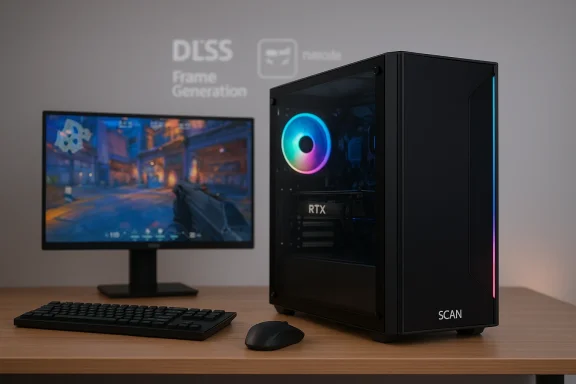
Gamers looking for a plug-and-play desktop may find the SCAN Aspect Gaming PC interesting because it sits squarely in the current sweet spot of entry-to-midrange 1080p gaming: a GeForce RTX 5060 8GB paired with an AMD Ryzen 5 8400F, 16GB of DDR5, and a 1TB SSD. The configuration matches the kind of balanced prebuilt Scan is currently selling under its 3XS line, which it explicitly positions as a system optimized for max settings 1080p gaming with the same CPU-GPU pairing and Windows 11 preinstalled. On paper, that makes this a sensible prebuilt for buyers who care more about getting into games quickly than micromanaging every component choice.
What makes the listing notable is not raw novelty, but how mainstream this class of gaming PC has become. The RTX 5060 launched as part of NVIDIA’s Blackwell family and is pitched around DLSS 4, Multi Frame Generation, neural rendering, ray tracing, and Reflex, while AMD’s Ryzen 5 8400F brings 6 cores, 12 threads, and boost clocks up to 4.7GHz on a 65W desktop platform. Add Windows 11 and a one-month Xbox Game Pass Ultimate offer, and the result is a very 2026-style desktop: performance first, convenience second, and aesthetics wrapped around both.
The SCAN Aspect PC arrives at a moment when the budget gaming desktop has become unusually important again. After years in which many buyers either delayed upgrades or settled for laptops and console-first gaming, the latest wave of midrange prebuilts is trying to restore the old desktop value proposition: more performance per pound, easier upgrades, and less setup friction. Scan’s own 3XS marketing around the RTX 5060 platform reflects that shift, with the company describing a similarly specced machine as a strong fit for 1080p gaming and pairing it with a mainstream AMD chip and fast NVMe storage.
The reason this matters is that today’s gaming market is defined as much by workflow as by silicon. Buyers increasingly want a machine that arrives ready to go, boots into Windows 11, and can launch a game library without forcing them into the parts market or a weekend of build troubleshooting. Microsoft continues to position Windows 11 as a gaming-capable platform with features like Auto HDR, Dynamic Lighting, and controller-friendly improvements, while also noting the practical realities of modern setup and account requirements.
At the hardware level, the SCAN Aspect configuration is a classic compromise build. The Ryzen 5 8400F is an AM5 desktop part with 6 cores and 12 threads, up to 4.7GHz boost, and 65W TDP, which makes it a strong gaming foundation without pushing into pricier eight-core territory. Meanwhile, the RTX 5060 represents NVIDIA’s strategy of pushing its newest features down into mainstream pricing, with the company specifically marketing the card for gamers who want DLSS 4 and Blackwell-era features without stepping up to enthusiast-class costs.
There is also a branding story here. Scan is not just slapping together commodity parts; it is selling the confidence of a UK-built system, backed by support and warranty positioning that matters to buyers who do not want to be their own integrator. That support angle is often the hidden differentiator in prebuilts, because the value is not merely the spec sheet, but the reduced risk of getting a machine that works correctly on day one.
The CPU is a smart, if conservative, choice. AMD’s official data shows the Ryzen 5 8400F as a 6-core/12-thread chip with a 4.2GHz base and up to 4.7GHz boost, built on Zen 4 and aimed at gaming-focused desktop systems. In practical terms, that means it should keep pace with the GPU in typical gaming workloads, especially at 1080p where frame pacing and background tasks matter more than all-core workstation muscle. It is the kind of processor that makes sense in a balanced system rather than an ambitious one.
The memory and storage choices reinforce that balance. 16GB of DDR5 at 5600MT/s is a solid baseline for Windows 11 gaming in 2026, and the 1TB NVMe SSD gives the machine enough room for a meaningful games library without immediately forcing a second drive purchase. That is especially useful in a prebuilt, because the first disappointment of many affordable gaming PCs is not the graphics card but the tiny, slow storage device buried inside them.
There are still trade-offs, and they are worth naming clearly:
For AAA gaming, the story becomes more nuanced. NVIDIA’s own framing of the RTX 5060 leans heavily on DLSS 4 and frame generation because those technologies are what help a mainstream card stretch into demanding new releases with modern visual features enabled. That means the card is best understood as a smart scaler rather than a brute-force monster. At 1080p, high settings should be a realistic target in many titles, but ultra settings with ray tracing will still benefit from using upscaling intelligently.
The 8GB memory buffer is the one part that may age faster than the rest of the system. That does not make the PC a bad buy, but it does affect how long buyers can expect to keep every visual slider maxed out. As game engines continue to use more texture memory and higher-resolution assets, 8GB remains a usable amount rather than a luxurious one.
The likely sweet spots are easy to identify:
Compactness is another theme. A smaller footprint can make a huge difference in real homes and dorm rooms, where desk space is more valuable than a few extra degrees of thermal headroom. That said, compact gaming systems always exist in a tension between style, size, and airflow, and this class of PC tends to work best when the builder has chosen components with reasonable power demands.
The support for Wi‑Fi also reflects the reality of modern desk setups. Not every buyer wants or can easily run Ethernet, and a ready-to-go wireless connection reduces friction on arrival day. It is a minor line in the spec list, but minor lines are often what turn a desktop into a pleasant purchase rather than an annoying project.
The aesthetic takeaways are straightforward:
The 16GB DDR5 5600MT/s configuration is also in the right place for a mainstream gaming rig. It is enough for modern Windows multitasking, browser-heavy gaming habits, Discord, streaming services, and background launchers without making the system feel starved. Still, it is worth acknowledging that 16GB is the minimum comfortable amount, not the most generous one.
This is where prebuilt desktops can be judged fairly: not by whether they are theoretically upgradeable, but by whether they feel smooth in actual use. Fast storage and modern memory do a lot of invisible work in a gaming PC, and Scan has avoided the embarrassment of pairing a new GPU with low-end supporting parts.
Key everyday benefits include:
The included one month of Xbox Game Pass Ultimate is a classic onboarding move. Microsoft’s Game Pass offering remains a major way to lower the first-week friction of a new PC by letting buyers immediately test a library of games without buying everything individually. Even when the subscription is only temporary, it creates a stronger emotional first impression because the machine arrives with something to do.
There is also a subtle marketing logic here. A new gaming PC that ships with an immediate content hook is more likely to feel “finished” on day one. That matters because the first experience is where many buyers decide whether a prebuilt feels like a good purchase or just an expensive box.
The most important software-level advantages are:
This is especially relevant for less technical buyers, families, and students. A gaming desktop is still a consumer electronics purchase, but it behaves more like a small appliance than a phone: it is expected to last, accept updates, and remain stable under use. The more a vendor can reduce ownership anxiety, the more justified a prebuilt’s premium becomes.
For enterprise or small-office contexts, the logic is different but still relevant. Windows 11 preinstallation, predictable component selection, and vendor-backed support reduce deployment risk. While this is not a business workstation in the strict sense, the same principles that make a machine reassuring to consumers also make it easier for IT-minded buyers to trust.
The ownership advantages are clear:
Against self-builds, the machine’s appeal is convenience and confidence. Many enthusiasts can assemble a better-balanced system on their own, but that is not the point. The point is whether Scan can deliver a machine that feels close enough to a thoughtful DIY build while removing the work and risk. On that score, this configuration is well chosen.
Against rival prebuilts, the RTX 5060 gives the system a timely angle. NVIDIA’s launch narrative around DLSS 4 and Blackwell features creates an easy marketing story, while the Ryzen 5 8400F prevents the system from feeling underpowered on the CPU side. The real competition, then, is not whether the components are impressive, but whether the entire package feels like good judgment.
In practice, buyers tend to weigh:
The bigger question is how long the 8GB mainstream GPU formula remains comfortable. NVIDIA has given the RTX 5060 strong feature appeal through DLSS 4 and the Blackwell platform, but game developers will keep pushing memory demand upward. If that happens faster than expected, the best value systems of 2026 may look very different by the time buyers are shopping again in 2027.
What to watch next:
Source: ruhrkanal.news https://ruhrkanal.news/RTX-5060-8GB-Ryzen-5-8400F-16GB-DDR5-1TB-SSD-RGB-Windows-611182/
What makes the listing notable is not raw novelty, but how mainstream this class of gaming PC has become. The RTX 5060 launched as part of NVIDIA’s Blackwell family and is pitched around DLSS 4, Multi Frame Generation, neural rendering, ray tracing, and Reflex, while AMD’s Ryzen 5 8400F brings 6 cores, 12 threads, and boost clocks up to 4.7GHz on a 65W desktop platform. Add Windows 11 and a one-month Xbox Game Pass Ultimate offer, and the result is a very 2026-style desktop: performance first, convenience second, and aesthetics wrapped around both.
 Background
The SCAN Aspect PC arrives at a moment when the budget gaming desktop has become unusually important again. After years in which many buyers either delayed upgrades or settled for laptops and console-first gaming, the latest wave of midrange prebuilts is trying to restore the old desktop value proposition: more performance per pound, easier upgrades, and less setup friction. Scan’s own 3XS marketing around the RTX 5060 platform reflects that shift, with the company describing a similarly specced machine as a strong fit for 1080p gaming and pairing it with a mainstream AMD chip and fast NVMe storage.The reason this matters is that today’s gaming market is defined as much by workflow as by silicon. Buyers increasingly want a machine that arrives ready to go, boots into Windows 11, and can launch a game library without forcing them into the parts market or a weekend of build troubleshooting. Microsoft continues to position Windows 11 as a gaming-capable platform with features like Auto HDR, Dynamic Lighting, and controller-friendly improvements, while also noting the practical realities of modern setup and account requirements.
At the hardware level, the SCAN Aspect configuration is a classic compromise build. The Ryzen 5 8400F is an AM5 desktop part with 6 cores and 12 threads, up to 4.7GHz boost, and 65W TDP, which makes it a strong gaming foundation without pushing into pricier eight-core territory. Meanwhile, the RTX 5060 represents NVIDIA’s strategy of pushing its newest features down into mainstream pricing, with the company specifically marketing the card for gamers who want DLSS 4 and Blackwell-era features without stepping up to enthusiast-class costs.
There is also a branding story here. Scan is not just slapping together commodity parts; it is selling the confidence of a UK-built system, backed by support and warranty positioning that matters to buyers who do not want to be their own integrator. That support angle is often the hidden differentiator in prebuilts, because the value is not merely the spec sheet, but the reduced risk of getting a machine that works correctly on day one.
The Core Specification
The headline combination of RTX 5060 8GB and Ryzen 5 8400F is where the machine earns its place in the market. NVIDIA’s launch materials frame the RTX 5060 family as a way to bring DLSS 4 Multi Frame Generation, neural rendering, ray tracing, and low-latency features into everyday systems, and that makes the GPU especially relevant for players who care about smoothness more than bragging rights. The 8GB frame buffer is important here: it is enough for mainstream 1080p gaming, but it also defines the limits of the card.The CPU is a smart, if conservative, choice. AMD’s official data shows the Ryzen 5 8400F as a 6-core/12-thread chip with a 4.2GHz base and up to 4.7GHz boost, built on Zen 4 and aimed at gaming-focused desktop systems. In practical terms, that means it should keep pace with the GPU in typical gaming workloads, especially at 1080p where frame pacing and background tasks matter more than all-core workstation muscle. It is the kind of processor that makes sense in a balanced system rather than an ambitious one.
The memory and storage choices reinforce that balance. 16GB of DDR5 at 5600MT/s is a solid baseline for Windows 11 gaming in 2026, and the 1TB NVMe SSD gives the machine enough room for a meaningful games library without immediately forcing a second drive purchase. That is especially useful in a prebuilt, because the first disappointment of many affordable gaming PCs is not the graphics card but the tiny, slow storage device buried inside them.
Why This Pairing Works
The CPU and GPU are paired in a way that minimizes obvious bottlenecks. At 1080p, the GPU will usually be the limiting factor, which is exactly where a midrange card should be spending its effort. In other words, Scan appears to have aimed for a system that makes the most of the money it spends on graphics rather than overinvesting in CPU capacity that would sit idle in many games.There are still trade-offs, and they are worth naming clearly:
- 8GB VRAM is fine for 1080p today, but it is not a comfort blanket for every future game.
- 16GB RAM is acceptable, though 32GB would be more comfortable for heavy multitasking.
- A Ryzen 5 8400F is competent, but not the last word in headroom for streaming and background workloads.
- The machine is optimized for mainstream gaming, not creator work or heavy productivity.
- The spec prioritizes value and practicality over future-proof bravado.
Gaming Performance Expectations
A machine like this should be judged against the games people actually play, not against synthetic bragging rights. For esports titles, the RTX 5060 and Ryzen 5 8400F pairing should be comfortably overqualified, especially if the user is targeting high-refresh 1080p play in games like Counter-Strike 2, Valorant, Rocket League, or Fortnite. In these scenarios, the system’s strengths are obvious: quick load times, responsive frame delivery, and enough CPU overhead to keep stutters under control.For AAA gaming, the story becomes more nuanced. NVIDIA’s own framing of the RTX 5060 leans heavily on DLSS 4 and frame generation because those technologies are what help a mainstream card stretch into demanding new releases with modern visual features enabled. That means the card is best understood as a smart scaler rather than a brute-force monster. At 1080p, high settings should be a realistic target in many titles, but ultra settings with ray tracing will still benefit from using upscaling intelligently.
The 8GB memory buffer is the one part that may age faster than the rest of the system. That does not make the PC a bad buy, but it does affect how long buyers can expect to keep every visual slider maxed out. As game engines continue to use more texture memory and higher-resolution assets, 8GB remains a usable amount rather than a luxurious one.
Where It Shines
This PC is most convincing when buyers view it as a high-FPS 1080p machine. That is the operating range where the CPU and GPU make the best use of each other and where the included SSD and DDR5 memory help the desktop feel nimble from boot to game launch. It is also a good fit for players who want to use Windows 11’s gaming enhancements without worrying about compatibility.The likely sweet spots are easy to identify:
- Competitive multiplayer games at high refresh rates
- Single-player games tuned for 1080p high settings
- DLSS-assisted play in newer AAA releases
- Light streaming or recording alongside gaming
- Everyday Windows 11 use with fast app switching
Design, Cooling, and Aesthetics
The case design is clearly part of the sales pitch. Scan highlights tempered glass, RGB lighting, and ASUS Aura control, which tells you the company understands that many buyers want a machine that looks like a gaming PC even when it is parked under a desk or beside a monitor. That visual identity matters in the prebuilt market because the desktop is now as much a lifestyle object as a utility box.Compactness is another theme. A smaller footprint can make a huge difference in real homes and dorm rooms, where desk space is more valuable than a few extra degrees of thermal headroom. That said, compact gaming systems always exist in a tension between style, size, and airflow, and this class of PC tends to work best when the builder has chosen components with reasonable power demands.
The support for Wi‑Fi also reflects the reality of modern desk setups. Not every buyer wants or can easily run Ethernet, and a ready-to-go wireless connection reduces friction on arrival day. It is a minor line in the spec list, but minor lines are often what turn a desktop into a pleasant purchase rather than an annoying project.
The Practical Side of RGB
RGB is easy to dismiss, but it plays a real role in value perception. When done well, it tells the buyer the system was assembled with some care rather than chosen purely by cheapest parts-bin logic. When done badly, it becomes cheap theater. In this case, the inclusion of customizable lighting controlled through ASUS Aura suggests Scan is trying to make the machine feel polished instead of loud for the sake of it.The aesthetic takeaways are straightforward:
- Tempered glass makes the build feel more premium.
- RGB lighting adds customization without affecting performance.
- A compact case is practical for smaller desks.
- Wi‑Fi support lowers installation friction.
- The overall look is aimed at mainstream gamers, not modders chasing extreme water-cooled builds.
Storage, Memory, and Everyday Responsiveness
One of the strongest things about this spec is that it avoids the cheap-PC trap of underserving the boring parts. A 1TB NVMe SSD with quoted read speeds up to 5000MB/s is fast enough to make Windows 11 feel immediate, and it gives the system a foundation for quick launches, fast patching, and tolerable game installs. For most buyers, that matters as much as raw benchmark numbers because it shapes daily satisfaction.The 16GB DDR5 5600MT/s configuration is also in the right place for a mainstream gaming rig. It is enough for modern Windows multitasking, browser-heavy gaming habits, Discord, streaming services, and background launchers without making the system feel starved. Still, it is worth acknowledging that 16GB is the minimum comfortable amount, not the most generous one.
This is where prebuilt desktops can be judged fairly: not by whether they are theoretically upgradeable, but by whether they feel smooth in actual use. Fast storage and modern memory do a lot of invisible work in a gaming PC, and Scan has avoided the embarrassment of pairing a new GPU with low-end supporting parts.
Fast Enough, But Not Overbuilt
There is wisdom in not overspending here. A prebuilt aimed at 1080p gaming does not need exotic PCIe 5.0 storage or huge memory capacity to satisfy most buyers. What it needs is a fast boot, quick game loading, and enough room to live comfortably for a while before the owner feels pressure to upgrade.Key everyday benefits include:
- Faster Windows 11 startup
- Shorter game loading times
- Better multitasking under load
- Fewer storage bottlenecks from updates and patches
- A more responsive feel in general desktop use
Windows 11, Xbox Game Pass, and the Software Layer
Bundling Windows 11 into the purchase is obvious, but it still matters. Microsoft continues to position Windows 11 as the default gaming desktop environment, with support for modern game features and a broad compatibility base that mirrors Windows 10’s game support while adding newer user-facing capabilities. For buyers, that means the SCAN Aspect is not just hardware; it is a fully provisioned Microsoft-compatible ecosystem.The included one month of Xbox Game Pass Ultimate is a classic onboarding move. Microsoft’s Game Pass offering remains a major way to lower the first-week friction of a new PC by letting buyers immediately test a library of games without buying everything individually. Even when the subscription is only temporary, it creates a stronger emotional first impression because the machine arrives with something to do.
There is also a subtle marketing logic here. A new gaming PC that ships with an immediate content hook is more likely to feel “finished” on day one. That matters because the first experience is where many buyers decide whether a prebuilt feels like a good purchase or just an expensive box.
Why the Software Bundle Matters
The software layer helps the machine appeal to buyers who are moving up from consoles or aging laptops. Those users often care less about individual component specifications than about whether the desktop gets them into games quickly and without anxiety. Windows 11 plus Game Pass is a neat package for that audience, because it combines familiarity with instant use.The most important software-level advantages are:
- Windows 11 is already familiar to many consumers.
- Game Pass Ultimate lowers the cost of first-month experimentation.
- Microsoft’s gaming stack supports a broad library and modern features.
- Preinstallation reduces setup friction.
- The machine is ready for both gaming and daily Windows work immediately.
Enterprise, Support, and Ownership Confidence
Scan’s support pitch is a meaningful part of the value story. A 2-year warranty and lifetime support can matter as much as a faster GPU for buyers who are uneasy about troubleshooting their own builds. In the prebuilts market, service terms often differentiate a serious system integrator from a mere assembler.This is especially relevant for less technical buyers, families, and students. A gaming desktop is still a consumer electronics purchase, but it behaves more like a small appliance than a phone: it is expected to last, accept updates, and remain stable under use. The more a vendor can reduce ownership anxiety, the more justified a prebuilt’s premium becomes.
For enterprise or small-office contexts, the logic is different but still relevant. Windows 11 preinstallation, predictable component selection, and vendor-backed support reduce deployment risk. While this is not a business workstation in the strict sense, the same principles that make a machine reassuring to consumers also make it easier for IT-minded buyers to trust.
Support as Product
Support is often talked about as an afterthought, but for prebuilts it is part of the product itself. If the system develops a hardware issue, the buyer is not just paying for a repair; they are paying to avoid the complexity of diagnosing a complete desktop on their own. That is worth real money.The ownership advantages are clear:
- 2-year warranty extends confidence beyond the box-opening moment
- Lifetime support lowers perceived risk
- Prebuilt assembly reduces compatibility guesswork
- UK-based integration implies a more controlled build process
- The machine is easier to recommend to less technical buyers
Competitive Positioning
The SCAN Aspect PC sits in the broad arena where prebuilt desktops compete with DIY builds, large retail bundles, and small integrators. Its best argument is that it combines modern GPU architecture, a current AMD desktop CPU, and enough memory and storage to avoid obvious compromises. That is a stronger pitch than the old “cheap gaming PC” formula, which often hid weak power supplies, tiny SSDs, or obsolete CPUs behind colorful cases.Against self-builds, the machine’s appeal is convenience and confidence. Many enthusiasts can assemble a better-balanced system on their own, but that is not the point. The point is whether Scan can deliver a machine that feels close enough to a thoughtful DIY build while removing the work and risk. On that score, this configuration is well chosen.
Against rival prebuilts, the RTX 5060 gives the system a timely angle. NVIDIA’s launch narrative around DLSS 4 and Blackwell features creates an easy marketing story, while the Ryzen 5 8400F prevents the system from feeling underpowered on the CPU side. The real competition, then, is not whether the components are impressive, but whether the entire package feels like good judgment.
What Buyers Are Really Comparing
Most shoppers will not compare transistor counts or PCIe lanes. They will compare experiences: one machine has better branding, one has more storage, one has a stronger warranty, and one feels safer to buy. That makes this SCAN system competitive because it bundles enough sensible choices to avoid red flags.In practice, buyers tend to weigh:
- Price versus convenience
- GPU generation versus raw memory size
- Warranty length versus do-it-yourself control
- Storage capacity versus upgrade path
- Aesthetics versus desk footprint
Strengths and Opportunities
The strongest case for the SCAN Aspect Gaming PC is that it is a cohesive mainstream gaming desktop rather than a Frankenbuild assembled around one flashy part. It has the right balance of GPU, CPU, storage, and user-facing polish, and that is exactly what many buyers want when they are trying to get into PC gaming without homework. It also benefits from a software bundle and service promise that make the machine feel more complete than the raw specs alone suggest.- RTX 5060 8GB gives it current-generation GPU credibility
- Ryzen 5 8400F is a sensible six-core gaming CPU
- 16GB DDR5 is enough for smooth day-to-day use
- 1TB NVMe SSD avoids the cramped-storage problem
- Windows 11 makes it plug-and-play for most buyers
- Game Pass Ultimate adds immediate value out of the box
- 2-year warranty and lifetime support improve trust
- RGB and tempered glass strengthen the premium perception
Risks and Concerns
The main concern is that 8GB of VRAM may age faster than buyers expect, especially if they try to stretch the machine beyond its intended 1080p comfort zone. That does not make the system obsolete, but it does limit how aggressively future games can be configured. A second concern is that 16GB of RAM is adequate rather than generous, so heavy multitaskers may eventually want to upgrade.- 8GB VRAM could become a bottleneck in newer AAA titles
- 16GB RAM may feel tight for streaming or many background apps
- The system is not ideal for 1440p max-settings aspirations
- Compact cases can impose thermal or acoustic compromises
- Prebuilt pricing can drift above DIY value
- Subscription bonuses are temporary, not permanent value
- RGB and glass add style, but not performance
Looking Ahead
The SCAN Aspect Gaming PC is part of a broader trend: the market is splitting between ultra-cheap entry systems and genuinely thoughtful midrange prebuilts. That middle ground is where many buyers live, and it is where vendors can still build strong loyalty if they get the balance right. In that sense, the Aspect is less a headline-grabber than a market indicator.The bigger question is how long the 8GB mainstream GPU formula remains comfortable. NVIDIA has given the RTX 5060 strong feature appeal through DLSS 4 and the Blackwell platform, but game developers will keep pushing memory demand upward. If that happens faster than expected, the best value systems of 2026 may look very different by the time buyers are shopping again in 2027.
What to watch next:
- Whether Scan refreshes the line with 32GB RAM options
- Whether a higher-VRAM variant becomes available
- How pricing compares with equivalent DIY builds
- Whether more retailers copy the same CPU-GPU pairing
- How well the RTX 5060 holds up in future AAA releases
Source: ruhrkanal.news https://ruhrkanal.news/RTX-5060-8GB-Ryzen-5-8400F-16GB-DDR5-1TB-SSD-RGB-Windows-611182/
