

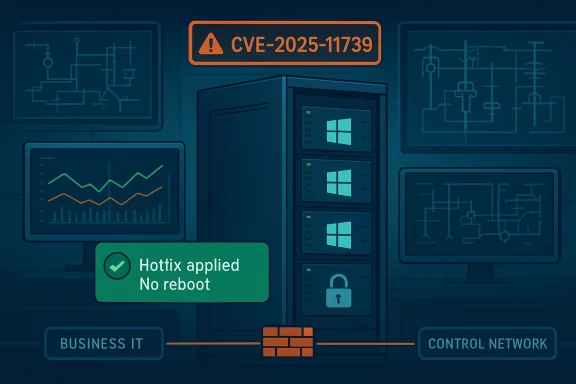
Schneider Electric’s latest advisory for EcoStruxure Power Monitoring Expert (PME) and EcoStruxure Power Operation (EPO) is the kind of industrial-software security notice that should immediately get the attention of OT teams, facilities operators, and Windows administrators alike. The issue, tracked as CVE-2025-11739, is a deserialization of untrusted data flaw that Schneider says could allow local arbitrary code execution with administrative privileges if an attacker can send a crafted data stream to a vulnerable system. The advisory assigns a CVSS 3.1 score of 7.8, places it in the high severity category, and stresses that failing to apply the fix may result in system compromise, operational disruption, or unauthorized administrative control. akes this advisory especially important is not just the severity score, but the role these products play in modern facilities. EcoStruxure Power Monitoring Expert is Schneider Electric’s on-premises software for helping critical and energy-intensive sites maximize uptime and operational efficiency, while EcoStruxure Power Operation is a platform for monitoring and controlling medium and lower power systems. In practical terms, these are not niche tools buried in an IT corner; they are often part of the operational spine for hospitals, data centers, manufacturing plants, campuses, utilities, and transportation infrastructure.
The vulnerability tn a direct way because the attack path is local and privilege-oriented. Schneider describes a scenario in which a locally authenticated attacker sends a malicious payload that triggers unsafe deserialization, enabling arbitrary code execution with administrative rights. That is a classic example of a bug class that looks narrowly scoped on paper but can become a major problem once an intruder has any foothold at all, especially in environments where Windows servers, domain credentials, remote support tools, and service accounts are already in heavy use.
The timing is also notable. CISA republiic’s CSAF advisory on March 19, 2026, with the original vendor release dated March 10, 2026. That means defenders are not dealing with a vague future risk; they are dealing with a current, vendor-acknowledged issue that has already been pushed into the ICS advisory ecosystem. The advisory also confirms that Schneider Electric reported the issue to CISA, which is an important sign that the company is treating this as a coordinated disclosure rather than an isolated product bug.
For WindowsForum readers, the more interesting question is nosts, but what this says about the state of industrial software in 2026. The answer is straightforward: on-premises control and monitoring platforms remain deeply dependent on Windows, local authentication, and administrative trust boundaries. Those are manageable assumptions when everything is well segmented and heavily governed, but they become brittle when remote access, shared admin accounts, or neglected legacy versions enter the mix.
At its core, deserialization of untrprogram takes incoming data and rebuilds objects from it without properly verifying whether the payload is safe. If the application trusts that data too much, an attacker may be able to manipulate the object graph or execution flow in a way that causes the software to run unwanted code. In Schneider’s case, the vendor says the vulnerable behavior could lead to arbitrary code execution with administrative privileges**.
That matters because deserialization flaws often sit close to the application’s deepest trust boundaries remotely exploitable in every deployment, but they are frequently dangerous once the attacker has legitimate access to the system or can exploit another weakness first. In industrial environments, that is a realistic chain: one stolen VPN credential, one abused jump host, one exposed remote service, or one insider with limited access can be enough to transform a “local-only” flaw into a serious operational incident.
Schneider’s own risk language supports that interpretation. The company explicitly warns of compromised systems, operational disruption, and unauve control if the fix is not applied. That is not the wording of a minor hardening issue; it is the language of a post-compromise pivot point that could let an attacker move from foothold to full authority.
That version spread tells a familiar story in industrial cybersecurity: the issue is not isolated to one aging build, but to a family of releases across multiple product generations. The inclusion of both current and older lines may have assumed they were protected because they had already upgraded once or were on a supported branch. Schneider’s advisory makes clear that assumption is unsafe unless the specific hotfix or release level has been verified.
That architecture is common in industrial software, and it is one reason remediation can be operationally complicated. Customers may think in terms of one product, one console, or one vendor relationship, while the actual software stack contains multiple interdependent mpatch paths. The advisory is effectively warning administrators to map the dependency tree before they declare the environment secure.
That distinction matters operationally. A hotfix is often the faster route for plant teams that need to close exposure without reworking a production support plan, while a full version upgrade can reduce long-term risk and eliminate accumulated technical debt. The vendor’s recommendation to consider PME 2024 R3** suggests Schneider sees this as more tt is an opportunity to move customers onto a cleaner, more maintainable branch.
Still, “no reboot” should not be confused with “no planning.” Administrators need to validate service state, confirm backups, check dependencies, and ensure the change is deployed against the correct component in the correct environment. The safest path is to treat the fix as a production change, not a quick desktop update.
The impact profile is especially sensitive because PME and EPO are used to manage power data and operational visibility. A compromise here can affect more than one server. It can interfere with monitoring fidelity, alarm handling, reporting, and in some deployments the confidence operators have in the state of the electrical system itself. In OT environments, loss of trust in telemetry is often nearly as bad as loss of telemetry.
Schneider’s call to audit all Windows-authenticated users is especially important. Industrial systems often accrete accounts over years, and no one rehem exist. Periodic entitlement reviews are not just compliance theater here; they are part of the practical containment strategy.
This is not merely about one Schneider product line. It is a reminder that industrial software is still catching up to the security realities of modern threat actors. Unsafe deserialization, support lifecycle gaps, and *dependency-heavyque to Schneider, but the consequences are especially severe in environments where power monitoring underpins business continuity.
The advisory also illustrates a broader market truth: vendors can issue fixes, but customers own the deployment risk. That means patch management is not only about downloading a hotfix. It is about version tracking, asset inventory, dependency mapping, credentindows, and validating that the vulnerable component is actually the one that gets updated. Security teams that skip any one of those steps usually find out the hard way.*
That pressure extends to rivals as well. Industrial software vendors are being judged on secure-by-default behavior, simpler upgrade paths, and fewer dependency traps. A product that is powerfuan become a liability in procurement conversations, especially in regulated sectors where security assurance now carries real budget weight.
Schneider’s advisory also hints at a broader trend in industrial cybersecurity: vendors are increasingly publishing more explicit, structured guidance through CSAF-styleublishing channels. That is good for visibility, but it also raises the bar for customers. Operators now have less excuse than ever to miss a high-severity issue, because the path from vendor disclosure to government advisory is fast and public.
In the end, the Schneider Electric EcoStruxure PME and EPO advisory is another reminder that industrial resilience now depends on software hygiene as much as on electrical engineering. The organizations best positioned to absorb this kind of event are the ones that already know their versions, already control their accounts, already segand already treat patching as a production discipline rather than a housekeeping task. For everyone else, the lesson is simple: the next outage may start with a missing hotfix, but it will end as an operational governance problem.
Source: CISA Schneider Electric EcoStruxure PME and EPO | CISA
The vulnerability tn a direct way because the attack path is local and privilege-oriented. Schneider describes a scenario in which a locally authenticated attacker sends a malicious payload that triggers unsafe deserialization, enabling arbitrary code execution with administrative rights. That is a classic example of a bug class that looks narrowly scoped on paper but can become a major problem once an intruder has any foothold at all, especially in environments where Windows servers, domain credentials, remote support tools, and service accounts are already in heavy use.
The timing is also notable. CISA republiic’s CSAF advisory on March 19, 2026, with the original vendor release dated March 10, 2026. That means defenders are not dealing with a vague future risk; they are dealing with a current, vendor-acknowledged issue that has already been pushed into the ICS advisory ecosystem. The advisory also confirms that Schneider Electric reported the issue to CISA, which is an important sign that the company is treating this as a coordinated disclosure rather than an isolated product bug.
For WindowsForum readers, the more interesting question is nosts, but what this says about the state of industrial software in 2026. The answer is straightforward: on-premises control and monitoring platforms remain deeply dependent on Windows, local authentication, and administrative trust boundaries. Those are manageable assumptions when everything is well segmented and heavily governed, but they become brittle when remote access, shared admin accounts, or neglected legacy versions enter the mix.
 The Vulnerability in Plain English
At its core, deserialization of untrprogram takes incoming data and rebuilds objects from it without properly verifying whether the payload is safe. If the application trusts that data too much, an attacker may be able to manipulate the object graph or execution flow in a way that causes the software to run unwanted code. In Schneider’s case, the vendor says the vulnerable behavior could lead to arbitrary code execution with administrative privileges**.That matters because deserialization flaws often sit close to the application’s deepest trust boundaries remotely exploitable in every deployment, but they are frequently dangerous once the attacker has legitimate access to the system or can exploit another weakness first. In industrial environments, that is a realistic chain: one stolen VPN credential, one abused jump host, one exposed remote service, or one insider with limited access can be enough to transform a “local-only” flaw into a serious operational incident.
Why local does not mean low risk
The word local can be misleading. Many defenders hear “local authenticated attacker”de the threat, but that only works if the environment is assumed to be clean and tightly controlled. In real plants and enterprise facilities, local access often means “somebody who already got in” rather than “somebody sitting at the console,” and that distinction changes the entire risk picture.Schneider’s own risk language supports that interpretation. The company explicitly warns of compromised systems, operational disruption, and unauve control if the fix is not applied. That is not the wording of a minor hardening issue; it is the language of a post-compromise pivot point that could let an attacker move from foothold to full authority.
- Attack vector: locally authenticated access
- Exploit class: unsafe deserialization
- Likely outcome: code execution with elevated privileges
- **Operatption, compromise, and admin takeover
Why this class keeps returning
Deserialization flaws are persistent because they often arise in complex software ecosystems where convenience and extensibility are prized. Industrialtly rely on rich data exchange between services, reporting modules, dashboards, historians, and third-party integrations. The more flexible the object handling, the easier it is for unsafe assumptions to slip in. That is the recurring tradeoff in enterprise software: the same features that make platforms useful also enlarge the attack surface.Affected Products and Versions
The advisory lists a wide set of affected versions. For EcoStruxure Power Monitoring Expert (PME), Schneider says the affected versions include 2022 and prior, , 2024, and 2024_R2. For EcoStruxure Power Operation (EPO), the affected software includes the 2022 Advanced Reporting and Dashboards Module and the 2024 Advanced Reporting and Dashboards Module. Schneider also identifies specific hotfix branches already in scope, including PME 2023_R2_Hotfix_282807 and PME 2024_R2_Hotfix_279338__2024R2CVS.That version spread tells a familiar story in industrial cybersecurity: the issue is not isolated to one aging build, but to a family of releases across multiple product generations. The inclusion of both current and older lines may have assumed they were protected because they had already upgraded once or were on a supported branch. Schneider’s advisory makes clear that assumption is unsafe unless the specific hotfix or release level has been verified.
Product dependency makes the blast radius bigger
Schneider also notes that EcoStruxure Power Operation 2022 with Advanced Reporting and EcoStruxure Power Operation 2024 with Advanced Reporting use EcoStruxure Power Monitoring Expert il is critical because it means the underlying PME component must be updated separately from EPO. In other words, patching the front-end application alone may leave the vulnerable layer intact.That architecture is common in industrial software, and it is one reason remediation can be operationally complicated. Customers may think in terms of one product, one console, or one vendor relationship, while the actual software stack contains multiple interdependent mpatch paths. The advisory is effectively warning administrators to map the dependency tree before they declare the environment secure.
- PME 2022 and prior: no fix planned, end of life
- PME 2023_R2: hotfix available
- PME 2024_R2: hotfix available
- PME 2024 R3: recommended upgrade path
- EPO Advanced Reporting and Dashboards Module: affected in 2022 and 2024 branches
End-of-life is a security boundary
Schneider sayEPO 2022** have reached end of life and are no longer supported. That means no vendor patch will arrive for those branches, which shifts the burden squarely onto the customer to upgrade or retire the affected installation. This is the uncoOT software: security advisories often become a de facto product lifecycle announcement.Patch and Remediation Path
The strongest message in the advisory is that Schneider already has fixes for supported product lines. For PME 2024 R2, the vendor says Hotfix_279338_Release_2024R2 is available and no reboot is required. For PME 2023_R2, Schneider says Hotfix_282807 is available, and customers mayE 2024 R3. Those are useful choices because they let organizations decide between a tactical hotfix and a more strategic release jump.That distinction matters operationally. A hotfix is often the faster route for plant teams that need to close exposure without reworking a production support plan, while a full version upgrade can reduce long-term risk and eliminate accumulated technical debt. The vendor’s recommendation to consider PME 2024 R3** suggests Schneider sees this as more tt is an opportunity to move customers onto a cleaner, more maintainable branch.
Why no reboot matters
The advisory says the hotfixes do not require a reboot, which is a useful detail for facilities that cannot easily take downtime. In industrial and critical infrastructure environments, reboot-free remediation can be the difference between a patch window and an outage. It also signals that Schneider understands the operational sensitivity of tis trying to minimize friction where possible.Still, “no reboot” should not be confused with “no planning.” Administrators need to validate service state, confirm backups, check dependencies, and ensure the change is deployed against the correct component in the correct environment. The safest path is to treat the fix as a production change, not a quick desktop update.
- Identify whether PME or EPO Advanced Reporting is in use.
- Confiand hotfix level.
- Apply the appropriate Schneider hotfix or upgrade branch.
- Verify the underlying PME dependency if EPO is installed.
- Reassess access control, segmentation, and hardening after remediation.
Unsupported versions need a different mindset
For unsupported builds, the correct response is not to keep tent patch. It is to plan an upgrade path, segment aggressively, and reduce exposure immediately. Schneider’s advisory repeatedly emphasizes hardening, isolation, firewall controls, and least privilege, which is exactly what you expect when a vendor can no longer issue fixes for old software.Operitical Infrastructure
CISA’s republication places the issue in multiple critical infrastructure sectors, including healthcare and public health, information technology, critical manufacturing, commercial facilities, energy, transportation systems, government services and facilities, and water and wastewater. That list is not decorative; it reflects the broad footprint of Schneider’s power-mosoftware across facilities where uptime is not optional.The impact profile is especially sensitive because PME and EPO are used to manage power data and operational visibility. A compromise here can affect more than one server. It can interfere with monitoring fidelity, alarm handling, reporting, and in some deployments the confidence operators have in the state of the electrical system itself. In OT environments, loss of trust in telemetry is often nearly as bad as loss of telemetry.
Enterprise and facility operators face Enterprise IT teams will tend to focus on account hygiene, Windows hardening, and patch orchestration. Facility and OT teams, meanwhile, are more likely to worry about uptime, shift schedules, contractor access, and whether a fix could disturb live operations. That divergence is why industrial advisories are so hard to execute: the security answer and the operational answer are not always identical.
The advisory tries to bridge thatisolated networks, Windows firewall controls, complex password policies, and periodic audits of authenticated users. Those suggestions may sound basic, but in industrial environments the basics are exactly what limit blast radius when software flaws occur. Defense-in-depth remains the only realistic strategy when a platform is both important and reachable.- Critical sectors touched by PME/EPO deployments
- Local privilege compromise can still be a major OT eveporting integrity matter as much as raw availability
- Windows hardening remains central to OT security posture
The local attack model still fits real incidents
It is easy to underestimate a local issue in a world obsessed with remote exploits. Yet a huge number of real-world compromises begin with a weak password, stolen token, abused support channel, or malicious insider. Once inside, the attacker’s next ge escalation, and that is exactly where this vulnerability becomes dangerous.Hardening Guidance and Defensive Posture
Schneider’s general recommendations read like a checklist for reducing OT exposure, and they are worth treatindiation package rather than generic advice. The company urges customers to keep control and safety system networks behind firewalls, isolate them from the business network, and avoid Internet exposure for control devices and systems. Those recommendations are consistent with long-standing industrial security guidance, but they take on extra weight when the software itself contains a privilee advisory also emphasizes physical controls, locked cabinets, and strict handling of mobile media. That may sound old-fashioned, but OT risk is often a compound of cyber and physical access. A vulnerability that requires local authentication is materially easier to exploit when a contractor laptop, shared maintenance account, or exposed workstation lowers the barrier to entry.Windows controls still matter in OT
The repeated references to Windows firewall, server access permissions, and least privilege underscore a truth many industrial organizations still learn the hard OT applications is inseparable from the security of the Windows hosts that run them. If the server is over-permissioned, poorly segmented, or riddled with standing admin access, then a local flaw can become a business problem very quickly.Schneider’s call to audit all Windows-authenticated users is especially important. Industrial systems often accrete accounts over years, and no one rehem exist. Periodic entitlement reviews are not just compliance theater here; they are part of the practical containment strategy.
- Segment PME/EPO from business networks
- Restrict Windows-authenticated users to essential personnel
- Enforce strong password policies
- Use firewalls to limit segment-to-segment access
- Remove unnecessary remote access paths
- Review privileged accounts on a recurring basis
Isolation is not optional
A network-isolated deployment gie room to maneuver when a product flaw surfaces. It reduces the chance that a compromised workstation, remote support channel, or adjacent IT segment can directly interact with the vulnerable software. In 2026, that is not a luxury design choice; it is a baseline expectation for mission-critical softwar Advisory Matters Beyond One VendorThis is not merely about one Schneider product line. It is a reminder that industrial software is still catching up to the security realities of modern threat actors. Unsafe deserialization, support lifecycle gaps, and *dependency-heavyque to Schneider, but the consequences are especially severe in environments where power monitoring underpins business continuity.
The advisory also illustrates a broader market truth: vendors can issue fixes, but customers own the deployment risk. That means patch management is not only about downloading a hotfix. It is about version tracking, asset inventory, dependency mapping, credentindows, and validating that the vulnerable component is actually the one that gets updated. Security teams that skip any one of those steps usually find out the hard way.*
Competitive implications in the industrial software market
From a market perspective, advisories like this can influence procurement decisions. Enterprise buyers increasingly compare not just feature sets, but also lifecycle discipline, patch velocity, and how clearly a vmediation. Schneider’s willingness to publish a precise advisory and provide hotfixes for supported branches is a positive signal, but the presence of an end-of-life unsupported branch also reminds customers to factor long-term support into purchase decisions.That pressure extends to rivals as well. Industrial software vendors are being judged on secure-by-default behavior, simpler upgrade paths, and fewer dependency traps. A product that is powerfuan become a liability in procurement conversations, especially in regulated sectors where security assurance now carries real budget weight.
- Advisories now influence buying decisions as much as feature lists
- Long-lived OT software needs clearer upgrade paths
- Support lifecycle transparency is becoming a competitive advantage
- Security maturity is part of product value, not a separate checkbox
The hidden cost of complexity
The more modular a platform becomes, the more places a weakness can hide. EcoStruxure’s architecture, with PME and EPO iuseful to customers who need integrated visibility, but it also creates upgrade coordination challenges. That is the price of sophisticated operational software: integration brings efficiency, yet it can also make patching more brittle.Strengths and Opportunities
The good news is that Schneider Electric is not leaving customers without a path dy published hotfixes for supported branches, documented the dependency between EPO and PME, and provided operational hardening guidance that gives defenders multiple layers of defense even before patches are fully deployed. That combination of vendor transparenciation options is exactly what industrial operators need when they are balancing uptime against security.- Hotfixes are available for supported PME branches.
- Upgrade guidance is clear for organizations moving to newer releases.
- No reboot is required for the published hotfixes.
- Dependency warnings help avoid incomplete remediation.
- Hardening guidance aligns with OT defense-in-depth.ity** reduces ambiguity around unsupported versions.
- CISA republication increases visibility for defenders in critical sectors.
Risks and Concerns
The biggest concern is that this vulnerability sits inside software used by critical infrastructure and requires only local authenticated access to become dangerous. In an enterprise or OT environment, that threshold is not especially high, and the impact of a successful compromise can extend far beyond a single host. The end-of-life status of some affected branche response because those installations have no direct vendor patch path.- Local access is enough to make the flaw dangerous.
- Administrative privileges could be obtained after exploitation.
- Unsupported versions may force disruptive upgrades.
- Mixed deployments increase the risk of partial patching.
- Legacy credentials can undermine otherwise good segmentation.
- Operational downtime fears may delay remediation.
- **Dependency cone underlying PME component unpatched.
The most dangerous failure mode
The worst outcome is not simply that a system remains unpatched. It is that operators believe they are protected because they updated the front-end application while the underlying PME layer remained exposed. That kind of false confidence is common in multi-module industrial stacks and is exactly why Schneider’s note about separate PME updates is so important.Looking Ahead
The next phase for defending, but verification. Organizations should expect to inventory installed versions, confirm whether EPO deployments depend on PME, and validate that the correct hotfix or upgrade path has actually been applied. In a mixed OT environment, assumed remediation is not remediation.Schneider’s advisory also hints at a broader trend in industrial cybersecurity: vendors are increasingly publishing more explicit, structured guidance through CSAF-styleublishing channels. That is good for visibility, but it also raises the bar for customers. Operators now have less excuse than ever to miss a high-severity issue, because the path from vendor disclosure to government advisory is fast and public.
- Confirm exact PME and EPO versions in every environment
- Separate PME patching from EPO change management
- Prioritize supported branches with hotfix agrations away from end-of-life releases
- Recheck Windows permissions and user entitlements after patching
What good looks like
A well-run response will combine emergency patching, access review, segmentation checks, and post-change validation. A merely adequate response will download the fix and hope the rest of the environment is safe. The ose two approaches often decides whether a vulnerability stays a bulletin or becomes an incident.In the end, the Schneider Electric EcoStruxure PME and EPO advisory is another reminder that industrial resilience now depends on software hygiene as much as on electrical engineering. The organizations best positioned to absorb this kind of event are the ones that already know their versions, already control their accounts, already segand already treat patching as a production discipline rather than a housekeeping task. For everyone else, the lesson is simple: the next outage may start with a missing hotfix, but it will end as an operational governance problem.
Source: CISA Schneider Electric EcoStruxure PME and EPO | CISA
