Seattle Pauses Microsoft Copilot Rollout to Recheck Privacy, Security

  • Thread Author
Seattle’s decision to pause a broader rollout of Microsoft Copilot is more than a routine procurement delay. It signals a noticeable shift in tone from the previous administration’s AI-forward ambitions toward a more deliberate, governance-heavy posture under Mayor Katie Wilson. The move does not abandon AI adoption outright; instead, it slows the pace, rechecks the guardrails, and re-centers questions of privacy, security, and public trust. For Seattle, a city that has marketed itself as a responsible tech leader, the pause may prove just as consequential as the rollout would have been.

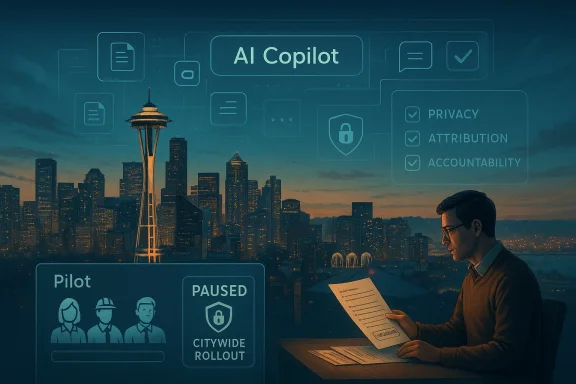
A digital visualization related to the article topic.Overview​

Seattle has been building toward broader AI use inside city government for several years, starting with one of the country’s earlier formal generative AI policies in 2023. That policy set rules around transparency, human review, and prohibitions on risky uses such as hiring decisions and facial recognition. By 2025, the city had updated its approach into a wider Responsible AI Plan, reflecting a more mature strategy that tries to balance innovation with accountability.
Former Mayor Bruce Harrell embraced AI as a civic modernization tool. His administration framed Seattle as a place that could become a national leader in responsible artificial intelligence implementation, and it tested Microsoft Copilot with 500 employees. The early results were favorable, with the city reporting that users saved about two and a half hours a week on average and found the chatbot useful for drafting, note-taking, and research. Those results made a citywide expansion look like the next logical step.
But the transition from pilot to production is always where the hard questions appear. A tool can score well in a controlled trial and still raise concerns once it reaches thousands of employees, different departments, and more sensitive workflows. That is especially true in local government, where public records rules, confidentiality obligations, and resident-facing impacts create a much higher bar than in many private-sector settings.
The Wilson administration’s pause should therefore be read as a governance decision, not simply a tech decision. The city says it wants the AI direction to reflect its priorities in a “thoughtful and responsible manner,” while continuing educational roadshows and foundational work in data governance and data readiness. In other words, Seattle is not stepping off the AI path; it is slowing down to make sure the road is paved before traffic increases.

Why the Pause Matters​

A citywide Copilot launch would have been a major operational change because Seattle is already a Microsoft 365 customer, making the tool relatively easy to distribute across the workforce. That convenience matters: when AI comes bundled into existing software, adoption pressure rises quickly because the cost barrier is low and the friction is minimal. For a city government, though, low friction can also mean low scrutiny if leaders are not careful.
The pause matters because it interrupts a trajectory that had already been publicly validated. The Harrell administration’s pilot had positive employee feedback, and the city IT department described the tool as having “significant business value” and strong potential to boost productivity. A cautious administration would not ignore that evidence, but it may ask a different question: what are the hidden costs of scaling a productivity tool before governance is fully ready?

The difference between pilot success and citywide readiness​

Pilots are designed to be forgiving. Users are selected, support is concentrated, and expectations are lower than they will be in full deployment. Once a tool like Copilot becomes citywide, the variability explodes: legal staff, planners, permit reviewers, analysts, and administrators all use it differently, and each workflow carries different risks.
That is why the city’s emphasis on a phased approach is so important. The administration says it wants to meet privacy and security requirements and ensure any tool provides clear benefits while honoring its Responsible AI commitments. That language suggests the city wants a standards-based framework, not an enthusiasm-based one. That distinction is the whole story.
  • Pilot data can be encouraging without proving scalability.
  • Productivity gains do not automatically translate into safe enterprise deployment.
  • Citywide use increases legal, security, and training complexity.
  • Public-sector AI has to work for many departments, not just a few early adopters.
  • Responsible rollout is often slower than vendors want, but safer for government.

Seattle’s AI Policy Evolution​

Seattle’s current posture did not emerge overnight. The city released an interim generative AI policy in spring 2023 and then formalized it later that year, making Seattle one of the first cities in the country to do so. The policy required attribution when AI-generated text was used substantially, prohibited certain high-risk uses, and established a human-in-the-loop model to ensure employees remained responsible for final outputs.
By 2025, Seattle had broadened that thinking into a more comprehensive AI framework. The city’s Responsible AI Program now emphasizes equity, privacy, transparency, and public trust, and it evaluates AI through a lens tied to race and social justice commitments. That matters because local governments are not just using AI to save time; they are using it in contexts where bias, exclusion, or inaccuracy can affect residents directly.

From generative AI rules to enterprise AI governance​

The policy progression shows Seattle moving from guardrails for chatbots to a governance model for broader AI systems. That is a meaningful shift because enterprise AI use includes workflow automation, data analysis, operational forecasting, and public-service support tools—not just text generation. Once those systems are connected to city data, the stakes rise sharply.
The city’s 2025–2026 AI Plan also points toward training, data quality, and compliance as the foundations of scale. In practical terms, that means Seattle is trying to build the plumbing before opening all the faucets. That kind of discipline may look slow, but it is exactly what a public institution should do when dealing with citizen data and mission-critical services.
  • Seattle moved early on generative AI policy in 2023.
  • The policy was later expanded to broader AI use.
  • Human review remains a central requirement.
  • Equity and privacy are explicit evaluation criteria.
  • Training and data readiness are now core parts of the strategy.

What Harrell Built, and What Wilson Inherited​

Harrell’s administration treated AI as an innovation agenda item, not a side experiment. The city launched pilots across departments and created an AI officer role to coordinate efforts, signaling that AI was becoming part of the municipal operating model rather than a temporary novelty. Hiring Lisa Qian, a former LinkedIn data science leader, reinforced that signal by bringing in private-sector expertise to guide public-sector adoption.
Wilson, by contrast, inherited both the opportunity and the risk. She also inherited the political expectation that AI should serve residents, not just internal productivity goals. In that sense, pausing Copilot rollout is a way to assert that the city’s technology agenda will not simply continue on autopilot under a new mayor. That is politically subtle but operationally significant.

The significance of the AI officer role​

The AI officer position matters because it institutionalizes responsibility. A city needs a single point of coordination when multiple departments are piloting tools, especially if those tools involve data governance, vendor management, and compliance with public-sector requirements. Without that role, AI adoption can become fragmented, with each department improvising its own standards.
Seattle’s hiring of Qian also indicates that the city wants expertise on how AI systems are evaluated, not just how they are marketed. Private-sector experience can help, but public-sector deployment adds constraints that consumer and enterprise vendors often underestimate. The mayor’s pause may reflect a desire to make sure that new expertise translates into process, not just ambition.
  • Harrell pushed AI as a modernization strategy.
  • Seattle created an AI officer role to centralize oversight.
  • Wilson is signaling more caution and recalibration.
  • The city is trying to align AI with public values, not just productivity.
  • Leadership change often resets the pace even when the destination stays similar.

Copilot, ChatGPT, and the Government Chatbot Problem​

Seattle’s Copilot pause sits inside a broader public-sector question: which chatbot, if any, should employees be allowed to use? Microsoft Copilot has one major advantage in government—it's embedded in the Microsoft ecosystem many agencies already use, and in some cases it is included at no extra cost. That can make it feel safer and easier to govern than consumer chatbots like ChatGPT, especially when administrators want enterprise controls and auditability.
Yet the KNKX reporting also underscores a reality many governments would rather not advertise: employees experiment. Seattle employees are not authorized to use ChatGPT, but public records showed that some had tried it for drafting emails, presentations, and grant applications. That is not unusual, but it does show how quickly informal use can run ahead of formal policy.

Why “approved” does not always mean “adopted”​

The public sector often assumes that if a tool is approved, employees will use only that tool. In practice, workers choose the path of least resistance. If one chatbot is built into the software they already use while another feels more flexible or more familiar, shadow usage becomes likely. That is exactly why policy cannot rely on trust alone.
Washington local governments have also reportedly directed staff to use Copilot instead of other chatbots for security reasons. That strategy makes sense on paper because it consolidates risk and support, but it can create a false sense of completeness. An approved enterprise chatbot is still only as safe as the data controls, training, and human review around it.
  • Government employees will try tools that make their jobs easier.
  • Enterprise approval does not eliminate shadow AI usage.
  • Security controls matter as much as vendor branding.
  • Training has to cover why tools are approved, not just which ones.
  • Public agencies need norms for acceptable use, not just lists of banned products.

Productivity Gains Versus Public-Sector Caution​

The central tension in Seattle’s story is the classic one: productivity versus prudence. The pilot results suggest Copilot can save staff time, especially on writing, summarization, and research tasks. In a city government with heavy administrative workloads, even modest time savings can free employees to focus on constituent services and higher-value analysis.
But public sector productivity is not the same thing as public value. A faster draft can be good, yet a faster draft that is inaccurate, incomplete, or improperly attributed can create downstream headaches. For a city, the issue is not whether AI can help employees work faster; it is whether it helps them work better without introducing hidden liabilities.

The economics of “free” AI​

Copilot’s appeal is stronger because it is often bundled into Microsoft 365. That makes it seem like a near-zero-cost upgrade, which is exactly the kind of offer that can accelerate adoption before a city has fully measured governance costs. Training, compliance review, policy maintenance, and incident response are all real costs even when the license itself looks free.
That hidden-cost problem is one reason cautious governments sometimes delay rollout after positive pilots. It is not skepticism for its own sake; it is recognition that enterprise licensing economics can mask organizational burdens. If Seattle is serious about scalable responsible AI, it has to account for those burdens before expanding access.
  • Time saved in a pilot is not the whole ROI picture.
  • Training and policy enforcement are real implementation costs.
  • AI-generated work still requires human validation.
  • “Free” software can produce expensive oversight demands.
  • Public-sector productivity must be measured against public accountability.

Security, Privacy, and the Human-in-the-Loop Model​

Seattle’s responsible AI stance is rooted in the idea that humans, not models, remain accountable for decisions and final outputs. That principle is especially important in government, where the sensitivity of records, legal exposure, and resident trust all impose a much stricter standard than in ordinary business settings. The city’s policy specifically requires human review and prohibits certain high-risk uses, which is exactly where a city should draw lines.
The concern is not only that a chatbot might hallucinate. It is also that staff may inadvertently paste sensitive information into prompts, rely on outputs without enough scrutiny, or blur the line between draft assistance and official city communication. Once AI becomes a routine workplace habit, small mistakes can become systematic risks.

Security is a process, not a checkbox​

Seattle’s internal review process matters because it turns AI adoption into a managed workflow rather than an ad hoc purchase. That process has already approved only one chatbot besides Copilot for internal use: the ESRI Support Chatbot, designed for a limited GIS support function. That narrow approval list suggests the city is still in an early governance phase, even if public interest in AI has moved much faster.
The city’s educational roadshows and data-readiness work reinforce that reality. Security and privacy are not one-time approvals; they are ongoing operational disciplines that depend on training, departmental understanding, and clean data practices. If those pieces are weak, even a well-intentioned AI deployment can become a liability.
  • Human review reduces but does not eliminate risk.
  • Sensitive data handling remains the biggest day-to-day concern.
  • AI governance must be continuous, not one-off.
  • Limited approvals indicate a deliberately cautious posture.
  • Training is part of security infrastructure.

The Broader Pilot Portfolio​

Seattle’s AI story is not limited to Copilot. The city has also tested tools in permitting, traffic safety, public-facing support, and GIS troubleshooting. That breadth matters because it shows the city is exploring AI not as a single product decision but as a portfolio of use cases with different levels of risk and payoff.
Some pilots sound more obviously practical than others. A permitting-focused partnership such as CivCheck can be read as a direct response to the city’s chronic need to speed up approvals, while the C3.ai and Microsoft project analyzing near-miss incidents suggests AI can help identify danger patterns in transportation data. A public-facing chatbot like SEAMore Voice, on the other hand, raises different concerns because residents are involved directly, not just employees.

Different pilots, different risk levels​

This is where Seattle’s approach becomes interesting. The city is not treating every AI use case the same, and that is the right instinct. Internal productivity tools, departmental analytics, and resident-facing bots each demand different standards for accuracy, explainability, and escalation paths.
The portfolio approach also suggests that Seattle sees AI as a tool for operational modernization rather than a single strategic bet. That can be a strength because it lowers the risk of a grand failure, but it also makes governance harder because each pilot introduces a distinct set of dependencies. The challenge is not launching AI projects; it is coherently managing them.
  • Permitting, traffic safety, and public support have very different AI profiles.
  • Internal tools are easier to govern than public-facing ones.
  • Department-specific pilots can reveal where AI actually helps.
  • A portfolio approach spreads risk but complicates oversight.
  • Coherent governance becomes more valuable as pilot count increases.

Enterprise, Workforce, and Political Implications​

For city employees, the pause may feel frustrating if they were expecting a productivity upgrade. For managers, however, it may be reassuring, because a delayed rollout buys time for training and process design. The city’s educational roadshows suggest it still wants to socialize the technology internally, which is likely the right way to preserve eventual adoption while reducing confusion.
Politically, the pause also gives Wilson room to define her own governance style. She can preserve the idea that Seattle should innovate while showing that she will not simply inherit and extend every initiative untouched. That stance may resonate with residents who expect prudence from city hall, especially when AI debates often mix genuine utility with real uncertainty.

Enterprise deployment is a culture change​

Rolling out AI in government is not like turning on a software feature. It changes work habits, raises questions about authorship, and can alter expectations about output speed and quality. If employees begin to rely on AI for first drafts, then managers have to decide what level of revision is enough and who is responsible when errors slip through.
That is why the city’s emphasis on upskilling matters. The best enterprise AI programs do not just distribute access; they build judgment. Employees need to know not only how to prompt a chatbot, but when not to use one.
  • Employees need training, not just access.
  • Managers need standards for review and accountability.
  • AI changes workflow expectations across departments.
  • Political leadership uses rollout pace to signal values.
  • Adoption success depends as much on culture as on software.

Strengths and Opportunities​

Seattle still has real advantages here, and the pause should not be mistaken for retreat. The city has already done much of the conceptual and policy work other governments are still debating, and that creates a foundation for more credible AI deployment later. If Wilson’s administration can turn caution into a better operating model, the city could emerge with a more durable framework than a faster rollout would have produced.
  • Seattle already has a formal Responsible AI framework in place.
  • The city has pilot data showing measurable productivity gains.
  • An AI officer role gives the city a focal point for governance.
  • Microsoft 365 integration makes deployment technically straightforward.
  • Seattle has already identified multiple use cases beyond chatbots.
  • Training roadshows can reduce shadow usage and improve trust.
  • A slower rollout can produce better long-term adoption if done well. That is not a soft outcome; it is a strategic one.

Risks and Concerns​

The risks are equally real, and they start with the possibility that delay becomes drift. If the city pauses without defining a clear path forward, employees may continue to improvise with unauthorized tools, which defeats the purpose of cautious governance. There is also the danger that by being overly careful, the city misses opportunities to modernize routine work and improve service delivery.
  • Shadow AI use may continue if approved tools are slow to arrive.
  • Productivity gains from the pilot may be lost in bureaucratic delay.
  • Data privacy and prompt hygiene remain persistent exposure points.
  • A leadership transition can create policy inconsistency.
  • Public confidence could suffer if the city appears indecisive.
  • Departmental pilots may outpace centralized oversight.
  • Overreliance on Microsoft tools could narrow vendor diversity and strategic flexibility. That is a subtle but important concern.

Looking Ahead​

The next few months will tell us whether Seattle’s pause is the beginning of a more robust AI governance model or simply a temporary reset. The city is expected to submit its first quarterly AI report in April, which should give Council and the public a better sense of what is active, what is stalled, and where value is actually being delivered. That reporting will matter because transparency is the bridge between pilot enthusiasm and public legitimacy.
The other key question is whether Seattle can turn internal education into broad confidence. If the city can pair training, governance, and selective deployment, it may end up with a model other municipalities want to copy. If it cannot, the result may be a familiar public-sector pattern: lots of experimentation, uneven adoption, and a lingering sense that the technology arrived faster than the institution could absorb it.

Watch for these developments​

  • The April quarterly AI report to Council and what it reveals.
  • Whether Copilot rollout resumes with new conditions or guardrails.
  • How Seattle formalizes training for employees across departments.
  • Whether additional AI tools clear privacy and security review.
  • Whether Wilson’s administration refines, expands, or redefines the 2025–2026 AI Plan.
Seattle is not rejecting AI; it is deciding how much trust to extend, how quickly, and under what conditions. That is a harder political and administrative test than simply announcing a rollout, but it is also the more serious one. If the city gets this right, the pause will look less like hesitation and more like the moment Seattle chose to treat AI as civic infrastructure rather than software hype.

Source: KNKX Mayor Wilson pumps the breaks on Seattle AI chatbot adoption
 

Seattle’s decision to slow down its citywide Microsoft Copilot rollout is a notable pivot in how one of America’s most tech-saturated cities wants to use artificial intelligence in government. After months of momentum under former Mayor Bruce Harrell, Mayor Katie Wilson is signaling that enthusiasm alone will not be enough to justify broad deployment. The pause does not mean Seattle is abandoning AI; it means the city is trying to answer a more consequential question: where does productivity end and public accountability begin?

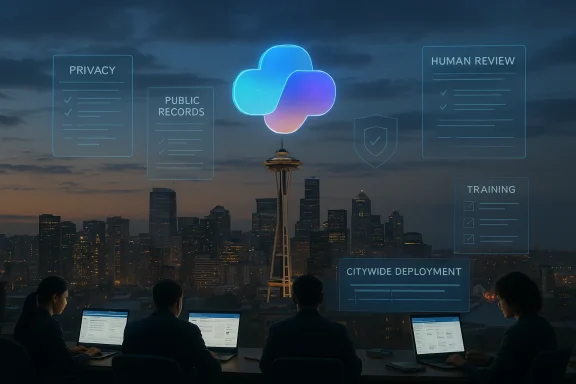
A digital visualization related to the article topic.Background​

Seattle has been one of the most visible municipal laboratories for generative AI governance in the United States. The city moved early to create a formal policy framework in 2023, well before many peers had even settled on internal guidance. That policy emphasized human review, attribution, privacy protections, and prohibitions on uses such as hiring decisions and facial recognition, making Seattle an early adopter of what is often called a human-in-the-loop model.
Under Harrell, that framework evolved from a governance document into an operational strategy. City officials not only wrote rules, they explored actual tools, including Microsoft Copilot, because Seattle is already deeply tied to Microsoft 365. That matters: when a government is already paying for the productivity suite, adding Copilot can look less like an experiment and more like a practical software upgrade. Yet the same convenience also creates pressure to roll out quickly, sometimes before agencies have fully mapped the risks.
The Copilot pilot reportedly produced encouraging internal feedback. According to the OPB report, a survey of 185 users found substantial perceived productivity gains, and staff said the tool saved time on document drafting, note summarization, and research. Those results help explain why the Harrell administration had been preparing a broader deployment. In the logic of city management, if a tool reliably saves staff hours, it can look like a rare win in an era of limited budgets and growing service demands.
But municipal AI adoption is never just a workplace efficiency story. It is also a procurement story, a privacy story, a records-retention story, and increasingly a political story. Seattle’s experience reflects a broader trend across Washington state and other local governments: public agencies are eager to use AI, but the policy infrastructure is still catching up. That tension is especially visible when the technology in question is a chatbot that can draft official-sounding text in seconds.
The leadership transition is what turns this from a standard technology rollout into a policy signal. Wilson, who succeeded Harrell in January, is not rejecting AI outright. She is, instead, re-framing the burden of proof so that citywide adoption must be justified by stronger governance, clearer benefits, and tighter alignment with her administration’s priorities. That is a subtle but important shift for a city that often treats technology policy as a civic identity issue as much as an IT issue.

What Seattle Changed​

The practical change is straightforward: the citywide rollout of Microsoft Copilot for all Seattle employees is paused. The existing 500-person pilot can continue, but the broader expansion that had been expected is on hold while the Wilson administration reviews priorities and process. City IT says the pause is intended to make sure adoption is thoughtful, secure, and consistent with the city’s responsible AI commitments.
That sounds procedural, but it is politically meaningful. A pause in government technology is rarely just a delay; it often signals a demand for new criteria. Wilson is effectively saying that the previous administration’s momentum is not enough to authorize citywide scale, even if the pilot data looked promising. In public-sector technology, scale is the real decision point, because small pilots can hide the operational and legal complexities that emerge when every department starts using the same tool.
The city’s IT department says the workforce can keep testing Copilot while the rollout is paused, which suggests Seattle is not abandoning experimentation. That distinction matters because it preserves learning while withholding full endorsement. It also gives the new administration room to compare Copilot against other potential tools, revise guardrails, and decide whether a Microsoft-centric approach is still the best fit for the city’s needs.

Why a Pause Is Not a Rejection​

A pause can mean three different things in municipal tech: a genuine reevaluation, a political course correction, or a way to slow down a predecessor’s flagship initiative without publicly killing it. In Seattle’s case, the available reporting points most strongly to the first and second explanations at once. Wilson is not disputing the existence of productivity gains; she is questioning whether those gains are enough to justify a citywide rollout under the current governance model.
  • The pilot remains active.
  • The citywide rollout is delayed.
  • The administration wants stronger alignment with policy priorities.
  • Security and privacy review remain prerequisites.
  • The shift preserves flexibility without a full reversal.

Why Seattle Moved Early on AI​

Seattle’s early adoption of AI policy was shaped by geography, politics, and industry pressure. It is home turf for Microsoft, Amazon, and a dense ecosystem of cloud and software talent, so it is unsurprising that city leaders wanted to present Seattle as a credible, responsible technology capital. Harrell’s administration embraced that identity explicitly, saying the city could become a national leader in responsible AI implementation.
The city’s 2023 generative AI policy was one of the first of its kind among major U.S. cities. It required human review before AI-generated work went public, called for attribution when AI output was used substantially, and blocked certain high-risk uses. That policy gave Seattle a vocabulary for saying “yes” to experimentation while also saying “no” to automation that could erode accountability.
Seattle’s timing also reflected a practical budget logic. If a chatbot can shave hours off routine drafting or meeting summaries, the city can theoretically get more out of a limited workforce. That is especially attractive to local governments facing staffing constraints, rising service expectations, and pressure to modernize without dramatic spending increases. In that sense, the AI push was not simply about innovation; it was about capacity.

The Civic-Tech Argument​

The strongest case for municipal AI is not that it replaces workers, but that it reduces friction in routine administrative work. Drafting, summarization, and internal research are the kinds of tasks where large language models can save time without directly making policy decisions. That is why Copilot became such an appealing fit for city government: it promises speed while remaining, in theory, within the boundaries of clerical assistance.
Still, civic technology has a way of expanding beyond its first use case. A tool introduced for memos can migrate into grant writing, constituent responses, policy memos, or public-facing communications. Once that happens, the question is no longer whether the system saves time, but whether it quietly shapes the voice and judgment of government itself. That is the deeper democratic concern.
  • Early adoption let Seattle define the rules before the market hardened.
  • The city’s Microsoft relationship made Copilot especially attractive.
  • Productivity gains are real, but they are not the same as policy legitimacy.
  • AI use in government often spreads from low-risk to higher-stakes tasks.
  • The city’s own policy language reflects that caution.

The Copilot Pilot and the Productivity Pitch​

The pilot’s reported results are easy to understand and hard for budget officials to ignore. If employees say they are saving an average of two and a half hours a week, that translates into meaningful reclaimed time over the course of a year. The city’s IT team said users found Copilot especially useful for editing documents, summarizing meetings, and accelerating research.
That kind of feedback is exactly what tech vendors want cities to hear. Copilot is attractive because it is embedded in the software employees already use, so adoption friction is low. For a government that already lives in Microsoft 365, the chatbot can look less like a new product than a value-added layer on top of familiar workflows.
But productivity metrics in the public sector can be misleading if they are not tied to service outcomes. Saving time on drafting is useful only if the underlying work is accurate, reviewable, and aligned with city policy. The most important question is whether the saved hours translate into better resident services, faster permitting, more responsive support, or simply faster production of more text. Those are not the same thing.

Where Chatbots Help Most​

Municipal employees spend large portions of their day on repetitive written work, and AI can be genuinely helpful there. That includes first drafts, summaries, agenda prep, internal notes, and template-based communication. In those environments, the technology can reduce drudgery without making consequential decisions on its own.
  • Drafting internal documents.
  • Summarizing meetings and email threads.
  • Creating first-pass research notes.
  • Editing repetitive communications.
  • Supporting knowledge retrieval inside large departments.
The danger is that local governments may overvalue the convenience of these uses and underestimate the governance burden they create. Even when an AI tool does not make the final decision, it can still influence what options are considered, what language is chosen, and how quickly work moves through review. That makes the human reviewer more important, not less.

Governance, Privacy, and Security​

Seattle’s pause is inseparable from its formal AI governance framework. The city’s policy requires that AI-generated content be checked by a person before publication, that substantive AI text be attributed, and that high-risk applications remain off-limits. Those guardrails were designed for exactly this moment: when the city wants the upside of AI but needs a clear legal and ethical boundary around it.
The security dimension is equally important. City employees are not authorized to use ChatGPT, and local governments in Washington have reportedly been steering staff toward Copilot for security and compatibility reasons. That choice reduces the number of consumer tools entering government workflows, but it also concentrates risk in one vendor ecosystem. A single approved chatbot can become a single point of policy failure if controls are weak.
Seattle’s concern is not hypothetical. Public records reviewed by KNKX showed some employees experimenting with ChatGPT for emails, presentations, and grant applications, even though it was not authorized. That kind of shadow use is common whenever an official policy lags behind real-world demand. The more restrictive the approved path, the more tempting the unofficial shortcut becomes.

Why Human Review Still Matters​

A chatbot can produce fluent text that looks authoritative even when it is incomplete or wrong. In government, that is a serious problem because polished language can create false confidence. Seattle’s “human-in-the-loop” requirement is therefore not bureaucratic fussiness; it is a safeguard against automation bias, where people trust machine output more than they should.
  • Human review helps catch errors before publication.
  • Attribution creates accountability for AI-assisted work.
  • Security controls reduce exposure to unapproved tools.
  • Privacy requirements limit risky data handling.
  • Policy consistency matters more at scale than in pilots.
The challenge, of course, is that a citywide rollout can pressure departments to speed up reviews rather than strengthen them. If employees treat the chatbot as a timesaver, they may be less likely to scrutinize outputs line by line. That is precisely why a pause can be prudent: it gives the city time to test whether the governance model still works when usage expands.

The Role of the New AI Officer​

Seattle’s newly created AI officer role adds another layer to the story. The city hired Lisa Qian, a former LinkedIn data science manager, to help oversee AI initiatives and build the organizational muscle required for broader adoption. That appointment suggests Seattle wants not just a policy, but a center of expertise inside government.
An AI officer can serve several functions at once. The role can standardize tool evaluation, coordinate department pilots, translate technical tradeoffs for nontechnical leaders, and ensure that privacy and procurement reviews happen early rather than late. In a city like Seattle, where AI initiatives are already spreading across multiple departments, that coordination may be more valuable than any single chatbot.
But the role also reveals a structural truth: AI governance is becoming a permanent administrative function, not a one-off policy memo. Once a city hires staff to manage AI, it is acknowledging that experimentation has entered routine operations. That makes Wilson’s pause even more important, because it tests whether the city’s new institutional capacity will be used to accelerate adoption or slow it down until standards are truly ready. The answer will shape the next phase of civic technology in Seattle.

From Pilot to Bureaucracy​

Technology pilots are easy to launch because they are small, symbolic, and reversible. Bureaucratic adoption is different: it requires training, support, procurement rules, data governance, and someone accountable when things go wrong. Seattle’s AI officer is meant to bridge that gap, but the pause indicates the bridge is still being built.
  • The AI officer helps convert policy into operational practice.
  • Cross-department coordination becomes essential as use grows.
  • Governance capacity is now as important as technical capability.
  • Hiring the role signals long-term commitment.
  • A pause lets the city define the role before scaling too quickly.

How This Affects Seattle Employees​

For city workers, the pause likely means less uncertainty in the short term and more process in the medium term. Employees who liked Copilot can keep using it in the pilot group, but everyone else must wait for a broader decision. That may frustrate staff who were expecting a rollout, yet it also protects them from having a tool imposed before the city has settled the rules around it.
There is also a labor-management angle. Whenever governments introduce AI, employees worry about surveillance, workload compression, and the possibility that “efficiency” will become a euphemism for staffing cuts. Seattle’s early emphasis on human oversight helps blunt those fears, but only if it is maintained in practice. If workers think AI is just a cost-cutting device, adoption will be much harder.
The reporting also comes shortly after IT director Rob Lloyd announced his resignation, which adds leadership churn to a sensitive transition. Even if the resignations are unrelated, administrative continuity matters during major tech changes. Employees generally tolerate experimentation better when the chain of command is stable and the rationale is clear.

The Staff Perspective​

Employees often experience AI tools first as time-savers and later as policy objects. That means their support can evaporate if a tool becomes associated with more review, more monitoring, or more risk without corresponding benefits. The best municipal AI rollouts are the ones that make work easier without making staff feel second-guessed by software or buried under compliance.
  • Staff need clarity on what is approved and what is not.
  • Training matters as much as access.
  • Ambiguity encourages shadow use.
  • Leadership changes can slow adoption.
  • Trust is easier to lose than to rebuild.

Competitive Implications for Microsoft and Rivals​

Seattle’s pause is also a reminder that Microsoft’s product advantage does not automatically guarantee municipal adoption. Copilot benefits from being embedded in Microsoft 365, but government buyers still need to justify why that convenience is worth the governance commitment. A citywide pause in Seattle, of all places, is notable because the city sits inside Microsoft’s broader gravitational field.
For rivals such as Google, OpenAI, and smaller civic-tech vendors, the lesson is mixed. On the one hand, the pause underscores that local governments are still shopping for the right AI model, and that no vendor has locked up the market. On the other hand, it shows that procurement is only the first hurdle; governance, security, and labor concerns can slow even a preferred tool. This is not a winner-take-all market yet.
Seattle’s conduct may also influence how other cities negotiate with vendors. If a city famous for technology caution decides to slow a Copilot rollout, that gives other local governments cover to insist on their own pilot stages, internal controls, and exit clauses. In procurement terms, the pause strengthens the hand of buyers who want proof before scale.

Vendor Lock-In and Flexibility​

One strategic concern is that a Microsoft-first AI strategy could narrow future options. Once a city standardizes one chatbot across departments, it creates technical habits, training dependencies, and workflow assumptions that are hard to unwind. That is why reevaluation is healthy: it keeps the city from confusing compatibility with inevitability.
  • Microsoft gains from integration, not just from model quality.
  • Municipal buyers are increasingly sensitive to lock-in.
  • A pause preserves bargaining power.
  • Competitors can frame themselves as governance-friendly alternatives.
  • Cities may demand more vendor transparency before scaling.

Risks and Unintended Consequences​

The biggest risk is that the pause becomes policy drift. If the city spends months reviewing AI without making a clear decision, employees may continue using unapproved tools in the shadows while official adoption stalls. That produces the worst of both worlds: less accountability and no coherent standard.
A second risk is uneven adoption across departments. Some teams may become highly fluent in AI-assisted workflows while others remain fully manual, creating inconsistent service quality and uneven institutional knowledge. That can become a hidden equity issue inside the city itself, because departments with better technical comfort may simply move faster than the rest.
A third concern is that chatbot output may gradually shape official language in ways that dull civic specificity. AI writing tools tend to produce smooth, generalized prose, which can be useful for drafting but dangerous for public communication if it flattens nuance or local context. Cities do not merely inform residents; they represent themselves.

Specific Threats to Watch​

Some risks are operational, while others are cultural. The former can be measured in security incidents or policy violations; the latter show up as a slow erosion of originality, accountability, and judgment. Municipal leaders should be wary of treating those softer harms as trivial simply because they are harder to quantify.
  • Shadow AI use by employees.
  • Overreliance on polished but inaccurate drafts.
  • Inconsistent department-level governance.
  • Vendor lock-in that limits future flexibility.
  • Reduced scrutiny if AI feels “official.”
  • Public skepticism if transparency lags behind deployment.

Strengths and Opportunities​

Seattle still has real advantages if it chooses to pursue AI carefully rather than quickly. Its early policy work, existing Microsoft infrastructure, and in-house talent give it a head start over cities that are only now confronting the issue. The current pause could become a strength if it leads to a more durable operating model instead of a rushed rollout.
  • Strong early policy framework already exists.
  • The city has a live pilot with real user feedback.
  • Microsoft 365 compatibility lowers implementation friction.
  • An AI officer role provides internal coordination.
  • The city can refine governance before scaling.
  • Departments can learn from ongoing pilot programs.
  • Seattle can still set a national example for responsible adoption.
The broader opportunity is to move from novelty to discipline. If Seattle can show that a city can experiment with AI, slow down when needed, and still extract productivity gains, it may offer the most credible public-sector model in the country. That would be a more meaningful achievement than simply being first. Being first is easy; being right is hard.

Looking Ahead​

The next few months should reveal whether this is a temporary administrative pause or the beginning of a more cautious Seattle AI strategy. The city says it will continue educational outreach and foundational work on data governance and readiness, which suggests the underlying machinery is still moving. The real question is whether those preparations lead to a broader rollout, a narrowed deployment, or a more selective use case inventory.
The April quarterly report requested by the City Council will be an important marker because it will show how the city is evaluating active pilots. That report may help separate useful experiments from projects that are merely fashionable. It will also give Wilson’s administration a chance to define what “responsible” means in operational terms rather than rhetorical ones.
The larger lesson extends beyond Seattle. Across the Pacific Northwest and the country, governments are discovering that AI policy is not a one-time checklist but a continuing negotiation between efficiency, public trust, and institutional competence. Seattle’s pause is therefore not a retreat from innovation; it is a test of whether innovation can survive governance.
  • Watch for the April AI usage report.
  • Watch for whether the pilot expands, stalls, or gets redesigned.
  • Watch for how the new AI officer frames evaluation criteria.
  • Watch for department-level adoption guidance.
  • Watch for any shift in the city’s approved-tool list.
Seattle’s AI story is no longer about whether Copilot works. It is about whether a city that prides itself on technological leadership can resist the temptation to equate early success with safe scale. If Wilson’s pause produces clearer standards, better oversight, and more trustworthy deployment, the delay will have been worth it. If it simply creates uncertainty while unofficial AI use grows, then Seattle will have learned the hardest lesson in public-sector technology: hesitation is only useful when it leads to better decisions.

Source: Oregon Public Broadcasting - OPB Seattle mayor pumps the brakes on the city’s AI chatbot adoption
 

Seattle’s decision to pause a citywide Microsoft Copilot rollout is more than a procurement delay; it is a signal that the city’s next phase of AI adoption will be shaped as much by governance as by enthusiasm. The move lands at a pivotal moment for one of America’s most tech-saturated cities, where Microsoft’s productivity stack is already deeply embedded and where the pressure to modernize government work has been building for years. But the pause also reflects a more cautious political reality: public-sector AI now has to clear privacy, records, labor, and trust hurdles before it can be treated like ordinary software. Seattle is not walking away from Copilot — it is asking what a responsible deployment should look like before scaling it to every desk.

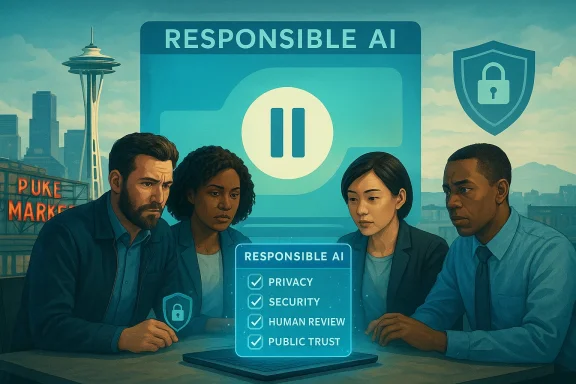
A digital visualization related to the article topic.Background​

Seattle has spent several years building a reputation as one of the most ambitious municipal AI policy laboratories in the United States. In 2023, the city adopted one of the earlier formal generative AI policy frameworks among major U.S. local governments, emphasizing human review, attribution, privacy protections, and bans on high-risk uses such as facial recognition and employment decisions. That early framework mattered because it turned abstract AI ethics into operational rules, giving the city a way to say yes to experimentation without surrendering accountability.
By 2025, Seattle had moved beyond a narrow chatbot policy and toward a broader Responsible AI Plan. That evolution reflected a more mature view of the technology: generative AI was no longer just an experiment on the fringes of government work, but a tool that could touch drafting, summarization, search, and even internal workflow design. In other words, the city had already begun treating AI not as a novelty, but as civic infrastructure in the making.
Former Mayor Bruce Harrell’s administration leaned into that shift. Because Seattle is already a Microsoft 365 customer, Copilot could look less like a radical new purchase and more like an add-on to software the city was already paying for. That convenience is a big part of the story: when a tool is embedded in existing workflows, the temptation is to move fast, especially if early pilot feedback looks positive. But convenience can also blur the line between a smart upgrade and a premature scale-up.
The previous administration’s Copilot pilot reportedly included 500 employees and generated favorable internal feedback. City materials and later reporting suggested the pilot users found the tool useful for drafting, note-taking, and research, with some estimates pointing to meaningful weekly time savings. That kind of result can be compelling for a cash-strapped city trying to stretch staff capacity, but pilot results are always easier to celebrate than citywide realities. A successful trial does not automatically prove that a tool can survive public-records obligations, union concerns, and the messy diversity of real municipal workflows.
The leadership transition is what turns this into a bigger policy story. Mayor Katie Wilson is not rejecting AI outright; rather, she is reordering the burden of proof. Her administration wants broader adoption to align with privacy, security, labor, and public trust requirements before Copilot is expanded across all departments. That is a subtle but important change in tone, and it may prove just as significant as the rollout itself.

What Seattle Actually Paused​

The practical change is straightforward: Seattle has paused the citywide expansion of Microsoft Copilot for municipal employees. The existing pilot can continue, but the broader plan to roll the tool out more widely is on hold while the Wilson administration reviews priorities, process, and guardrails. That makes the move a pause, not a cancellation, which is a meaningful distinction in public-sector technology.

Pause vs. Rejection​

A pause in government IT can mean several things at once. It can signal a genuine review, a political reset, or a way to slow down a predecessor’s flagship initiative without openly killing it. In Seattle’s case, the reporting points to all three dynamics, but the strongest reading is that the city wants more certainty before standardizing the tool across departments.
That distinction matters because the difference between a pilot and a production deployment is huge. A pilot is a controlled environment with selected users, extra support, and lower expectations. A citywide rollout, by contrast, forces the same tool into legal work, public communications, planning, permitting, and administrative tasks that carry very different risks.
The pause also preserves optionality. Seattle can continue educating staff, refine its policies, and compare Copilot with other tools before fully committing to one vendor ecosystem. In a city that wants to be seen as thoughtful rather than reflexively tech-forward, that is not hesitation so much as institutional discipline. That discipline may frustrate some staff, but it is often what separates a durable AI program from a flashy pilot.

Why This Is Not the Same as Freezing Innovation​

The city is still allowing the pilot to continue, which tells us something important: Seattle is not anti-AI, and it is not even anti-Copilot. Instead, it appears to be trying to separate experimentation from enterprise standardization. That is a much more defensible posture for a municipal government, especially one that has already built a formal Responsible AI framework.
The city’s educational roadshows and ongoing data-governance work reinforce that point. Seattle is trying to build internal literacy before forcing everyone into the same workflow, which is often the right sequencing for enterprise technology adoption. If employees do not understand what AI is approved for, they will either misuse it or avoid it entirely. Neither outcome is good for the city.
In that sense, the pause is a governance tool. It buys time for standards, training, and political alignment to catch up with the software rollout. And in public-sector AI, that extra time can be the difference between a credible modernization effort and a compliance headache. The city is slowing down not because the technology failed, but because the institution wants to understand its own tolerance for risk.

Privacy, Public Records, and the Municipal Risk Profile​

The privacy concern is the most obvious reason Seattle’s pause resonated beyond city hall. When government employees use a generative AI assistant, the questions are not just whether the output is useful, but whether prompts, drafts, and underlying data are handled in a way that respects retention rules, confidentiality obligations, and public expectations. That is a very different bar from consumer AI use.

Why Public Records Are Complicated​

Public agencies are not simply using software; they are creating records. If staff use Copilot to draft correspondence, summarize meetings, or shape official language, the city has to think carefully about what is retained, what is discoverable, and what should be attributable to human judgment rather than machine assistance. This is why municipal AI is as much a records-management challenge as a productivity story.
The city’s earlier policy architecture already anticipated some of these risks by requiring human review and attribution when AI output is used substantially. But the leap from policy language to citywide operational reality is where the complexity rises. One department’s “safe enough” use case can become another department’s legal exposure.
There is also a reputational dimension. Residents generally expect their city to use tools responsibly, but they also expect government communications to be clearly accountable. If a city appears to outsource too much of its voice to AI, it risks sounding generic, detached, or less trustworthy. That is not just a branding issue; it is a democratic legitimacy issue.

Privacy as a Policy Constraint, Not a Buzzword​

Seattle’s pause suggests privacy is functioning as a real procurement constraint rather than a vague principle. That distinction matters because many organizations claim to value privacy while still making deployment decisions on speed and convenience. Seattle appears to be treating privacy as a gating requirement, which makes the rollout slower but also more credible.
The same logic applies to security. Once a city embeds a tool across multiple departments, it has to consider access controls, data boundaries, and how outputs are used in sensitive workflows. A tool that is safe enough for internal note drafting may be unacceptable for legal reviews or resident-facing communications without stricter controls.
That is why the city’s pause may end up being more about risk classification than technology preference. Seattle seems to be deciding where Copilot belongs, where it does not, and which protections have to be in place before broader use is acceptable. In a government environment, that kind of classification work is not overhead; it is the job.

Labor, Productivity, and the Human Side of AI​

Any municipal AI rollout immediately becomes a labor story because employees understandably ask whether “efficiency” is code for downsizing, work intensification, or surveillance. Seattle’s pause gives the administration a chance to address those concerns before they harden into resistance. That may be especially important in a city where public-sector unions and worker expectations can shape the success or failure of new tools.

The Productivity Case Is Real​

The strongest argument for Copilot in city government is not that it replaces staff, but that it helps them spend less time on routine drafting and summarization. That matters because the modern public sector is chronically asked to do more with less. A tool that can shave hours off repetitive work can be genuinely valuable if it is deployed carefully.
Seattle’s earlier pilot data reportedly supported that case, with employees saying the tool saved time and improved workflow. Those are not trivial gains. For a manager, even a modest boost in efficiency can translate into faster responses, better documentation, and more room for strategic work.
But productivity gains do not eliminate worker anxiety. If employees feel that AI is being introduced mainly to accelerate output expectations or reduce headcount pressure, adoption will be much harder. People will tolerate tools that help them work; they are far less enthusiastic about tools that seem designed to measure them.

Training Matters as Much as Access​

One of the clearest lessons from Seattle’s approach is that access alone is not a strategy. Employees need to know what Copilot can be used for, what it should not be used for, and where human review is mandatory. Training is not optional in this environment; it is part of the control surface.
The city’s educational roadshows suggest Seattle understands that. Rather than simply flipping a switch, it appears to be socializing the technology internally, which is the smarter long-term play. If staff adopt AI before they understand its limits, the city will spend more time cleaning up mistakes than capturing value.
That training burden also helps explain why the pause may be politically easier than the rollout. A phased approach allows labor concerns to be addressed in public, not after problems show up in production. That kind of transparency can slow adoption, but it also makes adoption more durable.

Microsoft’s Position in the Municipal AI Market​

Seattle’s pause is important for Microsoft because the city sits inside the company’s own backyard. Microsoft already benefits from deep institutional familiarity in the region, and Copilot’s tight integration with Microsoft 365 should, in theory, make deployment easy. But the Seattle decision shows that technical convenience does not automatically convert into political approval.

Why Microsoft’s Advantage Is Not Absolute​

Copilot’s strength is that it fits into existing software habits. That is also its weakness. When a new AI layer arrives inside a familiar productivity suite, buyers can feel like the vendor is trying to turn infrastructure into a subscription upsell. That perception is especially sensitive in government, where procurement legitimacy matters as much as feature depth.
Seattle’s pause shows that Microsoft’s brand strength does not eliminate buyer scrutiny. Even in a city closely linked to Microsoft’s ecosystem, officials still want to know whether the tool is the best fit for public-sector governance. That means the market for municipal AI is not locked up, even if Microsoft has a head start.
For rivals, this is a useful opening. Google, OpenAI, and smaller civic-tech vendors can frame themselves as alternatives that may offer different governance models, data boundaries, or deployment terms. The broader lesson is that municipal AI is still a contest over trust, not just capability.

Vendor Lock-In and Strategic Flexibility​

There is also a strategic concern buried in the Seattle decision: once a city standardizes one AI assistant, it can become harder to switch later. Training, habits, and workflow integration all create inertia. A pause helps Seattle avoid conflating convenience with inevitability.
This matters because the market is still evolving quickly. Cities that commit too early may find themselves locked into a vendor whose governance model, product direction, or pricing changes faster than public procurement can adapt. That is a real risk in a category where the software itself is still maturing.
The pause therefore strengthens Seattle’s negotiating position. It says, in effect, that Microsoft has to prove not just that Copilot is useful, but that it is safe, governable, and politically acceptable at scale. That is a much harder sell — and a much more meaningful one.

The Broader Competitive and Policy Signal​

Seattle’s move is bigger than Seattle. When a city known for technical sophistication slows down a high-profile AI rollout, other governments take notice. The signal is not that AI should be avoided, but that responsible adoption requires more than pilot enthusiasm and vendor convenience.

How Other Cities May Read This​

For local governments watching Seattle, the pause offers political cover to insist on stronger controls, longer pilots, and clearer exit clauses. A city famous for being close to the tech industry can say “not yet,” and that makes it easier for less tech-saturated municipalities to do the same. In procurement terms, Seattle is helping normalize caution.
That could slow vendor momentum across the public sector, but it could also produce better contracts. Buyers who ask harder questions early are less likely to be trapped later by poorly understood data-sharing terms or weak governance provisions. In that sense, a pause is not a failure of innovation; it is a form of market discipline.
The same logic extends to labor and privacy policy. Cities that see Seattle hesitate may decide that employee training, union consultation, and public-records planning need to happen before rollout, not after. That shift would be healthy for the market even if it annoys vendors looking for faster adoption.

Why This Matters for the Public-Sector AI Playbook​

Seattle’s story is part of a larger pattern in which governments are eager to use AI but still figuring out the operational playbook. Formal policies are useful, but they do not answer every question that emerges once a tool hits real workflows. The Seattle pause highlights the gap between policy design and institutional readiness.
It also demonstrates that public-sector AI is not a binary choice between innovation and caution. The better model is iterative: pilot, assess, train, revisit, scale. That sequence sounds boring, but in government, boring is often what success looks like. The dramatic launch is not the hardest part; the hard part is the second year, when governance either holds or starts to crack.
Seattle’s pause may therefore become a reference point for other cities deciding how to deploy Copilot or similar assistants. If Seattle ultimately resumes the rollout with clearer guardrails, it will have helped define a more mature public-sector AI model. If it stalls out, the lesson will be just as important: speed alone is not enough to justify scale.

Operational Implications for City Hall​

Beyond the politics and vendor strategy, the pause has concrete operational consequences for city employees. Some staff will keep experimenting through the pilot, while others wait for a broader decision that could reshape how they draft, research, and communicate. That mixed state can be frustrating, but it may also be the safest way to introduce a complex new tool.

The Short-Term Effect on Employees​

For workers who hoped Copilot would soon be available citywide, the pause means more waiting and more uncertainty. But it also prevents the city from imposing a tool before rules are finalized. In practical terms, that may reduce confusion and help managers avoid inconsistent usage across departments.
For managers, the pause is not necessarily bad news. It buys time to define acceptable use, design training, and decide what oversight should look like. That is especially important in a government environment where one department’s workflow can be dramatically more sensitive than another’s.
There is a deeper cultural point here as well. AI rollouts are not just technology deployments; they are behavior changes. Employees need to understand not just how to use the tool, but when not to use it. Without that judgment, the city risks replacing one kind of inefficiency with another.

How Governance Shapes Daily Work​

Seattle’s emphasis on data governance and readiness suggests that the administration wants AI to sit inside a larger operational framework rather than act as a standalone shortcut. That is the right instinct. Tools like Copilot can amplify good processes, but they can just as easily accelerate bad ones if the city is not careful.
This is why the pause is not just about Copilot. It is about whether Seattle can build a repeatable process for evaluating all the AI tools that will inevitably come next. If the city gets this right, the current pause could become the template for future adoption decisions.
If it gets it wrong, the city risks drift: staff may continue using unauthorized tools while official rollout remains stuck in limbo. That would leave Seattle with the worst possible combination of weaker oversight and no coherent standard. The challenge is not simply to slow down; it is to slow down with purpose.

Strengths and Opportunities​

Seattle still has real advantages in this moment, and the pause should not be mistaken for retreat. The city already has policy scaffolding, pilot experience, and a workforce that has seen the tool in action. If Wilson’s administration uses the pause well, Seattle could end up with one of the most credible municipal AI playbooks in the country.
  • The city has pilot data showing measurable productivity gains.
  • An AI officer role gives Seattle a governance focal point.
  • Microsoft 365 integration makes deployment technically straightforward.
  • Seattle already has a Responsible AI framework to build on.
  • Training roadshows can reduce shadow use and improve trust.
  • A slower rollout may produce stronger long-term adoption if managed well.
  • The pause gives the city room to compare vendors and refine guardrails.
The opportunity is bigger than Copilot. Seattle can use this moment to turn AI governance into a civic strength, showing that careful adoption is not anti-innovation but a prerequisite for trustworthy innovation. That would be a meaningful model for other cities facing the same pressure.

Risks and Concerns​

The risks are equally real, and they start with the possibility that delay turns into drift. If Seattle pauses without setting a clear decision path, employees may keep using unapproved tools while official deployment stalls. That would create the worst of both worlds: less accountability and no coherent standard.
  • The pause could become policy drift instead of a deliberate review.
  • Staff may continue shadow AI use if approved tools lag.
  • The city could miss near-term productivity gains from routine tasks.
  • Leadership churn may create inconsistent policy signaling.
  • Department-level adoption could become uneven and fragmented.
  • Overreliance on Microsoft could narrow vendor diversity.
  • AI-generated language could flatten civic specificity if used carelessly.
There is also a political risk. If the pause is seen as indecision rather than prudence, it could erode confidence in the administration’s ability to manage technology change. Public-sector AI requires patience, but it also requires a visible path forward. Without that path, caution starts to look like confusion.

Looking Ahead​

The next few months will show whether Seattle’s pause is the start of a more mature AI governance model or simply a temporary reset. The city’s reporting and internal process work will matter because transparency is what turns a pilot into something the public can trust. If Seattle communicates clearly, it can preserve staff momentum while still tightening controls.
Just as important, the city now has a chance to define what “responsible” actually means in daily municipal work. That may include more detailed training, clearer use-case boundaries, stronger records practices, and better review processes before broader rollout resumes. If the administration treats this as a design problem rather than a delay problem, the pause could pay off.
Watch for these developments:
  • The city’s next quarterly AI report and what it says about active use cases.
  • Whether Copilot returns with new guardrails or conditions.
  • How Seattle expands or formalizes employee training.
  • Whether the city approves other AI tools after privacy and security review.
  • Whether Wilson’s administration refines the city’s broader AI plan rather than just the Copilot rollout.
Seattle is not rejecting AI. It is deciding how much trust to extend, how fast, and under what conditions. That is a harder test than announcing a rollout, but it is also the more serious one. If the city gets this right, the pause will look less like hesitation and more like the moment Seattle chose to treat AI as civic infrastructure rather than software hype.

Source: Hoodline Seattle Pauses Microsoft Copilot Rollout Over Privacy Concerns
 

Back
Top