

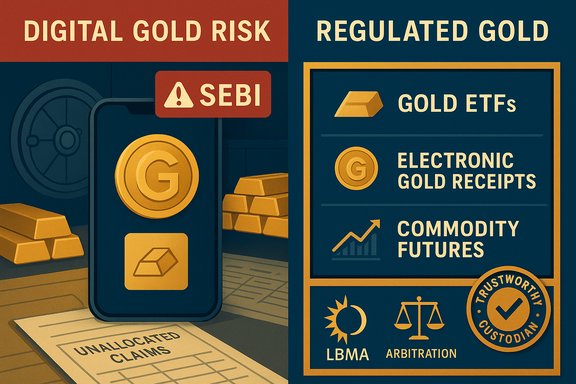
The Securities and Exchange Board of India (SEBI on November 8, 2025) issued a clear, public advisory warning investors that “digital gold” or “e‑gold” products offered by unregistered online platforms operate outside SEBI’s regulatory framework and therefore carry material investor‑protection gaps and counterparty risks. This move — aimed at an expanding retail market that increasingly chooses app‑based gold purchases — clarifies that such offerings are not notified as securities, are not regulated as exchange‑traded commodity derivatives, and do not benefit from the protections that SEBI‑regulated instruments provide.
Background and overview
Digital or “e‑gold” has emerged as a mainstream retail route to own gold without physical possession: small, app‑friendly purchases; fractional ownership measured in milligrams or grams; and promises of secure vault storage and instant liquidity. The business model has spread via fintech apps, e‑commerce tie‑ups and specialized bullion platforms, and in some cases through partnerships between refiners, jewellers and large payments or wallet providers.SEBI’s advisory does three things in one short paragraph: it warns consumers, it distinguishes unregulated digital gold from SEBI‑regulated gold products, and it points investors toward regulated alternatives — specifically Gold Exchange‑Traded Funds (Gold ETFs), exchange‑traded commodity derivatives, and Electronic Gold Receipts (EGRs) tradable on stock exchanges. The regulator emphasised that investor protections available under securities laws — dispute resolution through exchanges, custody rules, fund accounting and mandated disclosures — will not apply to unregulated digital gold schemes.
This advisory is not a blanket ban or a prohibition. It is a risk‑warning designed to remind retail buyers that convenience does not automatically equal safety, and to push investors toward verified, transparent structures where custody, audit and counterparty obligations are clearly laid out.
Why SEBI acted: market context and regulatory intent
The advisory reflects a simple regulatory calculus: a rapid product proliferation met by patchy disclosure and varying custody models creates the kind of information asymmetry that regulators are intended to correct.- The consumer appeal of digital gold is obvious — low minimum purchases, fractional ownership, easy redemption claims and the psychological convenience of an app.
- The supply side has become crowded: refiners, organized bullion houses, fintech wallets, e‑commerce platforms and online jewellers have launched or marketed gold‑linked products.
- The regulatory problem arises when those offerings are presented as “gold investments” without transparent, enforceable legal links between the buyer and the physical asset: who owns the metal? Is ownership allocated or unallocated? Where is it stored? Is it auditable? What happens if the platform becomes insolvent?
What “digital gold” actually is — and why the model varies
Digital gold is a broad label covering multiple models. Understanding the differences is central to assessing risk.Typical digital gold models
- Custody‑backed, allocated model: the platform purchases physical bars and allocates a specific portion (or serialised bar weight) to a customer; records are maintained so the customer can, in theory, claim their bar.
- Unallocated/pooled model: the platform holds a pool of gold and customers have a contractual claim to a portion of that pool, not to specific bars. These arrangements are more like bank deposits than direct ownership.
- Inventory‑obligation model: the platform does not hold gold on behalf of each buyer but maintains an inventory and promises to deliver or settle at the prevailing price.
- Tokenised models (blockchain): a digital token represents a claim on gold held by a custodian; the token may be transferable, and in some cases is redeemable for allocated bars.
Key differences that matter
- Allocated vs unallocated: Allocated holdings generally provide superior legal recourse, because you can point to specific bullion bars. Unallocated claims are unsecured obligations of the platform.
- Auditability: Does the platform publish independent, frequent attestation or audit reports that show the physical gold reserve matches outstanding customer claims?
- Redeemability: Can customers reliably convert their digital holding into physical gold, or into cash, and under what terms and minimum sizes?
- Custodian and location: Which vault operator or custodian holds the metal? Is it a regulated custodian? Where is the metal physically stored?
- Insurance and segregation: Is the metal insured? Is it segregated from the company’s balance sheet and creditors in insolvency?
SEBI’s advisory: what it stated and what it means for investors
The regulator’s message is succinct and authoritative:- Digital gold products being sold on some online platforms are not SEBI‑regulated. They are not “notified as securities” and are not treated as exchange‑traded commodity derivatives.
- Investor protection under securities laws does not apply. Key exchange and securities protections — transparent NAVs, mandated disclosures, custody segregation, exchange arbitration — are not guaranteed.
- Such products can carry significant counterparty and operational risks. If the platform is the counterparty, customers may be left exposed if it becomes insolvent, is found to have mis‑reported holdings, or if operational failures occur.
- Buyers should confirm whether their chosen product or intermediary is regulated. SEBI points investors toward regulated alternatives: Gold ETFs, exchange‑traded commodity contracts, and Electronic Gold Receipts.
Regulated alternatives: what SEBI recommends
Investors wanting exposure to gold while retaining regulatory protections should consider instruments SEBI oversees or regulates indirectly.- Gold Exchange‑Traded Funds (Gold ETFs)
- Gold ETFs are mutual fund schemes that hold physical gold or gold exposures and are listed on stock exchanges.
- They trade during market hours, are bought through a Demat/trading account, and are subject to SEBI’s mutual fund and listing rules.
- Gold ETFs generally hold bars of high purity (industry practice is 99.5% or better) and are overseen by custodians and trustees under mutual fund regulations.
- Exchange‑traded commodity derivatives
- Futures and options on gold traded on recognised commodity exchanges are regulated under commodity market rules and offer standardized contracts, clearing guarantees (via clearing corporations), and transparent price discovery.
- Electronic Gold Receipts (EGRs)
- EGRs are exchange‑listed instruments representing a specified quantity of physical gold, with rules for issuance, custody and trading.
- Like ETFs, EGRs are subject to exchange rules and oversight that provide operational protections for investors.
Technical and operational risks in unregulated digital gold
SEBI’s warning focuses on precisely these operational weaknesses. A systematic look at risk vectors:- Counterparty and credit risk
- If the platform is merely promising exposure rather than allocating physical metal to each customer, buyers are unsecured creditors of the platform. In insolvency, return of assets is uncertain.
- Custody ambiguity
- The absence of clear, verifiable custodian arrangements means investors may not be able to establish legal ownership of specific bars.
- Audit and attestation gaps
- Some platforms publish periodic attestations; others publish none. Frequency, independence, scope and granularity of audits vary — and that variance matters.
- Liquidity and redemption constraints
- Platforms may limit redemptions (e.g., minimum quantities) or apply wide buy/sell spreads and hidden fees that effectively reduce investor returns.
- Operational and cyber risks
- Apps and wallets introduce cybersecurity, KYC/AML and data‑protection concerns; a hack or operational outage could disrupt access or settlement.
- Price transparency and fees
- Platforms can layer convenience fees, storage charges, transaction spreads and redemption fees. Without exchange pricing, price discovery may be opaque.
- Regulatory coverage mismatch
- Consumer protection or trade law may offer some remedies, but securities market protections (segregated custody, exchange arbitration, investor compensation funds) will be absent.
How to do due diligence: a practical checklist for retail investors
SEBI’s advisory is a trigger to go back to basics. Use this checklist before transacting in any digital gold product:- Confirm the legal structure
- Does the product offer allocated physical ownership or an unallocated claim? Allocated is materially safer.
- Ask who the custodian is
- Names, vault locations and custodian credentials should be explicit and verifiable.
- Check audit and attestation frequency
- Are independent third‑party attestation or audit reports published, and how often?
- Read the terms of redemption
- Minimum redemption units, conversion times, delivery charges, and whether physical delivery is guaranteed.
- Review insurance and segregation
- Is the metal insured and held in accounts segregated from the company’s operating assets?
- Confirm regulatory status of the intermediary
- Is the platform a regulated financial intermediary (exchange member, NBFC, bank, mutual fund distributor) or an unregulated commercial entity?
- Understand fee structure
- Look for explicit buy/sell spreads, storage fees, custody charges and redemption costs.
- Check insolvency treatment
- What happens to customer claims in the event of bankruptcy — is there statutorily segregated ownership or a contractual promise?
- Evaluate transparency of pricing
- Does the platform publish live pricing, and is that pricing referenced to a recognised benchmark (e.g., LBMA, domestic exchange price)?
- Test customer service and dispute resolution
- Is there a clear arbitration or complaint escalation mechanism that is independent of the company?
Industry reactions and short‑term market impact
The advisory landed at a time when digital gold volumes and platform partnerships have been rising. Several consequences are likely in the near term:- Retail reallocation toward regulated products. SEBI’s statement will encourage risk‑conscious buyers to move capital into Gold ETFs or exchange products, particularly those who value legal protections over pure convenience.
- Marketing and disclosure shifts. Platforms that previously blurred the line between “owning gold” and holding a refund obligation will face pressure to improve disclosures and publish audit reports.
- Commercial responses from platforms. Expect platforms to either formalise custodial arrangements (partner with recognised vault operators and independent auditors) or pivot to providing access to regulated instruments (e.g., integration with Gold ETFs) to close the trust gap.
- M&A and capital market moves. Larger regulated bullion players or refiners may accelerate public listings or partnerships to signal transparency and regulatory compliance.
Global parallels: tokenised gold and regulated models abroad
The digital gold phenomenon is not unique to India. Two contrasting global approaches show the regulatory spectrum:- Regulated tokenised gold (example: Pax Gold / PAXG). Some tokenised gold products issued by regulated trust companies provide monthly third‑party attestations, allocated custody in LBMA‑grade vaults, and regulatory oversight by financial authorities. These models emphasise transparency and redemption mechanics as anchors of investor protection.
- Unregulated token pools. Other global players issued tokens backed by pooled gold or by balance‑sheet promises; these have faced scrutiny when underlying assets were found insufficient or inadequately audited.
Legal and regulatory paths forward: what SEBI (and other regulators) might do next
SEBI’s advisory is an immediate, administrative step. The regulator has several options — each with tradeoffs — that could shape the market longer term:- Rulemaking to require disclosures for digital gold platforms (custody, audit, insurance, redemption terms).
- Classification decisions that bring certain digital gold products into securities/commodity regulation if they meet statutory tests (e.g., whether the product confers a proprietary interest akin to a security).
- Coordination with other regulators (consumer affairs, payments regulator, tax authorities) to establish cross‑sector rules for custody, anti‑money‑laundering, taxation and consumer protection.
- Promoting regulated entry by encouraging refiners and vault operators to offer exchange‑like products, EGRs or institutional custodial services that meet SEBI standards.
What SEBI’s advisory does not say — and what remains unverified
SEBI’s public note warned broadly; it did not name specific platforms or allege fraud. That restraint is important: the advisory is preventive rather than accusatory.A few claims in the market narrative remain hard to verify in aggregate:
- Precise percentages of platforms that hold allocated vs unallocated gold at any given time.
- The frequency and independence of audits across the entire industry — some platforms publish monthly attestations, others none.
- The exact terms of insolvency treatment for customers across different contract forms — outcomes vary by contractual drafting and jurisdiction.
Practical next steps for policymakers and platforms
For policymakers:- Prioritise disclosure rules that force clear statements on custody, allocation, audit and redemption.
- Encourage industry attestation standards (frequency, scope, independent auditors) to build trust.
- Coordinate across financial, payments and consumer regulators for consistent consumer protection.
- Publicly disclose custodians and publish regular, independent audit/attestation reports.
- Clarify legal ownership (allocated vs unallocated) and spell out redemption mechanics in plain language.
- Consider product redesigns that map directly to regulated constructs (e.g., issuance of EGR‑like receipts, distribution of units of regulated Gold ETFs).
Strategic implications for retail investors and financial advisers
The current landscape creates a competitive advantage for clarity and regulatory compliance. Financial advisers should:- Re‑examine client holdings in digital gold and map each holding to its legal and operational protections.
- Where clients value convenience but also protection, recommend regulated instruments (Gold ETFs, EGRs) or fully‑disclosed, allocative digital gold offerings with third‑party attestations.
- Advise clients about tax implications and redemption mechanics before purchase — sometimes the convenience of app purchases hides illiquidity or minimum‑redemption constraints.
Conclusion
SEBI’s advisory is a timely wake‑up call in a market where technology has outpaced standardised investor protections. Digital gold will remain attractive for its ease of access and fractionalisation, but the advisory underlines an immutable fact of investing: convenience without transparency is risk. Investors who choose digital gold need to insist on the same proof points that would comfort them in any financial market — clear custodianship, independent attestation, redemption guarantees, and contractual segregation of client assets.Platforms and policymakers now face a shared challenge: keep innovating while building the transparency and legal frameworks that allow millions of retail investors to hold gold digitally without sacrificing the guardrails that preserve trust. In the short run, expect sharper disclosures and migration of cautious investors to SEBI‑regulated instruments; in the medium term, institutionalisation and standardisation will determine whether digital gold matures into a safe, mainstream asset class or remains a convenience product with material hidden risks.
Source: Storyboard18 ‘No investor protection cover’: SEBI alerts against Digital Gold sold by unregistered platforms
