

This week’s Security Affairs roundup stitches together a worrying mosaic: ransomware extortion and data-leak threats hitting critical infrastructure, proof‑of‑concept and real‑world exploits of a long‑standing Linux kernel flaw, a dramatic law‑enforcement revelation that casino card‑shufflers were manipulated in large illegal gambling schemes, targeted political and academic breaches that weaponize mass email, and a continuing torrent of stealthy malware and supply‑chain abuse that together raise the bar for defensive priorities across Windows environments and mixed OS estates. The newsletter edition by Pierluigi Paganini collects dozens of high‑impact alerts and research notes — and the individual items, when verified against independent reporting and vendor advisories, outline both immediate operational risks and structural gaps that must be addressed now.
Security Affairs Round 548 assembles an international press digest: cybercrime developments, malware campaigns, exploitation of widely used software, AI‑related attack vectors, and geopolitically charged intelligence operations. The edition strings together dozens of short items — from ransomware gangs claiming terabytes of stolen data to emerging Android strains and npm supply‑chain abuse — giving defenders a single, curated pulse on what to prioritize. The breadth of reporting is its strength: by juxtaposing disparate items (infrastructure compromises, kernel vulnerabilities, developer ecosystem deception, and AI/browser plumbing weaknesses), the newsletter highlights how attackers operate across layers and platforms. Below, this feature unpacks the most consequential items in depth, verifies key claims against independent sources, flags assertions that remain unverified, and offers practical, prioritized guidance for Windows administrators and mixed‑platform responders.
Priority Windows guidance:
The cross‑cutting themes are also instructive: supply‑chain hygiene, robust identity controls, hardened logging and telemetry, and aggressive containment playbooks will blunt the most common follow‑on attacks. Operationalizing those defenses in the next 30–90 days will dramatically reduce exposure — and will keep organizations out of the daily headlines collected in newsletters like Security Affairs.
Source: Security Affairs Security Affairs newsletter Round 548 by Pierluigi Paganini – INTERNATIONAL EDITION
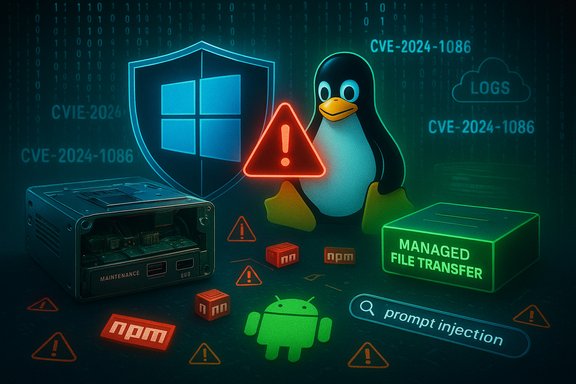 Background / Overview
Security Affairs Round 548 assembles an international press digest: cybercrime developments, malware campaigns, exploitation of widely used software, AI‑related attack vectors, and geopolitically charged intelligence operations. The edition strings together dozens of short items — from ransomware gangs claiming terabytes of stolen data to emerging Android strains and npm supply‑chain abuse — giving defenders a single, curated pulse on what to prioritize. The breadth of reporting is its strength: by juxtaposing disparate items (infrastructure compromises, kernel vulnerabilities, developer ecosystem deception, and AI/browser plumbing weaknesses), the newsletter highlights how attackers operate across layers and platforms. Below, this feature unpacks the most consequential items in depth, verifies key claims against independent sources, flags assertions that remain unverified, and offers practical, prioritized guidance for Windows administrators and mixed‑platform responders.Cybercrime and Infrastructure: What’s New and Why It Matters
Ransomware claims versus operational impact — Svenska kraftnät and the Everest leak
One of the most alarming entries in the newsletter describes a claimed breach at Sweden’s national transmission operator, Svenska kraftnät, with a ransomware group (reported as Everest) threatening to publish hundreds of gigabytes of stolen files. Svenska kraftnät confirmed an incident tied to an external file‑transfer solution and stressed that electricity supply was not affected, while investigations and law‑enforcement coordination proceed. Independent reporting from major security outlets and aggregated briefings corroborate the operator’s confirmation and the extortion claim, noting the group’s posting of alleged exfiltrated material and the operator’s statement that critical OT systems were not impacted. This is a classic “data extortion” profile: no immediate grid outage, but significant operational and intelligence risk if internal documentation, partner contacts, or supplier credentials were exposed. Why this matters for Windows and enterprise environments:- File‑transfer gateways are common integration points for Windows back‑office systems (ERP, procurement) and third‑party workflows. A compromised Managed File Transfer (MFT) instance often is the path to privileged document stores or service accounts.
- Exfiltrated documentation can be used for targeted phishing, pre‑positioning, or to craft plausible supply‑chain attacks that later hit Windows servers and admin consoles.
- Contain and triage any exposed file‑transfer systems: revoke and rotate service credentials, inspect transfer logs, and isolate the MFT appliance from critical domain controllers and AD replication paths.
- Assume the attacker has read access to whatever was in the transfer queues: apply targeted threat‑hunt queries for lateral movement and suspicious service account use.
- Activate partner notification and strengthen MFA and email protections to blunt follow‑on phishing.
FBI: card‑shuffler manipulation and the wider lesson on embedded device security
The newsletter picks up reporting that the FBI says card‑shuffling devices were hacked in a major gambling fraud probe. Independent, detailed investigations and coverage explain how the DeckMate 2 automated shuffler can — under certain conditions — be reprogrammed via exposed maintenance ports and used to reveal deck order to off‑site collaborators, enabling undetectable cheating. Law‑enforcement indictments and technical research (IOActive and reporters) now connect this concept with a broader criminal scheme that leveraged compromised equipment plus covert signaling to win millions in private games. Security takeaway for Windows administrators:- Physical or embedded devices that integrate with Windows management consoles (drivers, vendor update tools, or diagnostic utilities) can be pivot points. Treat attached embedded devices like networked endpoints: apply inventory, expose minimal management ports, and forbid unsupervised USB access to devices with privileged functions.
- Audit vendor maintenance processes and insist on cryptographic firmware validation and change controls; if vendor firmware‑hash checks are themselves modifiable, assume compromise is feasible.
Vulnerabilities and Active Exploitation
CISA: high‑severity Linux kernel flaw (CVE‑2024‑1086) now used in ransomware campaigns
Security Affairs flags a high‑severity Linux kernel privilege‑escalation flaw now exploited by ransomware groups. This is not a rumor: the vulnerability tracked as CVE‑2024‑1086 (a use‑after‑free in netfilter: nf_tables) was disclosed in January 2024, later added to CISA’s Known Exploited Vulnerabilities catalog, and has been observed in real ransomware operations. Multiple vendor advisories and NVD/Ubuntu security pages confirm the technical details, CVSS score, and the recommended mitigations (apply kernel updates, restrict user namespaces, or disable nftables where unused). Independent coverage and vendor advisories underline that local access is required for exploitation, but once achieved the bug enables root escalation — a classic stepping stone from foothold to full compromise. Why Windows teams should care:- Many Windows shops run Linux workloads (web, container hosts, build agents, or WSL) and rely on Linux‑hosted toolchains. A single unpatched Linux kernel on a build or CI host can be leveraged to pivot into Windows domain resources via stolen service account secrets or CI secrets.
- Ransomware actors increasingly combine multi‑platform toolsets; defenders must assume cross‑OS exploitation chains.
- Patch kernels across all Linux hosts, including cloud VMs and container hosts, per vendor advisories.
- If patching is deferred, block nf_tables or limit user namespaces and lift LKRG (Linux Kernel Runtime Guard) where acceptable.
- Harden CI/build hosts and treat them as high‑value assets: restrict local access, credential injection, and store secrets in vaults with minimal access policies.
Malware and Supply‑Chain Threats
Rapid, stealthy malware families and npm supply‑chain abuse
The newsletter catalogs a string of malware discoveries: a stealthy new RAT (Atroposia), Android strains that mimic human behavior (Herodotus), and multiple npm typosquatting campaigns delivering credential harvesters and invisible dependencies. These are familiar modern tactics: blend human‑like actions to defeat heuristics, weaponize developer ecosystems, and hide malicious code in transitive dependencies. Independent analysis of npm abuse campaigns and Android malware confirms the pattern: adversaries favor minimal‑signal payloads, multi‑stage loaders, and abuse of developer trust. Operational guidance for Windows developers and administrators:- Enforce package signing, lockfiles, and supply‑chain scanning in CI pipelines. Treat transitive dependencies as first‑class risk.
- For Android/Windows hybrid shops, treat mobile‑app telemetry and sign‑in sessions as potential pivot paths; enable conditional access and device posture checks for corporate resources.
- Monitor for anomalous outbound connections from developer workstations and CI runners; these hosts often hold secrets and elevated tokens.
AI, Browsers and Prompt‑Injection Risks
Browser‑level prompt injection, OpenAI Atlas, and malicious extensions
Security Affairs highlights an alarming trend: AI browser interfaces and omnibox features are being weaponized with prompt injections and extension impersonation, including vulnerabilities in OpenAI Atlas and research showing “unseeable” prompt injection through screenshots. Independent reports and vendor advisories have recently detailed how UI layers and URL handling can be abused to implant instructions or to capture sensitive context that an LLM interface then executes or leaks. These attacks are subtle — they target the inference pipeline and user interface rather than classic network exploits — and they require defenders to adopt new heuristics. Practical steps:- Lock down browser extension policies centrally (Edge/Chrome group policies), disallowing user installs in corporate devices where possible.
- Educate users about copy‑paste or image upload workflows that feed sensitive content into AI tools; treat AI tools as new sinks for sensitive data and apply DLP policies accordingly.
- Monitor and restrict local plugins or custom omnibox handlers that can alter prompt flow to hosted AI services.
Intelligence, Law Enforcement, and Attribution
High‑value arrests and espionage allegations
The newsletter covers multiple law‑enforcement and intelligence developments: an ex‑U.S. defense contractor manager pleading guilty to selling trade secrets to a Russian broker, extradition of an individual tied to Conti operations, and continued targeting of Ukrainian institutions. These items underscore a dual reality: criminal groups and nation‑state actors both pursue intellectual property, operational intelligence, and disruption, sometimes through mixed criminal‑spy collusion. Independent press reporting and government statements corroborate several of these incidents; defenders should not conflate legal outcomes with technical remediation, but rather use them as reminders to reduce insider risk, tighten data exfiltration detection, and prioritize privileged‑account controls. Actionable security measures:- Strengthen privileged access management (PAM) and apply zero‑trust principles around sensitive IP repositories.
- Increase monitoring for anomalous downloads from insider accounts and use behavioral baselining to detect data‑smuggling patterns.
- Enforce data classification and apply automated blocking/alerting for attempted exfiltration of classified or sensitive artifacts.
Windows‑Specific Notes: Lifecycle, Patching, and Enterprise Risk
Windows 10 end of support and Windows 11 servicing deadlines — migrate now
Security Affairs bundles lifecycle news that is essential for Windows admins: the hard end‑of‑support date for Windows 10 and servicing cutoffs for Windows 11 feature releases create a large, immediate migration workload. Community intelligence and deployment advisories in our own Windows forums independently documented Microsoft’s servicing deadlines and the practical implications for Home/Pro versus Enterprise SKUs; consumer 23H2 servicing for Home/Pro was set to end on November 11, 2025, creating compliance and security gaps for devices that remain on the release. These lifecycle milestones materially change the threat calculus: unsupported Windows builds accumulate unpatched kernel and platform vulnerabilities that are actively weaponized.Priority Windows guidance:
- Inventory endpoints immediately by build and SKU; tag 23H2 Home/Pro and Windows 10 endpoints for urgent remediation.
- Use Windows Update for Business, WSUS, or Intune feature‑rings to stage upgrades to 24H2/25H2 and ensure recovery points/backups before mass upgrades.
- If migration is not immediately feasible, treat Extended Security Updates (ESU) or isolating unsupported devices behind strict network controls as a temporary mitigation while planning replacement.
Critical Analysis: Strengths, Weaknesses, and Risk Trade‑offs
What Security Affairs does well
- Breadth and curation: the newsletter aggregates high‑value, global headlines that let practitioners triage what needs immediate attention versus watchful waiting. Its international lens shines light on infrastructure incidents, cross‑border law enforcement actions, and vendor advisories in a single reading.
- Tactical concreteness: many items are paired with specific indicators, CVE identifiers, and vendor‑level recommendations that map cleanly to operational playbooks.
- Timeliness: the digest captures emergent trends — kernel exploits, prompt‑injection research, supply‑chain abuse — that are time‑sensitive and affect both Windows and heterogeneous environments.
Where the gaps and risks lie
- Attribution uncertainty: several claims in the newsletter (for instance, attacker group identities and precise extortion magnitudes) are often reported from the threat actor’s leak sites or preliminary statements. These should be treated as claims, not firm attribution, until corroborated by forensic artifacts or law‑enforcement attribution. Security Affairs is careful to note ongoing investigations, but readers must avoid reflexive decisions based on unverified actor identity.
- Operational detail variance: for high‑impact items (infrastructure breaches or kernel exploit usage) the newsletter links out to technical advisories but does not always include full mitigation checklists tailored to mixed Microsoft/Linus estates. Readers should consult vendor advisories and CISA/National CERT guidance for step‑by‑step remediation.
- Signal versus noise: the sheer volume of small items (npm typosquatting, Android strains, browser issues) can overwhelm teams with limited capacity. The necessary follow‑up is to prioritize based on asset criticality and cross‑platform exposure rather than chasing each headline equally.
Prioritized Remediation Roadmap for Windows Admins and Hybrid Teams
- Immediate (0–72 hours)
- Inventory and patch: identify all Windows 10 and Windows 11 endpoints, flag unsupported builds, and accelerate patching/migration plans.
- Harden identity: enforce MFA, rotate service account credentials, and enable conditional access for remote admin interfaces.
- Contain MFT exposures: if your organization uses managed file transfer or third‑party document portals, isolate them from AD and ensure urgent credential rotation and log forensics.
- Short term (3–14 days)
- Patch Linux hosts for CVE‑2024‑1086 and apply mitigations on hosts that cannot be patched immediately; remove nf_tables/limit user namespaces where feasible.
- Audit developer pipelines and enforce package‑integrity checks, lockfiles, and signed artifacts to reduce npm typosquatting impact.
- Enforce browser extension policies and deploy enterprise DLP rules to prevent sensitive data exfiltration into LLM interfaces.
- Medium term (2–3 months)
- Deploy PAM and vault systems for privileged secrets; remove long‑lived secrets from build agents and service accounts.
- Run realistic IR exercises simulating data‑extortion incidents and MFT compromise, validating communications and legal notification workflows.
- Review and harden firmware verification procedures for embedded devices and attached equipment management policies, especially where vendor integrity checks are inadequate.
Flagged Claims and Caveats
- Ransom figures and exact exfiltrated data sizes reported by extortion sites should be treated as provisional; threat actors inflate figures for leverage. Treat their postings as risk indicators, not definitive inventories, until forensic results validate the scope.
- Some technical summaries in aggregated newsletters summarize vendor advisories; always consult the original CVE/vendor advisory for precise patch versions and mitigation commands. For example, kernel commits and backport status vary across distributions; cross‑check Ubuntu/Red Hat guidance before applying vendor patches.
Conclusion: Priorities for the Week
The Security Affairs Round 548 newsletter is a useful, actionable synthesis of the global threat landscape — but it must be paired with prioritized, cross‑platform remediation. For Windows administrators the immediate focus is clear: complete the migration of unsupported Windows builds, harden and audit any Windows‑integrated file‑transfer or management tools, and treat Linux and developer CI hosts as mission‑critical assets that require the same patch discipline as domain controllers. The active exploitation of CVE‑2024‑1086 underscores that adversaries will stitch together multi‑OS chains: a foothold on a patched‑out Linux host can turn into a domain compromise if credentials and secrets are not protected.The cross‑cutting themes are also instructive: supply‑chain hygiene, robust identity controls, hardened logging and telemetry, and aggressive containment playbooks will blunt the most common follow‑on attacks. Operationalizing those defenses in the next 30–90 days will dramatically reduce exposure — and will keep organizations out of the daily headlines collected in newsletters like Security Affairs.
Source: Security Affairs Security Affairs newsletter Round 548 by Pierluigi Paganini – INTERNATIONAL EDITION
