

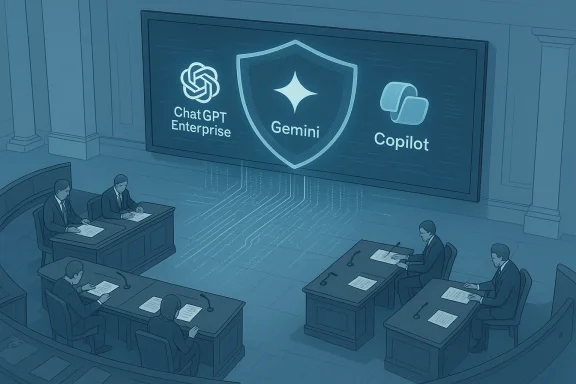
A terse, one‑page memo quietly circulated by the Senate sergeant‑at‑arms’ Chief Information Officer has opened the door for frontline Senate aides to use three major commercial generative‑AI chatbots—OpenAI’s ChatGPT, Google’s Gemini, and Microsoft Copilot—for routine, non‑sensitive official work, marking a pragmatic but imperfect leap from informal experimentation to explicit institutional permission.
For more than two years, congressional offices have been wrestling with how to treat generative AI: outright bans, tacit tolerance, or tightly governed adoption. The House has been more forward‑leaning in carving out controlled paths for staff use; independent organizations that track Congressional IT policy have built training and templates to help offices adopt AI without blowing past basic privacy and security rules.
The Senate’s memorandum, reviewed by national press outlets, specifically names the three vendors above and limits use to routine tasks—drafting and editing documents, summarizing information, preparing talking points and briefing material, and conducting open‑source research and analysis. It also makes operational references to the way some of those tools are already integrated into the chamber’s platforms (notably Microsoft Copilot inside Microsoft 365). The memo stresses guardrails: staff must avoid entering personally identifiable information (PII), physical security information, classified content, or other sensitive data into those tools unless special approvals and technical controls are in place.
This move arrives amid broader political friction over which AI vendors the federal government will or will not use. Notably, Anthropic’s Claude—excluded from the Senate list—has recently been the subject of a high‑profile dispute between its leadership and elements of the federal government, prompting the President to call for federal agencies to halt use of the firm’s products in a widely publicized social‑media post. That dispute has cascaded into Pentagon actions and national debate about whether and how private AI firms should accept government demands on product guardrails.
Mitigations:
Mitigations:
Mitigations:
Mitigations:
Mitigations:
But the devil is in the details. Contracts, tenant configuration, logging, and staff training—not slogans or vendor names—will determine whether this memo becomes a model for responsible adoption or a cautionary tale about rushed tech rollouts in high‑stakes civic environments. The Senate has chosen pragmatism; now it must demonstrate diligence, accountability, and the technical follow‑through that turns a one‑page permission slip into safe, auditable practice.
Source: PCMag UK Google's Gemini, OpenAI’s ChatGPT, or Microsoft Copilot Are Coming to the Senate
 Background / Overview
For more than two years, congressional offices have been wrestling with how to treat generative AI: outright bans, tacit tolerance, or tightly governed adoption. The House has been more forward‑leaning in carving out controlled paths for staff use; independent organizations that track Congressional IT policy have built training and templates to help offices adopt AI without blowing past basic privacy and security rules.The Senate’s memorandum, reviewed by national press outlets, specifically names the three vendors above and limits use to routine tasks—drafting and editing documents, summarizing information, preparing talking points and briefing material, and conducting open‑source research and analysis. It also makes operational references to the way some of those tools are already integrated into the chamber’s platforms (notably Microsoft Copilot inside Microsoft 365). The memo stresses guardrails: staff must avoid entering personally identifiable information (PII), physical security information, classified content, or other sensitive data into those tools unless special approvals and technical controls are in place.
This move arrives amid broader political friction over which AI vendors the federal government will or will not use. Notably, Anthropic’s Claude—excluded from the Senate list—has recently been the subject of a high‑profile dispute between its leadership and elements of the federal government, prompting the President to call for federal agencies to halt use of the firm’s products in a widely publicized social‑media post. That dispute has cascaded into Pentagon actions and national debate about whether and how private AI firms should accept government demands on product guardrails.
What the memo authorizes — practical scope and immediate effects
Allowed use cases (short, specific list)
- Drafting and editing internal and external documents.
- Summarizing reports, testimony, and long research items into digestible briefs.
- Preparing talking points, memos, and briefing materials for lawmakers.
- Conducting open‑source research and rapid background analysis to inform hearings and markups.
Operational detail you should know
- Microsoft Copilot is highlighted as already integrated into Senate Microsoft 365 environments, which makes it operationally straightforward for many offices to begin using it under existing tenant controls. The memo indicates Copilot can be used within those government‑grade Microsoft environments and notes that Copilot will not access Senate data unless a user explicitly shares it in a prompt—an operational claim that depends on correct tenant configuration and administrative controls.
- Reports circulating in the wake of the memo suggest that the technology office may provision enterprise licenses for Gemini and ChatGPT for staff; however, those licensing details remain incompletely documented publicly and should be treated as provisional until the Sergeant‑at‑Arms or responsible procurement bodies publish formal rollout data.
Why the Senate’s approach is pragmatic — and why pragmatism alone is not enough
The upside: realistic productivity gains
The day‑to‑day workload of Senate staffers is dominated by time‑consuming, low‑to‑medium‑complexity tasks: summarizing hearings, drafting constituent responses, creating briefing one‑pagers, and composing memos under tight deadlines. Carefully provisioned LLMs can:- Reduce drafting time and accelerate research synthesis.
- Standardize briefing formats across offices.
- Help junior staff get up to speed faster on new policy portfolios.
- Improve accessibility (plain‑language summaries, alternative formats) for staffers with diverse needs.
The technical governance tradeoffs
Still, authorization without technical and legal clarity can create false confidence. The memo relies on an institutional preference for enterprise or government‑configured instances (e.g., ChatGPT Enterprise, Gemini in Google Workspace, Microsoft 365 Copilot in GCC environments)—which come with contractual assurances about data handling and training. But those assurances are only meaningful when:- Contracts explicitly prohibit vendor reuse of tenant data for model training (or provide a clearly auditable opt‑out).
- Administrative controls are correctly set to prevent accidental access to internal drives, mailboxes, or Teams channels.
- Robust DLP (data loss prevention), logging, and eDiscovery integrations exist and are tested against plausible failure modes (for example, tenant misconfiguration or software bugs that expose protected content).
Verifying vendor technical claims — what the vendors actually promise
Google Gemini (Workspace/Generative AI Services)
Google’s enterprise guidance states that Gemini in Google Workspace treats prompts and outputs as customer data governed by the Workspace agreement and the Cloud Data Processing Addendum; it asserts the company will not use customer data to train its foundation models without explicit permission, and admins can control retention and deletion settings for chats. These are meaningful contractual features for public‑sector use, but they depend on correct admin configuration and the procurement terms in the contract.OpenAI ChatGPT Enterprise
OpenAI’s enterprise offerings typically include contractual language that claims customer inputs will not be used to train the general models and that enterprise data handling and retention policies differ from consumer offerings. Those claims are central to why institutions choose enterprise accounts rather than public ChatGPT access. Implementation details (where inference runs, how long logs are retained, exportability, audit rights) are negotiated with procurement teams.Microsoft Copilot (Microsoft 365)
Microsoft positions Copilot as an integrated extension of Microsoft 365—when run in government continuum clouds (GCC, GCC‑High, DoD), it inherits the tenant’s identity and compliance controls and can run within contractual and technical perimeters appropriate for many public‑sector workflows. That integration is operationally attractive because it reduces friction: staff already work in M365 and Copilot can be accessed without creating off‑tenant consumer accounts. However, history shows complex interactions between Copilot and tenant DLP/eDiscovery policies can produce unexpected exposures if not validated and patched. A publicly disclosed Copilot bug demonstrated that, under certain circumstances, sensitivity labels and DLP protections did not reliably exclude some content from Copilot’s retrieval set—showing that even enterprise integrations need active governance.The biggest risk categories and practical mitigations
1) Data exfiltration and improper disclosure
Risk: Staff accidentally paste PII, protected constituent case details, or sensitive national‑security information into prompts; even if vendor contracts prohibit training on that data, the immediate disclosure is already a breach.Mitigations:
- Enforce a strict no PII, no classified, no physical security information policy for consumer and enterprise chat tools unless explicit approval exists.
- Deploy prompts and browser controls that prevent copy‑paste from sensitive systems into external fields.
- Use Data Loss Prevention (DLP) rules tuned to detect and block paste operations or uploads originating from classified or restricted mailboxes.
2) Model hallucinations and civic risk
Risk: LLMs generate plausible but false legal or policy assertions; staff may inadvertently pass those into talking points or briefings.Mitigations:
- Require explicit human verification and source citation for any factual claims used in external communications.
- Include a standard "LLM‑assisted draft" banner for internal drafts, and mandate an author attestation step before a memo reaches a member’s desk.
3) Auditability, transparency, and the congressional record
Risk: Outputs generated or edited by AI could become part of the legislative or public record without traceability, complicating oversight and FOIA compliance.Mitigations:
- Log all AI interactions used for official work; preserve prompt/response pairs for a defined retention period and index them in eDiscovery systems.
- Add metadata practices that record the tool, model version, and tenant context for each AI‑assisted item.
4) Supply‑chain and vendor political pressure
Risk: Political disputes—such as the recent federal row over Anthropic—can abruptly change availability of vendors or instruments, creating operational instability and political entanglement. Banning a vendor for political reasons leaves staff scrambling for replacements and raises questions about vendor neutrality when contracts are influenced by political posture.Mitigations:
- Maintain multi‑vendor procurement strategies where practicable and define interoperability limits so offices can transition without losing core capabilities.
- Insist on contractual commitments about government‑only deployment options or on‑premises/offline inference for extremely sensitive workloads.
5) Overreliance and skill atrophy
Risk: Staff may outsource judgment or analytical rigor to LLMs, degrading institutional knowledge and increasing the chance of systemic error.Mitigations:
- Invest in training: prompt literacy, verification practices, and an understanding of LLM failure modes.
- Limit LLMs to first‑draft and brainstorming roles for non‑sensitive work; keep final decisioning and legal/policy judgments human and auditable.
Governance checklist — what responsible offices should implement now
- Inventory: Identify the systems, drives, mailboxes, and data categories that are off‑limits for any AI tool without explicit exception.
- Procurement: Ensure vendor contract terms include an explicit training‑restriction clause, audit rights, and breach reporting obligations.
- Configuration: Lock admin controls (retention, sharing, connectors) and test DLP/eDiscovery integrations in an independent audit before rollout.
- Logging: Capture prompts, responses, timestamps, and the user identity for every official AI interaction.
- Training: Require mandatory, recurring training for staff on safe AI use and the office’s specific policies.
- Incident Playbook: Define an incident response playbook for accidental exposure (containment, notification, forensics, remedial training).
- Oversight: Publish a brief, public FAQ that explains permitted uses and governance approaches to bolster transparency and public confidence.
Political and institutional implications
Authorizing commercial AI tools for everyday Senate work is not just an IT decision; it has legislative, oversight, and political dimensions.- Politically sensitive output: AI‑drafted talking points or memos could amplify misstatements or inadvertently produce partisan framing that is difficult to disentangle from human authorship. That risk is especially salient when lawmakers face rapid news cycles and short windows to respond.
- Oversight and records: If an AI tool influences legislative drafting, committees and the public will reasonably demand visibility into how those tools were used. Transparency mechanisms, including structured logs and archival practices, will be essential to sustain public trust.
- Vendor influence: Enterprise deals often come with co‑development or advisory arrangements. Congress must be wary of vendor relationships that create regulatory capture or closed channels for influence. Diversified procurement and robust conflict‑of‑interest checks are prudent safeguards.
- Strategic resilience: Political disputes—like the recent Anthropic confrontation—can result in abrupt shifts in federal policy toward vendors. Offices should avoid single‑vendor lock‑in for critical workflows and retain contingency plans for continuity.
Case study: Claude, the Pentagon, and the political back‑draft
The Senate’s explicit authorization notably omitted Anthropic’s Claude from the approved list. That omission did not happen in a vacuum: Claude and Anthropic have been at the center of a public dispute between the company and senior national‑security officials, culminating in public directives for federal agencies to stop using its tools. The political dispute—manifest in a high‑profile social‑media statement by the President—illustrates how vendor choices can be weaponized into broader supply‑chain and policy fights. For the Senate this means two things: (1) vendor selection can become a national story overnight, and (2) institutional policy must be robust enough to withstand political turbulence without compromising mission continuity.Practical examples and quick guidance for staffers (what to do, what not to do)
- Do use approved enterprise instances for drafting and summarization tasks where the output will be checked by a human.
- Do capture minimal metadata: tool used, model ID or version, and reviewer name for any AI‑assisted deliverable.
- Don’t paste constituent health records, Social Security numbers, classified citations, or physical‑security details into any chat prompt.
- Don’t use consumer/free accounts for official work; consumer products do not generally offer the contractual or technical assurances required for government data.
- Do flag and escalate any odd or potentially harmful AI outputs to an office lead and the IT helpdesk before sending externally.
Five technical truths to keep front‑of‑mind (verified)
- Enterprise and government AI products include contractual commitments that typically prohibit use of customer data to train public foundation models; those commitments are not automatic for consumer versions.
- Microsoft Copilot’s integration with Microsoft 365 can reduce friction, but integrations have produced operational bugs in the past that resulted in unexpected exposure of protected content—so tenant‑level validation is essential.
- Administrative controls (retention settings, auto‑delete options, connector permissions) are effective only when correctly configured and when admins verify behavior through testing and audit logs.
- Logging prompt/response pairs and associating them with user accounts is the only practical way to make AI use auditable and compatible with FOIA/eDiscovery expectations.
- Vendor political disputes can create sudden procurement and access changes; multi‑vendor strategies provide resilience and reduce political leverage.
Where the Senate still needs to sharpen policy
- Publish the memo and a Q&A for staff that maps exactly which everyday tasks are permitted and which require managerial sign‑off. Ambiguity fosters risky workarounds.
- Release the basic contractual assurances the SAA negotiated with vendors (training prohibition, audit rights, data‑residency guarantees) or a summary that protects procurement confidentiality while giving staff confidence.
- Roll out mandatory, short certification training for all staff before granting enterprise AI access, paired with technical controls that prevent misuse from day one.
- Commission an independent technical audit of tenant configuration and DLP/eDiscovery integration to ensure known vulnerability classes—like the Copilot retrieval bug—are not present.
Conclusion
The Senate’s memo is a consequential, largely sensible step: it recognizes that generative AI is already reshaping white‑collar workflows and chooses to manage that change rather than pretend it does not exist. Authorizing ChatGPT, Gemini, and Copilot for routine, non‑sensitive tasks places the institution on a path toward the productivity benefits of modern LLMs while attempting to preserve essential security boundaries.But the devil is in the details. Contracts, tenant configuration, logging, and staff training—not slogans or vendor names—will determine whether this memo becomes a model for responsible adoption or a cautionary tale about rushed tech rollouts in high‑stakes civic environments. The Senate has chosen pragmatism; now it must demonstrate diligence, accountability, and the technical follow‑through that turns a one‑page permission slip into safe, auditable practice.
Source: PCMag UK Google's Gemini, OpenAI’s ChatGPT, or Microsoft Copilot Are Coming to the Senate
