

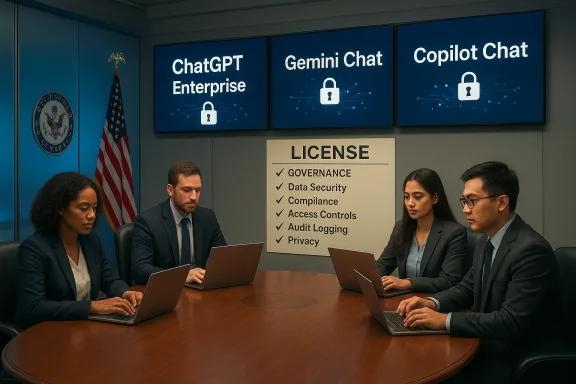
The U.S. Senate quietly moved from experiment to endorsement this week: a one‑page memorandum from the Sergeant at Arms’ Chief Information Officer authorizes frontline Senate staff to use three mainstream generative‑AI chat assistants — OpenAI’s ChatGPT (Enterprise), Google’s Gemini Chat, and Microsoft Copilot Chat — with official Senate data for routine, non‑sensitive work.
The memo — circulated internally and reviewed by multiple outlets — states that Microsoft Copilot Chat is available now inside the Senate’s Microsoft 365 environment, while the Sergeant at Arms’ office will assign one free license per Senate employee for either Google Chat or OpenAI ChatGPT Enterprise.
That administrative decision is significant not only because it formalizes what many staffers were already doing informally, but because it represents a practical blueprint for how a major legislative body intends to balance productivity gains with security, privacy, and procurement controls as generative AI becomes part of everyday office tooling. The memorandum focuses the tools’ allowed uses — drafting and editing documents, summarizing information, preparing talking pterials, and research and analysis — while continuing to place restrictions on classified or highly sensitive inputs.
Across the federal government, agencies have adopted a patchwork of approaches: some agencies have limited commercial chd tightly controlled pilots, while others — notably the Department of Veterans Affairs — have pursued aggressive internal deployments and inventories of AI systems. The Senate authorization sits between those extremes: broader than “research only,” but still constrained by data‑type restrictions.
Note: the reporting about Worthington’s departure circulated in trade press and social channels; while the biographical and programmatic details of his work are verifiable through agency pages and prior interviewis post‑departure plans and final date should be treated as contingent until the VA posts an official statement.
The short version: the door is open — but the hard work of governance, procurement, and verification starts now.
Source: FedScoop ChatGPT, Gemini, Copilot approved for use with Senate data
 Background / Overview
The memo — circulated internally and reviewed by multiple outlets — states that Microsoft Copilot Chat is available now inside the Senate’s Microsoft 365 environment, while the Sergeant at Arms’ office will assign one free license per Senate employee for either Google Chat or OpenAI ChatGPT Enterprise.That administrative decision is significant not only because it formalizes what many staffers were already doing informally, but because it represents a practical blueprint for how a major legislative body intends to balance productivity gains with security, privacy, and procurement controls as generative AI becomes part of everyday office tooling. The memorandum focuses the tools’ allowed uses — drafting and editing documents, summarizing information, preparing talking pterials, and research and analysis — while continuing to place restrictions on classified or highly sensitive inputs.
Why this matters now
Washington has been wrestling with the question of how to adopt generative AI responsibly: the technology can dramatically reduce administrative toil for legislative staff, but it also raises familiar concerns about data exfl property, privacy, and vendor control of government workflows.- The Senate’s move shifts the debate from “if” to “how” — from piecemeal experimentation to controlled deployment with enterprise licensing and central oversight.
- The decision aligns the Senate with broader federal efforts to adopt AI while attempting to codify guardrails that limit risk to sensitive information and national security.
What the memo actually authorizes
Core permissions
The memo explicitly authorizes the use of three named platforms — Copilot Chat, Gemini Chat via Google Workspace, and ChatGPT Enterprise — for routine, non‑sensitive Senate work, including:- Drafting
- Summarizing information and briefings
- Preparing talking points
- Conducting research and analysis
Licensing and access
According to the internal notice, Arms) will provide each Senate employee with one generative‑AI license at no cost for either Google Workspace with Gemini Chat or OpenAI ChatGPT Enterprise; Copilot will also be available at no cost through the existing Microsoft 365 integration. That arrangement removes a key access barrier (per‑user license cost) and encourages experimentation under centrally managed vendor agreements.Limits and guardrails
The memo reiteratd classified information and other high‑risk data categories. It emphasizes use of enterprise or government‑deployed instances where available rather than consumer chat pages, and directs staff to follow compensating controls already in place for government data handling. Those points replicate lessons learned from earlier guidance (and incidents) in the federal sector and mirror the “moderate risk if controls are followed” posture that appeared in prior Senate guidance.How this compares with earlier Hill policy and broader federal practice
The Senate’s new one‑page authorization builds on earlier 2023 guidance that allowed staff to use ChatGPT, Google Bard, and Microsoft Bing Chat for research and evaluation only and only with non‑sensitiveidance treated consumer chat tools as acceptable for experimentation but not for operational work. The current memo marks a clear expansion of permitted use.Across the federal government, agencies have adopted a patchwork of approaches: some agencies have limited commercial chd tightly controlled pilots, while others — notably the Department of Veterans Affairs — have pursued aggressive internal deployments and inventories of AI systems. The Senate authorization sits between those extremes: broader than “research only,” but still constrained by data‑type restrictions.
Operational impact: immediate benefits and friction points
Productivity upside (near term)
- Faster drafting and brief creation. Staff who routinely prepare memos, talking points, and briefings can use generative assistants to scaffold drafts, summarize long reports, and create initial talking pointn refine. This can compress turnaround times for fast‑moving legislative issues.
- Lower administrative burden. Routine tasks — format conversions, summarization of hearing transcripts, and extraction of key points from long reports — are exactlyre LLM assistants deliver the most measurable ROI.
- Cross‑platform parity. Making multiple providers available (OpenAI, Google, Microsoft) gives staff the freedom to choose the tool that best fits a workflow, whileuces the friction of procurement.
Shortfalls and integration costs
- Training and onboarding. Enterprise AI tools require training users on safe‑use practices: what to input, what to avoid, and how to verify outputs. Without training, hallways‑use can produce embarrassing errors or risky disclosures.
- Workflow fragmentation. Allowing multiple vendors without a top‑level integration strategy creates the risk that different offices will build their own, incompatible AI‑powered workflows — increasing long‑term operational and Verification overhead. Outputs from generative models must be verified; that verification still rests on human staffers and often adds an implicit second pass to workflows rather than eliminating effort entirely.
Security and privacy analysis — what to watch for
The speed of adoption should not obscurcumented risks when external AI vendors process government data. The Senate memo attempts to mitigate these concerns via restrictions, enterprise instances, and central provisioning, but several risk vectors remain:- Data residency and retention: Even when deployed via enterprise accounting policies — including backup, retention, and access by vendor staff for model improvement — must be contractually constrained. Enterprise deployments can vary widely in whether and how they limit vendor access to prompt and content data.
- Unintended disclosure through prompts: Staff may inadvertently include personally identifiable information (PII), law‑enforcement sensitive details, or security planning information in prompts. That kind of accidental disclosure is the most common operational error when non‑technical users interact with LLMs.
- Model hallucination Generative assistants can produce plausible‑sounding but false assertions. When those outputs are used as the basis for official briefings or legal language, the reputational and policy risks are nontrivial. Human verification remains essential.
- Supply‑chain and vendor risk: Centralizing on a subset of vendors (even if multiple vendors are included) concentrates risk: outage, legal disputes, or an adversary’s targeting of a privileged vendor relationship could impact whole swaths of Senate operations.
Legal and procurement implications
The memo’s choice to provide one free license per employee signals a move toward centralized vendor contracting and away from ad hoc, consumer‑grade usage. That has several downstream effects:- Procurement leverage: central licensing can secure enterprise contracts with contractual commitments around data handling, audit rights, and indemnification that individual consumer subscriptions cannot.
- Responsibility and auditability: issuing agency‑managed licenses makes it easier to ensure lng, and compliance with Records Act obligations. But it also places the burden of oversight on the SAA and each Senate office’s information governance teams.
- Competition and vendor neutrality: the memo’s vendor list excludes many smaller or emerging providers; over time, procurement decisions that favor a small number of large vendors can steer long‑term vendor lock‑in and reduce competition. This matters both for pricing and for resilience.
Political and institutional dynamics
The Senate’s explicit endorsement of three major commercial chatbots will reverberate across multiple axes:- Legislative optics: an endorsement can be framed as modernization and efficiency; critics will emphasize security, expenditure, and potential for error or influence by private platforms.
- Inter‑chamber divergence: the House and Senate have not always aligned on IT policy. Centralized Senate licensing may force House offices and committees to reconsider their own policies to remain operationally competitive.
- Vendor strategy: Microsoft — with Copilot integrated into M365 — gains a clear deployment advantage inside organizations already standardized on Microsoft 365. Google and OpenAI gain parity via enterprise licenses, but the vendor with the tightest integration into day‑to‑day apps enjoys the lowest friction for staff adoption.
A closer look at vendor capabilean for risk
- Microsoft Copilot Chat: integrated into Microsoft 365 Government environments, Copilot offers the operational benefit of data staying inside a government‑controlled Microsoft cloud when properly configured, with Microsoft’s government cloud controls layered on top. That integration reduces some operational exposure compared with consumer web chat, but thls (which Gov cloud tier, what logging is enabled) determine actual risk.
- Google Workspace + Gemini Chat: Google has pushed Gemini into Workspace so staff can use natural language queries directly inside Docs, Sheets, and Slides. Enterprise deployments may offer data isolation and logginrs and contract terms must be scrutinized. ([404media.co](Here’s the Memo Approving Gemini, ChatGPT, and Copilot for Use in the Senate Enterprise: provides administrative controls and promises not to use customer data to train public models, but the legal and contractual commitments must be validated and operationalized for the Senate’s data classification model.
Practical recommendations for the Senate’s IT leadership (actionable checklist)
- Define clear data classification guidance for AI tools, with concrete examples. (What is “sensitive?” What is “classified?”)
- Require enterprise‑only usage: disable consumer access to the named vendors on Senate networks and enforce the use of SAA‑provisioned accounts.
- Embed a mandatory verification step in any workflow where AI outputs are used for policy, legal, or constituent communications.
- Ensure contractual commitments that prohibit vendor reuse of Senate prompts for model training, and insist on auditable logging and forensic access.
- Provide mandatory training for all license holders on safe prompt design, PII handling, and deception detection.
- Create a central log and monitoring pipeline for AI usage so the SAA can detect anomalies, spikes in use, or politically sensitive patterns requiring escalation.
Broader implications for federal AI governance
The Senate’s program is a useful case ss and legislative bodies because it demonstrates a path between outright prohibition and unfettered consumer adoption. It shows:- How central procurement can expand access while providing a lever for contractual protections.
- Why technical integration (Copilot inside M365) matters for uptake and operational efficiency.
- The tension between enabling staff productivity and maintaining strict controls over sensitive government data.
The Department of Veterans Affairs’ leadership change: context and uncertainty
Separately, reporting circulated that Cthe VA’s Chief AI Officer and Chief Technology Officer — has stepped down after nearly nine years, a move described in an t and reported by FedScoop. Worthington has been a central figure in the VA’s digital modernization and AI puse VA produced a large inventory of AI uses and piloted internal AI tools, including the agency’s VA‑branded chatbot programs. The FedScoop summary notes his role in founding VA’s modernization initiatives and his prior work at the U.S. Digital Service. The departure, if confirmed, represents a material leadership change at one of the federal government’s most AI‑active agencies. The claim originates in FedScoop’s reporting and the individual’s LinkedIn post as described in that report; independent public confirmation is desirable.Note: the reporting about Worthington’s departure circulated in trade press and social channels; while the biographical and programmatic details of his work are verifiable through agency pages and prior interviewis post‑departure plans and final date should be treated as contingent until the VA posts an official statement.
Strengths and risks — an executive summary
- Strengths:
- Practical, pragmatic approach to adoption that reduces friction for day‑to‑day staff tasks.
- Centralized procurement that can deliver enterprise protections and consistent licensing.
- Vendor diversity (three major vendors) that reduces single‑vendor dependence — at least at the outset.
- Risks:
- **Residualt content and model outputs if contracts or configurations are insufficient.
- Operational complacency if staff assume model outputs are accurate and do not perform due diligence.
- Longer‑term vendor lock‑in and procurement inertia favoring dominant cloud incumbents if open competition is not preserved.
What success looks like
A successful Senate implementation will be measurable and safe. Look for the following indicators over the next 6–12 months:- Comprehensive training completed by a majority of license holders.
- Deployment of logging, records capture, and auditing for AI interactions involving government data.
- Clear reporting on the scope of allowable use and well‑documented exceptions for sensitive workflows.
- A procurement roadmap that allows smaller vendors and specialized government offerings (e.g., on‑prem or sovereign cloud variants) to compete where appropriate.
Conclusion
The Senate’s one‑page memo formalizes a pragmatic center ground: enterprise access to leading generative‑AI assistants for routine legislative work, combined with central licensing and guardrails meant to limit risk. That choice acknowledges the real, near‑term productivity benefits of tools like Copilot, Gemini, and ChatGPT while placing the burden of safety on operational controls, contracts, and user training. Whether this approach becomes a durable model for the federal government depends on the Senate’s ability to translate a permissive memo into rigorous governance: enforceable technical controls, auditable procurement commitments, and sustained user education.The short version: the door is open — but the hard work of governance, procurement, and verification starts now.
Source: FedScoop ChatGPT, Gemini, Copilot approved for use with Senate data
