

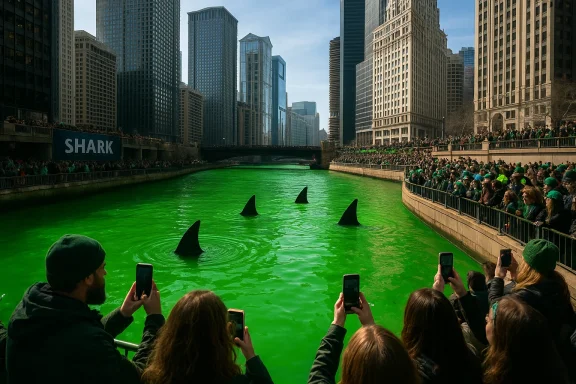
The green river looked like the opening shot of a horror movie: at midmorning on the Saturday when Chicago traditionally dyes the Chicago River for St. Patrick’s Day, spectators reported seeing what appeared to be shark fins slicing through the emerald current — only for local chatter and a single outlet’s reporting to later attribute the spectacle to a marketing stunt tied to a forthcoming Netflix shark thriller. The image was arresting, the timing impeccable, and the moment exposed everything modern publicity and urban pageantry have in common: spectacle, surprise, and the thin line between reality and staged performance.
The annual coloring of the Chicago River is a ritual as recognizable to the city as its skyline. Organized by the Chicago Journeymen Plumbers Local 130, the dyeing takes place on the Saturday before St. Patrick’s Day and has been part of Chicago civic life for six decades. In 2026 the dyeing was scheduled to begin at 10 a.m., with crews releasing an environmentally formulated dye between Columbus Drive and State Street that turns the river a vivid emerald for several hours each year, drawing thousands of spectators to the riverwalk and downtown bridges.
The dye itself is described repeatedly by city sources and longstanding reporting as a vegetable-based, biodegradable formula that organizers and local environmental experts say is formulated to be non-toxic at the concentrations used for the celebration. While the recipe is treated as proprietary by the union that applies it, public-facing statements and university environmental commentary have generally characterized it as safe and short-lived in the water. That technical framing is important: the dye makes the stunt visually possible, and the familiar sight of neon-green water primed the public to accept — at least for a few minutes — that anything unusual in the water might actually be happening.
A story published by one online outlet reported that the fins were not biological but were instead part of a promotional stunt orchestrated to publicize an upcoming Netflix film titled THRASH, a hurricane-and-sharks thriller set for release in April. That account said the mock fins were placed along the river and moved up and down its main stretch for several hours, apparently creating the illusion that sharks were patrolling the dyed water. The film in question is very much real as a forthcoming Netflix release: THRASH (also reported in trade and entertainment outlets under that title) is being positioned as a shark-infused survival picture directed by Tommy Wirkola and starring Phoebe Dynevor, Whitney Peak, and Djimon Hounsou, with streaming launch dates set for April 10, 2026 on platforms reporting Netflix distribution.
It is worth stressing one journalistic caveat up front: an authoritative, independently verified Netflix press release or placement in major Chicago news outlets confirming Netflix as the responsible party for the river fins was not available at the time of our reporting. Multiple film trade outlets confirm the film’s cast and premiere date, but the specific claim — that Netflix placed moving shark-fin props in the Chicago River during the dyeing — appears to have been reported by a single news outlet and echoed across social media without a clear, direct statement from Netflix appearing in the wider press cycle. For that reason we flag the attribution as plausible and consistent with modern studio marketing practices but not fully corroborated by multiple independent mainstream sources. Readers should treat the studio-attribution language accordingly until Netflix or a city permit log confirms the stunt directly.
Why might a studio choose a guerrilla-style stunt for a shark movie? The answer is marketing logic: visceral images and short-form video assets are perfect for social feeds, and an audacious stunt staged during a citywide event multiplies the reach because fans, tourists, and local press are already watching. Netflix has a recent history of high-visibility, playful or unconventional promotions — from themed pop-ups to viral PR moves that generate earned media far beyond paid placements — and brands in the streaming era frequently use such stunts to make their films trend on release.
That administrative reality is an important constraint on guerrilla marketing. A fully authorized promotional deployment would be documented through permits and insurance filings; an unauthorized stunt that used river props without permits would risk municipal fines, seizure of equipment, and public-safety enforcement. The practical upshot: if the fins were, in fact, placed by a studio or its agency, it is likely — though not guaranteed — that permitting or coordination with the Chicago Film Office occurred, especially given how visible the scene was and how many people were present to witness it. If no permit appears publicly, that would be a notable red flag about the stunt’s authorization.
First, the Chicago dyeing uses a vegetable-derived formula that organizers and environmental commentators say is biodegradable and non-toxic at the concentrations used for the festivities, with a relatively short environmental half-life in sunlit, moving water. That characterization has been repeated in academic and local reporting, and is the baseline reason thousands of spectators are comfortable watching the river turn without immediate alarm for fish and bird life. That said, environmental scientists urge caution: any introduced substance, even if deemed non-toxic at low concentrations, should be evaluated for cumulative or indirect impacts, such as alterations to turbidity, dissolved oxygen, or small fauna behavior during an otherwise intense run of human activity.
Second, any mechanical or floating props placed in a waterway — especially moving props intended to simulate animals — carry safety risks. Props can entangle boat engines, collide with kayakers, or create panic among recreational users. Properly designed, buoyant promotional elements are engineered to minimize snag hazards and to be quickly retractable. When executed with permits and safety oversight, such moves can be done without harm; done without oversight, they potentially expose both operators and the public to real hazards and liability. In short: spectacle must be balanced with marine safety planning and environmental due diligence.
But the calculus is not purely promotional. There are reputational trade-offs:
Three dynamics were especially visible in this episode:
From a reputational perspective, studios and agencies generally prefer to control the narrative: if they planned the stunt, they will often claim credit quickly to harvest the earned media. If they did not, they will typically deny responsibility and may offer to work with city officials to address consequences. The opacity in the present case — where studio confirmation was not widely visible in mainstream outlets at the time of reporting — leaves a gap that both journalists and the public will expect to see filled.
But the risks in this case are demonstrable. Using a civic ceremony as the backdrop for a fictional predator — however fake — runs the risk of:
The bigger story is not simply whether Netflix planted props — it is how city rituals, environmental stewardship, and marketing ingenuity now intersect. As streaming platforms and studios continue to look for fresh ways to break through the noise, cities and citizens must insist on clarity, safety, and accountability. Public spectacle can be delightful; it becomes corrosive only when it neglects the duties that come with using a shared public stage.
For readers curious about verification: check the Chicago Film Office permit listings for the dyeing date, watch for an official studio statement on the film’s promotion, and look to local municipal communications for any post-event safety or environmental reports. Until the responsible party speaks unambiguously and municipal records are consulted, the shark-fin spectacle remains a perfect example of the modern attention economy — breathtaking, viral, and, for now, only partly verified.
Source: USA Herald Sharks in the Chicago River? Viral Sightings Turn Out to Be a Clever Movie Stunt - USA Herald
 Background: the dye, the tradition, and the scene on the river
The annual coloring of the Chicago River is a ritual as recognizable to the city as its skyline. Organized by the Chicago Journeymen Plumbers Local 130, the dyeing takes place on the Saturday before St. Patrick’s Day and has been part of Chicago civic life for six decades. In 2026 the dyeing was scheduled to begin at 10 a.m., with crews releasing an environmentally formulated dye between Columbus Drive and State Street that turns the river a vivid emerald for several hours each year, drawing thousands of spectators to the riverwalk and downtown bridges.The dye itself is described repeatedly by city sources and longstanding reporting as a vegetable-based, biodegradable formula that organizers and local environmental experts say is formulated to be non-toxic at the concentrations used for the celebration. While the recipe is treated as proprietary by the union that applies it, public-facing statements and university environmental commentary have generally characterized it as safe and short-lived in the water. That technical framing is important: the dye makes the stunt visually possible, and the familiar sight of neon-green water primed the public to accept — at least for a few minutes — that anything unusual in the water might actually be happening.
What happened: viral sightings and the claim of a movie stunt
On the morning of the dyeing, eyewitnesses and social posts described dark, triangular shapes that looked like dorsal fins cutting the surface of the bright green river. Video clips and photos — shared widely on social platforms — captured fins that appeared to circle in repetitive patterns, particularly in stretches near downtown bridges. Those posts spread quickly, producing the exact kind of urban virality PR teams covet: short, dramatic clips that begged for explanation.A story published by one online outlet reported that the fins were not biological but were instead part of a promotional stunt orchestrated to publicize an upcoming Netflix film titled THRASH, a hurricane-and-sharks thriller set for release in April. That account said the mock fins were placed along the river and moved up and down its main stretch for several hours, apparently creating the illusion that sharks were patrolling the dyed water. The film in question is very much real as a forthcoming Netflix release: THRASH (also reported in trade and entertainment outlets under that title) is being positioned as a shark-infused survival picture directed by Tommy Wirkola and starring Phoebe Dynevor, Whitney Peak, and Djimon Hounsou, with streaming launch dates set for April 10, 2026 on platforms reporting Netflix distribution.
It is worth stressing one journalistic caveat up front: an authoritative, independently verified Netflix press release or placement in major Chicago news outlets confirming Netflix as the responsible party for the river fins was not available at the time of our reporting. Multiple film trade outlets confirm the film’s cast and premiere date, but the specific claim — that Netflix placed moving shark-fin props in the Chicago River during the dyeing — appears to have been reported by a single news outlet and echoed across social media without a clear, direct statement from Netflix appearing in the wider press cycle. For that reason we flag the attribution as plausible and consistent with modern studio marketing practices but not fully corroborated by multiple independent mainstream sources. Readers should treat the studio-attribution language accordingly until Netflix or a city permit log confirms the stunt directly.
THRASH: the film being promoted
THRASH, as presented in trailers and trade write-ups, is a hurricane-driven survival thriller in which a Category 5 storm pushes seawater — and predatory sharks — into a coastal town’s flooded streets, transforming ordinary urban geography into a sudden aquatic hunting ground. The film is directed by Tommy Wirkola and features an ensemble cast including Phoebe Dynevor, Whitney Peak, and Djimon Hounsou; multiple entertainment outlets and the trailer rollout positioned an April 10 streaming premiere on Netflix. These details are corroborated in more than one entertainment news outlet and a number of industry listings, which makes the film’s existence and release window among the better-substantiated facts in this story.Why might a studio choose a guerrilla-style stunt for a shark movie? The answer is marketing logic: visceral images and short-form video assets are perfect for social feeds, and an audacious stunt staged during a citywide event multiplies the reach because fans, tourists, and local press are already watching. Netflix has a recent history of high-visibility, playful or unconventional promotions — from themed pop-ups to viral PR moves that generate earned media far beyond paid placements — and brands in the streaming era frequently use such stunts to make their films trend on release.
How plausible was the stunt — logistics, permits, and city rules
A stunt that places engineered props in a major urban waterway is not as simple as unloading inflatable sharks and letting them drift. In Chicago, film shoots, stunts, and activities that impact public property — and especially actions on or above the Chicago River and the riverwalk — generally require coordination with the Chicago Film Office and other municipal agencies. Producers who want to place equipment on the river, close sections of riverwalk, or alter public access typically must secure city permits, provide certificates of insurance, and coordinate with police, fire, and sanitation services when necessary. Complex or commercial shoots can require several days to weeks of advance processing and community notification.That administrative reality is an important constraint on guerrilla marketing. A fully authorized promotional deployment would be documented through permits and insurance filings; an unauthorized stunt that used river props without permits would risk municipal fines, seizure of equipment, and public-safety enforcement. The practical upshot: if the fins were, in fact, placed by a studio or its agency, it is likely — though not guaranteed — that permitting or coordination with the Chicago Film Office occurred, especially given how visible the scene was and how many people were present to witness it. If no permit appears publicly, that would be a notable red flag about the stunt’s authorization.
Environmental and safety considerations: more than theatrics
The optics of shark fins in an already surreal, dyed-green river naturally prompt questions about environmental safety and public risk. Two separate vectors matter: the dyeing itself, and the deployment of physical props in the river.First, the Chicago dyeing uses a vegetable-derived formula that organizers and environmental commentators say is biodegradable and non-toxic at the concentrations used for the festivities, with a relatively short environmental half-life in sunlit, moving water. That characterization has been repeated in academic and local reporting, and is the baseline reason thousands of spectators are comfortable watching the river turn without immediate alarm for fish and bird life. That said, environmental scientists urge caution: any introduced substance, even if deemed non-toxic at low concentrations, should be evaluated for cumulative or indirect impacts, such as alterations to turbidity, dissolved oxygen, or small fauna behavior during an otherwise intense run of human activity.
Second, any mechanical or floating props placed in a waterway — especially moving props intended to simulate animals — carry safety risks. Props can entangle boat engines, collide with kayakers, or create panic among recreational users. Properly designed, buoyant promotional elements are engineered to minimize snag hazards and to be quickly retractable. When executed with permits and safety oversight, such moves can be done without harm; done without oversight, they potentially expose both operators and the public to real hazards and liability. In short: spectacle must be balanced with marine safety planning and environmental due diligence.
The PR calculus: why studios stage viral stunts, and the ethical tightrope
Studios and streamers in the 2020s increasingly seek shareable moments that will seed conversations and free publicity across social platforms. A stunt executed during an established civic event like the Chicago River dyeing ticks several boxes: large built-in audience, a visually compelling backdrop, and a steady stream of personal video assets that can be amplified to create trending topics. From a pure marketing perspective, the stunt is appealing because it creates a short, emotional spike of attention that paid ad buys would struggle to match for the same cost.But the calculus is not purely promotional. There are reputational trade-offs:
- Risk of public backlash if a stunt is perceived as manipulative, dangerous, or disrespectful to a cultural tradition.
- Regulatory and legal risk if organizers circumvent permits or safety protocols.
- Environmental scrutiny if props or operations are perceived to harm the river or wildlife.
- Erosion of trust: audiences may react negatively if they feel tricked rather than entertained.
The social-media lifecycle: sighting, share, and spin
The shark-fin moment followed the now-familiar social-media lifecycle: an ambiguous sighting (or staged image) is captured on a smartphone, the clip is posted, a handful of influencers or local accounts amplify it, and then outlets — hungry for clicks — publish explanatory pieces that may or may not verify the underlying claim. That cycle fosters rapid rumor generation and can make local authorities and event organizers play catch-up to manage public perception.Three dynamics were especially visible in this episode:
- The event’s timing (a major public spectacle) ensured wide organic distribution of the footage.
- The content tapped a perfect cultural nerve — sharks in an unlikely place — that easily crossed the line between funny and alarming.
- The promotional attribution was quickly repeated by online outlets and social chatter before independent verification of the studio’s role was publicly available.
What to watch for next: verification, permits, and post-mortems
There are a few concrete steps that local reporters, city officials, and curious residents can take to close the verification loop on events like this:- Check the Chicago Film Office permit logs for the date and location to see whether a commercial shoot permit or city coordination was filed for activities on the river that day. Such permits will indicate whether the studio or an agency coordinated with the city.
- Seek an official statement from the studio or distributor. A simple confirmation or denial from Netflix would resolve the attribution question; otherwise, the story remains in the “unverified attribution” category. Entertainment trades that covered THRASH’s release schedule can confirm the film’s existence and release window, but not the stunt’s authorship.
- Ask environmental oversight agencies or Shedd Aquarium-affiliated scientists whether any monitoring was planned for the dyeing day and whether additional floating props were permitted. Routine monitoring and oversight would indicate the event was coordinated with environmental safeguards.
A brief look at marketing accountability: who answers when a stunt goes sideways?
The line between creative marketing and public nuisance can blur, but the mechanisms for accountability are not mysterious: if the activity required city permits, the permit application and the named insured on the certificate of insurance point to a responsible party. If city services were required (police or fire detail), those invoices can be public records. Likewise, if the stunt caused any public-hazard incidents, marine safety records would document responses. That means journalists and civic-minded citizens have record-based tools to determine whether a stunt was legitimate and authorized.From a reputational perspective, studios and agencies generally prefer to control the narrative: if they planned the stunt, they will often claim credit quickly to harvest the earned media. If they did not, they will typically deny responsibility and may offer to work with city officials to address consequences. The opacity in the present case — where studio confirmation was not widely visible in mainstream outlets at the time of reporting — leaves a gap that both journalists and the public will expect to see filled.
Lessons for civic life, publicity, and urban spectacle
The shark-fins-in-the-river moment reads like a parable for contemporary media: public spaces are platforms, spectacles are currency, and authenticity is a scarce resource. There are at least three practical takeaways:- Municipalities should publish quick, searchable logs for permits tied to major public spectacles so the public can easily verify whether something is authorized.
- News consumers (and platforms) should demand better verification before repeating stunt-attribution claims; a good rule of thumb is to seek at least two independent confirmations for any claim that assigns responsibility for an action in public space.
- Brands and agencies that stage stunts should budget for community engagement, environmental monitoring, and clear post-event public statements so that the spectacle does not create lasting harm or resentment.
Critical appraisal: strengths, risks, and the ethics of staged surprises
There’s no denying that creative publicity can be powerful. The purported stunt accomplished what modern marketers aim for: attention, viral content, and a cultural hook that ties an entertainment product to an iconic city moment. When executed responsibly, stunts like this can be an artful way to insert narratives into public consciousness without the expense of traditional advertising.But the risks in this case are demonstrable. Using a civic ceremony as the backdrop for a fictional predator — however fake — runs the risk of:
- Causing panic or misinterpretation among vulnerable populations or casual observers.
- Creating liability exposure if props interfere with recreational watercraft.
- Eroding trust in civic rituals if residents feel public spaces are being appropriated for commercial gain without consent.
- Encouraging copycat stunts by less responsible actors who lack the safety protocols of a studio-level team.
Final take: a viral moment that tells a larger story
For a few electric hours, the emerald Chicago River felt less like a familiar civic display and more like a movie set come to life. Whether the fins were the work of a well-resourced studio carefully coordinating with city authorities, or a cheeky guerrilla act that exploited the dyeing day’s crowds for maximum buzz, the incident highlights the convergence of entertainment, urban ritual, and social media.The bigger story is not simply whether Netflix planted props — it is how city rituals, environmental stewardship, and marketing ingenuity now intersect. As streaming platforms and studios continue to look for fresh ways to break through the noise, cities and citizens must insist on clarity, safety, and accountability. Public spectacle can be delightful; it becomes corrosive only when it neglects the duties that come with using a shared public stage.
For readers curious about verification: check the Chicago Film Office permit listings for the dyeing date, watch for an official studio statement on the film’s promotion, and look to local municipal communications for any post-event safety or environmental reports. Until the responsible party speaks unambiguously and municipal records are consulted, the shark-fin spectacle remains a perfect example of the modern attention economy — breathtaking, viral, and, for now, only partly verified.
Quick checklist for readers who witnessed the event or are following the story
- Preserve any original video or photo files (don’t repost compressed copies) for verification.
- Note exact time and location (bridge name, nearest landmarks).
- If you plan to file a public-records request, ask the Chicago Film Office for permits and insurance declarations for the date in question.
- Follow updates from established local outlets and official city channels before trusting social reposts assigning responsibility.
- If environmental or safety impacts occurred, report them to the city’s relevant departments so officials can document any incident.
Source: USA Herald Sharks in the Chicago River? Viral Sightings Turn Out to Be a Clever Movie Stunt - USA Herald