

Agentic commerce is moving from concept to checkout faster than most retailers expected, and Shopify is positioning itself at the center of that shift. The company’s latest guidance makes a blunt argument: AI agents are no longer just helping shoppers compare products, they are becoming the shopping interface itself, and merchants that are not machine-readable risk being left out of the sale. That matters because the economics are shifting from search visibility to agent visibility, and the merchant who gets selected by the model may win the transaction before a human ever reaches a product page.
Agentic commerce is the natural next step after conversational commerce, but it is not the same thing. Conversational commerce uses AI to answer questions, suggest products, and guide the shopper; agentic commerce gives the AI authority to act, compare, negotiate, and sometimes complete the purchase. The distinction matters because it changes who is doing the shopping, how products are selected, and where control sits in the buying journey.
For years, ecommerce was built around human browsing behavior. A customer searched, clicked, compared tabs, added to cart, and checked out. Now the interface is shifting toward a model where intent gets expressed in natural language and the agent performs the work of evaluation. OpenAI’s shopping research feature already shows that product discovery is becoming a structured, guided, model-led process, with up-to-date price, specs, reviews, and availability feeding into recommendations. (openai.com)
The commercial stack is following that change. Stripe and OpenAI introduced the Agentic Commerce Protocol, describing it as an open standard for AI-led commerce flows, with ChatGPT users in the United States able to buy from Etsy merchants and, soon, Shopify merchants directly in chat. Stripe says the protocol lets merchants retain control over fulfillment and existing systems while exposing products and payments in a way agents can use. (stripe.com)
Shopify’s own answer is broader and more infrastructure-driven. The company says it has released the Universal Commerce Protocol, co-developed with Google, as an open standard to bring commerce to agents at scale. Shopify also says its Agentic Storefronts can surface products across ChatGPT, Microsoft Copilot, Google AI Mode, and Gemini, while letting merchants keep ownership of the customer relationship and post-purchase experience. (shopify.com)
The opportunity is large enough to be taken seriously by the market, not merely discussed in product marketing. McKinsey estimates that AI agents could mediate $3 trillion to $5 trillion of global consumer commerce by 2030, and it argues that retailers that become agent-ready will be best positioned as AI becomes an increasingly central interface of commerce.
That is why Shopify’s blog frames this as a mandate rather than a novelty. The company’s message is that merchants do not need to rebuild everything, but they do need to make product data, brand information, and checkout flows understandable to agents. In practical terms, that means structured data is no longer just an SEO concern; it is the ticket to admission for machine-mediated retail. (help.shopify.com)
This is why the term gets applied so broadly across the commerce stack. OpenAI’s shopping research can gather information and build a buyer’s guide, but the company explicitly notes that future purchase flows will happen directly through Instant Checkout where available. Stripe’s ACP goes further by standardizing the transaction layer between agent, buyer, and merchant. (openai.com)
Shopify’s UCP adds another layer by describing commerce as something that needs universal primitives, standardized operations, and custom extensions. That framing is important because retail is messy: subscription cadences, discount codes, loyalty credentials, preorders, and fulfillment rules all need to work in conversation, not just in a browser tab. (shopify.com)
That raises the stakes for every product field and policy page. If the model cannot parse shipping terms, return rules, or stock status, it may simply choose another merchant. In an agent-led market, a missing attribute can function like a missing storefront.
The most important implication is that the point of competition shifts. Brands are no longer competing only for clicks and rankings; they are competing for selection inside a model’s reasoning process. That is a very different game.
Shopify is also widening the aperture beyond native Shopify merchants. Its Agentic plan lets brands on any platform use Shopify infrastructure to sell through AI channels, and the company says its product catalog can be syndicated once and then surfaced across multiple assistants. That is a strategic bet on being the connective tissue of agent commerce, not merely a store builder. (shopify.com)
The company is making a standards play, too. The Universal Commerce Protocol is presented as an open standard backed by interoperability, dynamic negotiation, and standardized workflows like product discovery, checkout, orders, and post-purchase. That matters because the first platform to dominate agentic commerce may not be the one with the best UI; it may be the one that becomes the default translation layer between merchants and agents. (shopify.com)
For merchants, the appeal is equally obvious. A store that can appear in ChatGPT, Copilot, Gemini, and Google AI Mode without building a bespoke integration for each one gains distribution without proportional operational drag. That is a meaningful advantage, especially for smaller brands with limited engineering resources. (shopify.com)
The bigger industry implication is that platforms are now racing to define the transaction language of AI commerce. Whoever wins that language layer will shape how fees, identity, inventory, and trust are handled across the next generation of shopping interfaces.
Shopify’s own guidance says products are automatically discoverable by AI channels through Shopify Catalog and other methods, and that structured product data is parsed by AI systems to understand title, description, options, images, price, and availability. In other words, a small business does not need to become a data platform, but it does need to become machine legible. (help.shopify.com)
The second benefit is channel expansion without the usual integration sprawl. Historically, every new sales channel required new feeds, new listings, or new workflows. Agentic storefronts promise a more centralized model: list once, syndicate widely, and maintain control in one admin view. (shopify.com)
It also changes the economics of experimentation. Instead of building a large storefront-specific integration for each assistant, merchants can test visibility and conversion across channels more quickly. That makes the model especially attractive to niche brands with a strong product-market fit but limited operational headcount.
The caveat, of course, is that visibility is not guaranteed just because a store exists. The agent still has to trust the data, trust the policy language, and trust that the merchant can fulfill the promise. That is where the real work begins.
Stripe’s ACP announcement makes the mechanics clearer. It says the buyer’s payment credentials are not exposed to the merchant, and that a Shared Payment Token can be scoped to a merchant and cart total before the order is passed through the agentic flow. That is an important signal that agentic checkout is being engineered to preserve trust while reducing friction. (stripe.com)
OpenAI’s shopping research also reinforces the direction of travel. Its product-discovery flow can guide the shopper through clarifying questions, compare options using live information, and eventually hand off into Instant Checkout where available. That creates a continuum from research to transaction that feels much more native than the old tab-hopping model. (openai.com)
But shorter checkout also means the merchant has less time to persuade. In an agentic environment, the product data, reputation signals, and policy clarity must carry more of the weight. That makes information quality not just a merchandising issue, but a revenue issue.
It also means checkout design is no longer purely visual. The experience has to be structured so agents can negotiate, confirm, and complete the order without confusion. That is a very different discipline from traditional UX design.
The second step is to clean up your metadata and grouping logic. Shopify notes that Catalog Mapping is especially useful for stores with custom fields, metafields, metaobjects, tag prefixes, or title delimiters. That means many merchants already have the data they need; it just has to be mapped in a way the system can understand.
The third step is to stop thinking like a copywriter and start thinking like a classifier. AI agents need factual specificity. A vague description can hurt discoverability; a precise one can improve relevance, especially when a buyer query is highly constrained.
That means FAQs, shipping policies, return terms, and post-purchase support pages become part of your sales engine. If a shopper tells an agent to buy only from brands with free returns, the model needs a clear answer, not a buried footer. In agentic commerce, ambiguous policy language is a competitive disadvantage.
The trust layer extends into data handling, too. Stripe says ACP enables merchants to retain control over fulfillment and existing systems, while OpenAI says shopping research relies on publicly available retail sites and transparent, cited sourcing. Those choices suggest that platform builders understand trust as a prerequisite, not a bonus feature. (stripe.com)
That means brands should audit whether their most important policies are actually visible to crawlers and agents. If the information exists only inside accordion menus, image text, or inaccessible scripts, the model may not use it effectively.
The smarter approach is to publish key policy content clearly, consistently, and in plain language. The less interpretation an agent needs to do, the better the chance it will choose you.
That creates a messy but familiar platform dynamic. Whoever owns the user attention layer has leverage, but whoever owns the merchant infrastructure layer can dictate standards and preserve the economics of the sale. Agentic commerce is likely to be a negotiation between those two forces, not a clean takeover by one winner.
The importance of interoperability cannot be overstated. Shopify says UCP is built for interoperability, and Stripe says ACP is open so businesses not processing with Stripe can still adopt it with existing providers. That openness is not just altruism; it is a response to the reality that no merchant wants to rebuild checkout for every assistant. (shopify.com)
Expect the next phase to revolve around practical questions rather than hype. Which channels convert best? Which data fields matter most? How much attribution do merchants really get? Which products are best suited to agentic purchase flows? Those answers will probably vary by category, geography, and price point, which means the winners will be the merchants that test methodically rather than assuming one universal playbook.
Source: Shopify Agentic Commerce: Benefits & How To Get Started (2026) - Shopify Indonesia
 Background
Agentic commerce is the natural next step after conversational commerce, but it is not the same thing. Conversational commerce uses AI to answer questions, suggest products, and guide the shopper; agentic commerce gives the AI authority to act, compare, negotiate, and sometimes complete the purchase. The distinction matters because it changes who is doing the shopping, how products are selected, and where control sits in the buying journey.For years, ecommerce was built around human browsing behavior. A customer searched, clicked, compared tabs, added to cart, and checked out. Now the interface is shifting toward a model where intent gets expressed in natural language and the agent performs the work of evaluation. OpenAI’s shopping research feature already shows that product discovery is becoming a structured, guided, model-led process, with up-to-date price, specs, reviews, and availability feeding into recommendations. (openai.com)
The commercial stack is following that change. Stripe and OpenAI introduced the Agentic Commerce Protocol, describing it as an open standard for AI-led commerce flows, with ChatGPT users in the United States able to buy from Etsy merchants and, soon, Shopify merchants directly in chat. Stripe says the protocol lets merchants retain control over fulfillment and existing systems while exposing products and payments in a way agents can use. (stripe.com)
Shopify’s own answer is broader and more infrastructure-driven. The company says it has released the Universal Commerce Protocol, co-developed with Google, as an open standard to bring commerce to agents at scale. Shopify also says its Agentic Storefronts can surface products across ChatGPT, Microsoft Copilot, Google AI Mode, and Gemini, while letting merchants keep ownership of the customer relationship and post-purchase experience. (shopify.com)
The opportunity is large enough to be taken seriously by the market, not merely discussed in product marketing. McKinsey estimates that AI agents could mediate $3 trillion to $5 trillion of global consumer commerce by 2030, and it argues that retailers that become agent-ready will be best positioned as AI becomes an increasingly central interface of commerce.
That is why Shopify’s blog frames this as a mandate rather than a novelty. The company’s message is that merchants do not need to rebuild everything, but they do need to make product data, brand information, and checkout flows understandable to agents. In practical terms, that means structured data is no longer just an SEO concern; it is the ticket to admission for machine-mediated retail. (help.shopify.com)
What Agentic Commerce Actually Means
At its core, agentic commerce means an AI system can act on behalf of a shopper across the full buying journey. That journey can include discovery, comparison, qualification, selection, checkout, and even post-purchase support. The key difference from earlier AI tools is autonomy: the agent is not merely suggesting; it is operating.This is why the term gets applied so broadly across the commerce stack. OpenAI’s shopping research can gather information and build a buyer’s guide, but the company explicitly notes that future purchase flows will happen directly through Instant Checkout where available. Stripe’s ACP goes further by standardizing the transaction layer between agent, buyer, and merchant. (openai.com)
Shopify’s UCP adds another layer by describing commerce as something that needs universal primitives, standardized operations, and custom extensions. That framing is important because retail is messy: subscription cadences, discount codes, loyalty credentials, preorders, and fulfillment rules all need to work in conversation, not just in a browser tab. (shopify.com)
Why the distinction matters
The practical significance is enormous. A chatbot can answer a question and then hand the shopper back to the site. An agentic system can compress that entire flow into a single interaction, which means the store has to be discoverable, understandable, and transaction-ready at the same time.That raises the stakes for every product field and policy page. If the model cannot parse shipping terms, return rules, or stock status, it may simply choose another merchant. In an agent-led market, a missing attribute can function like a missing storefront.
The most important implication is that the point of competition shifts. Brands are no longer competing only for clicks and rankings; they are competing for selection inside a model’s reasoning process. That is a very different game.
Why Shopify Is Moving Aggressively
Shopify’s move is not subtle, and it does not read like a side experiment. The company says its Agentic Storefronts let eligible merchants sell directly in AI channels, and that the ChatGPT storefront is available to eligible stores while other channels such as Microsoft Copilot and Google AI Mode and Gemini remain in early access. Orders placed through those storefronts still show up in Shopify admin with attribution, preserving channel visibility and customer ownership. (help.shopify.com)Shopify is also widening the aperture beyond native Shopify merchants. Its Agentic plan lets brands on any platform use Shopify infrastructure to sell through AI channels, and the company says its product catalog can be syndicated once and then surfaced across multiple assistants. That is a strategic bet on being the connective tissue of agent commerce, not merely a store builder. (shopify.com)
The company is making a standards play, too. The Universal Commerce Protocol is presented as an open standard backed by interoperability, dynamic negotiation, and standardized workflows like product discovery, checkout, orders, and post-purchase. That matters because the first platform to dominate agentic commerce may not be the one with the best UI; it may be the one that becomes the default translation layer between merchants and agents. (shopify.com)
What this means strategically
For Shopify, the upside is obvious. If AI shopping becomes a major new discovery surface, Shopify wants merchants to stay inside its ecosystem even when the sale starts somewhere else. That preserves data, attribution, and merchant relationships while making the platform more indispensable.For merchants, the appeal is equally obvious. A store that can appear in ChatGPT, Copilot, Gemini, and Google AI Mode without building a bespoke integration for each one gains distribution without proportional operational drag. That is a meaningful advantage, especially for smaller brands with limited engineering resources. (shopify.com)
The bigger industry implication is that platforms are now racing to define the transaction language of AI commerce. Whoever wins that language layer will shape how fees, identity, inventory, and trust are handled across the next generation of shopping interfaces.
Benefits for Small Businesses
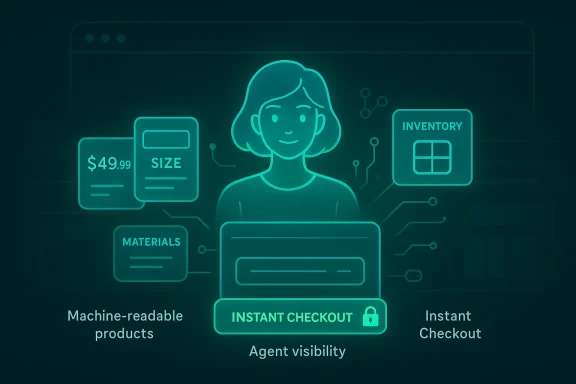
The most immediate benefit is reach. If shoppers are asking AI assistants for the best option under a budget, with specific materials, use cases, or sizes, then the products that are readable to the model have a chance to be recommended. That matters because these are not casual browsers; they are often high-intent buyers who have already articulated a need.Shopify’s own guidance says products are automatically discoverable by AI channels through Shopify Catalog and other methods, and that structured product data is parsed by AI systems to understand title, description, options, images, price, and availability. In other words, a small business does not need to become a data platform, but it does need to become machine legible. (help.shopify.com)
The second benefit is channel expansion without the usual integration sprawl. Historically, every new sales channel required new feeds, new listings, or new workflows. Agentic storefronts promise a more centralized model: list once, syndicate widely, and maintain control in one admin view. (shopify.com)
Why this matters for lean teams
Small businesses often win on focus, not scale. Agentic commerce can amplify that advantage by letting a tiny brand show up in places that would otherwise be unreachable without a larger marketing and engineering budget.It also changes the economics of experimentation. Instead of building a large storefront-specific integration for each assistant, merchants can test visibility and conversion across channels more quickly. That makes the model especially attractive to niche brands with a strong product-market fit but limited operational headcount.
The caveat, of course, is that visibility is not guaranteed just because a store exists. The agent still has to trust the data, trust the policy language, and trust that the merchant can fulfill the promise. That is where the real work begins.
Conversion, Friction, and the Checkout Advantage
One of the strongest arguments for agentic commerce is checkout friction reduction. The standard ecommerce funnel still leaks badly, and cart abandonment remains one of the industry’s most frustrating realities. Shopify’s own article leans on that pain point by showing how a conversation can collapse discovery and checkout into a shorter, less interruptive flow.Stripe’s ACP announcement makes the mechanics clearer. It says the buyer’s payment credentials are not exposed to the merchant, and that a Shared Payment Token can be scoped to a merchant and cart total before the order is passed through the agentic flow. That is an important signal that agentic checkout is being engineered to preserve trust while reducing friction. (stripe.com)
OpenAI’s shopping research also reinforces the direction of travel. Its product-discovery flow can guide the shopper through clarifying questions, compare options using live information, and eventually hand off into Instant Checkout where available. That creates a continuum from research to transaction that feels much more native than the old tab-hopping model. (openai.com)
Friction removed, responsibility added
The upside is obvious: fewer steps can mean higher conversion. If a shopper already knows the need, the agent can compress the comparison and purchase process dramatically.But shorter checkout also means the merchant has less time to persuade. In an agentic environment, the product data, reputation signals, and policy clarity must carry more of the weight. That makes information quality not just a merchandising issue, but a revenue issue.
It also means checkout design is no longer purely visual. The experience has to be structured so agents can negotiate, confirm, and complete the order without confusion. That is a very different discipline from traditional UX design.
How to Make Your Store Machine-Readable
This is the part most merchants will actually need to do. The first step is to audit and enrich structured product data. Titles, materials, dimensions, categories, variants, availability, and pricing need to live in standard fields that machines can parse, not hidden in marketing copy or front-end behavior. Shopify’s help documentation explicitly says its catalog structures product data so agents can parse title, description, options, images, price, availability, and other attributes. (help.shopify.com)The second step is to clean up your metadata and grouping logic. Shopify notes that Catalog Mapping is especially useful for stores with custom fields, metafields, metaobjects, tag prefixes, or title delimiters. That means many merchants already have the data they need; it just has to be mapped in a way the system can understand.
The third step is to stop thinking like a copywriter and start thinking like a classifier. AI agents need factual specificity. A vague description can hurt discoverability; a precise one can improve relevance, especially when a buyer query is highly constrained.
Practical cleanup checklist
Here are the basics most merchants should review first:- Make product titles specific and descriptive.
- Ensure variants are grouped correctly.
- Put materials, sizing, and use case into structured fields.
- Add schema markup and feed data wherever applicable.
- Avoid burying important facts in images or JavaScript-only content.
- Include legal, shipping, and return details in plain language.
- Verify that inventory and price are synchronized across channels.
Brand Presence, Trust, and Policy Clarity
Agents do not just consume product data; they also read policy data. Shopify says AI channels can use product data plus other methods such as web crawling, indexing, and product feeds. Its help pages also note that orders from agentic storefronts retain full ownership of the customer relationship and post-purchase experience. (help.shopify.com)That means FAQs, shipping policies, return terms, and post-purchase support pages become part of your sales engine. If a shopper tells an agent to buy only from brands with free returns, the model needs a clear answer, not a buried footer. In agentic commerce, ambiguous policy language is a competitive disadvantage.
The trust layer extends into data handling, too. Stripe says ACP enables merchants to retain control over fulfillment and existing systems, while OpenAI says shopping research relies on publicly available retail sites and transparent, cited sourcing. Those choices suggest that platform builders understand trust as a prerequisite, not a bonus feature. (stripe.com)
Why trust becomes a ranking factor
In a human-driven funnel, trust can be conveyed through branding, design, and social proof. In an agent-driven funnel, trust is inferred from structured policies, stable inventory, and machine-readable credibility signals.That means brands should audit whether their most important policies are actually visible to crawlers and agents. If the information exists only inside accordion menus, image text, or inaccessible scripts, the model may not use it effectively.
The smarter approach is to publish key policy content clearly, consistently, and in plain language. The less interpretation an agent needs to do, the better the chance it will choose you.
The Competitive Landscape
The competitive battle is no longer simply between ecommerce platforms. It is between ecosystems that can control discovery, checkout, and transaction standards. OpenAI wants shopping to happen inside ChatGPT; Stripe wants ACP to be the transaction standard; Shopify wants to be the merchant infrastructure layer that feeds multiple AI channels; Google and Microsoft want their assistants to be part of the buying path. (stripe.com)That creates a messy but familiar platform dynamic. Whoever owns the user attention layer has leverage, but whoever owns the merchant infrastructure layer can dictate standards and preserve the economics of the sale. Agentic commerce is likely to be a negotiation between those two forces, not a clean takeover by one winner.
The importance of interoperability cannot be overstated. Shopify says UCP is built for interoperability, and Stripe says ACP is open so businesses not processing with Stripe can still adopt it with existing providers. That openness is not just altruism; it is a response to the reality that no merchant wants to rebuild checkout for every assistant. (shopify.com)
What rivals must solve
Each major player has a different challenge.- OpenAI must keep the shopping experience useful without becoming too gatekeeper-like.
- Google must turn discovery into commerce without alienating merchants.
- Microsoft must make Copilot commerce feel native rather than bolted on.
- Shopify must prove that merchant control and broad distribution can coexist.
- Stripe must show that a new protocol can work across many payment providers.
- Merchants must decide how much control they are willing to trade for reach.
Strengths and Opportunities
The strongest thing about agentic commerce is that it finally matches how people increasingly shop: by describing intent, not by manually navigating every step. Shopify’s infrastructure push, Stripe’s protocol work, and OpenAI’s shopping flows all point in the same direction, which makes the market feel more real than speculative. The biggest opportunity is not just incremental conversion; it is entirely new demand capture from shoppers who never reach a classic product page. (shopify.com)- Broader reach across AI channels without rebuilding every integration.
- Higher-intent discovery from shoppers already expressing specific needs.
- Cleaner checkout flows that reduce abandonment and tab fatigue.
- Better attribution when orders flow back into merchant admin systems.
- Merchant control over fulfillment, branding, and customer relationships.
- Standards-based interoperability that can lower integration complexity.
- More accessible scale for small teams with limited engineering resources.
Risks and Concerns
The biggest risk is assuming that agentic commerce is automatically merchant-friendly. In reality, the systems that mediate discovery may become powerful gatekeepers, and the merchant may have less influence over how products are ranked than they expect. There is also a very real risk that bad data, incomplete policies, or poor catalog hygiene will make a brand effectively invisible to agents even if the product is competitive. (help.shopify.com)- Platform dependency if too much discovery flows through a few AI assistants.
- Data quality failures that suppress visibility or distort product selection.
- Policy ambiguity that prevents agents from confidently recommending a store.
- Checkout fragmentation if multiple protocols and channels diverge.
- Customer-data loss when platforms limit what is shared back to merchants.
- Fraud and trust concerns as autonomous purchasing becomes normal.
- Uneven channel maturity because some storefronts are still in early access.
Looking Ahead
The near future of agentic commerce will probably look less like a single launch and more like a gradual normalization of AI-mediated buying. Expect more merchant tooling, more protocol refinement, and more examples of agents completing actions that used to require a browser and a checkout funnel. The systems that survive will be the ones that make trust, inventory, identity, and fulfillment work together without forcing every merchant to become a software company. (shopify.com)Expect the next phase to revolve around practical questions rather than hype. Which channels convert best? Which data fields matter most? How much attribution do merchants really get? Which products are best suited to agentic purchase flows? Those answers will probably vary by category, geography, and price point, which means the winners will be the merchants that test methodically rather than assuming one universal playbook.
- More early-access rollouts from major AI platforms.
- Better catalog mapping and feed tooling for merchants.
- Wider adoption of open commerce protocols.
- Stronger emphasis on policy clarity and structured data.
- More consumer comfort with agent-led shopping for routine purchases.
Source: Shopify Agentic Commerce: Benefits & How To Get Started (2026) - Shopify Indonesia
Last edited:
