

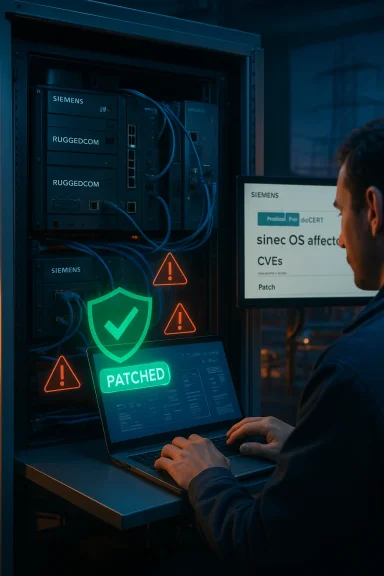
Siemens has confirmed that multiple products running SINEC OS versions earlier than 3.3 include third‑party components with dozens of security flaws — a broad, high‑impact update that requires immediate attention from operators of RUGGEDCOM and SCALANCE devices, and from any team responsible for OT/industrial networks that touch these devices.
Siemens ProductCERT published advisory SSA‑089022 on 28 January 2026 describing “Multiple Vulnerabilities in Third‑Party Components in SINEC OS before V3.3.” The advisory names specific industrial networking SKUs — including RUGGEDCOM and many SCALANCE variants — and lists an extensive set of CVE identifiers spanning memory corruption, input‑validation, certificate validation, path traversal, authentication bypass, and other critical classes of bugs. Siemens’ recommendation is straightforward: update affected devices to the vendor’s fixed versions as soon as practical.
CISA republished the vendor advisory to increase visibility for U.S. operators and reiterated standard ICS guidance: minimize network exposure, isolate control networks, and apply Siemens’ operational guidelines for industrial security where practical. CISA’s republishing confirms the advisory’s importance for critical‑infrastructure sectors such as energy, transportation, water/wastewater, and critical manufacturing.
Why this matters: the affected devices are deployed at the industrial edge and often serve as management, routing, and security platforms in operational networks. Weaknesses in those stacks — especially when tied to third‑party libraries — cr local and remote compromise, and in the worst cases can lead to data disclosure, denial‑of‑service, or code execution that impacts production.
Source: CISA Siemens SINEC OS | CISA
 Background / Overview
Siemens ProductCERT published advisory SSA‑089022 on 28 January 2026 describing “Multiple Vulnerabilities in Third‑Party Components in SINEC OS before V3.3.” The advisory names specific industrial networking SKUs — including RUGGEDCOM and many SCALANCE variants — and lists an extensive set of CVE identifiers spanning memory corruption, input‑validation, certificate validation, path traversal, authentication bypass, and other critical classes of bugs. Siemens’ recommendation is straightforward: update affected devices to the vendor’s fixed versions as soon as practical.CISA republished the vendor advisory to increase visibility for U.S. operators and reiterated standard ICS guidance: minimize network exposure, isolate control networks, and apply Siemens’ operational guidelines for industrial security where practical. CISA’s republishing confirms the advisory’s importance for critical‑infrastructure sectors such as energy, transportation, water/wastewater, and critical manufacturing.
Why this matters: the affected devices are deployed at the industrial edge and often serve as management, routing, and security platforms in operational networks. Weaknesses in those stacks — especially when tied to third‑party libraries — cr local and remote compromise, and in the worst cases can lead to data disclosure, denial‑of‑service, or code execution that impacts production.
What Siemens said (the core findings)
Affected product families and version boundary
- Siemens identified SINEC OS before V3.3 as the common root cause: third‑party components bundled with those versions contain the vulnerabilities.
- The advisory enumerates many SKUs across the RUGGEDCOM and SCALANCE product ranges (for example, RUGGEDCOM RST2428P and multiple SCALANCE XCM/XRM/XCH/XRH variants), and states that the manufacturer hirmware/OS images that remove or mitigate the vulnerable components. The advisory text provides the specific affected part numbers and the version predicate “< 3.3” for SINEC OS.
Nature of the vulnerabilities
Siemens’ CSAF advisory and associated lists map the problems to a wide variety of software weaknesses, including:- Memory corruption (out‑of‑bounds read/write, use‑after‑free, double free)
- Input validation flaws (path traversal, command injection primitives, improper comparison)
- Authentication/authorization gaps (missing authentication for critical functions, improper access control)
- Cryptographic/credential issues (improper certificate validation, exposure of sensitive information)
- Resource and logic issues (uncontrolled resource consumption, poor allocation limits)
Risk evaluation — what operators should assume
Who is at risk
- Operators of the listed RUGGEDCOM and SCALANCE SKUs3.3 are directly in scope. These devices are commonly installed in substations, industrial sites, rail/transportation nodes, and remote infrastructure where they perform routing, aggregation, and management tasks.
- Any environment where these devices are reachable from an attacker (internet‑facing, reachable through a VPN, or reachable from a contaminated business network) carries elevated risk. CISA reiterates minimizing network exposure as a primary mitigation.
Likely impacts
- Successful exploit chains could lead to information disclosure, temporary or sustained denial‑of‑service, local or remote code execution, or unauthorized file writes/read, depending on which CVE is chained and the deployment configuration.
- Several CVEs listed are classic memory corruption and input validation problems; those can be exp execution in contexts where a vulnerable component is exposed to attacker‑controlled input.
- Some issues may require local authenticated access; others may be triggered remotely if administrative interfaces are reachable. Treat each CVE individually during triage.
Exploitability and public evidence
- At the time of Siemens’ publication, the advisory focuses on vendor mitigations and does not assert widespread public exploitation for the entire set of CVEs. However, the presence of many medium‑to‑critical CVEs in common third‑party components means targeted attackers can craft exploit chains where prerequisites are met.
- Operators should treat the advisory as actionable. Waiting for proof‑of‑concept (PoC) exploits is a poor risk posture when ICS assets and public‑facing management endpoints are involved.
Immediate actions: a practical, prioritized checklNEC OS devices or operate networks where affected SKUs are present, take the following steps immediately.
- Inventory
- Identify every RUGGEDCOM and SCALANCE device on your network and capture the exact model and SINEC OS version string. An accurate inventory is mandatory before any remediation.
- Patch where possible (highest priority)
- Acquire the vendor fixed images for the specific SKUs and validate vendor checksums/signatures before deployment. Siemens’ advisory explicitly recommends updating to the latest versions that contain the third‑party fixes.
- If you cannot patch immediately, apply compensating controls
- Isolate devices behind OT firewalls.
- Restrict management access to a narrow set of engineering jump hosts using allowlists and strong authentication.
- Block management interfaces (web, SSH, SNMP, etc.) from non‑trusted networks.
- Disable unused services or interfaces on the devices.
- Tighten authentication and local controls
- Rotate credentials and remove default or shared accounts.
- Enforce least privilege for any accounts that can log into the devices locally.
- Monitoring and detection
- Increase logging and SIEM correlation fofile writes or changes to configuration directories.
- Repeated connection attempts or malformed requests to device management ports.
- Abnormal CPU/memory spikes indicative of exploitation or DoS attempts.
- Test before widescale rollout
- Use a staged approach: pilot → limited production → full rollout.
- Validate functional behavior and interoperability after upgrading firmware/OS images.
Technical guidance for patch management and rollout
Pre‑upgrade validation
- Obtain the exact remediation notes and fixed firmware list from Siemens ProductCERT. Verify the cryptographic hash of the downloaded image against the vendor‑provided value before installation.
- Recreate or snapshot device configuration where possible (backup configs) to enable an expedient rollback if needed.
Staged deployment
- Lab/staging deploy — mirror production network segmentation and management tools.
- Pilot on a single site with non‑critical traffic.
- Verify integration with supervisory and monitoring tools: check SNMP traps, syslog forwarding, and any NMS interactions.
- Sindows, especially for devices in production and safety‑critical networks.
- Record and audit each upgrade step and test post‑upgrade baseline performance.
Rollback planning
- Ensure you have a tested rollback plan and a backup of the pre‑upgrade configuration. Some OS/firmware updates are irreversible without vendor intervention; confirm the vendor’s rollback path before starting.
Detection and incident readiness
Even after updating, operators should prepare for detection and response:- Create analytic signatures for suspicious management‑plane operations (e.g., file export/import, unexpected reboot commands).
- Capture baseline telemetry: normal CPU usage, typical management session patterns, and expected traffic volumes. Deviations often point to ongoing exploitation attempts.
- Prepare forensic playbooks: collect volatile memory images, relevant device logs, and backups of configuration files when you detect anomalous behavior.
- If you suspect compromise, follow internal IR workflows and consider reporting to national authorities where appropriate (CISA in the U.S., CERTs elsewhere). CISA’s advisory explicitly encourages reporting suspected malicious activity for tracking and correlation.
The wider picture: why third‑party component management matters
This advisory is another illustration of a persistent supply‑chain problem in embedded and industrial software: vendors integrate third‑party libraries and components and — over time — those components may accumulate unpatched upstream vulnerabilities. The result:- Devices remain exploitable long after upstream fixes are released, if the vendor does not integrate the fixes into new firmware.
- Operators must therefore adopt a component awareness posture: record and track what third‑party components exist on devices, and follow upstream advisories proactively. Multiple independent security trackers and regional CERTs highlighted the same SSA‑089022 content, confirming the advisory’s reach and the need for vigilance.
Strengths and limits of Siemens’ advisory and the public response
Notable strengths
- Comprehensive disclosure: Siemens published a CSAF advisory listing affected SKUs and CVE identifiers, which enables operators to triage and cross‑check.
- Vendor remediation: the advisory states that Siemens has released update images for the affected products and recommends operators update to the latest versions.
- **Coordination with nationalepublished the advisory to increase visibility in the U.S., which is useful for operators who do not subscribe to vendor ProductCERT services.
Gaps and riskScope of exposure varies by deployment:** not all vulnerabilities have the same exploit prerequisites; some require local authentication or pre‑existing access. Operators must not assume full‑remote exploitation is possible for every CVE; conversely, they must not assume safety simply because a device is behind a corporate firewall without segmentation.
- Potential update complexity: patching embedded devices in production OT environments requires careful validation and rollback planning; in complex environments, the fixes may require additional configuration changes or updates to connected systems.
- Public exploit status may change quickly: while vendor advisories did not universally report active, public exploitation at time of publication, attackers often adapt; treat advisories as immediate operational priorities rather than academic items.
Recommended long‑term controls (beyond immediate patching)
- Formalize an OT patch‑management program that includes:
- Component inventory (including third‑party libraries).
- Regular reconciliation of vendor CSAF advisories and CVE feeds.
- A staging/test environment that mirrors production.
- Implement network micro‑segmentation for OT assetsovement by isolating management networks and enforcing strict ACLs.
- Consider dedicated jump hosts with multi‑factor authentication (MFA) for device management.
- Harden device configurations:
- Disable unused protocols and services.
- Enforce strong TLS and certificate management practices.
- Apply host‑level controls where available (limiting local accounts, SUDO restrictions, etc.).
- Continuous monitoring and threat hunting:
- Use SIEM and OT‑aware detection tools to find anomalous control‑plane behavior.
- Instrument syslog & telemetry collection from the edge devices to a central repository for correlation.
How to triage the long CVE list: a practical approach
The SSA‑089022 advisory contains a large number of CVE identifiers. Triage efficiently with this approach:- Map CVEs to devices: identify which CVEs affect which SKUs in your inventory.
- Prioritize CVEs that allow remote code execution or unauthenticated access; these are highest risk.
- For memory‑corruption CVEs, assume potential for exploitation if the vulnerable component is exposed to attacker‑controlled input.
- For CVEs requiring local authentication, evaluate the exposure of local accounts and consider immediate account hardening and monitoring.
- Cross‑referersions to determine whether the vendor patch resolves each CVE or whether compensating controls are needed until a fix is available.
Conclusion — a clear call to action
The SSA‑089022 advisory from Siemens is a reminder that industrial network devices are not just hardware bricks; they are software stacks composed of upstream libraries that must be tracked and updated. Operators of RUGGEDCOM and SCALANCE devices running SINEC OS prior to V3.3 should treat this advisory as actionable:- Immediately inventory affected SKUs and SINEC OS versions on your networks.
- Acquire and test vendor‑provided fixed images in a staged manner, validating func deployment.
- Apply compensating network and host controls where patching cannot be immediate, and increase monitoring for signs of exploitation.
Source: CISA Siemens SINEC OS | CISA
