

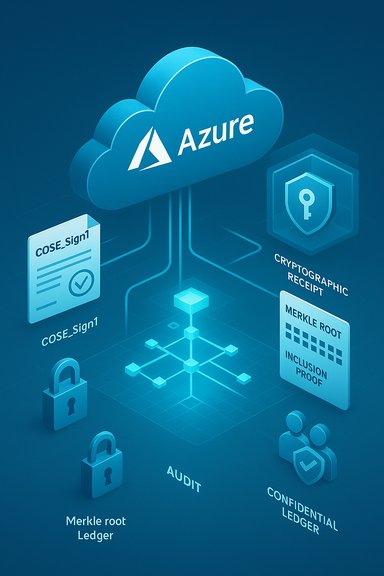
Microsoft’s preview of Signing Transparency for Azure is an important and practical step toward making software signing verifiably accountable across modern supply chains — it pairs traditional cryptographic signing with an append‑only transparency ledger and confidential hardware to provide auditable receipts, countersigned COSE envelopes, and Merkle‑based inclusion proofs that anyone can validate independently.
Software signing has long been viewed as a fundamental building block of trust: a signed binary, container image, or firmware artifact should prove who produced it and that it has not been altered since signing. In practice, however, signing is only as strong as the operational controls around the signing keys and the build systems that produce signed artifacts. Attackers have repeatedly demonstrated that once they gain access to a build system, signing key, or a developer workstation, they can produce legitimately signed malware or compromised releases that appear valid to downstream systems.
This is where the idea of transparency logs — cryptographically verifiable, append‑only ledgers of signing events — has proven its value. The concept originated in public certificate ecosystems and has been extended to software artifacts by projects such as Sigstore (Rekor) and by academic and industry specs. A transparency log makes it much harder for an adversary to surreptitiously introduce malicious signed artifacts without leaving cryptographic evidence in a public or auditable ledger.
Microsoft’s Signing Transparency announcement brings these ideas into Azure’s commercial tooling, combining three important elements:
What it helps prevent or detect:
That said, standards remain under active development and multi‑vendor tooling will determine how broadly and easily organizations can adopt the architecture. Enterprises should watch for interoperability tooling, client libraries, and audit ecosystems (mirrors, watchers, and monitors) that validate logs and detect equivocation.
The tradeoffs center on trust model choices (vendor‑operated log vs. multi‑operator ecosystem), the operational work to integrate receipts and verification into pipelines, and the residual dependence on TEEs and their attestation chains. Organizations should not equate Signing Transparency with full prevention of supply‑chain compromises; rather, they should view it as a high‑value detection, attribution, and compliance tool that materially reduces the likelihood of prolonged undetected compromise.
Adopting this approach will not replace the need for hardened build systems, strong key management, and vigilant operational controls. But when coupled with those practices, visibility through a verifiable transparency ledger materially improves assurance, deters misuse, and helps restore the core promise of software signing: that what is shipped is exactly what was intended by the signer.
Source: Microsoft Azure Microsoft Signing Transparency: Secure Software Supply Chains | Microsoft Azure Blog
 Background
Software signing has long been viewed as a fundamental building block of trust: a signed binary, container image, or firmware artifact should prove who produced it and that it has not been altered since signing. In practice, however, signing is only as strong as the operational controls around the signing keys and the build systems that produce signed artifacts. Attackers have repeatedly demonstrated that once they gain access to a build system, signing key, or a developer workstation, they can produce legitimately signed malware or compromised releases that appear valid to downstream systems.This is where the idea of transparency logs — cryptographically verifiable, append‑only ledgers of signing events — has proven its value. The concept originated in public certificate ecosystems and has been extended to software artifacts by projects such as Sigstore (Rekor) and by academic and industry specs. A transparency log makes it much harder for an adversary to surreptitiously introduce malicious signed artifacts without leaving cryptographic evidence in a public or auditable ledger.
Microsoft’s Signing Transparency announcement brings these ideas into Azure’s commercial tooling, combining three important elements:
- an append‑only ledger (Merkle‑tree based) to record signing events and provide inclusion/consistency proofs;
- countersigning of standard signing envelopes (COSE) so the log’s attestation is cryptographically bound to the original signature; and
- keys and service state protected inside a trusted execution environment (TEE) / confidential computing enclave (backed by Microsoft’s Confidential Ledger and the Confidential Consortium Framework).
Overview: what Signing Transparency does
Signing Transparency is presented as a cloud‑managed transparency service for software signing events. Its headline capabilities are:- Append‑only, tamper‑evident ledger: every recorded signature becomes a leaf in a Merkle‑tree ledger. Changing or deleting an entry breaks cryptographic proofs.
- COSE envelope countersigning: the service augments existing COSE signature envelopes (COSE_Sign1 and friends) with a countersignature and a pointer to a ledger inclusion proof.
- Receipts for audit and verification: on successful registration the service returns a cryptographic receipt that contains the Merkle root, an inclusion proof, and the service’s signature over those values.
- Key protection in confidential hardware: the signing service keys intended to sign the ledger root (and potentially countersign envelopes) are managed inside a confidential computing enclave so their use is attested and protected from operator access.
- Policy enforcement and identity checks: submissions to the log are subject to configured trust policies that validate the signer’s identity and other metadata before a countersignature and receipt are issued.
- Standards alignment: the workflow uses COSE and references the IETF SCITT architecture and related supply‑chain integrity work.
Why transparency is necessary for modern supply chains
Traditional code signing gives you two guarantees: (1) the artifact was signed with a private key corresponding to the stated identity, and (2) the artifact has not changed since signature. Those guarantees break down when operational or human failures occur.- Stolen or misused keys: if an attacker steals a signing key or hijacks a CI runner, they can produce validly signed malicious artifacts that downstream systems will accept unless the misuse is detected.
- Compromised build environments: compromised or misconfigured pipeline components can produce legitimate signatures for backdoored code.
- Opaque release flows: without a public, auditable record of signing events, there is no independent, third‑party confirmation that a particular release or update was created by the claimed entity at the claimed time.
How Signing Transparency actually works (practical flow)
- A developer, CI/CD pipeline, or signing service creates a COSE_Sign1 envelope around an artifact, per the COSE specification.
- The signed COSE envelope (the original signature + metadata) is submitted to the Signing Transparency service.
- The service validates the signature and the signer’s identity against its configured trust and registration policies.
- If validation succeeds, the service appends a registration entry (leaf) to its ledger; the ledger is implemented as an immutable Merkle tree.
- The service produces a countersignature on the COSE envelope (it does not replace the original signature — it augments it) and returns a receipt containing:
- the Merkle tree root at the time of inclusion,
- the inclusion path (Merkle inclusion proof), and
- the service signature over the receipt values.
- The application or pipeline stores the receipt alongside the artifact, publishes it with the release, or attaches it to distribution metadata.
- Any consumer, auditor, or automated verifier can independently verify that:
- the original COSE signature is cryptographically valid,
- the signing event is present in the transparency ledger (via the receipt inclusion proof), and
- the ledger root is self‑consistent and backed by the service’s confidentiality/attestation claims.
Technical building blocks at play
COSE and RFC 9052
COSE (CBOR Object Signing and Encryption) — including the COSE_Sign1 structure — is defined in IETF RFC 9052. It is a compact, binary signing/encryption envelope designed for constrained environments and modern signing needs.SCITT (Supply Chain Integrity, Transparency, and Trust)
SCITT is an IETF effort that defines architectures and interfaces for transparency services that register signed statements about artifacts. The draft specifies how COSE envelopes and ledger receipts interact in supply‑chain use cases.Merkle trees and transparency logs
Append‑only logs are typically implemented with a Merkle‑tree structure that enables small inclusion and consistency proofs. This is the same fundamental technique used in Certificate Transparency and in software transparency systems such as Rekor.Confidential computing, CCF, and Confidential Ledger
Microsoft’s Confidential Consortium Framework (CCF) and its Azure Confidential Ledger product are designed to run ledger and consensus services inside TEEs so service state and signing keys can be protected from operators. The Signing Transparency service is described as being backed by those confidential ledger primitives, providing an additional attestation layer for the validity of the log and the keys that sign receipts.Strengths: what Signing Transparency brings to enterprise security
- Tamper evidence at scale: by forcing logging of signing events and issuing cryptographic receipts, the service makes unauthorized changes and rogue signed artifacts auditable and provable.
- Independent verification: consumers need not trust the vendor or distribution channel alone; they can verify receipts locally and check ledger inclusion.
- Deterrence and accountability: recorded evidence deters insider misuse and provides a provable audit trail for investigations.
- Integration with familiar signing formats: using COSE and the SCITT model reduces friction for toolchains that already support those formats or can be adapted to them.
- Hardware‑backed integrity: keeping the ledger attestation keys in TEEs reduces the risk of operator or administrator compromise of the ledger‑signing keys.
- Extensible to firmware and hardware: the same architecture that records signed binaries scales to firmware updates and device attestation flows, enabling end‑to‑end supply‑chain transparency from manufacturing to deployment.
Risks, caveats and things that need scrutiny
No single service is a silver bullet. While Signing Transparency raises the bar, it introduces a set of operational, architectural, and threat‑model considerations enterprises must understand.- Centralization vs. decentralization: a single cloud‑managed transparency service bears availability and trust characteristics. Enterprises must decide whether to place unconditional trust in a vendor‑operated log, to mirror or audit it externally, or to run companion local logs. The value of transparency rises when multiple independent log operators exist and auditors cross‑check them.
- Trust in TEEs: confidential computing TEEs are powerful but not infallible. The security guarantee depends on the TEE vendor (CPU microcode, firmware, attestation services). TEEs minimize operator exposure but introduce a dependency on TEE attestation ecosystems.
- "Never leave the enclave" claims: statements that keys “can never leave” an enclave must be read cautiously. Enclave isolation is strong, but systems still depend on correct attestation, key generation, and implementation correctness. Operational misconfiguration or vulnerabilities in the TEE stack historically have produced real‑world escapes; absolute phrasing should be qualified.
- Metadata privacy and leakage: recording signing events, signer identities, and artifact hashes in a public or semi‑public ledger has privacy and commercial confidentiality implications. Organizations must plan which metadata to publish and which to keep private, and balance transparency with competitive or regulatory concerns.
- Equivocation and fork risk: an append‑only log must prevent equivocation (showing different versions of the log to different parties). Effective transparency models address this via witnesses, multiple logs, or cross‑checks; dependence on a single service increases the risk that a sophisticated attacker could attempt equivocation if there are no external monitors.
- Operational complexity and developer friction: integrating COSE envelopes, storing receipts, and modifying CI/CD pipelines imposes engineering work. Tooling and developer ergonomics will be decisive for adoption.
- Standards maturity and interoperability: SCITT and related drafts are advancing, but they are still evolving. Enterprises should expect changes and maintain flexibility to adapt tooling as standards firm up.
- Legal and forensic implications: signed receipts and logs will be used in audits and investigations — organizations must manage change control and retention to make receipt trails meaningful and admissible.
Threats the service reduces — and what it won’t stop
Signing Transparency materially reduces several classes of attack, but it is not a panacea.What it helps prevent or detect:
- Long‑running, stealthy distribution of malicious signed releases (because those signatures would appear in the ledger).
- Silent key compromise where attackers produce signed artifacts but do not log them (non‑logged signatures are detectable if consumers require receipts).
- Supply‑chain tampering that relies on replacing releases in distribution channels without corresponding signing events.
- If an adversary compromises your CI and also logs the malicious signature to the transparency ledger, the malicious release will be visible (detected later) but will still be distributed as signed. Transparency does not block such releases — it makes them discoverable and traceable.
- Real‑time prevention depends on consumers requiring and validating receipts, and on operational policies that gate deployment on log verification.
- Compromise of a TEE vendor or fundamental weaknesses in confidentiality hardware could undermine the attestation assumptions; transparency reduces trust in the artifact’s origin only if the ledger operator’s attestation itself is trustworthy.
Adoption checklist for organizations
Adopting Signing Transparency successfully demands coordination across teams. Below is a practical checklist to drive implementation.- Inventory signing workflows and artifacts:
- List every artifact type (binaries, containers, firmware, drivers) and the signing tools used.
- Evaluate and adapt signing format:
- Plan how to emit COSE_Sign1 envelopes from your signing pipeline or wrap existing signatures for logging.
- Integrate ledger submission and store receipts:
- Modify CI/CD to submit signed envelopes to the transparency service and persist returned receipts with releases.
- Enforce verification in deployment and runtime:
- Add automated verification gates that check receipts and inclusion proofs before accepting updates in production.
- Define privacy and metadata policies:
- Decide what metadata to expose in ledger entries and what to redact/hold privately.
- Plan monitoring and auditing:
- Build dashboards and anomaly detection for unexpected signing events (new keys, unusual frequency, odd timestamps).
- Run external audits:
- Schedule independent audits and cross‑checks against mirrored logs or third‑party monitors.
- Update incident response playbooks:
- Add steps for analyzing ledger receipts during a signing‑related incident and for identifying affected deployments.
- Train developers and DevOps teams:
- Ensure engineers understand the new signing and verification steps and see how receipts should be stored and used.
- Maintain agility for standards evolution:
- Track SCITT and related IETF progress and plan for updates to tools as drafts become standards.
Recommendations for security teams and architects
- Treat Signing Transparency as an auditability and deterrence mechanism, not as a substitute for strong key management and hardened build infrastructure.
- Require receipts in high‑security workflows: for critical systems, gate deployment on successful ledger verification and enforce policy that refuses artifacts without receipts.
- Use multi‑log verification where possible: mirror or verify receipts against multiple independent logs (or require multiple independent attestations) to reduce equivocation risk.
- Combine transparency with provenance and SBOMs: artifact provenance (build recipes, SBOMs, attestation statements) plus transparency logs yields stronger assurance than signatures alone.
- Plan for retention: store receipts alongside release artifacts and make retention policies consistent with compliance requirements and incident investigation needs.
- Validate TEE attestation: incorporate TEE attestation checks into your verification pipeline so consumers verify not only the receipt but the ledger operator’s attestation chain.
- Engage legal and privacy teams: formalize policies around what ledger metadata is published and how to manage sensitive identifiers.
Standards and ecosystem context
Signing Transparency is not inventing a new cryptographic primitive; it integrates established standards and architecture work that the industry is already embracing:- COSE (COSE_Sign1) provides a compact envelope for signatures and is standardized in RFC 9052.
- The IETF’s SCITT work describes transparency services and how signed statements should be registered and consumed in supply‑chain ecosystems.
- Public transparency logs (the Certificate Transparency ecosystem and projects like Rekor) are proven patterns for making signing events auditable and visible.
That said, standards remain under active development and multi‑vendor tooling will determine how broadly and easily organizations can adopt the architecture. Enterprises should watch for interoperability tooling, client libraries, and audit ecosystems (mirrors, watchers, and monitors) that validate logs and detect equivocation.
Final analysis: who benefits, and how to weigh the tradeoffs
Signing Transparency is a pragmatic, standards‑aligned move that addresses a clear gap in supply‑chain security: the lack of verifiable, public records of signing events. For organizations that:- operate large, complex CI/CD pipelines,
- distribute critical software across many customers and devices, or
- rely on third‑party vendors for software updates,
The tradeoffs center on trust model choices (vendor‑operated log vs. multi‑operator ecosystem), the operational work to integrate receipts and verification into pipelines, and the residual dependence on TEEs and their attestation chains. Organizations should not equate Signing Transparency with full prevention of supply‑chain compromises; rather, they should view it as a high‑value detection, attribution, and compliance tool that materially reduces the likelihood of prolonged undetected compromise.
Conclusion
Signing Transparency adds a critical, practical layer to software supply‑chain defense by making signing events provably visible and auditable. It leverages standardized signing envelopes (COSE), verifiable Merkle‑tree receipts, and confidential ledger technology to provide a notary‑style service that organizations can use to enforce accountability across releases and firmware updates. For enterprises building secure release pipelines, the service is worth serious evaluation: it strengthens detection and forensics, helps meet compliance needs, and — importantly — raises the operational cost for attackers seeking to hide signed malicious builds.Adopting this approach will not replace the need for hardened build systems, strong key management, and vigilant operational controls. But when coupled with those practices, visibility through a verifiable transparency ledger materially improves assurance, deters misuse, and helps restore the core promise of software signing: that what is shipped is exactly what was intended by the signer.
Source: Microsoft Azure Microsoft Signing Transparency: Secure Software Supply Chains | Microsoft Azure Blog
