

Simform’s recognition as a Microsoft Fabric Featured Partner is more than a PR badge — it’s a practical signpost in the ongoing consolidation of enterprise data architecture toward unified, AI-ready platforms, and it underlines a wider partner-market shift where systems integrators combine Azure engineering scale with data-platform delivery assets to accelerate production-grade Fabric deployments. ps://www.prnewswire.com/news-releases/simform-recognized-as-a-microsoft-fabric-featured-partner-reinforcing-azure-data--ai-leadership-302710400.html)
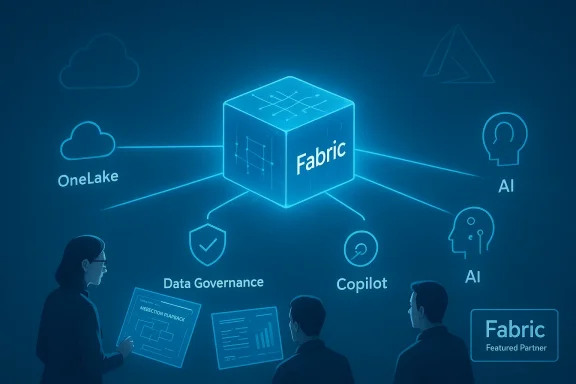
Microsoft Fabric launched as Microsoft’s intent to unify the sprawling Azure analytics and BI stack — bringing data engineering, integration, governance, analytics, and Power BI-centric consumption into a single SaaS-first platform. For enterprises chasing large-scale AI use cases, Fabric promises a single operating model (OneLake, Fabric workloads, and integrations with Azure AI and Copilot) that reduces data duplication and simplifies governance. Microsoft publishes a directory of partners that have demonstrable Fabric delivery experience under the “Fabric Featured Partner” rubric.
Simform’s recent announcement positions the company as one of the partners Microsoft highlights for Fabric projects, and ties the recognition back to its broader Azure credentials — including Solutions Partner designations across Digital & App Innovation, Data & AI, Infrastructure, and Security, and the Microsoft Azure Expert Managed Services Provider (AEMSP) audit-based designation it says it now holds. Those corporate claims are already visible in Simform’s own communications and the PR distribution that accompanied the partner recognition.
This article pulls together the public claims from Simform’s announcement, Microsoft’s partner program signals, and independent context about Fabric adoption patterns. It verifies the most material technical claims where public evidence exists, highlights what the recognition practically means for buyers, and outlines key operational and risk considerations for organizations evaluating Fabric adoption with partner help.
What this means for buyers:
That said, the market is crowded. Many partners are publishing Fabric credentials and promoting similar accelerators. Microsoft’s partner program is a meaningful procurement signal, but buyers should treat it as one of several inputs — along with customer references, technical trials, and independent cost modeling — when selecting a delivery partner. Independent partner announcements (Datavail, Smartbridge, Xoriant) show similar behavior across the market: partners are racing to capture Fabric engagements, which increases choice but also increases variability in delivery capabilities and commercial models.
For buyers, the imperative is clear: treat partner badges as a starting point, not an endpoint. Verify production references, run hands-on trials with candidate partners’ accelerators, demand transparency in cost and governance models, and insist on transferability of assets and knowledge. When those checks are in place, partnering with a firm that has both AEMSP-grade operations and Fabric delivery experience can materially shorten time to production and reduce operational friction for AI initiatives.
Simform’s announcement fits neatly into the larger pattern of Azure-focused partners scaling their data-and-AI practices around Microsoft Fabric; for pragmatic buyers, that trend is an invitation to modernize thoughtfully — balancing the efficiencies of a unified platform against the operational, security, and cost tradeoffs that come with centralizing enterprise data on a single SaaS-first stack.
Source: PRUnderground Simform Recognized as a Microsoft Fabric Featured Partner, Reinforcing Azure Data & AI Leadership | PRUnderground
 Background / Overview
Microsoft Fabric launched as Microsoft’s intent to unify the sprawling Azure analytics and BI stack — bringing data engineering, integration, governance, analytics, and Power BI-centric consumption into a single SaaS-first platform. For enterprises chasing large-scale AI use cases, Fabric promises a single operating model (OneLake, Fabric workloads, and integrations with Azure AI and Copilot) that reduces data duplication and simplifies governance. Microsoft publishes a directory of partners that have demonstrable Fabric delivery experience under the “Fabric Featured Partner” rubric.Simform’s recent announcement positions the company as one of the partners Microsoft highlights for Fabric projects, and ties the recognition back to its broader Azure credentials — including Solutions Partner designations across Digital & App Innovation, Data & AI, Infrastructure, and Security, and the Microsoft Azure Expert Managed Services Provider (AEMSP) audit-based designation it says it now holds. Those corporate claims are already visible in Simform’s own communications and the PR distribution that accompanied the partner recognition.
This article pulls together the public claims from Simform’s announcement, Microsoft’s partner program signals, and independent context about Fabric adoption patterns. It verifies the most material technical claims where public evidence exists, highlights what the recognition practically means for buyers, and outlines key operational and risk considerations for organizations evaluating Fabric adoption with partner help.
Why the Fabric Featured Partner label matters
What the label signals to buyers
- Delivery experience: The Fabric Featured Partner listing is Microsoft’s way of flagging partners with recent, demonstrable Fabric work. That matters to procurement teams who want evidence a partner has moved customers beyond pilots.
- Access and alignment: Featured partners usually gain higher-touch engagement with Microsoft product and partner teams (early roadmap briefings, technical resources, and co-innovation opportunities), which can shorten time-to-value on complex migrations. Simform explicitly calls out those program advantages.
- Market signal, not a guarantee: The label is a helpful procurement signal — but it is not a substitute for project-level due diligence. Independent verification of case studies, references, and delivery assets remains essential.
How this complements Azure Expert MSP standing
Simform’s announcement links the Fabric recognition to its AEMSP status — a separate, audit-based validation for managed services excellence on Azure. Microsoft’s AEMSP program is intentionally exclusive; public reporting by partners and press releases commonly state the cohort is small (roughly “around 100” globally), though the exact headcount can fluctuate with audits and renewals. Simform’s messaging (and its related press release) places the company in that elite group and uses AEMSP to underline operational maturity for running production workloads at scale.What Simform says it delivers on Fabric — and what we verified
Simform frames its Fabric work around four common enterprise needs:- Modernization of legacy data warehouses and reporting.
- Establishment of governed, unified data foundations.
- Enablement of business-ready self-service analytics.
- Preparation of data platforms for AI and Copilot-driven use cases.
How the broader Fabric partner ecosystem looks (context for procurement)
Microsoft’s Fabric partner ecosystem has grown rapidly since Fabric’s launch, with consultants, managed services firms, and ISVs carving out roles as featured partners, workload-specific specialists (Real-Time Intelligence, Fabric Databases), and marketplace consulting listings. Independent partners such as Datavail, Smartbridge, Xoriant, and others have published Fabric partner announcements, showing peers making similar claims and building Fabric-focused offerings. This is a real ecosystem shift — but it also increases the variability in delivery quality and specialization across vendors.What this means for buyers:
- Expect many vendors to wear the “Fabric” label; look for concrete artifacts: architecture diagrams, migration playbooks, governance templates, rehearsal/validation plans, and references for production-scale workloads.
- Look beyond badges to evidence of sustained Azure/AEMSP-level operational practices (runbooks, SRE/DevOps approach, incident metrics, and security posture).
Technical verification: claims we verified and claims that need caution
Verifiable claims
- Simform’s announcement that it has been recognized as a Microsoft Fabric Featured Partner appears in distributed press channels and Simform’s corporate blog. Those public statements are consistent across Simform-owned channels and PR syndication.
- Microsoft maintains a partners page and partner directories referring to “Fabric Featured Partners” and separate workload directories — confirming the program and its use as a discoverability mechanism for customers. This is a direct Microsoft signal that the Fabric Featured Partner program exists.
- AEMSP is a distinct Microsoft audit-based designation for managed services providers; multiple partner announcements and Microsoft-facing materials describe the program as exclusive and audit-driven. Partners commonly state the group is numerically small (commonly “~100” partners). That figure is reported by partners but can vary slightly over time as certifications are issued or renewed.
Claims that require caution or verification
- Simform lists specific outcome metrics in its marketing (for example, reductions in integration time or operational efficiency gains quoted for discrete customer stories). These are vendor-reported and not independently audited in public sources; they should be validated with customer references and contractually scoped SLAs before being relied upon for procurement decisions.
- The exact number “105” used to describe how many companies hold AEMSP is a moving target. Several partner press releases reference “around 100” or “fewer than 105” partners; buyers should treat headcount statements as illustrative rather than absolutes, and confirm the current roster through Microsoft partner programs if that is material to procurement.
Practical strengths Simform brings (as claimed) — and how they translate for buyers
- Engineering depth and Azure certifications: Simform reports a bench of 340+ Azure‑certified engineers and more than 50 Azure transformation engagements. If accurate, that level of bench depth helps with staffing large migration and managed-services efforts. Buyers should verify the composition (data engineers, security, SRE) and the applied experience on Fabric-specific workloads.
- AEMSP-backed operations: AEMSP status (if current) implies independent audit coverage of Simform’s run-state processes — helpful proof that the partner can operate production-grade Azure services at scale. Confirm the scope of the AEMSP audit (regional scope, recertification dates, and any limitations).
- Repeatable delivery assets: Reference architectures, migration playbooks, and accelerators (TrueMorph, governance guardrails) — when packaged and made repeatable — lower migration risk and cost. Request a hands-on demo of these assets and, importantly, ask for templated artifacts to review as part of technical evaluation.
Risks, limitations, and vendor-due-diligence checklist
Badges indicate capability and alignment, not automatic project success. Below are the major risk areas and questions buyers should ask when evaluating Simform or any Fabric partner.Key risks
- Vendor lock-in and platform economics: Moving a large data estate to Fabric centralizes data and tooling on Microsoft’s SaaS model. That reduces operational fragmentation but concentrates costs and platform dependency. Analyze TCO — including Fabric consumption, storage, outbound data egress, and Azure AI usage at expected scale.
- Governance and data residency: Fabric’s OneLake centralization makes governance critical. Enterprises in regulated industries must verify capabilities for data residency, lineage, RBAC, and legal hold across Fabric workloads.
- Operational readiness for AI: “AI‑ready” platforms require not just data ingestion but model governance, feature stores, observability, and MLOps. Verify partner experience across the entire ML lifecycle, not just data consolidation.
- Security posture across integrations: Fabric projects often involve connecting multiple sources and SaaS applications. Confirm identity and access controls (Entra ID/conditional access), encryption-at-rest/in-transit, and secure service-to-service patterns.
- Performance and cost at scale: Real-time intelligence and high-concurrency BI workloads can expose scaling and cost gaps. Ask for performance benchmarks and cost projections for anticipated query patterns.
Due-diligence checklist (what to request)
- Production references for Fabric migrations (include contactable customer references and a brief summary of project scope, timeline, and post-go-live outcomes).
- A walkthrough of the partner’s migration playbook and governance templates (request editable artifacts).
- Demonstration of runbooks, incident metrics, and SRE processes supporting AEMSP claims.
- A sample cost model for Fabric (consumption + storage + AI calls) using your dataset size and query patterns.
- Security architecture review: Entra ID, network/topology (private endpoints), encryption keys, and audit logs.
- Example ML/MLOps pipeline on Fabric demonstrating model retraining, lineage, and deployment controls.
- Contractual SLAs and remediation commitments tied to production goals.
A practical adoption roadmap for enterprises (recommended sequence)
- Assessment and inventory: Map current data sources, ETL/ELT pipelines, reporting artifacts, and data model dependencies.
- Target state architecture: Define the OneLake layout, Fabric workload choices (Data Engineering, Data Factory replacements, Real-Time Intelligence), and BI consumption patterns.
- Governance-first pilot: Run a controlled, governance-first pilot that deploys cataloging, lineage, RBAC, and data contracts for 1–2 business domains.
- Lift-and-optimize: Migrate EDW and reporting to a phased lakehouse model, refactor pipelines using the partner’s migration playbook.
- Scale and operationalize: Move to multi‑workload production (real-time, analytics, data science), establish SRE cadence, and finalize cost-optimization patterns.
- AI enablement: Add model-serving patterns, Copilot integrations, and experiment with agentic use cases only after governance, lineage, and ML lifecycle controls are proven.
How to judge partner accelerators and claimed metrics
Partners often publish technical accelerators (ETL converters, template governance guardrails, automated migration utilities). These can be genuine multipliers — but assess them with these criteria:- Reproducibility: Does the accelerator work on a clean, representative dataset from your environment?
- Transparency: Are the transformations and code visible for inspection and tuning?
- Maintainability: Can internal teams take over the asset after project close, or is it tightly coupled to partner tooling?
- Licensing and IP: Understand who owns derivative artifacts and whether the partner charges ongoing run‑time or support fees.
- Security: Validate that accelerators do not embed secrets or centralized access that would create a single-point-of-compromise.
Vendor claims that need explicit validation before contracting
- Exact headcount and skill distribution of the “340+ Azure‑certified engineers” (ask for role breakdown: data engineers, cloud architects, security engineers).
- The current scope and recency of the AEMSP audit (request audit scope documents and recertification dates).
- Real-world cost and performance metrics from the logistics engagement referenced; ask for a contactable reference and raw performance traces if cost/efficiency is material.
Strategic recommendations for CIOs and data leaders
- Treat Fabric adoption as platform engineering, not a one-off migration. Invest in internal platform product management to own cost, governance, and user experience post-migration.
- Use partner accelerators to bootstrap delivery — but insist on knowledge transfer and transferable artifacts. Ensure accelerators are included as deliverables in the contract.
- Require staged acceptance gates: security, governance, performance, and cost validation before broad rollout.
- Benchmark Copilot/agentic scenarios separately: they rely on high-quality, curated data and established lineage to be safe and useful. Don’t assume Copilot “just works” after data consolidation; plan MLOps, hallucination mitigation, and red-team testing.
- Maintain a multi-cloud or hybrid contingency plan where legal/regulatory concerns (data residency or sovereignty) arise; centralization doesn’t eliminate the need for architectural flexibility.
The commercial and market angle: what this recognition means for Simform’s marketplace posture
Simform’s Fabric Featured Partner recognition, combined with AEMSP and multiple Solutions Partner designations, positions the company as a credible mid-market to enterprise partner for Azure data and AI programs. That positioning is attractive to organizations seeking a single vendor for both migration and ongoing managed operations — a typical buyer preference when the goal is to accelerate AI-driven business outcomes.That said, the market is crowded. Many partners are publishing Fabric credentials and promoting similar accelerators. Microsoft’s partner program is a meaningful procurement signal, but buyers should treat it as one of several inputs — along with customer references, technical trials, and independent cost modeling — when selecting a delivery partner. Independent partner announcements (Datavail, Smartbridge, Xoriant) show similar behavior across the market: partners are racing to capture Fabric engagements, which increases choice but also increases variability in delivery capabilities and commercial models.
Conclusion
Simform’s Microsoft Fabric Featured Partner recognition (and related Azure Expert MSP claims) reflect a deliberate business move: combine Azure operations credibility with Fabric-specific delivery assets to win enterprise migrations and AI-readiness projects. The recognition itself is meaningful — it denotes recent Fabric delivery experience and closer Microsoft engagement — but it is not a substitute for project-level diligence.For buyers, the imperative is clear: treat partner badges as a starting point, not an endpoint. Verify production references, run hands-on trials with candidate partners’ accelerators, demand transparency in cost and governance models, and insist on transferability of assets and knowledge. When those checks are in place, partnering with a firm that has both AEMSP-grade operations and Fabric delivery experience can materially shorten time to production and reduce operational friction for AI initiatives.
Simform’s announcement fits neatly into the larger pattern of Azure-focused partners scaling their data-and-AI practices around Microsoft Fabric; for pragmatic buyers, that trend is an invitation to modernize thoughtfully — balancing the efficiencies of a unified platform against the operational, security, and cost tradeoffs that come with centralizing enterprise data on a single SaaS-first stack.
Source: PRUnderground Simform Recognized as a Microsoft Fabric Featured Partner, Reinforcing Azure Data & AI Leadership | PRUnderground
