

SKS’s booth at KBIS 2026 framed the company’s next act: a deliberate pivot from a kitchen‑first luxury appliance marque into a whole‑home lifestyle brand built around what it calls “Technicurean” living — a design philosophy that marries culinary-grade performance with seamless, design‑led integration across the home. At the Orange County Convention Center this February, SKS (the rebranded Signature Kitchen Suite backed by LG Electronics) debuted a widened portfolio—including its first luxury laundry lineup—while pressing familiar advantages such as induction innovation, steam‑combi ovens, and AI‑assisted cooking into a narrative of precision living for designers and affluent homeowners. The product rollouts, culinary stage programming, and Innovation Hour spotlight positioned SKS as both a technology storyteller and a trade‑show showman.
SKS launched as Signature Kitchen Suite and has spent the better part of the last several years building a reputation for high‑end, built‑in appliances aimed at the luxury kitchen market. In 2025 LG simplified the brand identity to SKS and used KBIS, the industry’s flagship trade show, to relaunch the lineup with radical design concepts such as a hidden induction island and a cook‑zone‑free induction pro range. At KBIS 2026 the company continued that trajectory: press releases and the brand’s show materials emphasized a thematic shift from discrete appliance launches to curated lifestyle vignettes reflecting the Technicurean homeowner — someone who values both culinary precision and integrated design. SKS presented live chef demos, immersive kitchen settings, and new category entries (notably, laundry) to make that case.
KBIS 2026 ran February 17–19 in Orlando, where KBIS programming (Innovation Hour, NEXTStage) and Best of KBIS awards continue to be kerbside indicators for what the industry prizes in product engineering and market impact. SKS used the event’s stages strategically: its Hidden Induction Island System was scheduled for Innovation Hour, and the company noted multiple Best of KBIS finalist nods for its new range and island concepts. The brand’s on‑floor storytelling was augmented by culinary demos hosted by SKS executive chef Nick Ritchie, intended to demonstrate the real‑world outputs of the engineering claims.
Verification and caveats:
Verification and caveats:
Verification and caveats:
Why live demos work:
Competitive realities to watch:
That said, a clear delineation between company claims and independently verified performance remains essential. Designers, specifiers, and builders should treat KBIS demonstrations as catalytic evidence and require lab data, warranty contracts, and a commissioning plan before locking SKS products into high‑value custom builds. The most valuable outcome from SKS’s KBIS program is not simply a press release; it is an invitation to test and verify these ambitious ideas in the real settings that matter to architects and homeowners. When the technical claims are validated in commissioned projects, SKS’s Technicurean thesis has the potential to reshape how luxury homes are specified — but until then, treat the KBIS spectacle as a starting point, not the final proof.
In summary: SKS used KBIS 2026 to expand its product horizon and brand narrative, introducing the first luxury laundry entries and reiterating bold kitchen innovations anchored by AI assistance and design integration. The marketing was compelling and consistent; the technology claims are plausible and exciting, but require independent testing and clear service commitments before they should be specified into major projects. For designers and builders, the prudent next steps are hands‑on tests, written performance data, and contractually explicit support terms — then evaluate whether SKS’s Technicurean promise yields repeatable results in the field.
Source: The Malaysian Reserve https://themalaysianreserve.com/202...g-with-precision-innovation-at-kbis-2026/amp/
 Background / Overview
SKS launched as Signature Kitchen Suite and has spent the better part of the last several years building a reputation for high‑end, built‑in appliances aimed at the luxury kitchen market. In 2025 LG simplified the brand identity to SKS and used KBIS, the industry’s flagship trade show, to relaunch the lineup with radical design concepts such as a hidden induction island and a cook‑zone‑free induction pro range. At KBIS 2026 the company continued that trajectory: press releases and the brand’s show materials emphasized a thematic shift from discrete appliance launches to curated lifestyle vignettes reflecting the Technicurean homeowner — someone who values both culinary precision and integrated design. SKS presented live chef demos, immersive kitchen settings, and new category entries (notably, laundry) to make that case.KBIS 2026 ran February 17–19 in Orlando, where KBIS programming (Innovation Hour, NEXTStage) and Best of KBIS awards continue to be kerbside indicators for what the industry prizes in product engineering and market impact. SKS used the event’s stages strategically: its Hidden Induction Island System was scheduled for Innovation Hour, and the company noted multiple Best of KBIS finalist nods for its new range and island concepts. The brand’s on‑floor storytelling was augmented by culinary demos hosted by SKS executive chef Nick Ritchie, intended to demonstrate the real‑world outputs of the engineering claims.
What SKS showed at KBIS 2026 — the product highlights
SKS staged a large, theatrical presence with multiple product threads running in parallel: kitchen re‑imagination, practical appliance upgrades, and a formal push into laundry. Key show items called out in SKS and PR materials included:- A new luxury laundry lineup, headlined by the SKS WashCombo™ all‑in‑one washer/dryer and a large‑capacity SKS dryer intended for designer‑friendly installs and flexible placement. SKS positioned these as the brand’s first fabric‑care products, extending the company’s “True to Food” engineering sensibility to textiles.
- The 36‑inch Induction Pro Range, a flagship pro‑style model with steam‑combi oven capability, induction flexibility and SKS’s Gourmet AI features. The range was publicly celebrated at KBIS and named a Best of KBIS finalist in messaging tied to sustainability attributes.
- The Hidden Induction Island System, a concept that integrates a powerful induction surface into the island and hides the cooktop when not in use to preserve a minimalist countertop aesthetic. SKS promoted the system as a highlight in Innovation Hour programming.
- Expanded refrigeration and dishwasher offerings, including 36‑inch integrated refrigerator/freezer columns and an upgraded PowerSteam® Dishwasher, designed to offer more flexible capacity and flush, integrated styling for high‑end cabinetry runs.
- A continued roll‑out of Gourmet AI cooking features in ovens and combinable steam technologies (built‑in sous‑vide, steam‑assist speed cook functions) meant to reduce the mastery curve for designers’ clients while promising repeatable results for home chefs.
Technicurean living: marketing language and design intent
What “Technicurean” means in practice
SKS defines Technicurean living as the intersection of technical excellence and culinary craftsmanship applied not only to cooking but to the broader home environment. The phrase encapsulates three linked commitments:- Precision performance — hardware engineered for reliability, repeatability, and pro‑grade results.
- Design integration — appliances that disappear into custom cabinetry and curated interiors rather than broadcasting appliance scale.
- Intelligent assistance — on‑device or cloud‑connected features (Gourmet AI, ThinQ connectivity) designed to simplify outcomes with automation and guidance.
Why that framing matters to specifiers
Design firms and builders increasingly prize whole‑home cohesion as a differentiator in high‑end projects. By presenting laundry alongside refrigeration and ranges, SKS models appliance continuity — consistent finish language, matched control logic, and a single brand story across rooms. For kitchen specifiers, pairing functional innovations (hidden induction, flush dishwashers) with interior finishes and partner brands enhances the ease of recommending a single integrated system to clients. At trade shows, that story is persuasive: designers buy vision as much as parts lists.Technical claims and verification — where the marketing meets engineering
SKS and its PR partners made several specific technical claims at KBIS 2026. Below I examine the most consequential claims, weigh available verification, and highlight where independent validation is still needed.Claim: “Free‑zone” induction cooktop on the 36‑inch Pro Range and hidden island cooktop
SKS has described the 36‑inch Induction Pro Range’s cooktop as a free‑zone surface that allows cookware to be placed anywhere on the surface, removing traditional discrete induction zones. The Hidden Induction Island System was presented similarly — a strong induction element that becomes visually discrete when inactive. These are engineering statements about induction coil architecture, sensor mapping and power management. SKS and prior PR materials document the feature as a headline differentiator.Verification and caveats:
- Company documentation and KBIS materials confirm the design intent and the novelty claim as SKS positions it. However, “industry‑first” claims should be read as vendor positioning until independent testing backs them up. Induction brands have offered variants of flexible zone cooktops for years (for example, overlapping or bridged zones), and the exact technical boundary between “bridged” and a true continuous free‑zone depends on coil layout and control firmware. SKS’s materials explain the capability, but independent lab testing (heat mapping, pan detection sensitivity, power distribution under multi‑pan loads) is required to substantiate superiority claims. Treat the “free‑zone” phrasing as a functional marketing shorthand rather than a guaranteed, sole‑source engineering patent.
Claim: Gourmet AI and on‑device cooking assistance
SKS continues to embed Gourmet AI in its wall ovens and ranges to analyze ingredients and suggest cooking modes. This class of feature generally combines sensor inputs (temperature, humidity, sometimes camera feeds) with model inference to recommend or automatically run cooking programs.Verification and caveats:
- SKS documents and demonstrations show AI‑enabled presets and automated cooking cycles; these are consistent with broader industry trends toward assisted cooking. The value proposition—repeatable, quality results for non‑professional cooks—depends on model quality, dataset diversity, and firmware update cadence. For installers and specifiers, the operational question is lifecycle support: how will models be updated, what happens when cloud services change, and where is the control/override? SKS’s materials do not publish a model update SLA; those procurement details are important for risk‑averse specifiers.
Claim: PowerSteam® dishwasher and sustainability credentials
SKS promoted an upgraded PowerSteam dishwasher and flagged its Induction Pro Range as a Best of KBIS finalist in the Sustainable Standout category.Verification and caveats:
- The product announcements and Best of KBIS finalist claims are present in PR materials. Sustainable credentials typically rest on energy and water use metrics, materials, and end‑of‑life policies. SKS’s public descriptions emphasize efficiency and design integration, but designers should request verified energy/water performance data (ENERGY STAR or equivalent testing) and any supplier sustainability reports to substantiate “sustainable standout” claims before committing them to project spec sheets.
Experience strategy: Culinary Stage, Innovation Hour and showroom theatrics
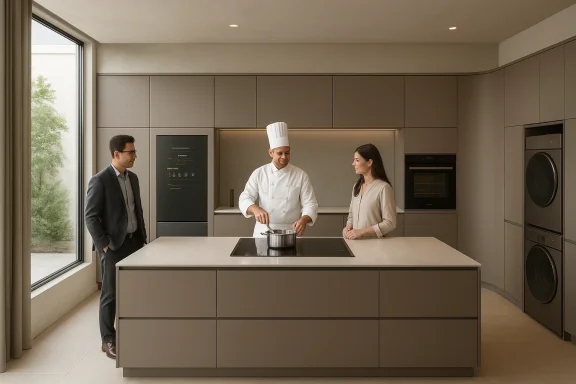
SKS leaned hard into live demonstrations at KBIS — a purposeful move in trade‑show marketing. The Culinary Stage featured repeated sessions of chef‑led menus and algorithmic baking demos (e.g., bagels via “Gourmet AI”), with a schedule designed to highlight repeatable techniques across both the new cooktop and oven platforms.Why live demos work:
- They convert abstract specs into sensory outputs: crisp crusts in bread, lift in a steam‑assisted roast, or sear quality on the induction range are visceral proofs that machine claims have merit.
- They provide social and press optics that feed PR cycles and buyer curiosity.
- For design buyers, seeing appliances in a vignette reduces cognitive friction when specifying a kitchen package.
- Trade‑show demos are controlled environments with trained staff, calibrated ingredients, and optimized cycles. Real‑world performance in a client’s custom kitchen (ventilation variance, panelized counters, electrical service) can diverge. Specifiers should test in a trade or showroom setting and ask for detailed installation and commissioning checklists to reproduce demo results on site.
Business strategy: why move into laundry now?
SKS’s laundry announcement is more than a product bid — it’s a strategic signal. For decades manufacturers have expanded adjacent categories (appliances that match styling, control ecosystems and service footprints) to lock in trade and retail channels. Several reasons make the move logical:- Whole‑home aesthetics: high‑end clients often require cohesive finishes across multiple rooms; laundry has historically been an afterthought, and a matched luxury offering is an upsell for specifiers.
- Service platform leverage: SKS (backed by LG) can extend warranty, installation, and technician networks across more categories, improving average transaction value and simplifying support models.
- Product differentiation: laundry is technically mature in mainstream markets but under‑served in luxury, where designers want both capacity and a finished look.
- Fabric care is materially different from culinary appliance engineering. Claims around fabric‑care efficacy (gentle cycles, moisture control, fiber preservation) require specialized testing against standards (AATCC test methods, consumer performance testing). Prospective buyers and specifiers should seek independent test data and clear service expectations for laundry electrics and ventilation.
Market implications and competition
SKS’s KBIS program is a defensive and offensive posture. Defensively, the brand must maintain its kitchen leadership as more mainstream players push into premium price tiers. Offensively, moving into laundry and repositioning the brand as “whole‑home luxury” enlarges the specifier conversation and builds cross‑sell opportunities for builders and design firms.Competitive realities to watch:
- Other premium appliance makers (both long‑established European brands and new U.S. premium entrants) are also innovating on induction flexibility, integrated ventilation, and AI cooking assistants. SKS’s marketing of “industry firsts” will be tested in product comparisons, lab tests and real installations.
- Credibility in the luxury segment is partly built in showrooms and service. SKS’s investment in THE MART showroom and NKBA recognition supports that credibility, but execution at scale (supply chain, spare parts, trained technicians) will determine whether SKS can convert trade interest into installed market share.
Implementation and procurement checklist for specifiers and builders
If you are specifying SKS products for a project or considering bundled SKS packages, insist on documentary proof and operational clarity before locking in decisions. At a minimum:- Request measured performance data (energy and water consumption, induction power distribution, cycle durations) and verify against accredited test labs.
- Obtain installation and service manuals for the exact SKS SKUs you plan to specify; confirm electrical service and ventilation requirements for both ranges and island systems.
- Ask for warranty and service SLAs in writing, including on‑site response windows and parts lead times for showrooms and large projects.
- Validate the update and model‑support roadmap for any AI features (Gourmet AI): who controls updates, what happens if cloud connectivity ceases, and will firmware updates be backward compatible?
- Schedule a hands‑on commissioning session in a showroom or test kitchen to reproduce demo results under real conditions.
Strengths — what SKS is doing well
- Cohesive brand storytelling. SKS successfully translated a set of discrete product launches into a coherent narrative — Technicurean living — that makes sense to both designers and affluent consumers. The KBIS vignettes and chef demos were tightly aligned to that narrative.
- Bold product concepts. The Hidden Induction Island System and free‑zone induction claims, if realized in practice, respond to a genuine market desire: powerful cooking that doesn’t dominate a kitchen’s aesthetics. The engineering ambition is noteworthy.
- Channel and service signaling. Opening a showroom at THE MART and promoting NKBA recognition signal that SKS is serious about the trade channel — a positive for long‑term adoption by designers and builders.
Risks and cautionary notes
- Marketing vs. independent validation. Much of what SKS promoted at KBIS aligns with product marketing. Several headlines (industry‑first free‑zone induction, Best of KBIS finalist claims) are verifiable as company or event statements, but engineers and specifiers should demand lab data before treating them as unqualified facts.
- AI feature longevity and governance. Gourmet AI and similar features depend on software ecosystems. Buyers should clarify update policies, data handling (what’s processed on device vs. cloud), and what happens if cloud services change or cease. Failure to secure clear terms risks future functionality loss or inconsistent user experience.
- Category expansion complexity. Entering laundry introduces new warranty, service and supply‑chain demands. SKS will need to scale technical training and parts distribution to match its kitchen footprint or risk degraded customer satisfaction.
- Installation realities for island systems. Hidden induction islands and integrated downdraft ventilation are installation‑sensitive. Expect coordination challenges with countertop fabrication, structural support, and local code compliance for ventilation and electrical services. These are not curb‑appeal features but execution features.
How to test SKS claims in practice — a short field protocol for trade buyers
- Book a KBIS or showroom demonstration for the exact SKU you intend to specify; look for the serial number and firmware version shown.
- Execute comparative baking and searing tests (same recipe, thermally‑equivalent pans) across the SKS unit and a comparable category peer; log time‑to‑target, internal temperature, and visual crumb/maillard development.
- For the free‑zone cooktop, run multi‑pan stress tests to measure power distribution and pan detection speed; document whether any pan is limited by placement.
- Run a complete laundry program with textile test swatches to verify wrinkle control, moisture extraction, and fabric wear across wash/dry cycles.
- Record software behavior: how are updates applied, how is telemetry handled, and can individual recipes/steps be exported or locked for pro clients?
Final assessment: an ambitious brand playing to its strengths, with reasonable guardrails
SKS’s KBIS 2026 presence was a cohesive, attention‑grabbing statement of intent: evolve from a kitchen‑centric appliance house into a design‑first, technology‑forward whole‑home luxury brand. The product concepts (free‑zone induction, hidden island, Gourmet AI, and the new laundry lineup) all align with that intent, and SKS’s trade‑show execution leveraged culinary theater and showroom credibility to sell the vision.That said, a clear delineation between company claims and independently verified performance remains essential. Designers, specifiers, and builders should treat KBIS demonstrations as catalytic evidence and require lab data, warranty contracts, and a commissioning plan before locking SKS products into high‑value custom builds. The most valuable outcome from SKS’s KBIS program is not simply a press release; it is an invitation to test and verify these ambitious ideas in the real settings that matter to architects and homeowners. When the technical claims are validated in commissioned projects, SKS’s Technicurean thesis has the potential to reshape how luxury homes are specified — but until then, treat the KBIS spectacle as a starting point, not the final proof.
In summary: SKS used KBIS 2026 to expand its product horizon and brand narrative, introducing the first luxury laundry entries and reiterating bold kitchen innovations anchored by AI assistance and design integration. The marketing was compelling and consistent; the technology claims are plausible and exciting, but require independent testing and clear service commitments before they should be specified into major projects. For designers and builders, the prudent next steps are hands‑on tests, written performance data, and contractually explicit support terms — then evaluate whether SKS’s Technicurean promise yields repeatable results in the field.
Source: The Malaysian Reserve https://themalaysianreserve.com/202...g-with-precision-innovation-at-kbis-2026/amp/