

SMS Gadget, founded in 2021 by Mahide Hasan, has expanded from a Bangladesh mobile-retail startup into a nationwide consumer-electronics chain with branches in major cities, a Barishal outlet planned, more than 110 brands, and a warranty-led pitch aimed at buyers wary of counterfeits. The company’s rise is less a story about one retailer selling more phones than about a market trying to professionalize around trust. In a country where mobile devices are both status objects and work tools, warranty clarity and after-sales support can matter as much as the chipset inside the box. SMS Gadget is betting that Bangladesh’s next phase of consumer tech retail will be won not only online, but in physical stores that feel accountable.
The most interesting thing about SMS Gadget’s expansion is not the branch count. It is the problem the company says it is solving: buyer distrust. In emerging consumer-electronics markets, the difference between an “official” device, a grey-market import, and a counterfeit accessory is not always obvious to the average customer standing in a crowded mall.
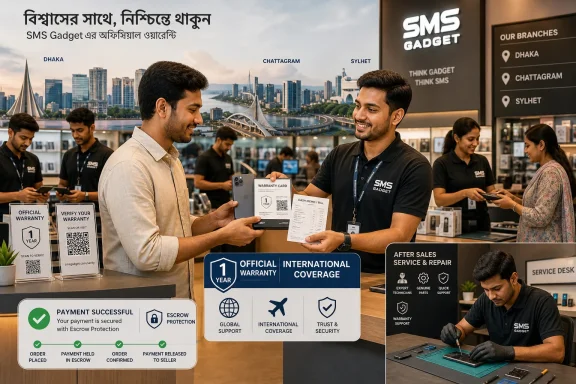
SMS Gadget’s pitch is designed around that unease. The company says it offers Bangladesh’s first one-year official warranty for Chinese and Indian products, one-year international warranty coverage for Apple devices, and the respective official warranty for devices distributed through official Bangladeshi channels. That warranty language is doing more than filling a policy page; it is the brand’s public claim that the transaction continues after the sale.
That matters because electronics retail is unusually vulnerable to information asymmetry. A buyer may know the phone model, the RAM configuration, and the camera specs, but still have no reliable way to verify the supply chain. The shopkeeper often knows more than the customer, and in weak-trust markets that gap becomes the business model for bad actors.
SMS Gadget’s rise suggests a counter-model: make authenticity, warranty, and service the product around the product. It is an old retail lesson, but in Bangladesh’s fast-growing device economy it still has force. The customer is not merely buying a smartphone; the customer is buying confidence that the box, the bill, and the repair desk will all tell the same story.
SMS Gadget currently lists branches in Dhaka’s Bashundhara City Shopping Complex and Jamuna Future Park, along with outlets in Savar, Chattogram, Sylhet, Mymensingh, Rangpur, Rajshahi, Bogura, Pabna, Kushtia, and Khulna. A Barishal outlet is reportedly next. That is not a boutique presence; it is a deliberate attempt to become familiar in multiple regional markets.
For expensive electronics, especially smartphones and laptops, the store is still a trust machine. Customers want to hold the device, inspect the packaging, ask about warranty terms, and know where to return if something fails. Online ordering can widen reach, but the branch network gives the promise a physical address.
This is why the expansion beyond Dhaka is strategically important. Bangladesh’s digital economy is not confined to the capital, and neither is demand for premium devices, accessories, laptops, smartwatches, smart-home products, and appliances. A retailer that can normalize official buying outside the largest urban centers has a chance to shape habits before those markets harden around informal sellers.
The company’s origin story is built around a simple observation: Bangladesh did not need another shop that could source popular phones. It needed a retailer that could convince customers the phone was real, the price was transparent, and the after-sales process would not disappear when the receipt faded.
That is a different entrepreneurial instinct from chasing the lowest price. In electronics retail, price competition can be brutal because hardware is easy to compare and margins can be thin. Trust, however, compounds more slowly and is harder for competitors to copy overnight.
SMS Gadget’s reported employment of roughly 500 people also signals that this is no longer a founder-with-a-counter operation. Sales, logistics, accounting, customer support, technical support, and after-sales service are the unglamorous machinery behind the brand promise. If those functions fail, the warranty-led identity collapses.
The company’s product categories now include smartphones, laptops, tablets, smartwatches, music devices, smart-home items, accessories, and home appliances. That mix mirrors the way consumer technology has expanded from a single personal device into an ecosystem of connected objects. A customer who first arrives for a phone charger may later return for earbuds, a smartwatch, a router, or a laptop.
The advance-order model is particularly revealing. SMS Gadget says buyers can order products through the website or any branch, with many imported and delivered within 7 to 10 days. That suggests the company is not trying to stock every possible device everywhere, but to use its retail network as a demand-capture layer for products that may not yet be locally available at scale.
This is where independent retailers can still compete with larger marketplace models. A marketplace may offer range, but it does not always offer interpretation. A customer wondering whether an imported tablet will have warranty support, local compatibility, or safe payment protection may prefer a specialist retailer with staff who can explain the trade-offs.
An escrow-style arrangement addresses that fear by adding a third-party layer to the transaction. Money is held until delivery conditions are satisfied, making the purchase feel less like a leap of faith. For a retailer whose brand is built on trust, payment infrastructure becomes part of the customer experience.
The company also says it has connections with 39 banks to provide EMI facilities for up to 36 months. That is important in a market where flagship phones and laptops can cost a substantial share of monthly income. Financing does not make devices cheaper, but it makes higher-end products reachable for customers who would otherwise delay or settle for unofficial alternatives.
There is a risk here too. Easy installments can encourage overbuying, especially in aspirational device categories where marketing is emotionally powerful. But from the retailer’s perspective, bank-backed EMI is a sign of institutionalization: the transaction is moving from cash-and-counter retail toward formal consumer finance.
Social visibility is especially valuable for independent retailers because it creates a public record of responsiveness. Customers ask about stock, pricing, delivery, authenticity, and warranty terms in semi-public spaces. Every reply becomes a tiny performance of reliability.
The downside is that public visibility raises expectations. A retailer with a large following cannot easily behave like a small shop when something goes wrong. Complaints travel through the same channels as product launches, and a warranty dispute can become a brand story faster than a sale announcement.
That is why SMS Gadget’s expansion will test the discipline behind its marketing. Scaling a social audience is easier than scaling consistent service across many branches. The company’s next challenge is not only to be visible, but to be predictably good when the transaction becomes messy.
This sophistication is partly forced by the products themselves. Modern smartphones, laptops, wearables, and smart-home devices are harder to repair casually and more dependent on software, batteries, sensors, and ecosystem compatibility. A defective charging brick or an unsupported imported model can turn a bargain into a headache.
It is also shaped by the growing role of devices in everyday work. A phone is not just a communication device; it may be a payment terminal, a learning tool, a content studio, a business inbox, and a family’s primary internet screen. Reliability therefore becomes economic, not just personal.
Retailers that understand this shift can move up the value chain. They stop acting as box movers and start acting as advisers, warranty brokers, finance facilitators, and service coordinators. SMS Gadget’s public positioning is very much in that direction.
The company’s 7-to-10-day import-and-delivery promise is useful, but it will need tight execution. Cross-border sourcing, customs timing, supplier reliability, and local delivery coordination can all complicate the neatness of a promised window. Customers may tolerate waiting if expectations are clear; they are far less forgiving when status updates go silent.
The branch network also creates a consistency problem. A customer in Rajshahi should receive the same warranty explanation as a customer in Dhaka. A buyer in Khulna should not feel that after-sales service is weaker because the capital city is far away. That is the hard part of national retail: the brand is only as strong as its least-prepared counter.
SMS Gadget’s reported 500-person workforce gives it the manpower to professionalize, but headcount alone does not guarantee process. The company will need training systems, service metrics, escalation paths, and internal discipline. Trust is earned locally, one receipt and one repair ticket at a time.
SMS Gadget is trying to occupy the middle ground: independent enough to carry a wide portfolio and source products on demand, formal enough to make warranty and payment protection part of the offer. That hybrid model can be powerful if executed well. It can also be fragile if scale outruns governance.
For Bangladesh’s tech market, the larger implication is that independent retail is maturing. The winning shop is no longer necessarily the one shouting the lowest price in a mall corridor. It may be the one that can document warranty coverage, offer financing, deliver outside major cities, and answer the phone after the sale.
This has consequences for global brands too. A retailer with national reach, strong social visibility, and a reputation for after-sales service becomes a valuable channel partner. It can introduce new product categories, educate customers, and reduce the friction that often slows adoption outside the largest metro areas.
That is why the company’s warranty promise is both its advantage and its exposure. If customers consistently receive help, the brand becomes stronger than a discount. If customers encounter fine print, delays, or branch-level confusion, the same promise becomes a liability.
Apple buyers receiving international warranty coverage is one example of how nuanced this can become. Customers often hear the word “warranty” and assume local convenience, but international coverage can involve conditions, authorized service networks, and regional limitations. A trusted retailer must explain those details plainly rather than rely on the comfort of a headline term.
The same applies to Chinese and Indian products. “Official warranty” should mean something operational: documented coverage, clear duration, service pathway, and predictable remedy. In a market sensitive to counterfeit and unofficial goods, vague assurance is not enough.
A district-level network would change the company’s identity again. It would no longer be a fast-growing chain with strong city coverage; it would become a national consumer-tech utility, one that tries to make genuine electronics accessible to urban and rural buyers alike. That is a much harder business.
Every new district brings different purchasing power, local competition, logistics realities, and service expectations. A model that works in Bashundhara City or Jamuna Future Park cannot simply be photocopied into every market. Expansion will require local knowledge without sacrificing central standards.
Still, the ambition is aligned with Bangladesh’s direction of travel. As digital services, mobile finance, online education, remote work, content creation, and small-business commerce continue to grow, reliable access to devices becomes part of economic participation. Retailers that can supply genuine hardware with service support may become more important than their storefronts suggest.
 SMS Gadget Turns Warranty Anxiety Into a Retail Strategy
The most interesting thing about SMS Gadget’s expansion is not the branch count. It is the problem the company says it is solving: buyer distrust. In emerging consumer-electronics markets, the difference between an “official” device, a grey-market import, and a counterfeit accessory is not always obvious to the average customer standing in a crowded mall.SMS Gadget’s pitch is designed around that unease. The company says it offers Bangladesh’s first one-year official warranty for Chinese and Indian products, one-year international warranty coverage for Apple devices, and the respective official warranty for devices distributed through official Bangladeshi channels. That warranty language is doing more than filling a policy page; it is the brand’s public claim that the transaction continues after the sale.
That matters because electronics retail is unusually vulnerable to information asymmetry. A buyer may know the phone model, the RAM configuration, and the camera specs, but still have no reliable way to verify the supply chain. The shopkeeper often knows more than the customer, and in weak-trust markets that gap becomes the business model for bad actors.
SMS Gadget’s rise suggests a counter-model: make authenticity, warranty, and service the product around the product. It is an old retail lesson, but in Bangladesh’s fast-growing device economy it still has force. The customer is not merely buying a smartphone; the customer is buying confidence that the box, the bill, and the repair desk will all tell the same story.
The Physical Store Refuses to Die
It would be easy to frame SMS Gadget as another e-commerce-era growth story. The company takes advance orders through its website and branches, imports many products on request, and offers home delivery across Bangladesh. But the company’s footprint shows that physical retail remains central to how many people buy technology.SMS Gadget currently lists branches in Dhaka’s Bashundhara City Shopping Complex and Jamuna Future Park, along with outlets in Savar, Chattogram, Sylhet, Mymensingh, Rangpur, Rajshahi, Bogura, Pabna, Kushtia, and Khulna. A Barishal outlet is reportedly next. That is not a boutique presence; it is a deliberate attempt to become familiar in multiple regional markets.
For expensive electronics, especially smartphones and laptops, the store is still a trust machine. Customers want to hold the device, inspect the packaging, ask about warranty terms, and know where to return if something fails. Online ordering can widen reach, but the branch network gives the promise a physical address.
This is why the expansion beyond Dhaka is strategically important. Bangladesh’s digital economy is not confined to the capital, and neither is demand for premium devices, accessories, laptops, smartwatches, smart-home products, and appliances. A retailer that can normalize official buying outside the largest urban centers has a chance to shape habits before those markets harden around informal sellers.
A Young Founder Finds the Market’s Weak Spot
Mahide Hasan founded SMS Gadget in 2021 while studying in his second year of university. That detail can sound like startup folklore, but it matters because the timing was unusually favorable. By 2021, smartphones had already become essential infrastructure for work, education, payments, entertainment, and social life, while buyers were increasingly aware of the risks of unofficial products.The company’s origin story is built around a simple observation: Bangladesh did not need another shop that could source popular phones. It needed a retailer that could convince customers the phone was real, the price was transparent, and the after-sales process would not disappear when the receipt faded.
That is a different entrepreneurial instinct from chasing the lowest price. In electronics retail, price competition can be brutal because hardware is easy to compare and margins can be thin. Trust, however, compounds more slowly and is harder for competitors to copy overnight.
SMS Gadget’s reported employment of roughly 500 people also signals that this is no longer a founder-with-a-counter operation. Sales, logistics, accounting, customer support, technical support, and after-sales service are the unglamorous machinery behind the brand promise. If those functions fail, the warranty-led identity collapses.
The Catalogue Is Becoming a Platform
SMS Gadget says it sells products from more than 110 global technology brands. That breadth is not just about having more shelves to fill. It changes the retailer’s role from a mobile shop into a consumer-electronics platform for a household’s digital life.The company’s product categories now include smartphones, laptops, tablets, smartwatches, music devices, smart-home items, accessories, and home appliances. That mix mirrors the way consumer technology has expanded from a single personal device into an ecosystem of connected objects. A customer who first arrives for a phone charger may later return for earbuds, a smartwatch, a router, or a laptop.
The advance-order model is particularly revealing. SMS Gadget says buyers can order products through the website or any branch, with many imported and delivered within 7 to 10 days. That suggests the company is not trying to stock every possible device everywhere, but to use its retail network as a demand-capture layer for products that may not yet be locally available at scale.
This is where independent retailers can still compete with larger marketplace models. A marketplace may offer range, but it does not always offer interpretation. A customer wondering whether an imported tablet will have warranty support, local compatibility, or safe payment protection may prefer a specialist retailer with staff who can explain the trade-offs.
Payments Are Part of the Trust Pitch
SMS Gadget’s use of SSLCommerz’s escrow-based payment system is not a footnote. In online electronics purchases, payment risk is one of the biggest obstacles to consumer confidence. The fear is straightforward: the customer pays, the product is delayed, substituted, damaged, or never arrives.An escrow-style arrangement addresses that fear by adding a third-party layer to the transaction. Money is held until delivery conditions are satisfied, making the purchase feel less like a leap of faith. For a retailer whose brand is built on trust, payment infrastructure becomes part of the customer experience.
The company also says it has connections with 39 banks to provide EMI facilities for up to 36 months. That is important in a market where flagship phones and laptops can cost a substantial share of monthly income. Financing does not make devices cheaper, but it makes higher-end products reachable for customers who would otherwise delay or settle for unofficial alternatives.
There is a risk here too. Easy installments can encourage overbuying, especially in aspirational device categories where marketing is emotionally powerful. But from the retailer’s perspective, bank-backed EMI is a sign of institutionalization: the transaction is moving from cash-and-counter retail toward formal consumer finance.
The Social Audience Is a Storefront of Its Own
SMS Gadget claims an online community of more than 400,000 followers across social media platforms. In consumer tech retail, that audience is not merely promotional. It is part catalogue, part customer-service desk, part reputation engine.Social visibility is especially valuable for independent retailers because it creates a public record of responsiveness. Customers ask about stock, pricing, delivery, authenticity, and warranty terms in semi-public spaces. Every reply becomes a tiny performance of reliability.
The downside is that public visibility raises expectations. A retailer with a large following cannot easily behave like a small shop when something goes wrong. Complaints travel through the same channels as product launches, and a warranty dispute can become a brand story faster than a sale announcement.
That is why SMS Gadget’s expansion will test the discipline behind its marketing. Scaling a social audience is easier than scaling consistent service across many branches. The company’s next challenge is not only to be visible, but to be predictably good when the transaction becomes messy.
The Bangladesh Tech Buyer Is Getting More Sophisticated
The SMS Gadget story fits a broader shift in consumer behavior. Bangladesh’s technology buyers are no longer simply chasing the newest phone at the lowest quoted price. They are weighing authenticity, warranty, payment safety, delivery speed, service access, and long-term value.This sophistication is partly forced by the products themselves. Modern smartphones, laptops, wearables, and smart-home devices are harder to repair casually and more dependent on software, batteries, sensors, and ecosystem compatibility. A defective charging brick or an unsupported imported model can turn a bargain into a headache.
It is also shaped by the growing role of devices in everyday work. A phone is not just a communication device; it may be a payment terminal, a learning tool, a content studio, a business inbox, and a family’s primary internet screen. Reliability therefore becomes economic, not just personal.
Retailers that understand this shift can move up the value chain. They stop acting as box movers and start acting as advisers, warranty brokers, finance facilitators, and service coordinators. SMS Gadget’s public positioning is very much in that direction.
Fast Growth Brings the Boring Problems That Matter
Nationwide expansion sounds heroic in brand copy. In practice, it introduces operational problems that are invisible until customers feel them. Inventory accuracy, branch-level training, warranty documentation, logistics, repair turnaround, and refund handling become the difference between a trusted chain and a chain that merely has many signboards.The company’s 7-to-10-day import-and-delivery promise is useful, but it will need tight execution. Cross-border sourcing, customs timing, supplier reliability, and local delivery coordination can all complicate the neatness of a promised window. Customers may tolerate waiting if expectations are clear; they are far less forgiving when status updates go silent.
The branch network also creates a consistency problem. A customer in Rajshahi should receive the same warranty explanation as a customer in Dhaka. A buyer in Khulna should not feel that after-sales service is weaker because the capital city is far away. That is the hard part of national retail: the brand is only as strong as its least-prepared counter.
SMS Gadget’s reported 500-person workforce gives it the manpower to professionalize, but headcount alone does not guarantee process. The company will need training systems, service metrics, escalation paths, and internal discipline. Trust is earned locally, one receipt and one repair ticket at a time.
Independent Retailers Are Learning to Behave Like Institutions
What makes SMS Gadget worth watching is that it sits between two older retail worlds. On one side is the informal mobile market, flexible and price-aggressive but often uneven in quality assurance. On the other side are official brand stores and large formal channels, which can be trusted but may not always offer the breadth or agility customers want.SMS Gadget is trying to occupy the middle ground: independent enough to carry a wide portfolio and source products on demand, formal enough to make warranty and payment protection part of the offer. That hybrid model can be powerful if executed well. It can also be fragile if scale outruns governance.
For Bangladesh’s tech market, the larger implication is that independent retail is maturing. The winning shop is no longer necessarily the one shouting the lowest price in a mall corridor. It may be the one that can document warranty coverage, offer financing, deliver outside major cities, and answer the phone after the sale.
This has consequences for global brands too. A retailer with national reach, strong social visibility, and a reputation for after-sales service becomes a valuable channel partner. It can introduce new product categories, educate customers, and reduce the friction that often slows adoption outside the largest metro areas.
The Warranty War Will Be Won After the Sale
The central claim around SMS Gadget is trust, and trust is measured after the purchase. A customer does not learn whether a retailer is serious about warranty support when the device powers on perfectly at the counter. The test comes weeks later, when a battery swells, a display fails, a charger overheats, or an imported product needs servicing.That is why the company’s warranty promise is both its advantage and its exposure. If customers consistently receive help, the brand becomes stronger than a discount. If customers encounter fine print, delays, or branch-level confusion, the same promise becomes a liability.
Apple buyers receiving international warranty coverage is one example of how nuanced this can become. Customers often hear the word “warranty” and assume local convenience, but international coverage can involve conditions, authorized service networks, and regional limitations. A trusted retailer must explain those details plainly rather than rely on the comfort of a headline term.
The same applies to Chinese and Indian products. “Official warranty” should mean something operational: documented coverage, clear duration, service pathway, and predictable remedy. In a market sensitive to counterfeit and unofficial goods, vague assurance is not enough.
The Barishal Plan Shows the Real Ambition
The planned Barishal outlet matters because it signals that SMS Gadget is still in expansion mode. The company’s long-term goal, according to its founder, is to open stores in every district of Bangladesh. That is an ambitious vision for a retailer founded only in 2021.A district-level network would change the company’s identity again. It would no longer be a fast-growing chain with strong city coverage; it would become a national consumer-tech utility, one that tries to make genuine electronics accessible to urban and rural buyers alike. That is a much harder business.
Every new district brings different purchasing power, local competition, logistics realities, and service expectations. A model that works in Bashundhara City or Jamuna Future Park cannot simply be photocopied into every market. Expansion will require local knowledge without sacrificing central standards.
Still, the ambition is aligned with Bangladesh’s direction of travel. As digital services, mobile finance, online education, remote work, content creation, and small-business commerce continue to grow, reliable access to devices becomes part of economic participation. Retailers that can supply genuine hardware with service support may become more important than their storefronts suggest.
The Concrete Test Behind the Growth Story
SMS Gadget’s current position can be reduced to a few practical claims: it is expanding geographically, widening product access, formalizing warranty expectations, and using payment systems to reduce buyer anxiety. Those claims are credible enough to explain its rise, but demanding enough to define its next risk.- SMS Gadget’s strongest differentiator is not its product range alone, but its attempt to make warranty, authenticity, and after-sales support central to the buying decision.
- The company’s branch network shows that physical retail remains essential in Bangladesh’s electronics market, especially for customers buying expensive devices.
- Its advance-order and import model gives customers access to a wider catalogue, but it also creates pressure to communicate clearly about delivery timing and warranty terms.
- Escrow-based payments and long-tenor EMI facilities make online and higher-value purchases more approachable, while also pushing the retailer into more formal financial territory.
- The next phase of growth will depend less on opening new outlets than on maintaining consistent service standards across every existing and future branch.
References
- Primary source: The Business Standard
Published: 2026-06-06T17:30:08.212307
Loading…
www.tbsnews.net