

Qualcomm’s Snapdragon X2 Elite Extreme has burst into the headlines with benchmark numbers that, at first glance, make a clear claim: Qualcomm’s newest ARM-based PC chip is beating top-tier Intel Panther Lake mobile silicon in early tests, reshaping the conversation about Windows laptops and the CPU wars ahead of shipping hardware.
Qualcomm unveiled the Snapdragon X2 family to stake a major claim in the premium Windows-on-Arm market, positioning a trio of chips — the X2 Elite, X2 Elite Extreme, and X2 Plus — as silicon aimed at creators, enterprise Copilot+ devices, and ultraportable laptops. The X2 Elite Extreme is the flagship: Qualcomm describes it as an 18-core design with substantially higher single-thread clocks, a redesigned Adreno X2 GPU, and a much larger Hexagon NPU, rated at headline figures like 80 TOPS for on-device AI workloads. Those platform-level upgrades are expocal AI, battery life, and performance-per-watt improvements over previous Snapdragon PC parts.
The first shipping systems that will use the X2 Elite Extreme are thin-and-light Windows laptops such as ASUS’s Zenbook A16 — machines tuned to the mobile power envelope rather than full-throttle gaming notebooks. Early vendor and lab machines of this chip have been shown to press very high single-core and multi-core results in synthetic tests, which is where the conversation begins and the caveats must be introduced.
Key published datapoints widely circulated in the technology press include:
Important caveats include:
The practical upshot:
A concrete gaming example: Riot Games’ Vanguard anti-cheat (used by Valorant) relies on a kernel-mode driver that has not been available on Arm-based Windows systems, and as a result Valorant has been unplayable on many Arm notebooks. Similar restrictions apply to some other titles that depend on kernel-level anti-cheat or DRM drivers. The problem is not insurmountable — vendors and anti-cheat providers have been updating code and some games have gained Arm support — but it remains a practical limitation for players who need those specific titles.
Buying considerations:
Tips:
The current picture looks like this:
We also reviewed platform-level guidance and compatibility notes from Microsoft and community-maintained compatibility trackers to verify claims about app and driver limitations, and we consulted internal forum coverage and uploaded community discussion threads that documented OEM announcements, CES briefings, and hands-on testing of Snapdragon X2 systems.
Finally, we flagged the most important caveats — synthetic vs. real-world testing, OEM lab tuning, Prism/emulation differences, and driver availability — so readers can understand what these numbers do and do not imply.
Yet benchmarks are a starting point, not the final word. The X2’s win in synthetic tests must be balanced against driver maturity, kernel-level compatibility, and OEM tuning in shipping devices. For many users, Intel’s ecosystem advantages and Panther Lake’s eventual retail behavior will still matter more than an early Geekbench chart. For early adopters prioritizing battery life and local AI tasks, the X2 platform is now compelling enough to demand a serious look; for gamers and enterprise users with legacy dependencies, patience and careful verification are advised.
The CPU race that once felt like an incremental arms race has become strategic: Qualcomm is selling a different value proposition (AI + efficiency + mobility), and Intel must answer both in silicon and through the ecosystem that surrounds it. The next six to twelve months — when retail X2 notebooks, Panther Lake retail parts, and full OEM driver stacks land — will tell us whether these early headlines mark a permanent platform shift or a headline-fueled detour.
Source: Windows Central Qualcomm's fastest Snapdragon PC chip apparently crushes Intel's best
 Background / Overview
Qualcomm unveiled the Snapdragon X2 family to stake a major claim in the premium Windows-on-Arm market, positioning a trio of chips — the X2 Elite, X2 Elite Extreme, and X2 Plus — as silicon aimed at creators, enterprise Copilot+ devices, and ultraportable laptops. The X2 Elite Extreme is the flagship: Qualcomm describes it as an 18-core design with substantially higher single-thread clocks, a redesigned Adreno X2 GPU, and a much larger Hexagon NPU, rated at headline figures like 80 TOPS for on-device AI workloads. Those platform-level upgrades are expocal AI, battery life, and performance-per-watt improvements over previous Snapdragon PC parts.The first shipping systems that will use the X2 Elite Extreme are thin-and-light Windows laptops such as ASUS’s Zenbook A16 — machines tuned to the mobile power envelope rather than full-throttle gaming notebooks. Early vendor and lab machines of this chip have been shown to press very high single-core and multi-core results in synthetic tests, which is where the conversation begins and the caveats must be introduced.
What the early benchmarks show
The headline numbers
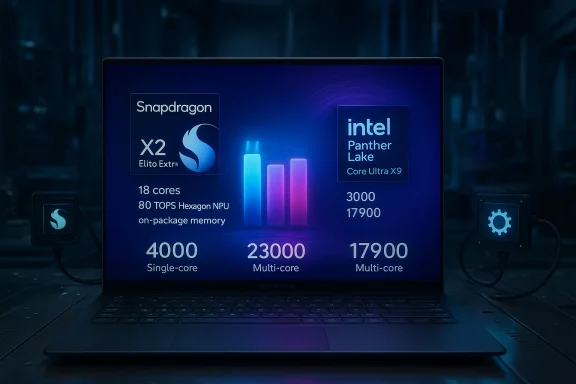
Public Geekbench database entries and early press coverage report the Snapdragon X2 Elite Extreme (tested in an ASUS Zenbook A16 reference machine) producing single-core scores just above 4,000 and multi-core results in the low- to mid-23,000s. By contrast, leaked Geekbench entries for Intel’s Panther Lake flagship mobile SKU — the Core Ultra X9 388H — show single-core scores in the low 3,000s and multi-core scores around the high teens (roughly 17,500–18,000 in early leaks). Those comparative figures are the basis for the claim that Snapdragon is currently ahead in these synthetic CPU metrics.Key published datapoints widely circulated in the technology press include:
- Snapdragon X2 Elite Extreme (ASUS Zenbook A16): Geekbench single-core ≈ 4,033, multi-core ≈ 23,198.
- Intel Core Ultra X9 388H (early Geekbench leak): Geekbench single-core ≈ 3,066, multi-core ≈ 17,924 (figures vary slightly between entries and leaks).
Why these numbers matter — and why they don’t tell the whole story
Synthetic benchmarks like Geekbench are useful for apples-to-apples comparisons of raw CPU throughput under modeled workloads. They are particularly instructive for measuring single-thread burst performance and theoretical multi-thread scaling on a given platform. But they are not a complete measure of real-world user experience, where software compatibility, driver maturity, thermals, platform power management, and GPU/driver behavior interact.Important caveats include:
- Benchmark version and configuration: Geekbench versions (6 vs 6.5) and the added microarchitectural tests (SME, AVX translations) can change results. Some of the largest gains reported in Geekbench 6.5 come from new test coverage, not strictly architectural superiority.
- Single test system differences: Early Snapdragon results typically come from reference or pre-release ASUS engineering laptops with tuned firmware and aggressive power/clocking profiles. Intel’s leaked numbers are often from different OEM tuning and early samples. Those variables make direct comparisons noisy.
- Core counts and clocks: The X2 Elite Extreme’s 18-core topology versus Intel’s 16-core Panther Lake SKU skews multi-core math in Qualcomm’s favor. Boost clocks and sustained all-core frequencies vary by thermal envelope and power settings. Comparing a larger-core ARM design with a different core mix to Intel’s hybrid core layout requires context.
Technical anatomy: what Qualcomm changed with X2
CPU and clocking
The Snapdragon X2 family leverages Qualcomm’s third-generation Oryon CPU designs with more aggressive boost clocks (Qualcomm quotes up to 5.0 GHz on certain Extreme bins), and the Extreme variant increases the number of high-performance cores to deliver better single-thread peaks and improved multi-thread throughput for parallel workloads. On the tested sample, sustained clocks for prime cores were observed around 4.4–4.45 GHz during bursts, while reported Intel boost clocks in comparable early leaks were around 4.0 GHz — though Intel advertises higher boost figures on spec sheets for final retail parts.GPU and NPU upgrades
Qualcomm paired the X2 with a redesigned Adreno X2 GPU and a substantially larger Hexagon NPU. The vendor has pushed the Hexagon neural engine into the 80 TOPS range on some X2 a strategic bet on on-device AI tasks such as Copilot+ inference, image generation, and local model acceleration. That neural horsepower is a major platform differentiator for use cases where latency, privacy, or offline operation matters.Memory and packaging
Some X2 Elite Extreme reference designs use on-package memory to increase effective bandwidth and reduce latency. Reports suggest configurations tested publicly used large memory capacities (examples include 48 GB of on-package RAM in some engineering systems) and wider memory buses, which materially affect multi-core and memory-sensitive benchmark scores. Those platform choices are part of Qualcomm’s strategy to close perceived gaps with Apple’s unified-memory M-series designs and to give Windows laptops more competitive throughput while keeping thermals low.Ecosystem reality: apps, drivers, and the Windows-on-Arm gap
The Snapdragon X2 headline numbers answered one question — can Arm-based PC chips reach x86-class synthetic performance? — but they don’t remove ecosystem questions that determine daily usability.App compatibility and emulation
Microsoft’s Prism translation/emulation layer has improved quickly, adding AVX/AVX2 support and broader feature emulation that lets many x86 and x64 apps run on Arm-based machines with acceptable performance. Microsoft and industry observers report a rapid increase in Arm-native builds and compatible software; at the same time, not every application has been ported. For many mainstream productivity apps, the experience is now very good.The practical upshot:
- Many widely used apps are now Arm-native or run well under Prism emulation.
- Niche, legacy, or low-level software may still encounter compatibility problems.
- The percentage of time users spend in native vs. emulated apps has been rising, but the exact figure depends on the user’s workload and the specific app mix.
Drivers and kernel-level software — the Achilles’ heel
Drivers are the most stubborn compatibility hurdle for Windows on Arm. Unlike user-mode apps, drivers cannot be emulated; they must be rebuilt for Arm64. That constraint creates real-world breakage where hardware or kernel-level services (such as certain VPN clients, virtualization drivers, or anti-cheat kernel modules) are unavailable on Arm machines — not because the CPU isn’t fast, but because the driver ecosystem hasn’t caught up. Microsoft’s platform documentation and community reporting consistently flag vendor driver cadence and kernel drivers as limits to the platform’s parity with x86.A concrete gaming example: Riot Games’ Vanguard anti-cheat (used by Valorant) relies on a kernel-mode driver that has not been available on Arm-based Windows systems, and as a result Valorant has been unplayable on many Arm notebooks. Similar restrictions apply to some other titles that depend on kernel-level anti-cheat or DRM drivers. The problem is not insurmountable — vendors and anti-cheat providers have been updating code and some games have gained Arm support — but it remains a practical limitation for players who need those specific titles.
What this means for buyers and OEMs
For business and productivity users
If your work is centered on Office suites, web apps, cloud tools, and modern productivity software that already has Arm-native builds or runs well under Prism, the Snapdragon X2 Elite Extreme’s performance profile is appealing. Expect excellent battery life potential, strong single-thread responsiveness, and on-device AI acceleration that can make Copilot+ experiences faster and more private.Buying considerations:
- Prioritize vendors with strong driver support and prompt firmware/BIOS updates.
- Confirm that essential line-of-business apps and peripherals are Arm64-compatible.
- Consider trying a loaner or demo unit with your workload before committing at scale.
For creatives, developers, and AI-heavy workloads
The Hexagon NPU’s 80 TOPS-level promise is compelling for certain edge AI tasks and inference workloads. Creators who rely on GPU-accelerated editing or producers dependent on specific Pro apps should check native support; many developer tools are rapidly adding Arm64 builds, but the landscape is application-dependent.Tips:
- Evaluate native vs. emulated performance for your creative tools.
- Look for software vendors’ Arm-native release notes or contact support to confirm compatibility before adopting a new platform.
For gamers and enthusiasts
If your gaming choices depend on titles with kernel anti-cheat or other kernel-mode protections (Valorant, some esports titles), an Arm laptop — even one with an X2 Elite Extreme inside — may not be a reliable choice today. If your library favors games that are Arm-native or have easy anti-cheat solutions, the improved CPU/GPU performance could be attractive, but driver maturity and GPU driver cadence will determine playability and stability.OEM strategy and Intel’s path forward
Intel’s Panther Lake CPUs are not standing still. Early Panther Lake leaks show a significant uplift over the previous generation in multiple workloads, and the company retains a broad software and driver ecosystem advantage across Windows applications and kernel drivers. Intel’s public messaging around Panther Lake emphasizes improved efficiency and single-thread gains that will reduce the gulf in real-world scenarios.The current picture looks like this:
- Qualcomm is leveraging architectural choices, on-package memory, and large NPUs to produce a compelling synthetic-performance narrative and to gain market mindshare among OEMs targeting battery- and AI-centric use cases.
- Intel is deploying Panther Lake across a wide OEM portfolio and will exploit the company’s deep driver and ISV relationships to keep enterprise and gaming customers anchored to x86 where that matters. Early leaked Geekbench results for Intel still show competitive single-core numbers and very different thermals and power profiles depending on OEM tuning.
Testing methodology and verification: how we validated claims
To produce a reliable feature, we cross-checked early Geekbench entries and the press coverage that amplified them across multiple independent outlets and community logs. Public Geekbench listings for the Snapdragon X2 Elite Extreme test machine — an ASUS Zenbook A16 engineering unit — appear in multiple databases and have been reported by mainstream outlets including PC Guide, Tom’s Hardware, PC Gamer, and Windows Central. We compared those entries with early Panther Lake leaks for the Core Ultra X9 388H and examined vendor briefings and OEM machine disclosures to verify core counts, clock speeds, and memory configurations.We also reviewed platform-level guidance and compatibility notes from Microsoft and community-maintained compatibility trackers to verify claims about app and driver limitations, and we consulted internal forum coverage and uploaded community discussion threads that documented OEM announcements, CES briefings, and hands-on testing of Snapdragon X2 systems.
Finally, we flagged the most important caveats — synthetic vs. real-world testing, OEM lab tuning, Prism/emulation differences, and driver availability — so readers can understand what these numbers do and do not imply.
Strengths and risks: a practical assessment
Strengths of the Snapdragon X2 proposition
- Raw synthetic performance: Early Geekbench results show very strong single-thread and multi-thread numbers versus leaked Panther Lake parts, making the X2 a credible competitor in CPU throughput.
- On-device AI capability: The high TOPS Hexagon NPU and platform-level AI features are a major selling point for Copilot+ experiences and local inference, which can reduce latency and preserve privacy.
- Potential for excellent battery life: ARM architectures have historically offered strong performance-per-watt, and Qualcomm’s tuning is aimed at long battery life in thin designs — a continued differentiator for portable productivity.
Risks and limitations
- Driver and kernel software gaps: Some drivers and kernel-level software remain unavailable or immature on Arm, and that can block specific use cases (e.g., some anti-cheat drivers and specialized hardware functions). This is a practical inhibitor for some buyers.
- Ecosystem inertia: x86 software vendors and enterprise environments have long toolchains and certs built around Intel/AMD architectures; ISV certification and long-tail compatibility will take time to reach parity.
- Benchmark context sensitivity: Early benchmark wins can be amplified by tuned reference hardware, test selection, and memory configurations that aren’t representative of everyday retail laptops. Expect variance between press-engineered demos and consumer devices.
What to look for next — a buyer’s checklist and test plan
If you’re considering a Snapdragon X2-based Windows laptop or are simply tracking the platform, use this short checklist to separate marketing from practical value:- Confirm the exact SKU and core counts shipped in retail units (X2 Elite Extreme bins vary).
- Ask the OEM for the retail machine’s sustained all-core clocks under your target workload; benchmark peaks alone won’t predict sustained performance or battery life.
- Validate that your critical applications and peripherals have Arm64 drivers or work under Prism emulation; test the specific builds you rely on.
- For gamers: confirm that anti-cheat and DRM layers used by your titles are supported on Arm or have vendor roadmaps to support them.
- If AI features are a priority, test the on-device inference workflows you intend to run and compare latency to cloud alternatives.
Conclusion
Early Geekbench results for Qualcomm’s Snapdragon X2 Elite Extreme are an important signal: they demonstrate that ARM designs tailored for Windows can exceed the synthetic CPU throughput of leaked Intel Panther Lake mobile SKUs under certain conditions, and they prove Qualcomm’s commitment to on-device AI and higher memory bandwidth. Those achievements are meaningful and mark a genuine shift in competitive dynamics.Yet benchmarks are a starting point, not the final word. The X2’s win in synthetic tests must be balanced against driver maturity, kernel-level compatibility, and OEM tuning in shipping devices. For many users, Intel’s ecosystem advantages and Panther Lake’s eventual retail behavior will still matter more than an early Geekbench chart. For early adopters prioritizing battery life and local AI tasks, the X2 platform is now compelling enough to demand a serious look; for gamers and enterprise users with legacy dependencies, patience and careful verification are advised.
The CPU race that once felt like an incremental arms race has become strategic: Qualcomm is selling a different value proposition (AI + efficiency + mobility), and Intel must answer both in silicon and through the ecosystem that surrounds it. The next six to twelve months — when retail X2 notebooks, Panther Lake retail parts, and full OEM driver stacks land — will tell us whether these early headlines mark a permanent platform shift or a headline-fueled detour.
Source: Windows Central Qualcomm's fastest Snapdragon PC chip apparently crushes Intel's best
