

The Washington Center for Equitable Growth’s recent Econ 101 briefing laid out a clear evidence-based argument: U.S. social insurance and safety-net programs are central engines of economic mobility and macroeconomic stability, and current policy choices—both at the federal and state level—will determine whether those engines continue to deliver or are allowed to sputter.
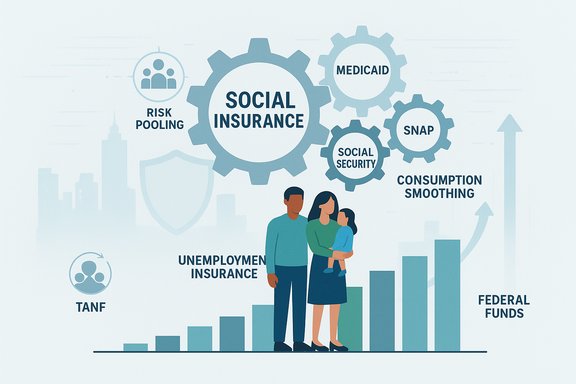
The briefing, aimed at state policymakers and staff, presented a compact primer on the structure, purposes, and documented impacts of major U.S. social insurance programs. Speakers emphasized two connected truths: first, that social insurance programs such as Social Security, Medicare, Unemployment Insurance (UI), and disability insurance are designed to pool risks that private markets cannot efficiently insure; and second, that means-tested supports like Medicaid, SNAP (Supplemental Nutrition Assistance Program), federal tax credits, and TANF (Temporary Assistance for Needy Families) supply targeted cash and in-kind resources that shape children’s life chances and household economic stability.
The briefing combined academic research with policy analysis to argue that these programs are not only moral or social safety nets but also pragmatic investments in long-run economic growth. Presenters urged states to use federal funds strategically, warned about the impact of expanding work requirements and program retrenchment, and highlighted structural problems—like block-grant design and state TANF reserves—that blunt the effectiveness of assistance.
Means-tested programs—Medicaid, SNAP, refundable tax credits, and targeted cash assistance—work differently but reinforce the same outcome. By ensuring that households maintain basic consumption and children receive adequate nutrition and health care, these programs improve human capital accumulation and reduce the likelihood that temporary hardship becomes permanent deprivation. Evidence summarized during the briefing shows correlations and causal links between early-life access to health insurance and nutrition programs and long-term outcomes such as school completion, adult health, and lifetime earnings.
The policy takeaway presented to state audiences was stark: protecting and effectively delivering these programs yields measurable returns in population health, educational attainment, and future productivity—outcomes that matter for state budgets and economic competitiveness.
In the last several years, federal legislative and regulatory moves have further prioritized work-based framing for means-tested benefits. Administrative changes and final rules implementing work-reporting reforms for SNAP were adopted, and recent federal budget proposals and committee bills have explicitly expanded work requirements across programs. Those reforms have two linked effects:
Key patterns to note:
Important contextual points:
Where numbers matter for policy (for example, the size of TANF reserves or the fiscal effect of a given Medicaid reform), states should rely on up‑to‑date federal financial data and nonpartisan scoring to evaluate trade-offs and avoid sweeping conclusions based on a single estimate.
That means three interlocking priorities for state and federal decision-makers:
Source: Equitable Growth Equitable Growth hosts Econ 101 virtual event on how U.S. social insurance programs boost economic mobility
 Background and overview
The briefing, aimed at state policymakers and staff, presented a compact primer on the structure, purposes, and documented impacts of major U.S. social insurance programs. Speakers emphasized two connected truths: first, that social insurance programs such as Social Security, Medicare, Unemployment Insurance (UI), and disability insurance are designed to pool risks that private markets cannot efficiently insure; and second, that means-tested supports like Medicaid, SNAP (Supplemental Nutrition Assistance Program), federal tax credits, and TANF (Temporary Assistance for Needy Families) supply targeted cash and in-kind resources that shape children’s life chances and household economic stability.The briefing combined academic research with policy analysis to argue that these programs are not only moral or social safety nets but also pragmatic investments in long-run economic growth. Presenters urged states to use federal funds strategically, warned about the impact of expanding work requirements and program retrenchment, and highlighted structural problems—like block-grant design and state TANF reserves—that blunt the effectiveness of assistance.
Why social insurance matters: risk pooling, consumption smoothing, and mobility
Social insurance programs operate by pooling risk across large populations and smoothing consumption when households face shocks. This is not an abstract claim: decades of economic research show that programs such as Unemployment Insurance limit the depth of consumption declines after job loss, stabilize local demand in downturns, and improve the match quality of job search by allowing displaced workers to look for better long-term fits rather than accepting the first available job. In short, UI stabilizes families and the broader economy.Means-tested programs—Medicaid, SNAP, refundable tax credits, and targeted cash assistance—work differently but reinforce the same outcome. By ensuring that households maintain basic consumption and children receive adequate nutrition and health care, these programs improve human capital accumulation and reduce the likelihood that temporary hardship becomes permanent deprivation. Evidence summarized during the briefing shows correlations and causal links between early-life access to health insurance and nutrition programs and long-term outcomes such as school completion, adult health, and lifetime earnings.
The policy takeaway presented to state audiences was stark: protecting and effectively delivering these programs yields measurable returns in population health, educational attainment, and future productivity—outcomes that matter for state budgets and economic competitiveness.
The evidence in brief: what research shows about program impacts
Medicaid: health, survival, and long-term gains
Research discussed at the briefing demonstrates that expanded Medicaid coverage has been associated with improved maternal and infant health indicators, including reductions in infant mortality and improvements in birth outcomes. Longer-term studies find links between early-life Medicaid eligibility and better adult health, reduced disability, and higher economic attainment. These findings are consistent across multiple empirical strategies and datasets, and they point to Medicaid as a public investment that pays dividends beyond immediate medical care.SNAP and nutrition assistance: short-term relief, long-term returns
Nutrition assistance reduces food insecurity and immediate health risks for children. Several longitudinal analyses find that children who had access to food assistance in early life show better health, higher test scores, greater high-school completion rates, and, in some analyses, higher adult earnings. SNAP’s anti-poverty effect is also large in the short term: it lifts millions out of poverty and reduces the severity of hardship, which in turn supports stable labor-force attachment and productive development in children.Unemployment Insurance: essential economic insurance
Unemployment Insurance protects households when earnings fall, preventing catastrophic drops in consumption. It acts as a macroeconomic stabilizer—maintaining demand during recessions—and as a form of private-market substitute where private insurance against job loss is largely unavailable. While economists document modest labor‑supply effects from UI generosity, the consensus from robust empirical work is that the consumption‑smoothing and stabilizing benefits are substantial and that UI design can be optimized to balance incentives and protection.TANF and cash assistance: a shrinking direct subsidy
Temporary Assistance for Needy Families (TANF), created by the 1996 welfare reform, was intended to promote work and reduce dependence. Over time, however, the program’s direct cash assistance role has diminished: states now spend a small share of TANF funds on basic cash assistance and use the block-grant flexibility to fund a range of programs. Empirical analyses show that the fraction of eligible families actually receiving direct TANF cash aid is far lower than for other core safety-net programs; take-up rates are low and vary substantially by state. This built-in underuse of TANF dollars has created sizable statewide reserves in many places.Policy shifts since 1996 and their consequences
The 1996 welfare reform fundamentally altered the federal-state relationship for cash assistance by replacing an entitlement structure with a fixed block grant and adding explicit work requirements. That reform reoriented the safety net toward work activation and time-limited supports and delegated large discretion to states. Over subsequent decades policy choices and economic conditions—particularly weak wage growth in many regions, growing nonstandard work, and labor-market obstacles—have meant that strict work requirements and limited cash support can leave vulnerable families without effective help.In the last several years, federal legislative and regulatory moves have further prioritized work-based framing for means-tested benefits. Administrative changes and final rules implementing work-reporting reforms for SNAP were adopted, and recent federal budget proposals and committee bills have explicitly expanded work requirements across programs. Those reforms have two linked effects:
- They increase administrative burden and documentation requirements, which often reduce take-up among eligible people; and
- They alter eligibility in ways that may not meaningfully increase employment but do reduce benefit receipt for populations with intermittent employment or caregiving responsibilities.
The TANF paradox: block grants, reserves, and unmet need
One of the more striking policy fragments highlighted at the briefing is the disconnect between unspent TANF funds and persistent family-level hardship. The block-grant structure allows states to carry forward unspent TANF allocations indefinitely and to use funds for a wide range of purposes. As a result, many states maintain multibillion-dollar TANF reserves even while poverty and material hardship continue.Key patterns to note:
- States are not required to spend their annual TANF allotments every year, and carry-over rules permit accumulation.
- A substantial share of total unspent funds in recent federal fiscal snapshots is “unobligated,” meaning the money is not currently committed to a specific program or contract.
- Estimates of the total unspent or unobligated TANF reserves vary by year and data source, but the broad picture—billions in reserves lining state accounts while cash assistance reaches only a fraction of eligible households—persists.
Political dynamics and fiscal pressures: cuts and expansions
Speakers at the briefing stressed that macro-fiscal proposals under consideration at the federal level—especially those that trade tax cuts for spending reductions—would reshape the social insurance landscape. Some recent legislative packages and budget proposals include provisions projected to sharply reduce federal Medicaid funding over a multi-year window and impose new eligibility rules. Those proposals are thematically consistent with a broader policy push to reduce federal spending by tightening eligibility and increasing state-level responsibilities.Important contextual points:
- Large projected reductions in federal Medicaid outlays are policy-dependent: they reflect scoring of specific legislative proposals and would only materialize if enacted.
- State fiscal exposure would rise if federal contributions shrink because states ultimately fund the nonfederal share of Medicaid and administer many program elements.
- Administrative capacity—already strained in some agencies—would face additional pressure if eligibility rules and reporting requirements expand.
Data, administration, and the practicalities of targeting
Accurate targeting of means-tested programs depends on reliable federal and state data and sufficient administrative staff to process applications, verify eligibility, and provide in-person services. Briefing participants raised two operational risks:- Data disruptions: interruptions to federal data releases or cuts to statistical programs make it harder for states to design and validate eligibility rules that reach intended populations. Timely income and demographic data underpin means testing, performance evaluation, and program evaluations.
- Staffing shortfalls: reduced staffing at field offices—particularly in Social Security and other benefit administration points—reduces access to in-person assistance and can deter eligible individuals from applying. Administrative complexity and burdensome recertification processes are a proven barrier to take-up.
Strengths of the current approach (what works)
- Large, evidence-based impacts: decades of research link Medicaid, SNAP, UI, and targeted tax credits to improvements in health, educational attainment, poverty reduction, and consumption stability.
- Countercyclical behavior: many federal supports expand automatically or can be scaled in downturns, helping buffer recessions and supporting local demand.
- Long-term returns: investments in early-life health and nutrition produce measurable adult outcomes—higher earnings, better health, and lower long-run public costs—multiplying the value of front-end expenditures.
- Program complementarity: when coordinated, health coverage, nutrition assistance, and modest cash transfers amplify each other’s benefits for family stability and child development.
Risks and shortcomings (what to watch)
- Work requirements that reduce access without boosting employment: evidence presented and discussed suggests that stricter work rules often lead to benefit losses for previously eligible families without large increases in sustained labor-force attachment.
- Block-grant design that incentivizes under-spending: programs that give states wide discretion but fix federal funding levels can foster accumulation of reserves even as local needs persist.
- Political vulnerability and fiscal retrenchment: policy proposals that cut federal shares or impose stricter eligibility could shift costs to states and reduce coverage, particularly in politically vulnerable or low-capacity jurisdictions.
- Administrative barriers and data gaps: paperwork burdens, verification hurdles, limited field-office access, and interruptions to federal data all degrade program effectiveness and suppress take-up among the neediest populations.
- Uneven state implementation: state-by-state variation in program design and priorities means that national-level statistics mask deep geographic inequities in who benefits and who is left behind.
What state policymakers can do now
The briefing closed with a pragmatic menu of actions states can take—even in a constrained fiscal and political environment—to enhance program delivery and support economic mobility:- Prioritize spending of existing TANF reserves on direct cash assistance and proven services that reach families in poverty.
- Protect and expand program elements that sustain household consumption—nutrition assistance and home energy assistance—because these supports have immediate stabilizing effects.
- Strengthen outreach and simplify administrative processes to raise take-up among eligible households, using modernized digital tools and restored in-person access where needed.
- Invest federal and state funds in early-childhood supports (including childcare) that increase parents’ ability to work and yield high long-term returns.
- Build robust data partnerships with federal agencies to ensure accurate targeting and program evaluation; preserve state capacity to use federal datasets for eligibility and design.
- Consider revenue measures or targeted expansions (for example, child-care subsidies or refundable credits) that strengthen labor-force participation and family stability while fostering growth.
Methodological cautions and contested figures
The briefing and subsequent discussions responsibly emphasized that specific numerical claims—projected federal savings or state reserves—depend on timing, scoring assumptions, and data vintage. For example, estimates of unspent TANF funds and unobligated reserves differ across fiscal years and analytical methods, ranging from several billions to near‑double‑digit billions in aggregate unspent funds depending on the measurement year and whether carryovers are counted as “obligated.” Likewise, projections of Medicaid savings cited in recent legislative scorecards depend on the precise policy package and CBO scoring assumptions; some proposals have been scored to reduce federal Medicaid outlays by amounts on the order of hundreds of billions to nearly a trillion dollars over a multi-year window, but those figures apply only under enactment of the specific proposals and hinge on behavioral responses by states and beneficiaries.Where numbers matter for policy (for example, the size of TANF reserves or the fiscal effect of a given Medicaid reform), states should rely on up‑to‑date federal financial data and nonpartisan scoring to evaluate trade-offs and avoid sweeping conclusions based on a single estimate.
Final assessment: defend the stabilizers; fix the frictions
The Econ 101 briefing underscored a simple policy principle with strong empirical backing: social insurance and means-tested programs are foundational to family-level stability and aggregate economic resilience. The policy debate should therefore shift from rhetoric—“welfare as dependency” versus “welfare as handout”—to a more constructive analysis of how programs are designed and administered.That means three interlocking priorities for state and federal decision-makers:
- Preserve the stabilizing core: safeguard the programs that undergird household consumption—Medicaid, SNAP, UI, refundable tax credits—because their loss would ripple through local economies and human-capital formation.
- Reduce administrative friction: streamline application and recertification processes, invest in staffing and IT, and use federal data responsibly to target resources. Reducing paperwork is an equity measure as much as an efficiency one.
- Reorient funding to outcomes: use existing TANF and other flexible funds to emphasize direct cash assistance and services that empirical evidence shows improve child well-being and family stability, and structure evaluations to track long-term mobility outcomes.
Source: Equitable Growth Equitable Growth hosts Econ 101 virtual event on how U.S. social insurance programs boost economic mobility