

SoDa’s move to place TAIM Insight Hub on Microsoft Azure is more than a routine channel announcement; it is a small but revealing signal about where enterprise AI is heading in the Gulf. The platform is pitched as a natural-language layer over fragmented corporate data, promising that employees can ask questions in plain English and get trusted answers without digging through disconnected systems. In a market like the UAE, where AI adoption is accelerating and data governance remains a board-level concern, that combination of accessibility, security, and scalability is precisely what makes the story worth watching. The launch also fits a broader pattern in the region: software vendors are increasingly using Azure as the enterprise-grade foundation for AI products that must balance innovation with control.
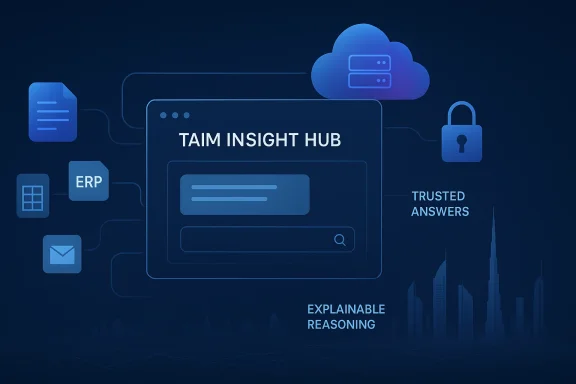
The appeal of TAIM Insight Hub rests on a problem that nearly every large organization recognizes but few have solved elegantly: knowledge is everywhere, yet usable insight is nowhere near as abundant as the data itself. Enterprises accumulate information across ERP systems, CRM platforms, file shares, email archives, ticketing tools, and bespoke databases. Over time, the challenge shifts from collecting data to making it legible to the people who need it most. SoDa’s pitch is that TAIM Insight Hub turns that sprawl into something more conversational, more searchable, and more decision-ready.
That framing matters because it reflects a wider change in enterprise software. The old model assumed users would learn dashboards, filters, and reporting layers. The emerging model assumes the software should adapt to human language instead. In other words, employees should not need to know where the data lives or how to query it; the system should infer intent and return a usable answer. The idea is not new, but modern AI makes it much more practical at enterprise scale.
The Azure angle adds another layer of significance. For many organizations, cloud choice is no longer just about infrastructure economics; it is a proxy for trust, compliance readiness, integration depth, and operational resilience. Azure has become especially important for companies that want AI features without giving up the enterprise controls that their security teams insist on. SoDa’s decision to anchor TAIM Insight Hub in Azure therefore signals an attempt to make the platform credible not just as a demo, but as production software.
The timing is also important. The UAE has been aggressively positioning itself as an AI-forward economy, and businesses across the country are under pressure to turn experimentation into measurable value. That pressure creates demand for systems that can move AI from novelty into operations, especially in sectors where compliance, auditability, and speed all matter at once. TAIM Insight Hub lands squarely in that sweet spot.
There is also a strategic subtext in how the product is being described. SoDa is not presenting TAIM as a replacement for every analytics stack or every business system. Instead, it is positioning the hub as a knowledge layer that sits on top of existing repositories and helps people extract meaning faster. That is a smarter story than promising a rip-and-replace platform, because most enterprises are not looking to start over; they are looking for a practical way to unlock what they already own.
The promise, of course, is not just convenience. Natural-language access can also improve adoption rates. Tools that require specialized query syntax often remain underused, even when they are technically powerful. A plain-English interface lowers the barrier to entry, which may matter more than raw model sophistication in many real-world deployments.
That is one reason this type of platform differs from consumer chatbots. Consumer tools can survive on a mix of convenience and personality. Enterprise tools, by contrast, must survive scrutiny. If a finance team, procurement manager, or compliance officer cannot inspect the reasoning path, the product becomes a novelty rather than a system of record. TAIM’s emphasis on clarity is therefore a practical necessity, not a marketing flourish.
That matters particularly in regulated industries, where sensitive information cannot be casually exposed to loose search or ungoverned retrieval. The pitch here is not that Azure magically removes all risk. Rather, it gives SoDa a framework that enterprises already understand and, in many cases, already use. Familiarity lowers procurement resistance, which is often the most underrated barrier in enterprise AI adoption.
That is where cloud-native architecture becomes strategic. A small proof of concept can survive on limited resources. A production deployment with multiple departments, business units, and governance rules cannot. By moving to Azure, SoDa is effectively saying the product is meant to survive that transition.
This is especially attractive in markets where boards want evidence of return on investment before approving broader AI programs. If TAIM Insight Hub can help customers get value from data they already own, the platform may feel like a lower-risk entry point into AI than more ambitious transformation programs. That pragmatic positioning is likely one of SoDa’s strongest selling points.
UAE organizations also tend to face the dual challenge of growth and governance. Rapid expansion often means more systems, more data silos, and more pressure on oversight teams. A platform that can sit above those silos and present a unified interface may be attractive precisely because it does not force a wholesale migration before benefits appear. That incrementalism is often the difference between interest and adoption.
Azure’s enterprise posture helps SoDa speak to those concerns more convincingly than a small standalone deployment would. The cloud platform becomes part of the trust story, not just the plumbing. That will matter in procurement conversations where legal, compliance, and security stakeholders all have a say.
That matters because productivity gains in enterprise AI often come from small, repeated savings rather than dramatic one-off breakthroughs. If teams can answer routine questions faster, onboarding improves, decision cycles shrink, and managers spend less time chasing context. Those are the kinds of benefits that survive budget scrutiny.
This is where context-aware answers become a differentiator. A system that merely retrieves keywords can still leave employees to do the hard work of synthesis. A system that can combine signals and explain its logic starts to behave more like an internal analyst. That is a much stronger business case.
It also means buyers will scrutinize governance features more than model size. They will want permissions, auditability, source tracing, and integration support. If SoDa can package those elements cleanly, TAIM Insight Hub could become more than a product; it could become a repeatable enterprise pattern.
This ecosystem pull can be a serious advantage against smaller competitors that lack cloud credibility. It also means SoDa is likely competing not just with direct rivals, but with the inertia of legacy processes. Winning that battle requires more than technical novelty; it requires operational fit.
But that also raises the bar. A general-purpose conversational layer is no longer impressive on its own. SoDa will need to demonstrate that TAIM can handle messy inputs, real governance constraints, and meaningful business questions with enough reliability to earn long-term usage.
This dynamic also helps explain why Microsoft’s ecosystem keeps drawing specialized vendors. The platform reduces some of the hardest adoption barriers, while partners supply the vertical or workflow expertise that Microsoft itself cannot always package narrowly enough. That division of labor is a big reason the Azure marketplace continues to matter.
That shift has consequences for buyers too. If AI becomes infrastructure, the standards for reliability, security, and support rise accordingly. Vendors that cannot meet those expectations will be left behind, even if their demos look impressive.
The second thing to watch is whether SoDa deepens the product’s sector focus. A platform that works well in one or two industries can build much stronger credibility than a generic AI layer that tries to be everything to everyone. In the Gulf market, where regulation and digital maturity vary widely by sector, that kind of focus may prove decisive.
Source: Tbreak Media SoDa launches TAIM Insight Hub on Azure for UAE | tbreak
 Background
The appeal of TAIM Insight Hub rests on a problem that nearly every large organization recognizes but few have solved elegantly: knowledge is everywhere, yet usable insight is nowhere near as abundant as the data itself. Enterprises accumulate information across ERP systems, CRM platforms, file shares, email archives, ticketing tools, and bespoke databases. Over time, the challenge shifts from collecting data to making it legible to the people who need it most. SoDa’s pitch is that TAIM Insight Hub turns that sprawl into something more conversational, more searchable, and more decision-ready.That framing matters because it reflects a wider change in enterprise software. The old model assumed users would learn dashboards, filters, and reporting layers. The emerging model assumes the software should adapt to human language instead. In other words, employees should not need to know where the data lives or how to query it; the system should infer intent and return a usable answer. The idea is not new, but modern AI makes it much more practical at enterprise scale.
The Azure angle adds another layer of significance. For many organizations, cloud choice is no longer just about infrastructure economics; it is a proxy for trust, compliance readiness, integration depth, and operational resilience. Azure has become especially important for companies that want AI features without giving up the enterprise controls that their security teams insist on. SoDa’s decision to anchor TAIM Insight Hub in Azure therefore signals an attempt to make the platform credible not just as a demo, but as production software.
The timing is also important. The UAE has been aggressively positioning itself as an AI-forward economy, and businesses across the country are under pressure to turn experimentation into measurable value. That pressure creates demand for systems that can move AI from novelty into operations, especially in sectors where compliance, auditability, and speed all matter at once. TAIM Insight Hub lands squarely in that sweet spot.
There is also a strategic subtext in how the product is being described. SoDa is not presenting TAIM as a replacement for every analytics stack or every business system. Instead, it is positioning the hub as a knowledge layer that sits on top of existing repositories and helps people extract meaning faster. That is a smarter story than promising a rip-and-replace platform, because most enterprises are not looking to start over; they are looking for a practical way to unlock what they already own.
What SoDa Is Really Selling
At face value, TAIM Insight Hub sounds like a conversational analytics product. But the more interesting proposition is that it tries to reduce the friction between internal knowledge and operational decision-making. Employees can apparently ask questions in natural language, while the system surfaces context-aware answers instead of forcing them through multiple tools or manual searches. That makes the product less like a dashboard and more like a guided interface to enterprise memory.A natural-language front end for business knowledge
This is the kind of design shift that enterprise software has been moving toward for years. Instead of training staff to become query experts, companies are now trying to make systems conversational enough for broader use. The business logic is simple: if more people can access insight directly, the organization becomes faster and less dependent on a small group of analysts. That democratization can be powerful, especially in large enterprises where information bottlenecks slow down everyday decisions.The promise, of course, is not just convenience. Natural-language access can also improve adoption rates. Tools that require specialized query syntax often remain underused, even when they are technically powerful. A plain-English interface lowers the barrier to entry, which may matter more than raw model sophistication in many real-world deployments.
Explainability as a trust strategy
SoDa’s emphasis on explainable AI is especially important. In enterprise settings, users rarely accept an answer simply because a model says so. They want to know where it came from, what it is based on, and whether the reasoning is traceable enough for audit or compliance review. The explanation layer is therefore not a cosmetic feature; it is a requirement for trust.That is one reason this type of platform differs from consumer chatbots. Consumer tools can survive on a mix of convenience and personality. Enterprise tools, by contrast, must survive scrutiny. If a finance team, procurement manager, or compliance officer cannot inspect the reasoning path, the product becomes a novelty rather than a system of record. TAIM’s emphasis on clarity is therefore a practical necessity, not a marketing flourish.
Why Azure Matters Here
The Azure deployment is not simply a hosting decision; it is part of the product’s value proposition. SoDa says Microsoft Azure gives TAIM Insight Hub enterprise-grade security, scalability, and cost efficiency, while also providing the resilient cloud foundation needed for production use. That language is telling, because it reflects the three things enterprise buyers usually care about most: whether the system is safe, whether it can grow, and whether it is financially sustainable.Security and identity are the real gatekeepers
For most enterprise AI projects, security teams are the real approval authority. If a platform cannot fit into identity controls, access policies, audit procedures, and data-protection requirements, it is dead on arrival. Azure’s strength in enterprise identity and security makes it easier for vendors like SoDa to pitch AI capabilities without asking customers to relax their guardrails.That matters particularly in regulated industries, where sensitive information cannot be casually exposed to loose search or ungoverned retrieval. The pitch here is not that Azure magically removes all risk. Rather, it gives SoDa a framework that enterprises already understand and, in many cases, already use. Familiarity lowers procurement resistance, which is often the most underrated barrier in enterprise AI adoption.
Scale is about more than uptime
Scalability is often discussed too narrowly as a cloud capacity issue. In a product like TAIM Insight Hub, scalability also means the ability to ingest more documents, more data sources, more users, and more questions without degrading answer quality or responsiveness. As organizations expand usage, the platform must remain useful under heavier load and messier data conditions.That is where cloud-native architecture becomes strategic. A small proof of concept can survive on limited resources. A production deployment with multiple departments, business units, and governance rules cannot. By moving to Azure, SoDa is effectively saying the product is meant to survive that transition.
Cost efficiency is a procurement message
The cost-efficiency argument is just as important. Many enterprises still hesitate on AI because the up-front infrastructure burden looks unpredictable. Cloud delivery lets vendors argue that customers can avoid large capital expenses while scaling use case by use case. That does not make AI cheap, but it does make adoption feel more controllable.This is especially attractive in markets where boards want evidence of return on investment before approving broader AI programs. If TAIM Insight Hub can help customers get value from data they already own, the platform may feel like a lower-risk entry point into AI than more ambitious transformation programs. That pragmatic positioning is likely one of SoDa’s strongest selling points.
The UAE Enterprise AI Context
The launch lands in a UAE market that is clearly warming to AI at speed. Tbreak’s framing points to research indicating that 92% of UAE firms prioritize AI, which is the kind of statistic that helps explain why vendors are racing to offer practical, enterprise-ready products rather than abstract AI concepts. Whether the exact number moves slightly over time is less important than the direction of travel: the market is committed, and the demand for implementation-ready tools is rising.From AI enthusiasm to operationalization
The next phase of AI adoption is not about adding another chatbot to a website. It is about embedding intelligence into the workflows that already govern operations, service delivery, and internal decision-making. TAIM Insight Hub speaks directly to that need by focusing on business knowledge retrieval rather than flashy generative output. That makes the product more credible for enterprises that have outgrown the “demo stage” of AI.UAE organizations also tend to face the dual challenge of growth and governance. Rapid expansion often means more systems, more data silos, and more pressure on oversight teams. A platform that can sit above those silos and present a unified interface may be attractive precisely because it does not force a wholesale migration before benefits appear. That incrementalism is often the difference between interest and adoption.
Sovereignty and control remain important
The article’s mention of sovereign cloud trends is especially relevant. Across the Gulf, enterprises and governments alike are asking hard questions about where data resides, who can access it, and how it is governed across borders. Even when the word sovereignty is used loosely in marketing, the underlying concern is real: businesses want modern AI without surrendering control of sensitive information.Azure’s enterprise posture helps SoDa speak to those concerns more convincingly than a small standalone deployment would. The cloud platform becomes part of the trust story, not just the plumbing. That will matter in procurement conversations where legal, compliance, and security stakeholders all have a say.
The regional market is getting more competitive
This is also a competitive signal. As more Microsoft partners, consultancies, and niche AI vendors target Gulf enterprises, the market will favor companies that can show measurable outcomes rather than generic AI branding. SoDa’s advantage may lie in being small enough to move quickly but rooted enough in the region to understand local business expectations. That combination is useful, but only if the product delivers in production.The Business Case for Natural-Language Intelligence
The biggest commercial promise of TAIM Insight Hub is that it may reduce the cost of finding answers. In many companies, that search cost is hidden inside hours of manual work, duplicated reporting, and analyst bottlenecks. A platform that makes internal knowledge directly queryable in plain English can cut through that friction and free staff to focus on higher-value tasks.Fewer tools, fewer handoffs
One of the quiet failures of enterprise technology is tool fragmentation. Employees open one system to find a document, another to check a policy, and a third to verify a metric. Every handoff creates delay, and every delay creates room for error. By giving users a single conversational interface, SoDa is trying to compress the path from question to decision.That matters because productivity gains in enterprise AI often come from small, repeated savings rather than dramatic one-off breakthroughs. If teams can answer routine questions faster, onboarding improves, decision cycles shrink, and managers spend less time chasing context. Those are the kinds of benefits that survive budget scrutiny.
Why this is more than search
It is tempting to describe platforms like TAIM as better search engines, but that undersells the proposition. Search returns documents; intelligence systems return synthesized answers with context. That distinction becomes important when the user is not looking for a file but for a decision-ready explanation. The value is not just retrieval, but interpretation.This is where context-aware answers become a differentiator. A system that merely retrieves keywords can still leave employees to do the hard work of synthesis. A system that can combine signals and explain its logic starts to behave more like an internal analyst. That is a much stronger business case.
Enterprise vs. consumer expectations
Consumer AI can tolerate some fuzziness because the stakes are usually low. Enterprise AI cannot. A wrong answer in a workplace context can lead to bad decisions, compliance missteps, or financial losses. That means the platform must be reliable enough to justify the trust placed in it, not merely impressive in a demo.It also means buyers will scrutinize governance features more than model size. They will want permissions, auditability, source tracing, and integration support. If SoDa can package those elements cleanly, TAIM Insight Hub could become more than a product; it could become a repeatable enterprise pattern.
Competitive Implications
SoDa is entering a crowded field, even if the exact niche is still taking shape. Microsoft, its partners, and dozens of enterprise AI vendors are all pushing similar ideas: natural-language access, retrieval-augmented systems, and secure cloud foundations. The real question is not whether the market exists, but which vendors can deliver a trustworthy implementation in real business conditions.The Microsoft ecosystem advantage
By building on Azure, SoDa benefits from a familiar enterprise ecosystem. That can shorten sales cycles, reduce integration anxiety, and make it easier for customers to connect the platform to other Microsoft-based workflows. In practical terms, the product is easier to imagine inside a Microsoft-centric IT estate than a standalone AI stack from an unfamiliar vendor.This ecosystem pull can be a serious advantage against smaller competitors that lack cloud credibility. It also means SoDa is likely competing not just with direct rivals, but with the inertia of legacy processes. Winning that battle requires more than technical novelty; it requires operational fit.
Differentiation will depend on domain depth
In enterprise AI, generic capability is quickly commoditized. What lasts is domain relevance: how well the platform understands specific business workflows, data structures, and industry pain points. If TAIM Insight Hub is tuned for the realities of UAE enterprises, that local relevance may become its biggest differentiator.But that also raises the bar. A general-purpose conversational layer is no longer impressive on its own. SoDa will need to demonstrate that TAIM can handle messy inputs, real governance constraints, and meaningful business questions with enough reliability to earn long-term usage.
The market is moving from “can it?” to “should we trust it?”
This is perhaps the most important competitive shift. Buyers are increasingly asking whether an AI platform can be trusted with internal knowledge, not whether it can produce a plausible answer. That favors vendors that can combine usability with governance and explainability. TAIM Insight Hub appears to be aimed squarely at that expectation.How This Fits the Wider Azure Pattern
SoDa’s announcement is not an isolated event. It belongs to a broader wave of enterprise software being re-anchored around Azure as vendors seek the legitimacy, distribution, and infrastructure that hyperscale cloud can provide. We have seen similar patterns across data management, industry-specific AI, and workflow automation, where partners use Microsoft’s platform to accelerate adoption and reduce procurement friction.Azure as a trust wrapper
For many partners, Azure is no longer just cloud hosting. It functions as a trust wrapper that signals a minimum level of enterprise readiness. That matters in fields where buyers are wary of startup risk but still want innovation. A smaller company can borrow some of Azure’s credibility by building on top of it, especially when security and scale are part of the pitch.This dynamic also helps explain why Microsoft’s ecosystem keeps drawing specialized vendors. The platform reduces some of the hardest adoption barriers, while partners supply the vertical or workflow expertise that Microsoft itself cannot always package narrowly enough. That division of labor is a big reason the Azure marketplace continues to matter.
The AI layer is becoming normal infrastructure
There is a deeper trend underneath all of this. AI is no longer being marketed only as a breakthrough capability; it is increasingly being sold as infrastructure. Organizations want intelligence that is always on, embedded in systems, and governed like any other enterprise workload. TAIM Insight Hub fits that evolution neatly.That shift has consequences for buyers too. If AI becomes infrastructure, the standards for reliability, security, and support rise accordingly. Vendors that cannot meet those expectations will be left behind, even if their demos look impressive.
Strengths and Opportunities
TAIM Insight Hub has several clear strengths: it addresses a concrete enterprise pain point, it uses a familiar cloud foundation, and it speaks the language of trust rather than hype. Those qualities should help it resonate with organizations that are tired of AI experiments but still hungry for practical gains.- Natural-language access lowers the barrier for non-technical users.
- Explainable AI helps build trust with compliance-heavy teams.
- Azure scalability gives the platform a credible production story.
- Enterprise security supports regulated-sector adoption.
- Cost efficiency may make early pilots easier to approve.
- Regional relevance could help SoDa align with UAE-specific business needs.
- Incremental deployment makes the product easier to adopt without replacing everything at once.
A pragmatic entry point for AI adoption
The biggest opportunity is probably not flashiness but practicality. Companies that have already collected mountains of data need a way to use it without rebuilding their entire stack. TAIM Insight Hub appears designed for exactly that use case, which gives it a clear business narrative.Risks and Concerns
Despite the strong pitch, platforms like TAIM Insight Hub carry familiar enterprise AI risks. The biggest danger is that the product may sound transformative while still requiring substantial integration, governance work, and change management to deliver real value. Buyers will need to test those assumptions carefully before rolling out widely.- Answer accuracy will need to hold up under real-world use.
- Integration complexity may be higher than the marketing suggests.
- Data governance requirements could slow deployment in sensitive sectors.
- User trust may erode if explanations are not sufficiently transparent.
- Vendor dependence could increase if the system becomes central to knowledge access.
- Change management may be underestimated inside large organizations.
- Scope creep could dilute the product if customers expect it to solve every data problem.
The usual enterprise AI trap
There is also a broader industry caution here: impressive prototype, difficult rollout. Many AI tools work well in demonstrations but struggle when confronted with noisy data, inconsistent policies, and multiple stakeholder groups. The true test for TAIM will be whether it can remain dependable once it leaves the lab and enters daily operational use.Looking Ahead
The most important next step for SoDa will be proving that TAIM Insight Hub delivers measurable business outcomes, not just better conversation. That means use cases, customer references, and integration depth will matter more than broad claims about AI readiness. If the company can show concrete time savings or better decision quality, the platform may gain real traction in the UAE enterprise market.The second thing to watch is whether SoDa deepens the product’s sector focus. A platform that works well in one or two industries can build much stronger credibility than a generic AI layer that tries to be everything to everyone. In the Gulf market, where regulation and digital maturity vary widely by sector, that kind of focus may prove decisive.
Key indicators to monitor
- Customer deployments beyond the initial announcement.
- Industry-specific templates or tailored workflows.
- Governance features that satisfy security and compliance teams.
- Integration breadth across common enterprise systems.
- Performance under scale as data and user counts rise.
Source: Tbreak Media SoDa launches TAIM Insight Hub on Azure for UAE | tbreak
