

Sonata Software’s announcement that it has been recognized as one of the early recipients of Microsoft’s new Frontier Partner badge marks a measurable elevation in the company’s standing inside the Microsoft ecosystem and crystallizes a broader industry dynamic: systems integrators and services firms that combine platform engineering with agentic AI offerings are being fast-tracked by hyperscalers into the front ranks of enterprise AI delivery. m]
Sonata Software — a long-standing Microsoft partner with a footprint across North America, Europe, APAC and ANZ — publicly positioned the Frontier recognition as validation of its AI‑first, human‑led delivery model and its recent investments in Microsoft‑aligned IP such as Platformation.AI, Sonata Harmoni.AI, and the agent orchestration platform AgentBridge. Those product and go‑to‑market moves are intenerprise adoption of Copilot‑style experiences, agentic workflows, and secure, governed GenAI at scale.
Microsoft’s Frontier Partner designation was introduced to spotlight partners that demonstrate leadership across three broad solution areas — Cloud & AI Platforms, AI Business Solutions, and Security — and who are building production‑grade solutions that combine AI models, Copilot/assistant experiences, and agentic architectures. Several other global integrators and consultancies were named Frontier Partners around the same launch window, illustrating Microsoft’s intent to create an elite cohort of firms able to deliver high‑impact AI transformations.
For enterprise IT leaders, the Frontier badge matters for three reasons:
For competitors and buyers, several dynamics are worth noting:
That said, badges are signals, not guarantees. Successful enterprise adoption will depend on Sonata’s ability to demonstrate predictable outcomes in production, to maintain robust security and compliance posture, and to manage the commercial risks inherent in a business model closely tied to a single hyperscaler. Decision‑makers should treat Frontier recognition as a strong starting signal — and then apply standard technical, legal, and financial due diligence before committing at scale.
Sonata’s Frontier recognition is an important milestone in the momentum behind enterprise AI on the Microsoft stack: it confirms that the partner ecosystem is reorganizing around platform‑led, agentic AI delivery. For enterprises, the takeaway is straightforward — if you plan Copilot, agentic automation, or Fabric‑backed analytics at scale, working with a Frontier partner like Sonata can reduce vendor integration risk and speed up time to value — provided you still insist on measurable outcomes, hardened governance, and transparent, auditable delivery commitments.
Source: Bolsamania Sonata Software Among the First Companies to Be Recognized as a Microsoft Frontier Partner
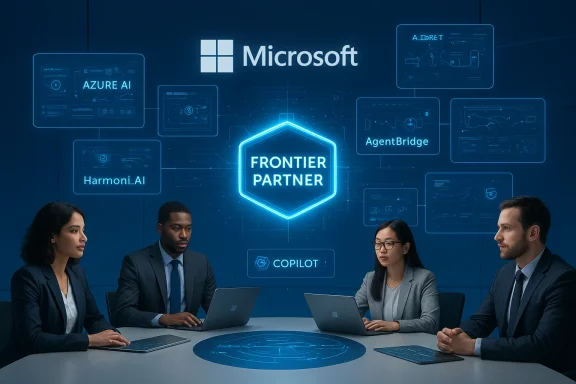 Background
Sonata Software — a long-standing Microsoft partner with a footprint across North America, Europe, APAC and ANZ — publicly positioned the Frontier recognition as validation of its AI‑first, human‑led delivery model and its recent investments in Microsoft‑aligned IP such as Platformation.AI, Sonata Harmoni.AI, and the agent orchestration platform AgentBridge. Those product and go‑to‑market moves are intenerprise adoption of Copilot‑style experiences, agentic workflows, and secure, governed GenAI at scale.Microsoft’s Frontier Partner designation was introduced to spotlight partners that demonstrate leadership across three broad solution areas — Cloud & AI Platforms, AI Business Solutions, and Security — and who are building production‑grade solutions that combine AI models, Copilot/assistant experiences, and agentic architectures. Several other global integrators and consultancies were named Frontier Partners around the same launch window, illustrating Microsoft’s intent to create an elite cohort of firms able to deliver high‑impact AI transformations.
What the Frontier Badge Means (and what it doesn’t)
The intent behind the program
The Frontier Partner badge is intended as a signal to enterprise customers that a partner has:- Demonstrated practical, measurable success building AI‑first solutions on Microsoft Cloud.
- Invested in Microsoft Copilot technologies and agent‑centric architectures.
- Achieved verified competencies across cloud, security, and business application solution areas.
What customers should expect from a Frontier Partner
- Early access and alignment with Microsoft product roadmaps and Copilot/agent tooling.
- Referenceable production deployments that combine Azure AI, Microsoft Fabric / data estates, and Copilot‑enabled workflows.
- Stronger partner governance and security posture designed for enterprise audits and compliance.
What the badge does not guarantee
- A Frontier designation is not a substitute for a formal proof‑of‑concept or security assessment. It signals capability and alignment, but customers must still validate fit for their own data governance, risk, and compliance needs before moving to production.
Sonata’s positioning: products, specializations and proof points
Sonata’s press materials and public filings outline three pillars that form the spine of its AI modernization story: Platformation.AI (the methodology and engineering approach), Sonata Harmoni.AI (a “responsible‑first” GenAI platform), and AgentBridge (an enterprise agent orchestration service). Sonata has repeatedly referenced its deep Microsoft alignment — Azure Expert MSP status, Fabric launch partnership, and membership in Microsoft’s AI Business Solutions Inner Circle — as foundational to delivering these capabilities.- Platformation.AI is Sonata’s modernization methodology designed to move legacy systems toward cloud‑native, platform‑driven architectures that are easier to attach AI services to.
- Sonata Harmoni.AI is presented as a responsible‑first GenAI platform that embeds ethics, privacy, security, and compliance guardrails into GenAI use cases.
- AgentBridge is a managed offering for orchestrating agentic workflows — creating, deploying, and governing multi‑agent automation across business functions with role‑based access controls and audit logging.
Independent verification: cross‑checking the key claims
Good journalism demands verification. I cross‑checked Sonata’s announcement and the Frontier badge facts against multiple independent sources and public materials:- Sonata’s own press communications describe AgentBridge and Harmoni.AI and list its Azure and Microsoft specializations; those pieces make the same product claims seen in the Frontier announcement.
- Independent partner and industry writeups about Microsoft’s Frontier program corroborate both the program’s existence and the criteria for the badge — multiple partners (Insight, Fellowmind, Protiviti, Valorem Reply and others) have publicized Frontier recognition, and Microsoft highlighted the program at Ignite. That corroborates the program’s scope and vanguard list of partners.
- Microsoft’s own documentation and partner case studies confirm Sonata’s long‑running participation in Fabric preview programs and an Azure‑aligned partnership that predates the Frontier designation — this supports Sonata’s claim of being a Fabric launch partner and an Azure Expert MSP.
Why Microsoft and enterprise customers care
Microsoft is building a two‑track strategy for enterprise AI: a platform track (Azure, Fabric, Azure AI Foundry) and an outcomes track (Copilot, Dynamics/Business Applications, agentic automation). Partners that can credibly straddle both are more valuable to customers and to Microsoft.For enterprise IT leaders, the Frontier badge matters for three reasons:
- Speed to production: Frontier partners are positioned for priority engagement with Microsoft’s product teams, which can compress time‑to‑production on Copilot and agent projects.
- Reduced supplier risk: Being a Frontier Partner signals that the firm has demonstrated production implementations and governance practices that large enterprises expect.
- Market leverage: Microsoft is incentivizing Frontier Partners with enablement, credits and ecosystem visibility that can materially lower customer procurement friction.
Critical analysis — strengths
- Deep Microsoft alignment: Sonata’s long history with Microsoft (Fabric launch partner, Azure Expert MSP, Dynamics Inner Circle membership) gives it a practical edge in co‑engineering and early access to platform changes. That alignment reduces technical friction for joint customers.
- Productized offerings for real problems: AgentBridge and Harmoni.AI signal a move from bespoke PoCs to repeatable productized paths for agentic automation and responsible GenAI, which increases the odds of reliable, auditable deployments at scale.
- Cross‑discipline coverage: The Frontier badge requires breadth across Cloud & AI Platforms, AI Business Solutions and Security. Sonata’s portfolio claims to address all three areas — the company’s market positioning is consistent with the multi‑discipline mandate Microsoft laid out for Frontier Partners.
- Commercial momentum: Public statements tied to Frontier recognition typically reflect both delivery maturity and commercial pipeline strength. For clients evaluating partners, demonstrated revenue momentum and case references matter, and Sonata’s placement in Microsoft’s partner programs suggests credible go‑to‑market traction.
Critical analysis — risks and caveats
No partner is a one‑size‑fits‑all solution. The Frontier badge is meaningful — but it doesn’t eliminate several real risks buyers and partners must weigh:- Dependence on the Microsoft ecosystem: Sonata’s strengths are also a strategic exposure. A meaningful portion of Sonata’s revenue historically ties back to Microsoft technologies and license reselling. If Microsoft shifts licensing, channel, or product roadmaps, it can create short‑term revenue and operating risk for partners whose business models are tightly coupled with Microsoft’s commercial motions. Recent analyst notes have flagged this type of channel exposure as material for mid‑tier partners. Buyers and Sonata’s leadership both need to actively manage that dependency.
- From pilot to production: Many enterprises have discovered that moving Copilot/agent pilots to fully governed, auditable production at scale requires non‑trivial investments in data lineage, model grounding, latency engineering and security. A Frontier badge indicates capability, but not guaranteed project outcomes; customers should insist on clear success metrics, observable KPIs, and a staged remediation plan for model drift, hallucinations, and auditability before pressing “go.”
- Tooling vs. process change: Building multi‑agent workflows is as much about organizational design, process redesign, and change management as it is about software. Partners who undersell the human and operational work required can produce brittle automations that fail when core systems change. Sonata’s messaging emphasizes human‑led AI, which aligns with best practice, but customers should verify the partner’s delivery methodology and change management track record on similar transformations.
- Numbers and claims verification: Public announcements often bundle aspirational language with verifiable claims. For example, the exact count of advanced Microsoft specializations or the company’s consolidated revenue figure can vary across press pieces and aggregators. Independent verification from audited filings and Microsoft partner records is the only defensible source for such numeric claims. Where precision matters, ask for the documentation.
Technical and procurement due diligence checklist (for CIOs evaluating Sonata or any Frontier Partner)
- Technical fit
- Request a reference architecture showing how Copilot, Azure AI Foundry, Microsoft Fabric, and Sonata’s AgentBridge interoperate end‑to‑end.
- Ask for telemetry and SLAs for the deployed agentic workflows (latency, mean time to recover, audit logs).
- Security & compliance
- Verify encryption key management and HSM use for sensitive data.
- Request model governance policies: data lineage, red team / adversarial testing documentation, and guardrails for sensitive intents.
- Operational readiness
- Confirm runbook maturity: incident response, version rollback, and model retraining cadence.
- Validate RBAC and least‑privilege configuration inside AgentBridge and associated integrations.
- Commercial clarity
- Validate the partner’s Azure committed use credits, Copilot test/POC licensing support, and any bundled consulting credits.
- Lock down outcome metrics (e.g., % time saved, error reduction, revenue uplift) and payment milestones tied to those metrics.
- Independent verification
- Cross‑check partner declarations against Microsoft partner portal listings and recent audited financial statements when assessing long‑term vendor risk.
Market implications and competitive landscape
Microsoft’s Frontier program is a selective mechanism to surface partners that can accelerate enterprise AI adoption. The program’s early ms integrators, consultancies and regional partners with demonstrated Microsoft AI maturity. By elevating partners like Sonata, Microsoft is effectively signaling to enterprise buyers where they should look for Copilot and agentic AI implementations.For competitors and buyers, several dynamics are worth noting:
- The market is bifurcating between a smaller number of deep platform‑aligned partners (Frontier firms) and a larger long tail of specialized integrators. Enterprises will increasingly make strategic bets on fewer partners for core AI initiatives.
- Firms that can productize agent orchestration and governance (AgentBridge‑type platforms) will capture larger share of multi‑year value, not just transient PoC revenue.
- The partnership economy now includes customer zero commitments — partners that operate and instrument AI for themselves tend to be more credible advisors. Sonata and other Frontier firms emphasize this internal usage as part of their value proposition.
What Sonata should do next (and what customers should ask for)
For Sonata:- Double down on transparent, auditable case studies that show measurable ROI across at least three industries. Buyers prefer concrete numbers (time saved, cost avoided, revenue uplift) over generic value statements.
- Publish independent security attestations for AgentBridge (SOC2 / ISO 27001 / penetration test summaries) to reduce procurement friction for regulated customers.
- Expand multi‑cloud compatibility and clearly document any vendor lock‑in risks associated with deep Microsoft integration.
- Require a short, high‑value proof of value (PoV) that produces one measurable KPI within 60–90 days and includes a full compliance checklist.
- Insist on a migration and rollback plan for any agentic automation tied to core ERP, CRM, or billing systems.
- Demand transparency on data residency, model grounding procedures, and the partner’s process for handling hallucinations or personally identifiable information.
Final assessment
Sonata Software’s inclusion among the early Microsoft Frontier Partners is a meaningful recognition that aligns with both the company’s public investments and Microsoft’s strategy of elevating a narrow group of partners to accelerate enterprise AI adoption. The recognition is consistent with Sonata’s previously published capabilities — AgentBridge and Harmoni.AI in particular — and with the company’s long history inside the Microsoft ecosystem.That said, badges are signals, not guarantees. Successful enterprise adoption will depend on Sonata’s ability to demonstrate predictable outcomes in production, to maintain robust security and compliance posture, and to manage the commercial risks inherent in a business model closely tied to a single hyperscaler. Decision‑makers should treat Frontier recognition as a strong starting signal — and then apply standard technical, legal, and financial due diligence before committing at scale.
Sonata’s Frontier recognition is an important milestone in the momentum behind enterprise AI on the Microsoft stack: it confirms that the partner ecosystem is reorganizing around platform‑led, agentic AI delivery. For enterprises, the takeaway is straightforward — if you plan Copilot, agentic automation, or Fabric‑backed analytics at scale, working with a Frontier partner like Sonata can reduce vendor integration risk and speed up time to value — provided you still insist on measurable outcomes, hardened governance, and transparent, auditable delivery commitments.
Source: Bolsamania Sonata Software Among the First Companies to Be Recognized as a Microsoft Frontier Partner
