

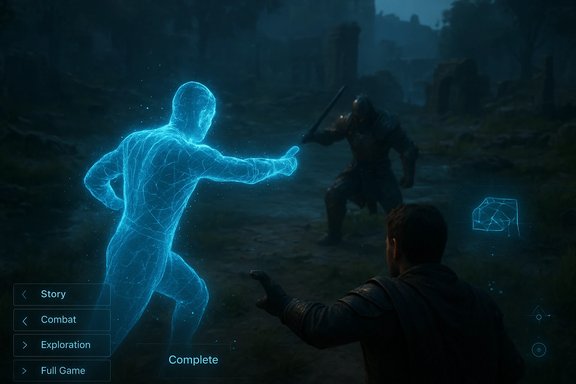
Sony’s recent patent filing for an AI-powered “ghost” player marks a deliberate and technically detailed attempt to embed contextual, in-game assistance that can range from an on-screen demonstration to taking direct control and completing sections of a game for the player. The filing describes multiple operational modes—Story, Combat, Exploration, Full Game and a more extreme Complete Mode—and explains how a rendered ghost character could either demonstrate solutions, highlight essential narrative beats, or execute inputs so the player receives progress credit. The proposal is explicitly optional, framed as a tool to reduce friction for players overwhelmed by the scale and mechanical complexity of modern blockbusters. The patent itself, which Sony filed as a PCT application and published internationally, provides the most authoritative technical description of the concept and its intended modes of operation.
Modern AAA games increasingly blend dense narratives, multifaceted puzzles, and sophisticated combat systems with open-world exploration, collectible hunting, and emergent gameplay. That complexity yields richer experiences but also steeper learning curves and more frequent “stuck” moments for players who lack time, interest, or the mechanical skill to push through specific obstacles.
Platform-level and in-game help systems have existed for years—examples include Nintendo’s Super Guide, which offered automated demonstrations in New Super Mario Bros. Wii, and PlayStation’s built-in Game Help, which surfaces hints and developer-provided walkthrough clips in supported PS5 titles. Sony’s patent frames the “ghost” idea as a next-generation step beyond those features: rather than static text or recorded clips, the ghost would be an AI-driven, situationally-aware agent that can interact with the live game world and adapt demonstrations to the player’s precise context. This is consistent with PlayStation’s incremental approach to integrated help—Game Help and the March 2024 Community Game Help expansion are precursor systems that keep players in-session while delivering hints and community videos. Industry reporting and patent databases confirm Sony’s filing timeline and public disclosure: the PCT application (published as WO2025080356A1 / US20250121289A1) lists Sony Interactive Entertainment as assignee, shows a 2024 filing date, and details the proposed “ghost assistance” methods and modes. That patent text is the primary document for the feature’s claimed capabilities.
For PlayStation owners and developers, the patent is a clear signal that integrated AI assistance is being actively explored at the platform level. Whether it becomes a mainstream PlayStation feature depends on whether engineering, legal, and community issues are solved in tandem—not just whether the idea works in a lab. The next steps to watch are technical proof-of-concept work, developer partnerships for in-engine hooks, and the concrete privacy and consent mechanisms Sony builds around any eventual product.
Source: SE7EN.ws https://se7en.ws/sony-patents-ai-ghost-to-help-players-navigate-increasingly-complex-games/?lang=en
 Background
Modern AAA games increasingly blend dense narratives, multifaceted puzzles, and sophisticated combat systems with open-world exploration, collectible hunting, and emergent gameplay. That complexity yields richer experiences but also steeper learning curves and more frequent “stuck” moments for players who lack time, interest, or the mechanical skill to push through specific obstacles.Platform-level and in-game help systems have existed for years—examples include Nintendo’s Super Guide, which offered automated demonstrations in New Super Mario Bros. Wii, and PlayStation’s built-in Game Help, which surfaces hints and developer-provided walkthrough clips in supported PS5 titles. Sony’s patent frames the “ghost” idea as a next-generation step beyond those features: rather than static text or recorded clips, the ghost would be an AI-driven, situationally-aware agent that can interact with the live game world and adapt demonstrations to the player’s precise context. This is consistent with PlayStation’s incremental approach to integrated help—Game Help and the March 2024 Community Game Help expansion are precursor systems that keep players in-session while delivering hints and community videos. Industry reporting and patent databases confirm Sony’s filing timeline and public disclosure: the PCT application (published as WO2025080356A1 / US20250121289A1) lists Sony Interactive Entertainment as assignee, shows a 2024 filing date, and details the proposed “ghost assistance” methods and modes. That patent text is the primary document for the feature’s claimed capabilities.
What the patent proposes: modes, mechanics, and player controls
Four operational modes (plus a “Complete” option)
Sony’s filing explains multiple assistance modes, each tailored to different kinds of roadblocks:- Story Mode — produces a streamlined “ghost narrative” that follows the essential progression path; it’s intended to show the critical path without tangential exploration.
- Combat Mode — performs tactical demonstrations, highlighting timing, parry windows, attack telegraphs, or boss patterns for the player to emulate.
- Exploration Mode — focuses on uncoverables: rare collectibles, secret paths, or placement-based puzzles.
- Full Game Mode — sequences the above behaviors to guide a player through larger swathes of the experience.
- Complete Mode (described in the press coverage of the filing) — an escalation where the AI not only demonstrates but executes gameplay actions, receives progress credit, and effectively finishes the section on the player’s behalf.
Technical approach and training data claims
The patent is explicit about the intended training sources and data flows: the assistance engine would be trained and tuned using playthrough footage and telemetry from many players—sources listed include PlayStation Network activity and publicly available streams or recordings on platforms like YouTube and Twitch. The AI would also analyze the live game state (player position, inventory, quest status, UI context) to generate actions and contextual demonstrations relevant to the player’s exact scenario. This combination of historical play data plus live state analysis is the mechanism Sony claims would let the ghost tailor its behavior to the user’s immediate needs.Where this sits relative to existing tools
PlayStation Game Help and Community Game Help
PlayStation’s Game Help (introduced with PS5) and its Community Game Help extension are official precedents: they keep hints in-session, surface developer-authored or community-sourced clips, and reduce context-switching to external guides. Those systems rely on curated or captured clips rather than a dynamic, embodied agent. The ghost patent suggests an evolution beyond passive clips—an interactive actor that can physically manipulate game elements in real time. PlayStation’s official docs show how Game Help is already opt-in and subject to moderation and controls; the ghost concept layers active control and generative decision-making on top of that established user flow.Nintendo’s Super Guide
Nintendo’s Super Guide (a 2009-era innovation) allowed the game to temporarily take over a player’s run to demonstrate how to pass a level, and was explicitly designed for accessibility to less-skilled players. Sony’s Complete Mode echoes that functionality in spirit but proposes a more context-aware and multi-modal system capable of fine-grained tactical demonstrations and account-linked tailoring rather than a single authored playthrough. Nintendo’s Super Guide is a useful historical touchstone for implementation trade-offs around player control and learning-by-observation.Microsoft’s Gaming Copilot and cross-platform trends
Microsoft has been public about research and product features that embed AI assistance in-game (for example, the Gaming Copilot concept inside Game Bar). Market research commissioned by Microsoft (Edelman Data & Intelligence) found a large share of surveyed players express openness to AI help—one headline stat cited by outlets was “79% open to help from AI”—but the survey framing and sample size (1,500 U.S. adult gamers) mean the figure must be read carefully. A company spokesperson later clarified that the 79% figure reflected respondents who selected at least one AI feature they’d find useful. The point is that platform players and publishers are actively experimenting with assistance mechanics and that user sentiment is mixed and context-dependent.Practical benefits Sony highlights (and why they matter)
- Reduced friction and retention: players who would otherwise quit at difficulty spikes or puzzle walls will be able to continue. The patent explicitly frames the technology as a retention mechanism for casual and time-constrained players.
- Accessibility: contextual, voice-driven demonstrations and a visual “how-to” can help players with motor or cognitive impairments navigate timing-sensitive or visually complex mechanics.
- Preservation of immersion: by keeping help inside the game rather than forcing players to alt-tab to guides, the system preserves narrative continuity and immersion.
- Personalization: analyzing a player’s live state and account progress promises advice that’s relevant rather than generic—e.g., showing the exact platforming route available from the player’s current checkpoint.
Technical feasibility: what the patent claims versus engineering reality
The patent describes a layered stack: game-state ingestors, session linking to an assistance AI engine, a control-mapping layer that converts AI outputs to valid game inputs, and a rendering overlay that shows the ghost character acting within the player’s session. Conceptually this is straightforward. Practically, engineering concerns are substantial:- Per-game integration: accurate ghost behavior requires either deep access to game state APIs or robust visual grounding via OCR and image analysis. For third-party titles, publishers must either enable hooks or accept less precise, vision-only behavior that can hallucinate or miss edge cases.
- Latency and determinism: low-latency input translation is critical for timing-sensitive demonstrations (frame-perfect dodges, parries). Cloud inference with round-trips will struggle for microtiming; on-device inference or engine-level APIs will be necessary for high-precision tasks.
- Generalization and corner cases: agentic systems must robustly handle thousands of unique puzzles, emergent physics interactions, and player-sequence states without producing unsafe inputs (e.g., creating save-corrupting sequences).
- Telemetry and scale: training models on streams and PNN data is plausible but requires careful curation to avoid learning poor play or exploitative sequences. The patent mentions using multiple data sources to build robust behaviors, but that raises IP, licensing, and de‑identification questions.
Privacy, IP, and data governance: the thorny questions
Sony’s patent mentions training on community footage and PlayStation Network telemetry. That raises three overlapping issues:- Consent and opt-in: PlayStation already offers Community Game Help with opt-in capture controls, demonstrating one governance pattern: explicit participation settings, moderation, and removal capabilities. Any ghost system that uses private player broadcasts or account telemetry needs similarly clear, granular consent flows with easy opt-outs.
- Use of third-party streams: scraping YouTube and Twitch footage to train models—if the patent’s suggestions are followed—raises copyright and licensing questions. Using public footage for model training is increasingly controversial and legally complex; platforms and publishers may require licensing or attribution regimes before corporate training begins.
- Telemetry and retention: the system needs transparent policies for how live gameplay snapshots, recordings, or derived embeddings are stored, who can access them, and whether they’re used for ongoing model retraining. Previous platform rollouts have shown that vague or permissive defaults spark backlash; conservative, opt-in defaults and clear retention limits will be expected by privacy-conscious users and regulators.
Player agency, fairness, and e-sports considerations
- Player agency and satisfaction: the ghost is framed as optional, but features that make a game trivially completable risk altering how players value discovery and mastery. That’s a design trade-off: some players want handholding; others prize organic learning. Sony’s insistence on toggles is essential but not sufficient—default settings and social signaling (e.g., achievement locks when a ghost was used) will shape behavior.
- Competitive fairness: any assistant that reads on-screen elements or provides tactical guidance could be repurposed in multiplayer or ranked contexts. Tournament organizers, anti-cheat vendors, and publishers will need to draw clear lines about permitted assistance modes in official competition.
- Economics of completion: if a Complete Mode grants progress credit while an AI executes the run, question marks appear about achievement credibility, trophy inflation, speedrun legitimacy, and the intrinsic value of “earned” completion. Platforms may opt to flag or gate achievements when assistance was invoked.
Realistic rollout paths and business motives
If Sony ships a ghost feature, expect a staged, gated approach:- Developer opt-in — start with first-party or partner titles where engine hooks exist.
- Limited modes — begin with Story and Exploration demonstrations (lower latency sensitivity) before attempting timing-critical Combat Mode.
- Conservative defaults and telemetry — require explicit opt-in for community training data and make Complete Mode a deliberate, clearly signposted choice.
- Accessibility-first framing — emphasize assistive use cases to build goodwill and regulatory defensibility.
Strengths, weaknesses, and risks — critical analysis
Strengths
- User experience payoff: integrated, contextual help that keeps players in-session is a strong UX lift for complex games.
- Accessibility potential: fine-grained demonstrations and voice-driven explanations add real value for players with disabilities.
- Platform differentiation: if implemented responsibly, the feature could become a meaningful PlayStation convenience and retention tool.
Weaknesses and risks
- Engineering complexity: achieving low-latency, reliable, and context-accurate demonstrations—especially for combat—requires either in-engine hooks or extremely robust computer vision and input-mapping logic.
- Data, IP, and legal exposure: training on third-party footage demands clarity on licensing and consent.
- Community pushback: many core players treat assistance as antithetical to challenge; defaulting to availability without clear opt-in could erode goodwill.
- Competitive misuse: the risk of cross-applications for live tactical cheats must be mitigated by design and policy.
What to watch next
- Whether Sony files follow-up patents or technical papers that outline concrete API or engine-integration approaches.
- Developer responses—particularly from third-party studios—about licensing, required engine hooks, or objections to training on third-party footage.
- Platform controls and UI design decisions: how Sony signals assistance use in achievement systems and whether it defaults to conservative, opt-in settings.
- Regulatory reactions regarding training on public streams and privacy-compliance across jurisdictions.
Conclusion
Sony’s “ghost” patent is notable less because it announces a finished product than because it maps a clear, cross-cutting strategy for how player-facing assistance might evolve: from developer-authored clips and static hints to embodied, context-aware agents that can teach, demonstrate, and even take over. The proposed system addresses real pain points—friction, accessibility, and retention—while also surfacing thorny technical, legal, and community trade-offs. The strongest safeguards will be transparent data governance, conservative defaults that preserve player agency, and careful policy work to protect competitive integrity.For PlayStation owners and developers, the patent is a clear signal that integrated AI assistance is being actively explored at the platform level. Whether it becomes a mainstream PlayStation feature depends on whether engineering, legal, and community issues are solved in tandem—not just whether the idea works in a lab. The next steps to watch are technical proof-of-concept work, developer partnerships for in-engine hooks, and the concrete privacy and consent mechanisms Sony builds around any eventual product.
- Key verified claims: the patent publication and application identifiers, the listed assistance modes, and Sony’s stated use of community and PlayStation Network data are recorded in the international patent filing.
- Contextual verification: PlayStation’s existing Game Help and Community Game Help demonstrate Sony’s prior product choices that make the ghost concept believable as an R&D direction.
- Survey context: broad claims about player receptivity to AI assistance exist (e.g., the 79% figure), but the underlying methodology, sample framing, and the precise meaning of “open to help from AI” require careful reading and were clarified by Microsoft in post-release commentary. Treat headline percentages as indicative of interest rather than unqualified endorsement.
Source: SE7EN.ws https://se7en.ws/sony-patents-ai-ghost-to-help-players-navigate-increasingly-complex-games/?lang=en
