

Sony used a June 5, 2026 investor Q&A for its Game & Network Services business to say the next-generation PlayStation platform is being designed for more accessible, flexible play beyond the living room, while avoiding confirmation of a new standalone handheld console. That is not a product announcement, and it is not a leak dressed up as strategy. It is something more useful: a map of Sony’s anxieties as the PS5 generation matures. The next PlayStation may still be a box under a television, but Sony is now openly preparing investors for an ecosystem where the box is no longer the whole story.
For three decades, PlayStation has been defined by a simple domestic geography: the console lives near the largest screen in the house, the controller lives on the coffee table, and the player comes to it. Sony’s latest investor language does not renounce that model, but it does quietly demote it. The living room is no longer framed as the natural endpoint of console design.
That shift matters because Sony is not speaking here to enthusiasts on a showcase stream. It is speaking to investors, which means the vocabulary is colder and more revealing. Phrases like “usage styles,” “play styles,” “profitability,” and “customer lifetime value” are not fan-service slogans; they are the grammar of platform management.
The handheld speculation is therefore understandable, but it risks narrowing the story too much. Sony did not say “PSP 3,” “PS Vita 2,” or “PS6 Portable.” What it said was that future PlayStation experiences should be seamless across different places and usage scenarios, and that dedicated hardware remains important because it removes friction between intent and play.
That is the real thesis hiding in the investor document. Sony is not merely considering a portable device. It is trying to redesign PlayStation around the idea that convenience, continuity, and device choice are now part of the premium console experience.
That made it easy to dismiss as an accessory for people with very specific household problems: one television, one PS5, and too many people competing for the display. But Sony’s latest comments make the Portal look less like a one-off and more like a live experiment in post-living-room PlayStation design.
Sony’s executives describe the Portal as a device meant to reliably deliver a PlayStation experience where smartphone touch controls and PC keyboard-and-mouse setups are less suitable. That distinction is important. Sony is not simply saying that games can technically be streamed to anything; it is saying the PlayStation experience requires a controlled input and display environment.
This is where Sony’s strategy diverges from the most maximalist version of cloud gaming. Microsoft has spent years arguing that Xbox should exist wherever a screen and controller can be found. Sony is making a narrower argument: PlayStation can travel, but it should travel in forms that preserve the feel and commercial structure of PlayStation.
The Portal also gave Sony a way to measure demand without committing to a full handheld platform. It could observe how many players wanted off-TV access, how much they tolerated streaming dependency, and whether PlayStation Plus cloud streaming could become more than a feature buried in a subscription tier. In investor language, the Portal is not nostalgia; it is market research with a retail price.
A native handheld tied to the next PlayStation generation would force Sony to make hard decisions about performance targets. If developers must support both a powerful home console and a much weaker portable, the handheld becomes either a baseline constraint or a second-class target. Nintendo has built its modern hardware strategy around that compromise; Sony’s cinematic first-party identity is less forgiving.
There is also the matter of price. Sony told investors it does not intend to sell hardware at significant losses, while also acknowledging component cost pressures. That is a polite way of saying the old console bargain — subsidize the box, make it back on software — is much less comfortable in 2026 than it was in earlier cycles.
A PlayStation handheld that natively runs modern AAA games would not be cheap. Fast memory, a capable processor, storage, battery, thermals, display quality, and controller hardware all collide in a small chassis. The Steam Deck normalized the idea of PC-class portable gaming, but it did not repeal physics or margins.
The alternative is a thinner cloud-first or remote-first device, which is cheaper and easier to manage but less transformative. That path extends the Portal concept rather than replacing it. It also asks players to accept that “portable PlayStation” may mean “portable access to a PlayStation service,” not a self-contained machine in the PSP tradition.
Sony is preparing the market for a more expensive idea of console ownership. The PS5 generation has already seen price increases in several regions, a premium PS5 Pro tier, and an accessories ecosystem that stretches far beyond the base console. The next PlayStation may continue that segmentation rather than reset the clock with a single mass-market box.
That has consequences for a possible handheld. If Sony refuses deep hardware subsidies, a portable device has to justify itself either as a premium accessory, a lower-cost cloud terminal, or a separate entry point with carefully managed expectations. None of those options recreates the old handheld-console fantasy exactly.
It also means Sony’s next-gen hardware strategy may become more tiered. There could be a powerful home console for enthusiasts, a remote or cloud device for flexible access, and peripherals designed to pull players away from the shared television. Sony does not need to announce three consoles for this logic to take hold; it only needs to stop treating the home console as the sole physical expression of PlayStation.
The phrase dedicated gaming device is doing a lot of work here. Sony still believes specialized hardware matters, but it is redefining specialization around experience rather than raw silicon. A device can be dedicated because it runs games locally, because it provides the right controller and screen for streaming, or because it keeps users inside the PlayStation commercial loop.
Sony’s answer was telling. It talked about personal monitors, speakers, and breaking the fixed perception that PlayStation equals the living room. That is not the language of a company merely defending console exclusives. It is the language of a platform trying to follow users into the places where they now actually play.
This is why a handheld focus makes strategic sense even if the final product is not a traditional handheld. Portable and semi-portable play is part of a larger shift toward flexible gaming contexts. People play on couches, beds, desks, trains, hotel Wi-Fi, second screens, and office monitors after hours. The console that demands a single location can start to feel anachronistic, even when it remains technically powerful.
The Windows handheld boom has made this pressure visible. Devices from Valve, ASUS, Lenovo, MSI, and others have shown that players will accept compromises for the ability to carry large libraries around. Those devices are often messy, battery-limited, and interface-challenged, but they have one unbeatable advantage: they meet players where they are.
Sony’s challenge is that PlayStation’s strength has always been curation and simplicity. A PlayStation handheld cannot simply become a Windows handheld with a different logo. It has to feel more immediate, more polished, and more console-like, or it risks entering a market where PC flexibility wins by default.
This caution explains why Sony has not rushed to make PlayStation cloud gaming a fully device-agnostic service. Streaming to phones and PCs sounds obvious on a slide deck, but Sony worries about input mismatch, display quality, network inconsistency, and the general-purpose clutter that sits between the player and the game. In other words, it sees openness as both an opportunity and a quality-control risk.
The Portal gives Sony a more controlled cloud endpoint. It has PlayStation controls, a predictable screen size, and a user expectation shaped around console play. If the network fails, the experience still suffers, but the failure is less likely to be blamed on a random phone controller, browser quirk, or office Wi-Fi setup.
That may point toward Sony’s preferred handheld future: not a single device that replaces the console, but a family of controlled endpoints that make PlayStation feel portable without surrendering the platform to every generic screen. It is less romantic than a new Vita, but it is far more aligned with Sony’s current business model.
The catch is that cloud gaming is only as good as the infrastructure and subscription economics behind it. Sony says PlayStation Plus will help recover cloud infrastructure costs. That means the handheld future may be inseparable from the subscription future, whether players like that or not.
A handheld or cloud-first device is much easier to sell if it arrives with access to a player’s existing purchases, subscriptions, saves, and social graph. Without that continuity, Sony would be asking users to start another ecosystem inside the ecosystem. With it, the pitch becomes simpler: your PlayStation follows you.
This is one reason the PS4-to-PS5 transition was so important. Sony entered the PS5 generation with far better continuity than it had in earlier hardware transitions. Digital purchases, cross-generation releases, upgrades, and PS Plus libraries helped soften the old reset-button effect of a new console.
For the next generation, that continuity will likely be even more central. Sony cannot credibly sell a flexible PlayStation ecosystem if every device has a different compatibility story. The more hardware forms Sony introduces, the more important it becomes that the user’s library behaves like a platform asset rather than a console-specific archive.
That is also why the handheld rumor is plausible but incomplete. The product only matters if the library strategy works. A beautiful portable PlayStation with fragmented compatibility would be a curiosity; a competent device with broad access to existing PlayStation content could become a daily-use machine.
That identity has been under strain. Development cycles are longer, budgets are larger, and live-service bets have produced mixed results. Bungie’s struggles and Sony’s broader studio recalibrations have made it harder to pretend that first-party prestige alone can carry every strategic risk.
Still, Sony’s most durable advantage is not a spec sheet. It is the promise that certain games will feel native to PlayStation first, whether through DualSense features, performance tuning, timed exclusivity, or simple brand association. If the next generation expands beyond the television, Sony has to extend that feeling with it.
That makes handheld design more complicated. A portable PlayStation that plays only a subset of games risks weakening the brand promise. A portable that streams everything depends on networks. A portable that runs everything natively risks cost, battery, and developer complexity. Sony’s first-party ambitions make each compromise more visible.
This is the tension behind the entire strategy. Sony wants PlayStation to be more accessible and more flexible, but it cannot let PlayStation become generic. The company is trying to escape the living room without losing the premium aura that made the living-room box valuable in the first place.
Sony’s problem is different. PlayStation has spent years competing at the high end of console fidelity, with blockbuster games designed for large screens, powerful hardware, and cinematic presentation. Translating that directly into a handheld-first model would either raise costs dramatically or force developers to design around a lower portable baseline.
That does not make a PlayStation handheld impossible. It makes it strategically delicate. Sony could offer a companion device that streams from the console or cloud. It could release a premium native handheld that targets lower resolutions and adaptive performance. It could create a split platform where not every game runs everywhere. Each option solves one problem by creating another.
Nintendo’s lesson is not that every console must become a handheld. The lesson is that hardware form affects software culture. If Sony truly wants PlayStation to move beyond the living room, it will need more than a device; it will need development tools, certification rules, save-sync reliability, store design, and UI assumptions that treat mobility as normal.
This is where WindowsForum readers should pay attention. The most interesting competition may not be Sony versus Nintendo, but Sony versus the PC ecosystem. Windows handhelds are clunky, but they inherit decades of software compatibility. Sony’s advantage is polish; its disadvantage is control.
Sony’s investor language repeatedly returns to immediacy. Dedicated devices matter because they reduce the layers between the player and the game. That is a subtle but important critique of PC gaming and general-purpose devices. Power is not the only metric; the path from desire to gameplay is part of the product.
This has always been the console argument, but it now has to be re-made in a world of handheld PCs, cloud gaming, remote play, and cross-platform libraries. A console cannot merely be simpler than a PC when sitting under a television. It has to remain simpler across a web of devices and locations.
That is difficult because complexity tends to leak. Add cloud streaming, remote play, multiple hardware tiers, cross-generation libraries, and subscription entitlements, and the elegant console experience can become a permissions puzzle. Sony’s challenge is to hide that machinery without taking away the flexibility players now expect.
If it succeeds, the next PlayStation could feel less like a single machine and more like a managed environment for high-end gaming. If it fails, it risks the worst of both worlds: less open than PC, less portable than Nintendo, and more expensive than either casual players expect.
Sony wants more touchpoints with players. It wants recurring revenue through PlayStation Plus, add-on content, and digital spending. It wants to increase customer lifetime value without chasing monthly active users at any cost. A handheld or portable endpoint fits neatly into that agenda.
More play sessions mean more store visits, more subscription value, more engagement, and more reasons not to drift to PC. Even a device that does not generate massive standalone profit could strengthen the ecosystem if it increases the frequency and convenience of play. That is exactly how platform companies think.
The danger is that players do not experience “customer lifetime value.” They experience prices, batteries, latency, storage limits, subscription prompts, and whether their games work. Sony’s investor logic may be sound, but the consumer product must survive a much harsher test: does it make playing games feel easier?
This is why the hardware-loss comment matters so much. If Sony asks players to pay premium prices for flexibility, the execution has to be excellent. A half-step handheld with too many caveats could feel less like the future of PlayStation and more like a monetized workaround for a problem Sony created by clinging too long to the television.
In that model, the next-generation console does not have to carry the entire brand alone. A home system can provide power. A portable device can provide access. Monitors and speakers can reposition PlayStation at the desk. Cloud streaming can extend the library. PS Plus can monetize continuity.
This is also why Sony is being careful about PC. It wants the reach of PC releases for selected games, especially live-service titles, but it does not want PlayStation hardware to become irrelevant. The company’s stated approach is cautious expansion beyond console without becoming constrained by its own hardware ecosystem. That is a delicate sentence because it points in two directions at once.
For players, the result may be a more flexible PlayStation but also a more segmented one. The simple choice between buying or not buying a console may become a set of decisions about which device, which subscription tier, which screen, which library rights, and which level of portability. Ecosystems create convenience, but they also create toll roads.
The best version of this future is compelling. Imagine a PlayStation account where a game can be started on a powerful home console, continued on a handheld in another room, streamed while traveling, and revisited from older generations without a compatibility headache. The worst version is equally easy to imagine: expensive hardware, confusing entitlements, uneven streaming, and a subscription layer that feels less optional every year.
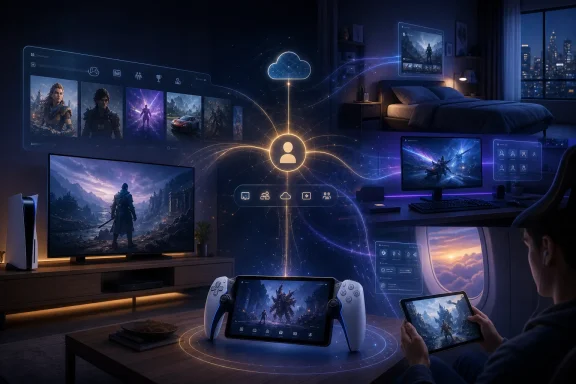 Sony Is No Longer Pretending the Couch Is the Center of Gaming
For three decades, PlayStation has been defined by a simple domestic geography: the console lives near the largest screen in the house, the controller lives on the coffee table, and the player comes to it. Sony’s latest investor language does not renounce that model, but it does quietly demote it. The living room is no longer framed as the natural endpoint of console design.That shift matters because Sony is not speaking here to enthusiasts on a showcase stream. It is speaking to investors, which means the vocabulary is colder and more revealing. Phrases like “usage styles,” “play styles,” “profitability,” and “customer lifetime value” are not fan-service slogans; they are the grammar of platform management.
The handheld speculation is therefore understandable, but it risks narrowing the story too much. Sony did not say “PSP 3,” “PS Vita 2,” or “PS6 Portable.” What it said was that future PlayStation experiences should be seamless across different places and usage scenarios, and that dedicated hardware remains important because it removes friction between intent and play.
That is the real thesis hiding in the investor document. Sony is not merely considering a portable device. It is trying to redesign PlayStation around the idea that convenience, continuity, and device choice are now part of the premium console experience.
The Portal Was the Test Balloon, Not the Destination
The PlayStation Portal looked strangely conservative when it arrived. It was not a Vita successor, not a Steam Deck rival, and not a general-purpose Android handheld. It was a Remote Play screen with DualSense grips attached, locked to the PlayStation ecosystem and dependent on network quality.That made it easy to dismiss as an accessory for people with very specific household problems: one television, one PS5, and too many people competing for the display. But Sony’s latest comments make the Portal look less like a one-off and more like a live experiment in post-living-room PlayStation design.
Sony’s executives describe the Portal as a device meant to reliably deliver a PlayStation experience where smartphone touch controls and PC keyboard-and-mouse setups are less suitable. That distinction is important. Sony is not simply saying that games can technically be streamed to anything; it is saying the PlayStation experience requires a controlled input and display environment.
This is where Sony’s strategy diverges from the most maximalist version of cloud gaming. Microsoft has spent years arguing that Xbox should exist wherever a screen and controller can be found. Sony is making a narrower argument: PlayStation can travel, but it should travel in forms that preserve the feel and commercial structure of PlayStation.
The Portal also gave Sony a way to measure demand without committing to a full handheld platform. It could observe how many players wanted off-TV access, how much they tolerated streaming dependency, and whether PlayStation Plus cloud streaming could become more than a feature buried in a subscription tier. In investor language, the Portal is not nostalgia; it is market research with a retail price.
A Real Handheld Would Solve One Problem and Create Three More
The dream version of a next-generation PlayStation handheld is obvious. It runs PlayStation games natively, syncs instantly with a home console, plays digital libraries without fuss, and gives Sony its own answer to the Steam Deck, Nintendo Switch, and the growing Windows handheld market. For players, the appeal is immediate. For Sony, the engineering and business trade-offs are brutal.A native handheld tied to the next PlayStation generation would force Sony to make hard decisions about performance targets. If developers must support both a powerful home console and a much weaker portable, the handheld becomes either a baseline constraint or a second-class target. Nintendo has built its modern hardware strategy around that compromise; Sony’s cinematic first-party identity is less forgiving.
There is also the matter of price. Sony told investors it does not intend to sell hardware at significant losses, while also acknowledging component cost pressures. That is a polite way of saying the old console bargain — subsidize the box, make it back on software — is much less comfortable in 2026 than it was in earlier cycles.
A PlayStation handheld that natively runs modern AAA games would not be cheap. Fast memory, a capable processor, storage, battery, thermals, display quality, and controller hardware all collide in a small chassis. The Steam Deck normalized the idea of PC-class portable gaming, but it did not repeal physics or margins.
The alternative is a thinner cloud-first or remote-first device, which is cheaper and easier to manage but less transformative. That path extends the Portal concept rather than replacing it. It also asks players to accept that “portable PlayStation” may mean “portable access to a PlayStation service,” not a self-contained machine in the PSP tradition.
Sony’s Pricing Message Is the Other Half of the Hardware Hint
The most revealing part of Sony’s Q&A may not be the phrase “beyond the living room.” It may be the blunt admission that Sony is not planning to absorb all component cost increases or sell hardware at heavy losses. In a normal console cycle, that would be background financial housekeeping. In the run-up to a new generation, it becomes strategic messaging.Sony is preparing the market for a more expensive idea of console ownership. The PS5 generation has already seen price increases in several regions, a premium PS5 Pro tier, and an accessories ecosystem that stretches far beyond the base console. The next PlayStation may continue that segmentation rather than reset the clock with a single mass-market box.
That has consequences for a possible handheld. If Sony refuses deep hardware subsidies, a portable device has to justify itself either as a premium accessory, a lower-cost cloud terminal, or a separate entry point with carefully managed expectations. None of those options recreates the old handheld-console fantasy exactly.
It also means Sony’s next-gen hardware strategy may become more tiered. There could be a powerful home console for enthusiasts, a remote or cloud device for flexible access, and peripherals designed to pull players away from the shared television. Sony does not need to announce three consoles for this logic to take hold; it only needs to stop treating the home console as the sole physical expression of PlayStation.
The phrase dedicated gaming device is doing a lot of work here. Sony still believes specialized hardware matters, but it is redefining specialization around experience rather than raw silicon. A device can be dedicated because it runs games locally, because it provides the right controller and screen for streaming, or because it keeps users inside the PlayStation commercial loop.
The PC Migration Is Forcing Sony to Compete With Habits, Not Just Hardware
One investor question cut directly to the behavior Sony is trying to reverse: players who shifted toward gaming PCs during the pandemic years. That migration was never only about performance. It was about desks, monitors, Discord, mods, ultrawide displays, multitasking, and the habit of gaming in spaces that are not the living room.Sony’s answer was telling. It talked about personal monitors, speakers, and breaking the fixed perception that PlayStation equals the living room. That is not the language of a company merely defending console exclusives. It is the language of a platform trying to follow users into the places where they now actually play.
This is why a handheld focus makes strategic sense even if the final product is not a traditional handheld. Portable and semi-portable play is part of a larger shift toward flexible gaming contexts. People play on couches, beds, desks, trains, hotel Wi-Fi, second screens, and office monitors after hours. The console that demands a single location can start to feel anachronistic, even when it remains technically powerful.
The Windows handheld boom has made this pressure visible. Devices from Valve, ASUS, Lenovo, MSI, and others have shown that players will accept compromises for the ability to carry large libraries around. Those devices are often messy, battery-limited, and interface-challenged, but they have one unbeatable advantage: they meet players where they are.
Sony’s challenge is that PlayStation’s strength has always been curation and simplicity. A PlayStation handheld cannot simply become a Windows handheld with a different logo. It has to feel more immediate, more polished, and more console-like, or it risks entering a market where PC flexibility wins by default.
Cloud Gaming Is Back, but Sony Is Still Afraid of Bad First Impressions
Sony’s cloud comments are cautious in a way that should reassure anyone who remembers the industry’s overpromising phase. The company says network conditions still determine the quality of the experience, and poor performance can quickly erode trust. That is a remarkably sober line in a market that has often treated latency as a branding problem.This caution explains why Sony has not rushed to make PlayStation cloud gaming a fully device-agnostic service. Streaming to phones and PCs sounds obvious on a slide deck, but Sony worries about input mismatch, display quality, network inconsistency, and the general-purpose clutter that sits between the player and the game. In other words, it sees openness as both an opportunity and a quality-control risk.
The Portal gives Sony a more controlled cloud endpoint. It has PlayStation controls, a predictable screen size, and a user expectation shaped around console play. If the network fails, the experience still suffers, but the failure is less likely to be blamed on a random phone controller, browser quirk, or office Wi-Fi setup.
That may point toward Sony’s preferred handheld future: not a single device that replaces the console, but a family of controlled endpoints that make PlayStation feel portable without surrendering the platform to every generic screen. It is less romantic than a new Vita, but it is far more aligned with Sony’s current business model.
The catch is that cloud gaming is only as good as the infrastructure and subscription economics behind it. Sony says PlayStation Plus will help recover cloud infrastructure costs. That means the handheld future may be inseparable from the subscription future, whether players like that or not.
Backward Compatibility Is the Quiet Engine of the Next Generation
Sony also emphasized that backward compatibility and digitization have expanded the reach of content. This is not a throwaway observation. If the next PlayStation is going to span more devices and locations, the digital library becomes the glue that makes the strategy credible.A handheld or cloud-first device is much easier to sell if it arrives with access to a player’s existing purchases, subscriptions, saves, and social graph. Without that continuity, Sony would be asking users to start another ecosystem inside the ecosystem. With it, the pitch becomes simpler: your PlayStation follows you.
This is one reason the PS4-to-PS5 transition was so important. Sony entered the PS5 generation with far better continuity than it had in earlier hardware transitions. Digital purchases, cross-generation releases, upgrades, and PS Plus libraries helped soften the old reset-button effect of a new console.
For the next generation, that continuity will likely be even more central. Sony cannot credibly sell a flexible PlayStation ecosystem if every device has a different compatibility story. The more hardware forms Sony introduces, the more important it becomes that the user’s library behaves like a platform asset rather than a console-specific archive.
That is also why the handheld rumor is plausible but incomplete. The product only matters if the library strategy works. A beautiful portable PlayStation with fragmented compatibility would be a curiosity; a competent device with broad access to existing PlayStation content could become a daily-use machine.
The First-Party Strategy Still Anchors the Whole Experiment
Sony’s executives were careful to remind investors that first-party games remain a core reason people enter the PlayStation ecosystem, even if third-party software drives most sales. That distinction is central to understanding the next-gen strategy. PlayStation hardware is not valuable merely because it exists; it is valuable because it is the most controlled place to experience PlayStation’s software identity.That identity has been under strain. Development cycles are longer, budgets are larger, and live-service bets have produced mixed results. Bungie’s struggles and Sony’s broader studio recalibrations have made it harder to pretend that first-party prestige alone can carry every strategic risk.
Still, Sony’s most durable advantage is not a spec sheet. It is the promise that certain games will feel native to PlayStation first, whether through DualSense features, performance tuning, timed exclusivity, or simple brand association. If the next generation expands beyond the television, Sony has to extend that feeling with it.
That makes handheld design more complicated. A portable PlayStation that plays only a subset of games risks weakening the brand promise. A portable that streams everything depends on networks. A portable that runs everything natively risks cost, battery, and developer complexity. Sony’s first-party ambitions make each compromise more visible.
This is the tension behind the entire strategy. Sony wants PlayStation to be more accessible and more flexible, but it cannot let PlayStation become generic. The company is trying to escape the living room without losing the premium aura that made the living-room box valuable in the first place.
Nintendo Won the Hybrid Argument, but Sony Cannot Copy It Cleanly
The obvious comparison is Nintendo, but it is also the most misleading. The Switch made hybrid play mainstream by designing an entire software and hardware ecosystem around portability from the beginning. Its technical ceiling was lower, but its usage model was coherent. Docked and handheld were two modes of the same machine.Sony’s problem is different. PlayStation has spent years competing at the high end of console fidelity, with blockbuster games designed for large screens, powerful hardware, and cinematic presentation. Translating that directly into a handheld-first model would either raise costs dramatically or force developers to design around a lower portable baseline.
That does not make a PlayStation handheld impossible. It makes it strategically delicate. Sony could offer a companion device that streams from the console or cloud. It could release a premium native handheld that targets lower resolutions and adaptive performance. It could create a split platform where not every game runs everywhere. Each option solves one problem by creating another.
Nintendo’s lesson is not that every console must become a handheld. The lesson is that hardware form affects software culture. If Sony truly wants PlayStation to move beyond the living room, it will need more than a device; it will need development tools, certification rules, save-sync reliability, store design, and UI assumptions that treat mobility as normal.
This is where WindowsForum readers should pay attention. The most interesting competition may not be Sony versus Nintendo, but Sony versus the PC ecosystem. Windows handhelds are clunky, but they inherit decades of software compatibility. Sony’s advantage is polish; its disadvantage is control.
The Next Console War May Be a War Over Friction
Console generations used to be fought over graphics, exclusives, and price. Those still matter, but the next fight may be about friction. How quickly can a player resume a game? How many screens can they use? How much does the system care where they are? How often does the platform ask them to think like a technician?Sony’s investor language repeatedly returns to immediacy. Dedicated devices matter because they reduce the layers between the player and the game. That is a subtle but important critique of PC gaming and general-purpose devices. Power is not the only metric; the path from desire to gameplay is part of the product.
This has always been the console argument, but it now has to be re-made in a world of handheld PCs, cloud gaming, remote play, and cross-platform libraries. A console cannot merely be simpler than a PC when sitting under a television. It has to remain simpler across a web of devices and locations.
That is difficult because complexity tends to leak. Add cloud streaming, remote play, multiple hardware tiers, cross-generation libraries, and subscription entitlements, and the elegant console experience can become a permissions puzzle. Sony’s challenge is to hide that machinery without taking away the flexibility players now expect.
If it succeeds, the next PlayStation could feel less like a single machine and more like a managed environment for high-end gaming. If it fails, it risks the worst of both worlds: less open than PC, less portable than Nintendo, and more expensive than either casual players expect.
The Handheld Rumor Is Plausible Because the Business Model Wants It
Rumors of multiple next-generation PlayStation devices, including a handheld, should be treated as unconfirmed. Sony has not announced the PS6, has not named a handheld, and has not given a launch window or price. But the business logic behind those rumors is no longer fringe speculation.Sony wants more touchpoints with players. It wants recurring revenue through PlayStation Plus, add-on content, and digital spending. It wants to increase customer lifetime value without chasing monthly active users at any cost. A handheld or portable endpoint fits neatly into that agenda.
More play sessions mean more store visits, more subscription value, more engagement, and more reasons not to drift to PC. Even a device that does not generate massive standalone profit could strengthen the ecosystem if it increases the frequency and convenience of play. That is exactly how platform companies think.
The danger is that players do not experience “customer lifetime value.” They experience prices, batteries, latency, storage limits, subscription prompts, and whether their games work. Sony’s investor logic may be sound, but the consumer product must survive a much harsher test: does it make playing games feel easier?
This is why the hardware-loss comment matters so much. If Sony asks players to pay premium prices for flexibility, the execution has to be excellent. A half-step handheld with too many caveats could feel less like the future of PlayStation and more like a monetized workaround for a problem Sony created by clinging too long to the television.
The PlayStation Ecosystem Is Becoming the Product
The cleanest way to read Sony’s comments is that the PlayStation ecosystem is replacing the PlayStation console as the company’s primary product. The console remains essential, but it is increasingly one node in a broader system of devices, services, accessories, content, accounts, and cloud infrastructure. That is not a retreat from hardware. It is a redefinition of what hardware is for.In that model, the next-generation console does not have to carry the entire brand alone. A home system can provide power. A portable device can provide access. Monitors and speakers can reposition PlayStation at the desk. Cloud streaming can extend the library. PS Plus can monetize continuity.
This is also why Sony is being careful about PC. It wants the reach of PC releases for selected games, especially live-service titles, but it does not want PlayStation hardware to become irrelevant. The company’s stated approach is cautious expansion beyond console without becoming constrained by its own hardware ecosystem. That is a delicate sentence because it points in two directions at once.
For players, the result may be a more flexible PlayStation but also a more segmented one. The simple choice between buying or not buying a console may become a set of decisions about which device, which subscription tier, which screen, which library rights, and which level of portability. Ecosystems create convenience, but they also create toll roads.
The best version of this future is compelling. Imagine a PlayStation account where a game can be started on a powerful home console, continued on a handheld in another room, streamed while traveling, and revisited from older generations without a compatibility headache. The worst version is equally easy to imagine: expensive hardware, confusing entitlements, uneven streaming, and a subscription layer that feels less optional every year.
The Living-Room Console Just Became One PlayStation Device Among Many
The practical reading of Sony’s investor message is not that a PS6 handheld is guaranteed. It is that Sony is preparing for a generation in which PlayStation must compete across locations, not just across teraflops. That makes the next hardware cycle more interesting — and riskier — than a conventional PS5 successor would be.- Sony has confirmed investment in the next-generation PlayStation platform, but it has not announced final hardware, pricing, or launch timing.
- The company’s repeated “beyond the living room” language makes a stronger portable or companion-device strategy plausible, even without confirming a native handheld.
- PlayStation Portal now looks like an early test of controlled portable access rather than an isolated accessory experiment.
- Sony’s refusal to sell hardware at significant losses suggests any next-generation device lineup may be more expensive or more carefully segmented than past console launches.
- Cloud gaming is likely to matter more, but Sony is still prioritizing controlled quality over rapid expansion to every phone, browser, and PC.
- Backward compatibility, digital libraries, and PlayStation Plus will be central if Sony wants multiple devices to feel like one coherent platform.
References
- Primary source: The Indian Express
Published: 2026-06-30T08:30:13.084000
Loading…
indianexpress.com - Related coverage: gamesradar.com
Loading…
www.gamesradar.com - Related coverage: techradar.com
Loading…
www.techradar.com - Related coverage: overclock3d.net
Loading…
overclock3d.net - Related coverage: gamespot.com
Loading…
www.gamespot.com - Related coverage: playstationlifestyle.net
Loading…
www.playstationlifestyle.net
- Related coverage: lowyat.net
Loading…
www.lowyat.net - Related coverage: ps-gaming.com
Loading…
www.ps-gaming.com - Related coverage: sony.com
Loading…
www.sony.com - Related coverage: digitaltrends.com
Loading…
www.digitaltrends.com - Related coverage: tomsguide.com
Loading…
www.tomsguide.com - Related coverage: pdf.indianexpress.com
Loading…
pdf.indianexpress.com - Related coverage: sony.net
Loading…
www.sony.net