Sophos’ decision to surface its Intelix threat intelligence inside Microsoft’s Copilot ecosystem marks a practical inflection point: high-fidelity telemetry and sandbox analysis that once lived behind SOC consoles are now available inside Microsoft Security Copilot and Microsoft 365 Copilot, promising faster triage for analysts and on‑the‑spot checks for everyday users — but also introducing new governance, data‑handling, and agent‑attack considerations that organizations must manage before flipping the switch.
Sophos announced general availability for the Sophos Intelix integrations with Microsoft Security Copilot and Microsoft 365 Copilot following demonstrations and partner activity at Microsoft Ignite. The company frames the move as making enterprise‑grade threat intelligence universally accessible inside Microsoft’s agentic AI surfaces, and it positions Sophos Intelix as the enrichment layer that supplies reputation lookups, sandbox detonation results, prevalence data, and natural‑language explanations directly into Copilot workflows. The underlying business case is straightforward: modern SOCs and IT teams face alert fatigue and rapid attacker timelines, so embedding authoritative context where analysts and knowledge workers already operate reduces context switching, shortens investigation loops, and — in theory — reduces dwell time. Sophos points to its Sophos Central telemetry (reported as more than 223 terabytes of telemetry daily, 34+ million detections, and 11+ million automated blocks per day) as the data backbone that feeds Intelix. These figures are consistent across Sophos’ public material but are company‑reported metrics that should be validated in procurement and pilots.
Before broad rollout, organizations must validate Sophos’ telemetry claims in representative pilots, design strict DLP and consent rules for Copilot flows, budget for metered compute and sandbox usage, and treat LLM outputs as decision‑support rather than a final authority. When those controls are in place, Intelix inside Copilot can be a meaningful force multiplier for defenders; without them, the integration risks becoming another ungoverned automation that amplifies attacker techniques.
Sophos has made the capability broadly available and Microsoft has delivered the control plane to run it — the next step falls to security teams: pilot smart, govern strictly, and measure outcomes carefully.
Source: Independent Newspaper Nigeria Sophos Integrates Advanced Cyber Intelligence Into Microsoft Security Copilot, Microsoft 365 Copilot | Independent Newspaper Nigeria
 Background
Sophos announced general availability for the Sophos Intelix integrations with Microsoft Security Copilot and Microsoft 365 Copilot following demonstrations and partner activity at Microsoft Ignite. The company frames the move as making enterprise‑grade threat intelligence universally accessible inside Microsoft’s agentic AI surfaces, and it positions Sophos Intelix as the enrichment layer that supplies reputation lookups, sandbox detonation results, prevalence data, and natural‑language explanations directly into Copilot workflows. The underlying business case is straightforward: modern SOCs and IT teams face alert fatigue and rapid attacker timelines, so embedding authoritative context where analysts and knowledge workers already operate reduces context switching, shortens investigation loops, and — in theory — reduces dwell time. Sophos points to its Sophos Central telemetry (reported as more than 223 terabytes of telemetry daily, 34+ million detections, and 11+ million automated blocks per day) as the data backbone that feeds Intelix. These figures are consistent across Sophos’ public material but are company‑reported metrics that should be validated in procurement and pilots. Overview: What Sophos Intelix brings into Microsoft Copilot
Core capabilities exposed inside Copilot
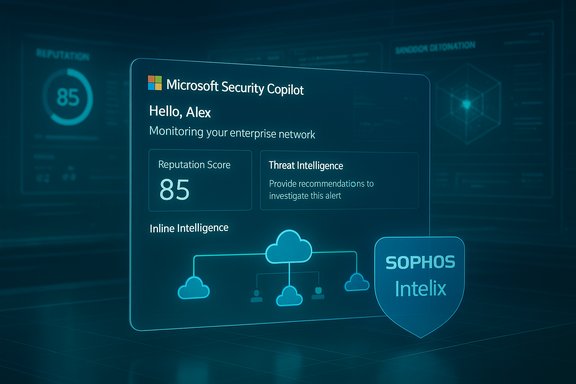
- Reputation lookups for file hashes, URLs, IPs and domains — returned inline in Copilot chat and Security Copilot investigations.
- Dynamic analysis / sandbox detonation summaries that reveal behavioral indicators when a binary is executed in a controlled environment.
- Prevalence and attribution data drawn from Sophos X‑Ops telemetry (how widely an IOC has been seen, campaign links).
- Natural‑language enrichment so analysts and non‑technical users can ask Copilot plain‑English questions and receive Intelix‑enriched, explainable answers.
Where intelligence appears in practice
- Inside Security Copilot, analysts can enrich alerts and incident timelines with Intelix context without switching consoles.
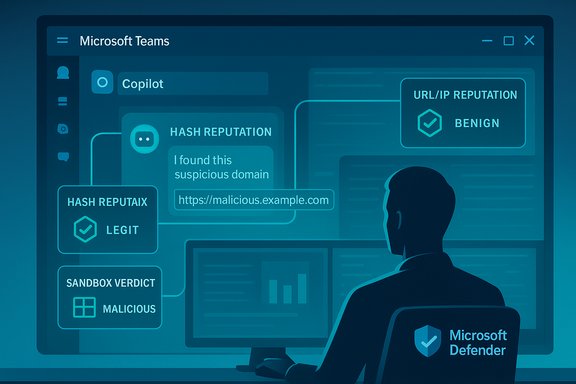
- Inside Microsoft 365 Copilot and Teams, IT admins and business users can ask, in natural language, whether a link or file is associated with malicious activity and get an authoritative Intelix verdict inline.
How the integration works (technical mechanics)
Model Context Protocol (MCP) and agent architecture
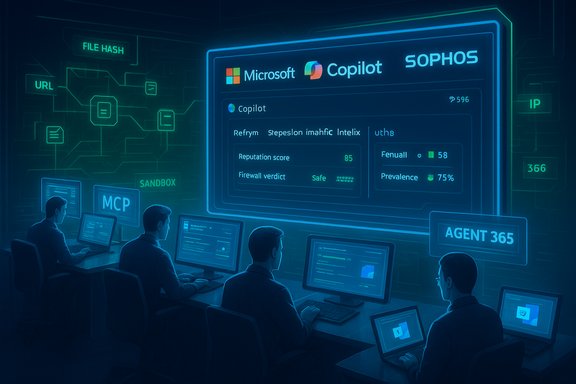
- Sophos exposes Intelix as an MCP‑capable agent that Copilot agents call for context requests.
- Copilot or Security Copilot sends structured queries (hash, URL, IP) to the Sophos Intelix agent; the agent returns structured responses (reputation score, sandbox verdict, prevalence metrics) that Copilot integrates into conversational or investigation outputs.
- Agent actions are tracked through Agent 365 and Microsoft Entra identities so administrators can audit, revoke, and manage agent lifecycles.
Where sandboxing and detonation live
Sophos advertises both cloud lookups and dynamic sandboxing as part of Intelix. Practical deployments can route certain files for detonation to Sophos X‑Ops sandbox environments, returning behavioral summaries to the querying Copilot instance. That capability accelerates IOC enrichment but also raises the operational cost profile (compute, storage, and metered Copilot/SCU usage) and privacy considerations (sending artifacts to an external analysis service).Practical benefits — what organizations actually gain
For SOCs and incident responders
- Faster triage: Replace manual reputation queries across multiple consoles with one Copilot query that returns reputational context, sandbox verdicts, and prevalence metrics.
- Richer context: Merging Microsoft telemetry (Defender, Sentinel, Intune, Entra) with Intelix enrichment can yield more actionable incident summaries and reduce time‑to‑containment.
- Integrated playbooks: Enriched outputs can feed automated or suggested playbook steps (isolate endpoint, revoke tokens, block domain), trimming the investigation‑to‑response cycle.
For IT administrators and business users
- Democratized intelligence: Non‑SOC staff can verify links, files, or domains inside Teams or Copilot chat, avoiding unnecessary escalations and empowering faster, safer decisions.
- Workflow continuity: Keeping threat checks inside productivity apps reduces friction and enhances security hygiene among users who encounter suspicious artifacts daily.
For MSPs and SMBs
- Enterprise‑grade telemetry at lower friction: Small teams gain access to the same Intelix data SOCs use, which can materially improve early detection and containment for under‑resourced organizations.
- Operational economics: When paired with Microsoft Copilot licenses, some enrichment steps may be effectively free to the user, but meter‑based compute and sandbox detonation can introduce variable costs. Verify entitlements and SCU billing before wide rollout.
Risks, limitations and governance considerations
Vendor‑reported claims require validation
Sophos’ telemetry statistics (223+ TB/day, 34+ million detections, 11+ million blocked threats, 600,000 protected organizations) are published by the vendor and repeated across partner channels. These figures are useful to understand scale but are vendor‑reported and not independent audits; procurement teams should insist on trial tests, representative telemetry validation, and SLAs where numbers are material to purchasing decisions.New attack surface: agent abuse and prompt injection
Introducing third‑party agents and LLM‑mediated flows creates fresh attack vectors:- Prompt injection & manipulation: When external intelligence is pulled into LLM workflows, crafted inputs can attempt to influence Copilot outputs or automation decisions. Organizations should require human authorization for high‑impact actions and validate suggested remediation against raw telemetry.
- Agent hijacking / OAuth token theft: Researchers have demonstrated social engineering techniques that weaponize agent interfaces to steal OAuth tokens or grant privileges to malicious agents. Microsoft and the community have raised CoPhish‑style concerns for Copilot Studio agents; tenant admins must control agent consent and monitor app activity.
Data handling and privacy boundaries
- What gets sent externally? Some lookups require sending file hashes only; others may involve uploading artifacts for sandbox detonation. Organizations must define DLP rules for Copilot and Teams and decide which content classes may leave the tenant boundary.
- Retention and logging: Verify retention policies for submitted artifacts and the degree to which Sophos logs and stores detonation outputs. Contractual terms and data processing agreements must be examined for regulated workloads.
Operational costs and metering
- Microsoft’s agent model applies Security Compute Units (SCUs) and other metering for agent execution. Heavy use of sandbox detonation or automated agent workflows can generate metered charges; estimate these in pilot phases and include caps or alerts in procurement.
Model risks and false confidence
- LLM‑mediated summaries are powerful but imperfect. Treat Copilot outputs enriched with Intelix as high‑quality inputs, not infallible or as sole evidence for destructive remediation actions. Retain human‑in‑the‑loop approval for containment steps that have business impact.
Independent verification and corroboration
The headline — that Sophos Intelix integrates with Microsoft Security Copilot and Microsoft 365 Copilot — is confirmed in Sophos’ official press release and product blog. Independent technology outlets and trade press have reproduced and summarized the announcement, confirming the feature set and platform mechanics described. Microsoft’s Ignite Book of News documents the platform features (Agent 365, Security Store, Copilot Studio) that make the integration operational. Those cross‑checks establish both the vendor announcement and the Microsoft platform features that deliver the integration. Still, telemetry and scale numbers remain company‑reported and should be validated in trials.A short, practical playbook for Windows‑centric IT and security teams
- Inventory: Identify teams that will need Intelix lookups (SOC, IR, Helpdesk, IT ops).
- Governance setup: Register the Sophos Intelix agent in Agent 365, assign a minimal Entra agent identity, and apply RBAC to limit who can invoke the agent.
- Pilot: Run a scoped pilot in a non‑production workspace to measure enrichment latency, false positive/false negative impacts, and SCU consumption for sandbox detonations. Log every Intelix call.
- Data controls: Create Copilot/Teams DLP rules to block regulated or sensitive content from being submitted for detonation; require hashes where possible.
- Playbook updates: Incorporate Intelix‑enriched steps into existing incident response playbooks and require human authorization for destructive actions recommended by Copilot.
- Procurement: Confirm licensing, SCU billing, and any limits or caps with both Microsoft and Sophos. Include usage thresholds and audit rights in contracts.
- Training: Train analysts on interpreting sandbox summaries and prevalence data; treat Intelix as an enrichment source, not a single source of truth.
Deployment checklist (concise)
- Enable Agent 365 lifecycle controls and audit logging.
- Configure Copilot DLP and Purview controls to limit artifact sharing.
- Pilot sandboxing with a capped monthly detonation budget to model costs.
- Add manual approval gates for any Copilot‑suggested containment.
Strengths — what Sophos + Microsoft Copilot gets right
- Reduced context switching: Having authoritative reputation and detonation context inside Security Copilot materially speeds triage for SOC analysts and cuts the manual lookup cycle.
- Democratized threat checks: Embedding Intelix into Microsoft 365 Copilot pushes basic IOC checks to IT admins and business users, improving baseline security hygiene.
- Platform governance: The Agent 365 control plane and Entra‑based identities provide a meaningful governance model to discover, manage, and deprovision agents, which is necessary to scale agentic automation safely.
- Extensibility via MCP: Using MCP (Model Context Protocol) supports a standard way to link generative AI to vendor intelligence, opening the door to multi‑vendor agent integrations over time.
Weaknesses and unanswered questions
- Vendor metrics vs. independent validation: The telemetry numbers Sophos publishes are persuasive but vendor‑sourced; organizations should require trial evidence and representative telemetry for procurement.
- Cost transparency: Metered SCU pricing and sandbox detonation compute are non‑trivial; unclear consumption patterns at scale can lead to unexpected bills unless the pilot models usage upfront.
- Agent security posture: Copilot Studio and agent UX make it easier to create agents; however, social engineering and consent abuse (e.g., CoPhish‑style flows) remain a concrete risk that tenants must mitigate through consent policies and monitoring.
- Overreliance on LLM summaries: Analysts can become overconfident in natural‑language summaries; organizations must keep raw telemetry and forensic evidence available in parallel.
Final analysis — who should enable the Intelix agent, and when
- Large enterprises and mature SOCs: Highly likely to benefit from immediate deployment in Security Copilot if they already use Microsoft Defender, Sentinel, and Copilot. The key requirement is a mature identity, logging, and DLP posture to manage agent scope and artifact flows.
- MSPs and MSSPs: Offer a fast win — integrating Intelix can raise detection fidelity for customers and enable more consistent enrichment across client engagements, but MSPs must model metered costs and multi‑tenant auditability first.
- SMBs with limited security staff: The Microsoft 365 Copilot integration offers immediate, practical value by embedding simple checks into Teams and Outlook, but SMBs should start with read‑only lookups (hashes, reputation) rather than artifact detonation.
- Regulated workloads: Pause and assess. Regulated sectors (healthcare, finance, government) should validate data residency, DPA coverage, and retention guarantees before enabling artifact submission to external sandboxes.
Conclusion
The Sophos Intelix integrations into Microsoft Security Copilot and Microsoft 365 Copilot are a clear and practical extension of two converging trends: vendors exposing authoritative telemetry and evidence as services, and platform owners embedding third‑party intelligence into agentic AI workflows under enterprise governance. For Windows‑centric IT and security teams the promise is tangible — faster investigations, more informed playbooks, and security checks inside the tools people already use — but the gain comes with real responsibilities.Before broad rollout, organizations must validate Sophos’ telemetry claims in representative pilots, design strict DLP and consent rules for Copilot flows, budget for metered compute and sandbox usage, and treat LLM outputs as decision‑support rather than a final authority. When those controls are in place, Intelix inside Copilot can be a meaningful force multiplier for defenders; without them, the integration risks becoming another ungoverned automation that amplifies attacker techniques.
Sophos has made the capability broadly available and Microsoft has delivered the control plane to run it — the next step falls to security teams: pilot smart, govern strictly, and measure outcomes carefully.
Source: Independent Newspaper Nigeria Sophos Integrates Advanced Cyber Intelligence Into Microsoft Security Copilot, Microsoft 365 Copilot | Independent Newspaper Nigeria