

Sophos’ announcement that Sophos Intelix is now integrated with Microsoft Security Copilot and Microsoft 365 Copilot marks a clear inflection point in how threat intelligence is delivered to both specialist security teams and everyday business users—bringing high-fidelity telemetry, reputation lookups, sandbox detonation results and prevalence data into Microsoft’s generative-AI assistants and agent framework. The move promises faster triage and enrichment for SOC analysts while extending accessible intelligence into Microsoft 365 workflows used by IT admins, risk managers and frontline staff, but it also amplifies a familiar trade-off: vastly improved operational speed and context versus new attack surfaces and governance challenges introduced by agentic AI integrations.
Sophos has expanded the reach of its threat-intelligence platform, Sophos Intelix, by connecting it to the Microsoft Copilot ecosystem—specifically Microsoft Security Copilot and Microsoft 365 Copilot—so that analysts and knowledge workers can query Sophos intelligence inside Copilot chat, Teams, and Security Copilot investigative workflows. The integration surfaced at Microsoft Ignite and follows Sophos’ broader push to productize and expose Sophos X‑Ops intelligence (the company’s combined telemetry, sandboxing and expert analysis) through APIs and agent endpoints. Sophos publicly states that its telemetry pipeline processes more than 223 terabytes of telemetry daily, produces 34+ million detections and automatically blocks 11+ million threats per day—figures the company uses to underline the breadth of data fueling Intelix. These performance and scale claims are reported directly by Sophos. Microsoft’s Copilot ecosystem now includes mechanisms for third‑party agents (a Security Store and agent framework), an “Agent 365” control plane to register and manage autonomous agents, and Copilot Studio for creators to connect external services via the Model Context Protocol (MCP) and other secure connectors. Those platform capabilities are the delivery path for Sophos Intelix’s lookups and analysis inside Microsoft products. Microsoft documentation describes a Security Store for agents and explains how third‑party agents are discovered and deployed inside Security Copilot, while press coverage around Microsoft Ignite also outlines the Agent 365 control layer and enterprise management workflows.
Source: The Manila Times Sophos Integrates Advanced Cyber Intelligence into Microsoft Security Copilot and Microsoft 365 Copilot
 Background / Overview
Sophos has expanded the reach of its threat-intelligence platform, Sophos Intelix, by connecting it to the Microsoft Copilot ecosystem—specifically Microsoft Security Copilot and Microsoft 365 Copilot—so that analysts and knowledge workers can query Sophos intelligence inside Copilot chat, Teams, and Security Copilot investigative workflows. The integration surfaced at Microsoft Ignite and follows Sophos’ broader push to productize and expose Sophos X‑Ops intelligence (the company’s combined telemetry, sandboxing and expert analysis) through APIs and agent endpoints. Sophos publicly states that its telemetry pipeline processes more than 223 terabytes of telemetry daily, produces 34+ million detections and automatically blocks 11+ million threats per day—figures the company uses to underline the breadth of data fueling Intelix. These performance and scale claims are reported directly by Sophos. Microsoft’s Copilot ecosystem now includes mechanisms for third‑party agents (a Security Store and agent framework), an “Agent 365” control plane to register and manage autonomous agents, and Copilot Studio for creators to connect external services via the Model Context Protocol (MCP) and other secure connectors. Those platform capabilities are the delivery path for Sophos Intelix’s lookups and analysis inside Microsoft products. Microsoft documentation describes a Security Store for agents and explains how third‑party agents are discovered and deployed inside Security Copilot, while press coverage around Microsoft Ignite also outlines the Agent 365 control layer and enterprise management workflows. What Sophos Intelix Adds to Microsoft Copilot
Core capabilities exposed inside Copilot
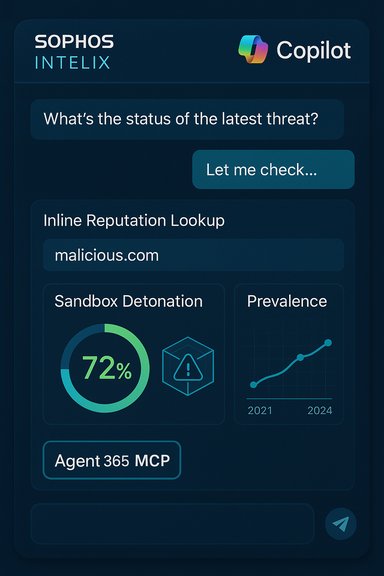
- Reputation lookups: File hash, URL, IP and domain reputation queries delivered at chat speed inside Copilot and Security Copilot to accelerate IOC (indicator of compromise) investigations.
- Sandbox and dynamic analysis: Detonation results and behavioral summaries that give analysts immediate context on how a suspicious binary behaves in a controlled environment.
- Prevalence and attribution: Global telemetry-derived metrics that indicate how widespread an indicator is and correlations to threat actors or campaigns discovered by Sophos X‑Ops.
- Natural‑language enrichment: Analysts can ask Copilot for “tell me everything about this hash, where it’s been seen and whether it’s linked to credential theft” and receive Intelix-enriched answers inside the same chat flow.
How this maps to typical SOC workflows
- Alert triage: Security Copilot ingests alerts from Defender, Sentinel, and other telemetry sources; Intelix enrichment reduces manual lookups by returning verdicts and sandbox summaries inline.
- Investigation: Analysts can rapidly pivot from timeline evidence to file detonations and reputation checks without leaving the Copilot console.
- Response: Enriched context shortens time-to-decision for containment (isolate endpoint, revoke token, block domain) and helps SOCs apply playbooks with higher confidence.
Why This Matters: Practical Benefits for Organizations
For enterprise SOCs and MSSPs
- Time savings at scale: In a crowded alert environment, having authoritative, contextual intelligence immediately available shortens dwell time. Sophos claims high telemetry volume and automated blocking that underpin Intelix’s data richness—useful for threat hunting and attribution. These numbers come from Sophos’ public statements about Sophos Central and X‑Ops.
- Integrated playbooks: Enriched alerts mean playbooks can be more selective and precise, reducing manual research steps and lowering the cognitive load on analysts.
- Expanded investigator toolkit: Security Copilot’s ability to orchestrate across Defender, Sentinel, Intune and Entra, now plus Intelix lookups, helps draw the full picture faster. Microsoft documents show this multi-product correlation is a core design goal for Security Copilot.
For SMBs and general Microsoft 365 users
- Democratized intelligence: Exposing threat lookups to Microsoft 365 Copilot and Teams embeds threat context into workflows used by IT admins and even non-security staff—improving decision-making (is this link safe? should I escalate this email? without requiring a dedicated SOC specialist.
- Faster validation for suspicious items: Users can query whether a link or file is associated with known malicious activity; this reduces risky behavior and supports security-aware workflows inside the productivity apps they already use.
Operational economics
- Organizations that already pay for Microsoft security and Copilot capabilities can potentially reduce the time analysts spend on manual enrichment and lower the chance that early-stage incidents escalate, which in turn helps contain remediation costs. However, pricing, licensing and compute charges for agent usage and Security Compute Units (SCUs) are separate constructs in Microsoft’s model and must be accounted for by customers. Microsoft’s Security Store documentation explains how agent acquisition and SCU billing are handled.
Technical and Governance Mechanics
How Sophos connects into Copilot (MCP and agent model)
Sophos is using the emerging Model Context Protocol (MCP) and agent plugins so Copilot agents can call Intelix services securely. MCP is being positioned by the vendor community as a standard for external model context access; Sophos’ engineering notes describe an MCP-based agent that supports cloud lookups, static and dynamic analysis. Copilot Studio and the Microsoft Security Store offer the runtime and distribution model on Microsoft’s side. This design enables conversational enrichment while maintaining per-tenant access control and logging through Microsoft’s agent controls.Identity, observability and compliance
- Agent registration and Entra control: Microsoft’s Agent 365 and Entra-based identity management are the control plane for registering agents, granting permissions and managing access across an organization’s tenants. This allows IT to enforce who can use Intelix lookups and what data agents can access. Documentation and press coverage on Agent 365 emphasize the control-plane nature of the product.
- Audit trails: Enterprise deployments require strong logging for regulatory needs. Both Microsoft and Sophos state that agent actions and lookups are auditable—important for incident forensics and compliance.
- Privacy boundary: Sophos says the integration adheres to its Copilot privacy principles and that data passed to Intelix is handled under Sophos’ protections. That said, organizations should review data‑handling and retention policies in both tenant and vendor contracts before broad usage.
Independent Verification — What’s Confirmed and What’s Company-Reported
- Confirmed integration: Sophos publicly announced an Intelix integration with Microsoft Copilot ecosystems (Sophos blog and press release). The mechanism (MCP agent, Copilot Studio, Security Store) is also documented by Microsoft.
- Confirmed Microsoft platform features: The Security Store, agent model and Agent 365 management concepts are documented by Microsoft and independently reported in the press around Ignite.
- Company‑reported telemetry and customer counts: Sophos’ figures for telemetry processed (223+ TB/day), detections (34+ million/day), blocked threats (11+ million/day) and the company’s stated customer base (600,000 organizations) appear in Sophos’ press materials and marketing pages. These are company disclosures—credible and consistent across Sophos’ public channels—but they are not independently audited public metrics. Treat them as vendor-reported.
Strengths and Strategic Upside
- Reduced friction for triage: Analysts can pivot from an alert to Intelix enrichment in seconds—this is a clear, measurable win where time-to-context correlates strongly with containment success.
- Democratization of intelligence: Embedding high‑quality threat data in mainstream productivity tools elevates baseline organizational decisions and reduces reliance on always‑available SOC staff for basic verdicts.
- Agentic automation: With Copilot Studio and Agent 365, Sophos intelligence becomes callable by authorized automation agents—enabling richer automation across playbooks, ticketing and remediation processes.
- Standards-based approach: Using MCP and Microsoft’s published agent model helps make the solution interoperable and easier for engineering teams to adopt in enterprise architectures.
Risks, Attack Surfaces and Operational Caveats
While the benefits are compelling, several non‑trivial risks must be managed before broad rollout.1) Expanded attack surface via agent integrations
Agent frameworks that allow third-party services to perform actions on behalf of users introduce new risk vectors. Researchers recently reported Copilot Studio agents being abused to hijack OAuth tokens and steal credentials via deceptive agent flows—attacks that can compromise account tokens and data if user consent controls and tenant policies are weak. Organizations must harden consent policies, restrict third‑party app permissions and monitor agent activity closely.2) Prompt-injection, data leakage and model exfiltration risk
Embedding threat intelligence inside model-driven workflows creates scenarios where sensitive tenant data could be inadvertently included in model context or responses. Microsoft has responded with prompt-injection detection and runtime protections in Defender and Purview, but customers still need robust DLP policies and careful configuration of Copilot data ingestion settings to prevent inadvertent disclosure. Microsoft’s security blog details additional protections and posture tools aimed at these risks.3) Trust, provenance and false positives/negatives
High‑velocity enrichment can create a false sense of certainty if SOCs treat intel lookups as authoritative without human validation. Threat intelligence can change quickly and telemetry-derived prevalence does not always mean a sample is malicious in a specific environment. Controls should include human validation gates for high‑impact actions and integration of multiple intelligence sources for corroboration.4) Billing, compute and licensing surprises
Microsoft’s agent model and Security Compute Units (SCUs) are separate billing lines; organizations should model expected costs for agent calls, detonation runs and Copilot interactions. What looks functionally “free” in a demo can generate compute, egress or subscription charges in production. Microsoft’s Security Store docs outline agent acquisition and billing separation; expect commercial due diligence when estimating TCO.5) Vendor‑reported metrics require skepticism
Sophos’ telemetry and blocked‑threat counts are meaningful indicators of scale, but they are company‑reported. Use them as context—not definitive proof of superiority—and combine with independent telemetry or case studies where accuracy requirements are critical. Sophos’ press materials make these claims publicly, but enterprises should validate performance via trials or proof-of-value tests.Deployment Guidance — Practical Steps for IT and Security Teams
- Inventory and policy design
- Catalog which tenants and sub-organizations will be permitted to install and use Sophos Intelix agents.
- Define consent policies and restrict app permissions via Microsoft Entra and tenant‑level consent settings.
- Pilot in a controlled SOC
- Start with a small SOC team that tests Intelix enrichment inside Security Copilot while measuring alert-to-action times, false positive rates and analyst satisfaction.
- Audit and alerting
- Ensure agents’ actions are logged centrally and that SCU usage and detonation runs are monitored for anomalous patterns or cost spikes.
- Integrate playbooks carefully
- Only permit automated playbooks to take low-risk, reversible actions (block IP, mark file as suspicious) in early stages. Reserve high‑impact actions (AD resets, tenant‑wide data actions) for human approval.
- Train the organization
- Provide short, role‑specific training for SOC analysts, incident responders, IT admins and business users on what Intelix queries mean, how to interpret prevalence scores and when to escalate.
- Data governance and DLP
- Configure Microsoft Purview and DLP policies to ensure that nothing sensitive is passed to external services unless an approved business case exists. Microsoft’s AI security posture recommendations and Purview controls are relevant checkpoints here.
Realistic Use Cases and Measurable Outcomes
- Measurable reduction in mean time to triage (MTTT): Track before/after triage times in the pilot SOC, especially for alerts involving files and URLs where reputation lookups provide high lift.
- Improved analyst throughput: Monitor alerts handled per analyst per shift and time saved from manual lookups.
- Lowered blast radius from phishing campaigns: If Intelix reputation lookups are integrated into user‑level Copilot flows (e.g., “Is this email link malicious?”), measure the reduction in user-clicks on malicious links via simulated phishing tests.
- Cost‑avoidance from faster containment: Model containment time savings relative to average incident remediation costs to build a business case for Copilot + Intelix investment.
Conclusion — An Important Step, Not a Panacea
Sophos’ integration of Intelix into Microsoft Security Copilot and Microsoft 365 Copilot delivers a practical and immediate productivity boost for analysts and business users alike: better context, faster triage and the opportunity to embed expert threat intelligence into everyday workflows. That advantage is real and verifiable through Sophos’ technical blogs and Microsoft’s agent and Security Store documentation. At the same time, this integration amplifies the industry’s persistent operational challenges: agent governance, prompt‑injection and token‑theft vectors, billing complexity and the need to treat vendor telemetry as one input among many. Organizations adopting these capabilities must pair technical rollout with rigorous policy controls, least‑privilege consent models, careful automation gating and robust audit and DLP mechanisms. Independent coverage of Microsoft’s Agent 365 and documented attacks against Copilot Studio agents underscore why conservative rollout plans are prudent. For Windows and Microsoft‑centric organizations, the path forward is pragmatic: pilot Sophos Intelix enrichment where it offers clear ROI, validate results against multiple intelligence sources, and harden governance before scaling. When these steps are followed, agentic AI and third‑party threat intelligence can become a force multiplier for defenders—delivering faster, more accurate security decisions without compromising control.Source: The Manila Times Sophos Integrates Advanced Cyber Intelligence into Microsoft Security Copilot and Microsoft 365 Copilot
