

Microsoft’s Copilot just picked up one of the fastest-moving — and most controversial — pieces of generative AI: OpenAI’s Sora 2 video model is now accessible inside Microsoft 365 Copilot for commercial Frontier preview customers, bringing studio‑caliber short‑form video generation and cameos directly into productivity workflows.
Microsoft 365 Copilot has spent the last two years evolving from an in‑app assistant into a platform for generative workflows across Word, Excel, PowerPoint, Outlook, Teams, and the broader Copilot Studio ecosystem. The company exposes early features through its Frontier preview program before broader rollouts, and this is the channel Microsoft is using to let commercial customers experiment with Sora 2 inside the Create experience of supported Microsoft 365 apps. OpenAI launched Sora 2 alongside a new Sora app that lets users generate short, synchronized audio‑video clips from text prompts and short source videos. Sora 2 raised eyebrows immediately for producing visually plausible motion, convincing audio sync, and a new cameos capability that allows a verified likeness to be placed into generated scenes with permission controls. OpenAI framed Sora 2 as a step change for text‑to‑video — “a GPT‑3.5 moment for videos,” according to the Sora team’s characterization — and Microsoft has steadily been funneling similar model capability into Bing, Azure, and now Copilot.
This consolidation also places a large amount of generative responsibility on Microsoft as a platform provider. Centralization simplifies governance but raises systemic risk: a flaw in moderation, a provenance bypass, or a misconfigured enterprise policy could scale harmful content quickly across many tenants.
OpenAI and Microsoft have built important safety features into Sora 2 and Copilot, but those mechanisms are mitigations rather than guarantees. Treat Sora 2 inside Copilot as a tool that must be managed, audited, and integrated into established content governance processes — and pilot it conservatively until platform provenance, cross‑platform preservation of metadata, and regional regulatory clarity are proven in real world publishing pipelines.
Source: Windows Central https://www.windowscentral.com/soft...rosoft-365-copilot-adds-openais-viral-sora-2/
 Background
Microsoft 365 Copilot has spent the last two years evolving from an in‑app assistant into a platform for generative workflows across Word, Excel, PowerPoint, Outlook, Teams, and the broader Copilot Studio ecosystem. The company exposes early features through its Frontier preview program before broader rollouts, and this is the channel Microsoft is using to let commercial customers experiment with Sora 2 inside the Create experience of supported Microsoft 365 apps. OpenAI launched Sora 2 alongside a new Sora app that lets users generate short, synchronized audio‑video clips from text prompts and short source videos. Sora 2 raised eyebrows immediately for producing visually plausible motion, convincing audio sync, and a new cameos capability that allows a verified likeness to be placed into generated scenes with permission controls. OpenAI framed Sora 2 as a step change for text‑to‑video — “a GPT‑3.5 moment for videos,” according to the Sora team’s characterization — and Microsoft has steadily been funneling similar model capability into Bing, Azure, and now Copilot. What Sora 2 brings to Microsoft 365 Copilot
Core features now available inside Copilot
- Short‑form text‑to‑video generation: Users can craft brief vertical or landscape clips from prompts, useful for explainer snippets, product demos, social assets, and internal training demos.
- Synchronized audio and voiceover: Sora 2 supports audio that is synchronized to generated visuals, including music and simple dialogue tracks — a major advance over earlier text‑to‑video models that struggled with lip sync and consistent audio alignment.
- Cameos (likeness insertion): A consented, verified mechanism to create and reuse a person’s likeness inside generated videos. Cameos are managed through permission controls so people can grant, revoke, or limit who can use their likeness.
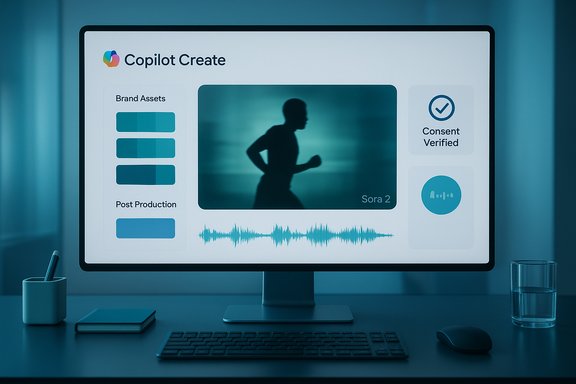
- Brand kit and post‑production controls: Within Copilot’s Create flow, Copilot supports adding brand assets, music, text overlays, and basic trim/edit operations so generated clips can be adjusted to organizational standards before distribution.
- Quotaed access through Frontier: Early access is gated to commercial users in the Frontier program; Microsoft appears to be applying usage quotas and metering to manage compute, moderation, and legal risk. Some field reports reference conservative free quotas (e.g., one draft video per day), but Microsoft has not published fixed public quotas and those numbers remain provisional.
Why this matters for enterprise productivity
Embedding Sora 2 into Copilot closes a long gap between idea and output: marketing teams, internal communications, training groups, and support teams can prototype and iterate short video content without leaving the productivity surface they already use. That lowers friction for quick storytelling and can shrink time‑to‑publish for campaign snippets and explainer clips. Microsoft’s larger play is to make Copilot a multi‑asset creative workspace rather than only a writing assistant.Technical validation and claims
OpenAI and Microsoft both document key safety and provenance controls around Sora 2. OpenAI states that every Sora output includes visible watermarks and embedded provenance metadata using industry standards like C2PA; the company also describes internal reverse‑search tooling that can trace Sora videos back to their source. Microsoft’s enterprise surfaces — Copilot and Azure AI Foundry — inherit model routing, moderation, and enterprise controls that include regional governance, logging, and billing. These are critical technical facts for IT teams assessing risk and auditability. At the same time, several practical claims require cautious interpretation:- Reports of strict free‑tier quotas (“one video per day” in Copilot free trials) originate from field testing and telemetry signals; Microsoft has not published official, universal quota numbers for Copilot‑integrated Sora 2 features and the figure should be treated as provisional.
- OpenAI’s visible watermarking and C2PA metadata are real mitigations, but metadata and watermarks can be removed or cropped, and the efficacy of traceability depends on downstream platforms honoring provenance signals. Enterprises should therefore treat provenance as a mitigation layer rather than an absolute defense.
Safety, legal, and governance implications
Likeness, consent, and the cameo controversy
Sora 2’s cameos let users create a reusable digital likeness through a short capture/verification flow, then control who may use that cameo. OpenAI’s documentation emphasizes consent controls, revocation, and extra guardrails for teen users. That model is a responsive design choice for a technology that quickly touches privacy, publicity, and moral‑rights issues. Still, the legal environment is already contentious. The celebrity video platform Cameo filed a trademark lawsuit against OpenAI over Sora’s use of the term “cameo,” and public figures’ willingness to allow likeness use varies widely; some, like Mark Cuban, have publicly embraced OpenAI’s cameos while others have signaled resistance. The existence of consent controls is important, but organizations must ensure any likeness‑based content in official communications has documented rights and approvals beyond the app’s internal toggles.Moderation and disinformation risk
Video raises moderation costs relative to text and still images: frame‑by‑frame checks, audio analysis, and human review scale poorly and are expensive. Sora 2’s improved realism magnifies the damage potential from misuse — realistic but false videos can harm reputations, propagate misinformation, or breach legal boundaries. Microsoft’s promise of layered moderation and enterprise filtering is necessary, but organizations should assume that automated moderation will produce false negatives and false positives and plan human review loops for high‑risk outputs.Provenance is a partial defense
Both OpenAI and Microsoft emphasize provenance metadata and watermarks and have published guidance on embedding traceability into outputs. These protections help downstream platforms and investigators identify synthetic media, but they rely on the whole supply chain — hosting platforms, social networks, and content management systems — to preserve and honor the metadata. Organizations should not assume provenance metadata will survive every publishing pathway; policies must require retention of original, watermarked masters and explicit provenance records.Practical guidance for IT leaders and creative teams
Deploying Sora 2 inside Microsoft 365 Copilot can provide unmistakable productivity gains — when implemented with governance. The following checklist is crafted for teams piloting Sora 2 in an enterprise environment.Pre‑pilot checklist (policy & risk)
- Classify use cases by risk (High: legal/HR/financial external statements; Medium: marketing; Low: internal rough prototypes).
- Create a written consent policy for likeness use: must include signed release, documented cameo capture session, and revocation procedure.
- Define approval gates: require legal/brand sign‑off for any external‑facing generated video.
- Reserve Frontier preview access for a small pilot group and enable logging and telemetry to track generation counts and costs.
Pilot operational steps (technical & process)
- Enable Frontier preview only for pilot tenants and limit users to a defined group.
- Route generated assets into a controlled Copilot Library or CMS that preserves the original (watermarked) master plus C2PA metadata.
- Implement human approval gates: draft → review → final render. Keep a changelog for each iteration.
- Meter consumption: establish budgets and alerts for per‑tenant Sora 2 usage to prevent runaway costs from agent workflows or bulk generation.
Productivity & workflow recommendations
- Use Sora 2 for short explainer clips, hero social snippets, and internal training highlights rather than full‑length production content. This balances creative speed with moderation feasibility.
- Store all final assets with provenance metadata attached and maintain an audit trail for takedowns or legal inquiries.
- Train brand and communications teams on how to read and preserve C2PA metadata and on how watermark integrity can be accidentally lost in re‑exports.
Business and product implications for Microsoft
Adding Sora 2 to Copilot aligns with Microsoft’s strategy to centralize content creation inside productivity surfaces, tying creative output to potential commerce and publishing flows. The Copilot sidebar is evolving into a creative and transactional hub where users can generate media, manage brand assets, and — eventually — publish or monetize content in tighter loops. Microsoft’s ability to route Sora 2 workloads across consumer (Bing Video Creator), enterprise (Azure AI Foundry), and Copilot surfaces gives it operational leverage: unified moderation, billing, and controls across model use cases.This consolidation also places a large amount of generative responsibility on Microsoft as a platform provider. Centralization simplifies governance but raises systemic risk: a flaw in moderation, a provenance bypass, or a misconfigured enterprise policy could scale harmful content quickly across many tenants.
Strengths, opportunities, and competitive context
Notable strengths
- Integrated workflow: Bringing Sora 2 into Copilot removes the friction of context switching and speeds iteration.
- Enterprise controls: Azure Foundry exposure and Copilot tuning allow enterprises to add governance, regionals controls, and billing transparency to Sora 2 usage.
- Technical maturity: Sora 2’s synchronized audio and improved physics plausibility mark a genuine step forward in text‑to‑video capability.
Opportunities
- Marketing and comms acceleration: Teams can rapidly prototype social clips, product teasers, and training snippets, increasing content velocity.
- Internal enablement: L&D and support can produce quick explainer clips, reducing time for micro‑learning.
- Agentic automation: Combined with Copilot agents, organizations could automate routine video generation for reporting and alerts, subject to strong moderation gates.
Competitive context
OpenAI, Meta, Google, and other major players all announced or released aggressive video models in late 2025; Microsoft’s path is to stitch best‑in‑class models into its productivity fabric rather than build every capability in‑house. That approach gives Microsoft access to frontier media capabilities while still allowing it to layer enterprise governance and billing models on top.Risks and unknowns (what to watch)
- Regulatory exposure: Regions with strict synthetic media rules may restrict Sora 2 availability until compliance controls mature. OpenAI initially launched Sora in limited countries; regulatory rollouts remain uneven.
- Provenance robustness: Watermarks and C2PA metadata are mitigations, not panaceas. Metadata stripping or image cropping on social platforms can erase provenance signals. Enterprise publish workflows must retain originals.
- Legal disputes over terminology and IP: The trademark suit by Cameo against OpenAI shows the legal friction that can occur around deceptively simple feature names and likeness commerce. That kind of litigation can influence product naming, consent mechanisms, and monetization models.
- Operational costs and metering unpredictability: Short video generation is compute‑heavy. Without strict metering, Copilot agents or creative teams can burn budgets quickly. Microsoft’s Frontier gates and per‑second pricing in Azure Foundry are intended to mitigate this, but organizations must still budget carefully.
A recommended rollout playbook for IT and product leaders
- Start with a 6–8 week pilot limited to marketing and internal communications. Keep the pilot group under 30 users.
- Require cameo approvals — any likeness used publicly must have signed consent and recorded cameo verification captured in the CMS record.
- Preserve master assets: always save the original watermarked file and its C2PA metadata in a secure storage location with retention rules.
- Add human reviewers into the workflow for external outputs and high‑visibility internal content. Use Copilot to generate drafts, but gate final rendering behind human sign‑off.
- Meter and model‑route: use Azure billing controls to cap per‑tenant spend and monitor generation counts daily. Set automated alerts for unusual spikes.
Final analysis — balance of promise and peril
Sora 2’s arrival inside Microsoft 365 Copilot is both inevitable and consequential. It represents a pragmatic product evolution: the ability to generate short, on‑brand videos without leaving Microsoft’s productivity surface is a powerful efficiency gain for many teams. Microsoft’s Enterprise positioning — Frontier gating, Azure Foundry model cataloging, Copilot tuning and agent controls — supplies many governance levers that organizations need to adopt the tech responsibly. At the same time, Sora 2’s realism, cameo likeness system, and viral social dynamics raise concrete legal, reputational, and operational risks that cannot be fully mitigated by watermarks and metadata alone. Provenance is helpful but fragile; consent toggles are useful but require offline legal backing; and moderation pipelines remain fundamentally resource‑intensive. Enterprises should treat Copilot‑integrated Sora 2 as a high‑value productivity tool that demands the same rigor as any system that publishes external media on behalf of an organization.Conclusion
Sora 2’s integration into Microsoft 365 Copilot pushes AI video firmly into the productivity mainstream. For organizations that pair creative ambition with careful governance — explicit consent policies, audit trails, human oversight, and consumption controls — the payoff can be immediate: faster, cheaper short‑form video content with the convenience of being produced where teams already work. For those that skip the governance steps, Sora‑powered Copilot risks producing legal headaches, brand damage, and runaway costs.OpenAI and Microsoft have built important safety features into Sora 2 and Copilot, but those mechanisms are mitigations rather than guarantees. Treat Sora 2 inside Copilot as a tool that must be managed, audited, and integrated into established content governance processes — and pilot it conservatively until platform provenance, cross‑platform preservation of metadata, and regional regulatory clarity are proven in real world publishing pipelines.
Source: Windows Central https://www.windowscentral.com/soft...rosoft-365-copilot-adds-openais-viral-sora-2/
