

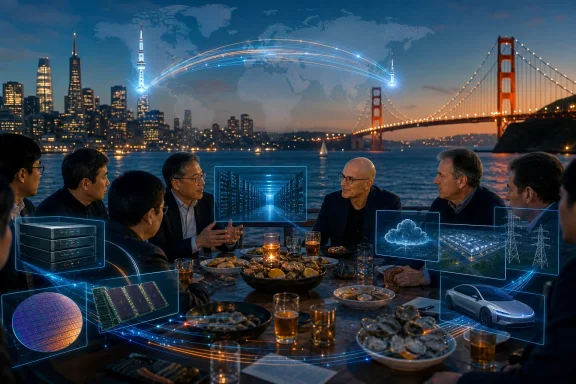
A reportedly informal dinner of fish and chips, fried calamari, crab cakes, clam chowder and beer has become a vivid symbol of South Korea’s determination to secure a larger role in the global artificial intelligence economy. President Lee Jae Myung’s San Francisco meeting with leaders from Nvidia, Broadcom, Microsoft and South Korea’s own industrial champions was not simply a diplomatic photo opportunity. It placed semiconductor supply, cloud infrastructure, data-center power, AI platforms and national industrial strategy at the same table.
The setting mattered. Rather than a formal summit room filled with prepared remarks and signed communiqués, the gathering was held at a casual waterfront restaurant. That choice reflected an increasingly important reality in the AI era: relationships between governments, cloud providers, chipmakers and manufacturing leaders can influence investment decisions that take years to negotiate but may be shaped by a few candid conversations.
Reported attendees included Nvidia founder and CEO Jensen Huang, Broadcom President and CEO Hock Tan, and Rani Borkar, president of Azure Hardware Systems and Infrastructure at Microsoft. South Korean business representation was equally consequential, with Samsung Electronics Executive Chairman Lee Jae-yong, SK Group Chairman Chey Tae-won, Hyundai Motor Group Executive Chair Chung Euisun and Naver founder and board chair Lee Hae-jin among the participants.
For Windows users, PC builders, enterprise IT managers and developers, the implications extend well beyond diplomatic theatre. The companies represented at this dinner collectively influence the chips inside AI servers, the networking that connects them, the memory they consume, the cloud platforms that rent them out, the cars that embed them, and the software ecosystems that increasingly bring generative AI to the desktop.
The reported purpose of the meeting was to build closer personal and commercial relationships between U.S. and South Korean technology leaders. That is a familiar goal for any presidential business mission. What makes this meeting distinctive is the concentration of AI infrastructure power represented by the guest list.
Nvidia remains a defining supplier of accelerated computing hardware and software for AI training and inference. Broadcom has become essential to large-scale AI infrastructure through custom silicon, high-performance networking and enterprise software. Microsoft operates one of the world’s largest cloud platforms, while its Azure hardware organization has direct responsibility for planning, architecting, developing and deploying the systems underpinning cloud services.
South Korea brings a different but equally critical set of capabilities. Samsung and SK Group are central to the global memory supply chain, including the high-bandwidth memory needed by modern AI accelerators. Hyundai is positioned at the intersection of AI, robotics, software-defined vehicles and manufacturing. Naver represents a home-grown internet and AI platform company with an interest in keeping Korea relevant not only as a supplier of components, but as a builder of AI services.
The result is a powerful message: AI leadership is no longer defined by a single company or a single processor. It is determined by an industrial stack stretching from advanced memory and chip packaging to networking, electricity, cloud capacity, enterprise software, local-language AI models and end-user devices.
Jensen Huang’s public profile has made him one of the most visible executives of the generative AI boom, but Nvidia’s success depends on a wide ecosystem. Its platforms require advanced foundry capacity, leading-edge memory, sophisticated packaging, fast interconnects, cooling systems, cloud partners and customers willing to commit billions of dollars to data-center expansion.
That makes South Korea far more than a market for AI products. It is a strategic production base, a capital partner, a memory powerhouse and an increasingly important demand center for AI services. President Lee’s dinner appears designed to reinforce all of those roles at once.
For Windows users, Nvidia’s influence is also visible on the client side. AI-capable GPUs are increasingly used for local inference, content creation, gaming enhancements, video processing and professional workloads. As Windows moves toward more on-device AI features, the value of local accelerated computing rises.
The broader issue, however, is data-center scale. The infrastructure used to train frontier AI models consumes huge quantities of compute, memory, networking bandwidth and power. Demand for these resources has transformed the relationship between chip vendors and national industrial policy.
The company also has a major presence in custom silicon and enterprise infrastructure software. Hyperscale cloud providers are increasingly exploring application-specific chips and differentiated infrastructure designs rather than relying on a one-size-fits-all approach. That shift makes Broadcom a strategically valuable partner in a market where AI data centers are becoming more specialized.
For enterprise Windows environments, Broadcom’s influence is especially relevant through virtualization, private cloud and hybrid infrastructure. AI adoption will not occur only in public clouds. Many organizations will seek to integrate AI workloads with existing Windows Server, Active Directory, VMware-based environments, private data stores and compliance-controlled systems.
Rani Borkar’s role places her at the intersection of cloud strategy and systems engineering. Microsoft has emphasized an approach that coordinates hardware and software, including its own silicon initiatives alongside partnerships with major chip suppliers. That design philosophy is increasingly important as AI data centers become constrained by energy efficiency, cooling, memory bandwidth and deployment speed.
Windows users will recognize the downstream effect. Microsoft’s AI strategy increasingly spans its entire product portfolio:
That tension is likely at the heart of President Lee’s engagement with U.S. technology leaders.
Samsung Electronics and SK Group, through SK hynix, have deep expertise in advanced memory. Their roles are therefore not peripheral to AI infrastructure; they are central. An accelerator without adequate high-speed memory cannot deliver the performance that cloud providers and AI developers expect.
This creates leverage for South Korea, but it is not permanent leverage. Memory markets are competitive, capital intensive and prone to cycles. Maintaining leadership requires relentless investment in process technology, yields, packaging and customer qualification. It also requires close collaboration with AI platform vendors, because memory design choices are increasingly tied to accelerator roadmaps.
This is one reason the AI supply chain is difficult to replicate quickly. Leading-edge products rely on specialized tools, materials, engineering talent and manufacturing coordination. The commercial value is concentrated not only in chip design, but also in the ability to manufacture complex systems at volume with acceptable yields.
A Korean industrial strategy that brings memory producers, equipment companies, advanced packaging capability, cloud platforms and AI developers closer together could generate more durable value than a strategy focused solely on commodity component output.
For countries seeking technological autonomy, sovereign AI does not necessarily mean complete isolation from U.S. cloud providers or chip companies. In practice, it means retaining the capacity to develop, deploy and govern AI systems suited to domestic needs.
South Korea has particular incentives to pursue this path. It has a technologically sophisticated population, major enterprise groups, a strong broadband infrastructure base and a globally relevant language ecosystem. Yet building competitive models and services requires compute capacity that remains expensive and heavily concentrated among a small number of global suppliers.
That means the availability of AI capabilities may vary according to hardware requirements, regional cloud capacity, subscription tiers and enterprise policy. The richer the AI workload, the more likely it is to involve a combination of local and remote processing.
The dinner’s importance lies in the systems behind that experience. If Microsoft can secure better access to infrastructure, advanced memory, networking components and supply-chain partners, it may be able to deploy AI services more reliably and at greater scale. Conversely, disruptions in any of those areas could affect availability, pricing and the pace of product rollout.
A realistic Windows AI future will include several computing tiers:
The practical questions are not glamorous, but they determine whether AI projects succeed:
For South Korea, closer ties can help secure demand and deepen access to the most influential AI platform ecosystems. For U.S. companies, Korean memory, manufacturing expertise and capital can support expansion at a time when demand for AI infrastructure remains intense.
This is especially valuable for cloud providers. The limiting factor in AI expansion is often not simply access to a processor. It may be the delivery of networking equipment, the qualification of memory, the availability of transformers, the design of liquid cooling or the speed of bringing a new data center online.
Hyundai’s presence at the dinner is relevant in this context. Modern vehicles are evolving into software-defined platforms that use AI for driver assistance, manufacturing optimization, predictive maintenance, in-cabin experiences and autonomous systems research. Access to better AI infrastructure can accelerate development across that entire chain.
For enterprises, that risk appears in several forms:
That uncertainty makes diversification essential. Strategic partnerships should be deep, but they should not become single points of failure. The most successful AI strategies will preserve options across hardware vendors, cloud platforms, software frameworks and manufacturing partners.
This raises a difficult question for governments seeking AI leadership: how much national infrastructure should be dedicated to data centers, and who bears the local environmental and financial costs? Faster AI deployment can support innovation and growth, but it can also strain grids and complicate decarbonization targets.
The dinner may advance conversations about hardware supply, but durable AI cooperation will require parallel agreements on energy, sustainability, facilities, workforce development and community impact.
Several developments would signal that the dinner produced more than goodwill.
President Lee Jae Myung’s effort to bring together U.S. AI infrastructure leaders and South Korea’s corporate heavyweights recognizes that AI policy is now industrial policy. It is trade policy, energy policy, education policy and security policy at the same time.
For Microsoft, Nvidia and Broadcom, South Korea offers critical manufacturing capabilities, sophisticated customers and influential technology partners. For South Korea, the U.S. companies offer access to the cloud, compute and software platforms that define much of today’s AI landscape. The opportunity is substantial, but so is the challenge of ensuring that cooperation produces shared capability rather than deeper dependence.
Fish and chips may have made the meeting feel casual. The competition for the infrastructure behind the next generation of Windows PCs, cloud services, enterprise automation and AI-powered devices is anything but.
The report also says the dinner followed the San Francisco AI Summit and included mini burgers alongside fish and chips, fried squid and beer.
The setting mattered. Rather than a formal summit room filled with prepared remarks and signed communiqués, the gathering was held at a casual waterfront restaurant. That choice reflected an increasingly important reality in the AI era: relationships between governments, cloud providers, chipmakers and manufacturing leaders can influence investment decisions that take years to negotiate but may be shaped by a few candid conversations.
Reported attendees included Nvidia founder and CEO Jensen Huang, Broadcom President and CEO Hock Tan, and Rani Borkar, president of Azure Hardware Systems and Infrastructure at Microsoft. South Korean business representation was equally consequential, with Samsung Electronics Executive Chairman Lee Jae-yong, SK Group Chairman Chey Tae-won, Hyundai Motor Group Executive Chair Chung Euisun and Naver founder and board chair Lee Hae-jin among the participants.
For Windows users, PC builders, enterprise IT managers and developers, the implications extend well beyond diplomatic theatre. The companies represented at this dinner collectively influence the chips inside AI servers, the networking that connects them, the memory they consume, the cloud platforms that rent them out, the cars that embed them, and the software ecosystems that increasingly bring generative AI to the desktop.
 An AI Dinner With Serious Industrial Consequences
The reported purpose of the meeting was to build closer personal and commercial relationships between U.S. and South Korean technology leaders. That is a familiar goal for any presidential business mission. What makes this meeting distinctive is the concentration of AI infrastructure power represented by the guest list.Nvidia remains a defining supplier of accelerated computing hardware and software for AI training and inference. Broadcom has become essential to large-scale AI infrastructure through custom silicon, high-performance networking and enterprise software. Microsoft operates one of the world’s largest cloud platforms, while its Azure hardware organization has direct responsibility for planning, architecting, developing and deploying the systems underpinning cloud services.
South Korea brings a different but equally critical set of capabilities. Samsung and SK Group are central to the global memory supply chain, including the high-bandwidth memory needed by modern AI accelerators. Hyundai is positioned at the intersection of AI, robotics, software-defined vehicles and manufacturing. Naver represents a home-grown internet and AI platform company with an interest in keeping Korea relevant not only as a supplier of components, but as a builder of AI services.
The result is a powerful message: AI leadership is no longer defined by a single company or a single processor. It is determined by an industrial stack stretching from advanced memory and chip packaging to networking, electricity, cloud capacity, enterprise software, local-language AI models and end-user devices.
Why the casual format was strategic
Technology executives often have more productive conversations in informal settings than at a scripted summit. A relaxed dinner can create space for discussions about constraints that rarely fit neatly into a press release: supply allocation, factory timelines, data-center permitting, engineering talent, power availability and the practical demands of deploying ever-larger AI clusters.Jensen Huang’s public profile has made him one of the most visible executives of the generative AI boom, but Nvidia’s success depends on a wide ecosystem. Its platforms require advanced foundry capacity, leading-edge memory, sophisticated packaging, fast interconnects, cooling systems, cloud partners and customers willing to commit billions of dollars to data-center expansion.
That makes South Korea far more than a market for AI products. It is a strategic production base, a capital partner, a memory powerhouse and an increasingly important demand center for AI services. President Lee’s dinner appears designed to reinforce all of those roles at once.
The Companies at the Table Represent the AI Supply Chain
The combined market-capitalization figure associated with the attendees may attract headlines, but the more useful measure is operational importance. Each organization occupies a different layer of the AI infrastructure stack, and bottlenecks in any one of those layers can slow the entire industry.Nvidia: The compute platform at the center of the boom
Nvidia’s position in AI is built on more than graphics processors. Its strength comes from a tightly integrated platform that includes GPUs, networking, interconnects, systems, software libraries and development tools. Enterprises and cloud providers do not simply buy chips; they build platforms around Nvidia’s hardware and software ecosystem.For Windows users, Nvidia’s influence is also visible on the client side. AI-capable GPUs are increasingly used for local inference, content creation, gaming enhancements, video processing and professional workloads. As Windows moves toward more on-device AI features, the value of local accelerated computing rises.
The broader issue, however, is data-center scale. The infrastructure used to train frontier AI models consumes huge quantities of compute, memory, networking bandwidth and power. Demand for these resources has transformed the relationship between chip vendors and national industrial policy.
Broadcom: Networking, custom silicon and the plumbing of AI
Broadcom’s role is sometimes less visible to consumers than Nvidia’s, but it is fundamental. AI clusters require far more than accelerators. They depend on networking equipment that can move massive volumes of data between servers with extremely low latency and high reliability.The company also has a major presence in custom silicon and enterprise infrastructure software. Hyperscale cloud providers are increasingly exploring application-specific chips and differentiated infrastructure designs rather than relying on a one-size-fits-all approach. That shift makes Broadcom a strategically valuable partner in a market where AI data centers are becoming more specialized.
For enterprise Windows environments, Broadcom’s influence is especially relevant through virtualization, private cloud and hybrid infrastructure. AI adoption will not occur only in public clouds. Many organizations will seek to integrate AI workloads with existing Windows Server, Active Directory, VMware-based environments, private data stores and compliance-controlled systems.
Microsoft: AI infrastructure from silicon to cloud services
Microsoft’s presence through Azure Hardware Systems and Infrastructure underscores the physical reality beneath cloud AI. Azure may be experienced by customers as an API, a virtual machine, a Copilot feature or a managed AI service, but those products depend on globally distributed hardware, power systems, networking, supply chains and facility operations.Rani Borkar’s role places her at the intersection of cloud strategy and systems engineering. Microsoft has emphasized an approach that coordinates hardware and software, including its own silicon initiatives alongside partnerships with major chip suppliers. That design philosophy is increasingly important as AI data centers become constrained by energy efficiency, cooling, memory bandwidth and deployment speed.
Windows users will recognize the downstream effect. Microsoft’s AI strategy increasingly spans its entire product portfolio:
- Azure AI services for developers and enterprises
- Microsoft 365 Copilot and business productivity tools
- Windows AI features on compatible PCs
- Copilot+ PC experiences designed around local neural processing
- GitHub Copilot and AI-assisted software development
- Security, management and analytics tools enhanced by machine learning
South Korea’s Bid to Move Beyond Component Leadership
South Korea has long been a top-tier technology manufacturing power. It has global influence in memory, displays, smartphones, consumer electronics, automobiles, telecom equipment and industrial production. The AI era creates an opportunity to extend that influence, but it also exposes a risk: becoming indispensable to the supply chain without capturing enough value from AI platforms, models and services.That tension is likely at the heart of President Lee’s engagement with U.S. technology leaders.
Memory is a strategic AI asset
The most advanced AI accelerators require enormous memory bandwidth. High-bandwidth memory, often referred to as HBM, has become one of the most strategically important components in the AI hardware market because it helps feed data to high-performance GPUs and other accelerators.Samsung Electronics and SK Group, through SK hynix, have deep expertise in advanced memory. Their roles are therefore not peripheral to AI infrastructure; they are central. An accelerator without adequate high-speed memory cannot deliver the performance that cloud providers and AI developers expect.
This creates leverage for South Korea, but it is not permanent leverage. Memory markets are competitive, capital intensive and prone to cycles. Maintaining leadership requires relentless investment in process technology, yields, packaging and customer qualification. It also requires close collaboration with AI platform vendors, because memory design choices are increasingly tied to accelerator roadmaps.
Advanced packaging is no longer a back-office detail
Traditional semiconductor discussions often focused on transistor size and wafer manufacturing. AI has pushed advanced packaging into the spotlight. Integrating compute dies, memory stacks and high-speed interconnects in tightly engineered packages has become a major differentiator.This is one reason the AI supply chain is difficult to replicate quickly. Leading-edge products rely on specialized tools, materials, engineering talent and manufacturing coordination. The commercial value is concentrated not only in chip design, but also in the ability to manufacture complex systems at volume with acceptable yields.
A Korean industrial strategy that brings memory producers, equipment companies, advanced packaging capability, cloud platforms and AI developers closer together could generate more durable value than a strategy focused solely on commodity component output.
Naver’s presence signals the importance of sovereign AI
Naver’s participation is notable because it represents a different layer of the AI stack: digital services, platforms, language data and local-market relevance. Large AI models may be built with global technology, but their usefulness depends heavily on language, culture, regulations, enterprise integration and access to trusted local data.For countries seeking technological autonomy, sovereign AI does not necessarily mean complete isolation from U.S. cloud providers or chip companies. In practice, it means retaining the capacity to develop, deploy and govern AI systems suited to domestic needs.
South Korea has particular incentives to pursue this path. It has a technologically sophisticated population, major enterprise groups, a strong broadband infrastructure base and a globally relevant language ecosystem. Yet building competitive models and services requires compute capacity that remains expensive and heavily concentrated among a small number of global suppliers.
The Windows and Enterprise IT Angle
At first glance, a presidential dinner in San Francisco may seem distant from the concerns of WindowsForum readers. In reality, it connects directly to the trajectory of Windows PCs, Microsoft cloud services and enterprise AI deployments.AI infrastructure will shape the Windows experience
Windows is increasingly part of a hybrid AI architecture. Some features will run locally on PCs using CPUs, GPUs and neural processing units. Others will depend on cloud-based inference, enterprise data connectors and large-scale services delivered through Azure.That means the availability of AI capabilities may vary according to hardware requirements, regional cloud capacity, subscription tiers and enterprise policy. The richer the AI workload, the more likely it is to involve a combination of local and remote processing.
The dinner’s importance lies in the systems behind that experience. If Microsoft can secure better access to infrastructure, advanced memory, networking components and supply-chain partners, it may be able to deploy AI services more reliably and at greater scale. Conversely, disruptions in any of those areas could affect availability, pricing and the pace of product rollout.
Copilot-era computing depends on an ecosystem, not one device
The marketing emphasis around AI PCs can make it appear that a neural processing unit alone defines the future of computing. It does not. NPUs are important for efficient, privacy-conscious local workloads, but the most resource-intensive generative AI tasks continue to require substantial cloud infrastructure.A realistic Windows AI future will include several computing tiers:
- Local AI processing for low-latency, privacy-sensitive and battery-efficient tasks.
- PC GPU acceleration for creative applications, gaming, engineering and professional workloads.
- Private enterprise AI for organizations that need control over sensitive data.
- Public cloud AI for large models, agentic workflows and globally scalable services.
- Hybrid AI orchestration that determines where a task should run based on cost, speed, policy and data sensitivity.
Enterprises face both opportunity and complexity
For organizations built around Windows, Microsoft 365 and Azure, closer U.S.-Korean technology cooperation could expand access to powerful AI capabilities. But deployment remains complex. Enterprises must balance productivity gains with cybersecurity, regulatory obligations, vendor dependence and cost control.The practical questions are not glamorous, but they determine whether AI projects succeed:
- Where does corporate data travel?
- Which models can access internal files and email?
- How are identities authenticated and permissions enforced?
- Can AI-generated content be audited?
- What happens when a cloud model, chip supply or service tier changes?
- How does an organization prevent experimental AI tools from becoming unmanaged shadow IT?
The Strengths of a Closer U.S.-Korea AI Partnership
The strategic logic of closer cooperation is compelling. The United States and South Korea possess complementary strengths, and AI infrastructure rewards such complementarity.A more resilient supply chain
AI hardware is vulnerable to concentration risk. The supply chain depends on a limited number of leading companies across chip design, fabrication, memory, packaging, networking and cloud deployment. Deepening relationships among trusted partners can improve planning, reduce uncertainty and support long-term capacity investments.For South Korea, closer ties can help secure demand and deepen access to the most influential AI platform ecosystems. For U.S. companies, Korean memory, manufacturing expertise and capital can support expansion at a time when demand for AI infrastructure remains intense.
Faster movement from components to deployed systems
The AI market is moving rapidly from individual chips toward integrated systems. A GPU, memory stack, network fabric, server rack, cooling design and power delivery plan must work together. A partnership model that coordinates these layers can reduce deployment friction.This is especially valuable for cloud providers. The limiting factor in AI expansion is often not simply access to a processor. It may be the delivery of networking equipment, the qualification of memory, the availability of transformers, the design of liquid cooling or the speed of bringing a new data center online.
Greater room for Korean AI services and products
South Korea’s most durable AI opportunity may be to combine manufacturing strength with service innovation. AI-enhanced vehicles, robotics, consumer electronics, industrial automation, healthcare tools, entertainment platforms and Korean-language AI services could create more strategic value than component exports alone.Hyundai’s presence at the dinner is relevant in this context. Modern vehicles are evolving into software-defined platforms that use AI for driver assistance, manufacturing optimization, predictive maintenance, in-cabin experiences and autonomous systems research. Access to better AI infrastructure can accelerate development across that entire chain.
Risks That a Friendly Dinner Cannot Solve
The symbolism of high-level cooperation should not obscure the risks. AI partnerships can be beneficial, but they also increase dependence on a small group of companies that control essential infrastructure.Vendor concentration remains a major concern
Nvidia, Microsoft and Broadcom each hold influential positions in adjacent layers of the technology stack. Their products are valuable precisely because they are difficult to replace. Yet widespread reliance on a narrow set of suppliers can reduce buyer leverage and make infrastructure costs harder to control.For enterprises, that risk appears in several forms:
- Price increases for accelerated compute and cloud AI services
- Limited alternatives for specialized hardware and software stacks
- High migration costs once AI systems are tightly integrated
- Dependence on proprietary APIs, models and management tools
- Difficulty reproducing performance on competing platforms
Geopolitics can disrupt even strong commercial ties
Semiconductors are now tightly bound to export controls, security policy, trade relationships and regional geopolitical tensions. A supply chain that looks stable in a business presentation can be altered quickly by new restrictions, licensing rules or diplomatic disputes.That uncertainty makes diversification essential. Strategic partnerships should be deep, but they should not become single points of failure. The most successful AI strategies will preserve options across hardware vendors, cloud platforms, software frameworks and manufacturing partners.
Energy and water constraints are becoming AI constraints
There is also a physical limit to AI expansion. Large data centers require electricity, cooling and grid capacity. In some regions, access to power is already as important as access to GPUs.This raises a difficult question for governments seeking AI leadership: how much national infrastructure should be dedicated to data centers, and who bears the local environmental and financial costs? Faster AI deployment can support innovation and growth, but it can also strain grids and complicate decarbonization targets.
The dinner may advance conversations about hardware supply, but durable AI cooperation will require parallel agreements on energy, sustainability, facilities, workforce development and community impact.
What to Watch After the Headlines Fade
The real test of this meeting will not be the restaurant menu or the combined valuation of the companies involved. It will be whether the discussions lead to concrete, measurable outcomes.Several developments would signal that the dinner produced more than goodwill.
Potential signs of meaningful progress
- New commitments for AI data-center investment in South Korea
- Long-term supply agreements involving advanced memory and AI hardware
- Joint research programs in semiconductors, packaging, robotics or AI safety
- Expanded Microsoft Azure infrastructure and AI service availability in Korea
- Partnerships connecting Korean AI models and platforms with global cloud capacity
- New AI manufacturing projects involving automotive, industrial or consumer electronics companies
- Training programs to expand semiconductor, cloud and AI engineering talent
- Clearer frameworks for AI governance, data handling and cross-border technology collaboration
A Table Set for the Next Phase of AI Competition
The reported San Francisco dinner captured the defining character of the current technology race. The global AI boom is driven by code and models, but it is constrained by physical systems: chips, memory, networks, factories, power plants, data centers and international relationships.President Lee Jae Myung’s effort to bring together U.S. AI infrastructure leaders and South Korea’s corporate heavyweights recognizes that AI policy is now industrial policy. It is trade policy, energy policy, education policy and security policy at the same time.
For Microsoft, Nvidia and Broadcom, South Korea offers critical manufacturing capabilities, sophisticated customers and influential technology partners. For South Korea, the U.S. companies offer access to the cloud, compute and software platforms that define much of today’s AI landscape. The opportunity is substantial, but so is the challenge of ensuring that cooperation produces shared capability rather than deeper dependence.
Fish and chips may have made the meeting feel casual. The competition for the infrastructure behind the next generation of Windows PCs, cloud services, enterprise automation and AI-powered devices is anything but.
Update: Additional details (July 25, 2026)
The Chosun Ilbo reports that Deputy Prime Minister and Science and ICT Minister Bae Kyung-hoon and presidential policy chief Kim Yong-beom also attended. President Lee reportedly framed his toast around sikgu—a Korean concept of people bound through shared meals—and the group responded, “We are family.”The report also says the dinner followed the San Francisco AI Summit and included mini burgers alongside fish and chips, fried squid and beer.
References
- Primary source: The Korea Herald
Published: 2026-07-25T03:00:51+00:00
Last edited: