

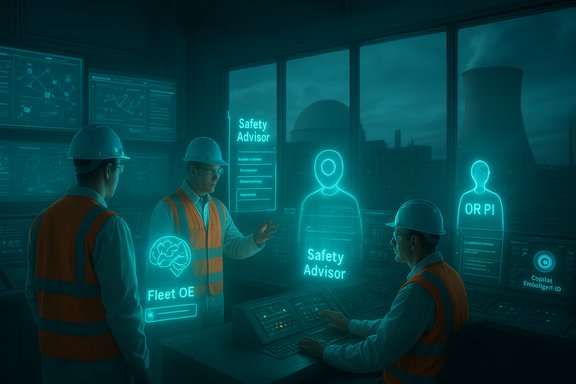
Southern Nuclear’s recent rollout of internally developed Microsoft Copilot agents — anchored by a Fleet Operating Experience (OE) agent, a Safety Advisor Copilot, and an Organizational Effectiveness & Performance Improvement (OR/PI) agent — marks a clear pivot from exploratory pilots to production-grade, worker-facing AI in a safety‑critical industrial environment.
Southern Nuclear, the nuclear operating arm of Southern Company, says it has embedded Copilot-based agents across its fleet to put operating history, safety guidance, and improvement-plan scaffolding into the hands of planners, technicians, and maintenance leaders. The company describes thousands of documented uses across its sites, an employee-built agent portfolio, and an active user base exceeding 850 Copilot seats. Those figures and the agent descriptions come from Southern Nuclear’s account to industry media. The vendor platform behind these agents — Microsoft’s Copilot ecosystem — has matured rapidly in 2024–2025. Microsoft publicly expanded Copilot Studio, introduced multi‑agent orchestration, and delivered governance primitives such as Entra Agent ID, the Agent Registry, and integrations to Azure AI Foundry for model routing and tenant-hosted grounding. These platform advances are designed to enable the low‑code creation, lifecycle governance, and identity management enterprises need to run agents at scale. The Southern Nuclear deployment is therefore best read as a pair of converging trends: frontline teams demanding contextualized, rapid access to domain knowledge (work that used to require searching multiple systems and asking subject matter experts) and platform vendors supplying agent tooling, identity and governance plumbing that make at-scale adoption plausible. Microsoft’s product releases show the building blocks Southern Nuclear cites are now available in enterprise previews and early production.
Source: American Nuclear Society AI at work: Southern Nuclear’s adoption of Copilot agents drives fleet forward
 Background / Overview
Southern Nuclear, the nuclear operating arm of Southern Company, says it has embedded Copilot-based agents across its fleet to put operating history, safety guidance, and improvement-plan scaffolding into the hands of planners, technicians, and maintenance leaders. The company describes thousands of documented uses across its sites, an employee-built agent portfolio, and an active user base exceeding 850 Copilot seats. Those figures and the agent descriptions come from Southern Nuclear’s account to industry media. The vendor platform behind these agents — Microsoft’s Copilot ecosystem — has matured rapidly in 2024–2025. Microsoft publicly expanded Copilot Studio, introduced multi‑agent orchestration, and delivered governance primitives such as Entra Agent ID, the Agent Registry, and integrations to Azure AI Foundry for model routing and tenant-hosted grounding. These platform advances are designed to enable the low‑code creation, lifecycle governance, and identity management enterprises need to run agents at scale. The Southern Nuclear deployment is therefore best read as a pair of converging trends: frontline teams demanding contextualized, rapid access to domain knowledge (work that used to require searching multiple systems and asking subject matter experts) and platform vendors supplying agent tooling, identity and governance plumbing that make at-scale adoption plausible. Microsoft’s product releases show the building blocks Southern Nuclear cites are now available in enterprise previews and early production. What Southern Nuclear rolled out — the agents and the story so far
Fleet Operating Experience (OE) agent
- What it does: Rapidly retrieves internal operating experience across the fleet to support work‑package preparation, troubleshooting, and issue response.
- Timeline: Southern Nuclear reports the OE agent was first deployed in June 2025 and is now used by issue‑response teams to find internal OE in minutes.
Safety Advisor Copilot
- What it does: Provides immediate access to safety procedures, OSHA guidance, and other safety artefacts to help planners ensure required controls are captured in work packages and that technicians can surface relevant safety references on the job.
- Origin story: Southern Nuclear credits the Plant Vogtle safety lead with developing the Safety Advisor Copilot to place subject‑matter knowledge “by your side” during work.
Organizational Effectiveness & Performance Improvement (OR/PI) agent
- What it does: Helps craft improvement plans, frames root‑cause communications, and standardizes improvement‑plan outputs used across the fleet to lift maintenance precision and craftsmanship.
Cross‑checking the platform claims: can Microsoft do this?
Southern Nuclear’s narrative maps closely to Microsoft’s documented agent capabilities. At Microsoft Build and Ignite in 2025, the company announced:- Copilot Studio for low‑code agent creation and multi‑agent orchestration;
- Copilot Tuning (tenant tuning with customer data) and Model Context Protocol (MCP) to connect agents to curated knowledge sources;
- Entra Agent ID and an Agent Registry to give agents managed identities and lifecycle controls; and
- Azure AI Foundry for multi‑model routing and enterprise model choice (bringing Anthropic, Cohere and other vendors into the mix).
Why this matters for plant maintenance and nuclear operations
Southern Nuclear frames the benefits in practical, operational terms:- Faster troubleshooting: Technicians and issue response teams find relevant OE and prior fixes quickly, reducing diagnosis time and improving repair planning.
- Better work packages: Planners can more consistently include applicable safety and procedural content, reducing rework and improving crew readiness.
- Higher-quality improvement plans: The OR/PI agent standardizes problem statements and remediation plans so fixes are clearer and more actionable.
Strengths of Southern Nuclear’s approach
- Domain‑led development: Building agents with direct input from Plant Vogtle and Farley practitioners — including the safety program lead and maintenance supervisors — reduces the classic “expertise gap” between IT teams and frontline domain experts. Southern Nuclear emphasizes end‑user involvement in agent design.
- Focused, high‑value agent set: The three agents described are high leverage for nuclear operations: operating experience search, safety guidance, and improvement-plan scaffolding. These directly touch maintenance cycle time, safety compliance, and organizational learning — the three dimensions most likely to produce conservative, auditable benefits.
- Enterprise governance is in view: The company’s AI Working Group and link to a corporate AI Center of Excellence mirror the recommended governance pattern (CoE + pilots + central guardrails) that independent practitioners advise for regulated industries. Microsoft product features (Entra Agent ID, Agent Registry, Purview integration) are expressly designed to support this pattern.
- Operational scale and real‑user adoption: Southern Nuclear reports a sizable active user base and “thousands” of documented uses, suggesting adoption moved beyond a small pilot into daily workflows — an adoption curve other utilities have found critical to unlocking ROI. Early utility deployments show the same sequence: pilot → targeted expansion → governance and measurement.
Cautions and risks — what to watch for
The positive outcomes are plausible, but several risks must be actively managed. The public account leaves important verification gaps that organizations and regulators should scrutinize.- Data grounding and hallucination risk: Generative models can produce plausible but incorrect answers (hallucinations). In safety‑critical contexts, an ungrounded recommendation could lead to improper procedures or misapplied fixes. This risk is mitigated when agents use retrieval‑augmented generation (RAG) from curated internal sources and provide provenance and links to the original documents — Microsoft tooling supports these patterns, but implementation quality matters.
- Auditability and identity controls: Agents must be auditable and have identities governed by IT policy. Microsoft’s Entra Agent ID and Agent Registry address this at the platform level, but organizations still need to operationalize lifecycle reviews, deprovisioning, and entitlement checks to avoid over‑privileged or “orphaned” agents.
- Regulatory and legal exposure: Any tool that influences operational decisions in a regulated utility or nuclear plant should be governed as a decision support tool, not an automatic decision maker. Human‑in‑the‑loop signoffs, documented decision boundaries, and conservative change control must remain in place. Vendor claims of time saved or uptime improved are often modeled rather than independently audited. Readers should treat such figures as directional until validated by instrumented studies.
- Hidden costs and consumption: LLM‑driven agents have two cost dimensions: licensing/tenant costs and runtime model consumption. Without caps and telemetry, agent sprawl can create surprising bills. Microsoft added Capacity Packs and usage dashboards to help manage consumption, but tenant administration still must set limits and monitor spend.
- Operational security and OT/IT integration: Routing operational telemetry, maintenance logs, and work‑order systems into cloud services changes the attack surface. Best practice is strong network segmentation, least‑privilege connectors, and careful retention policies for logs and agent transcripts. Many examples of successful industrial pilots explicitly call out these governance steps as essential.
Unverifiable or vendor‑reported claims — flagged
- The ANS account states Southern Nuclear has “more than 850 active Copilot users” and that the OE agent was “first deployed in June 2025.” Those numbers and dates are reported by Southern Nuclear and are plausible, but they are company disclosures reported in trade media and are not yet confirmed by independent audit or regulatory filings in the public domain. Treat such operational counts as company‑reported adoption metrics pending independent confirmation.
- Claimed outcomes such as “thousands of documented uses,” faster repair measured in minutes, or demonstrable increases in equipment reliability are credible but are not accompanied in the public article by raw telemetry or pre/post KPIs. When a company uses a numerator like “thousands,” request the measurement methodology (time windows, cohort definitions, control groups) to understand net benefit.
Technical and governance checklist (how Southern Nuclear — or any operator — should operationalize agents)
- Define decision boundaries and human‑in‑the‑loop rules. Require explicit sign‑offs for any agent output that changes work scope, safety controls, or technical specification.
- Ground every agent in curated, versioned knowledge stores (document repositories, OE databases, procedures) and surface provenance for each answer. Use RAG patterns and attach source links to outputs.
- Register all agents in a central Agent Registry and assign Entra Agent IDs. Enforce lifecycle reviews (quarterly) and deprovision agents that are unused or orphaned.
- Instrument telemetry: capture query volumes, latency, “provenance success” (how often agent provides source links), and error rates. Tie these to measurable KPIs such as MTTR, first‑time fix rate, and rework incidence.
- Set consumption caps and billing alerts. Use Capacity Packs or monthly caps to prevent runaway model costs, and route routine queries to smaller, cheaper models while reserving high‑capability models for complex synthesis.
- Run blind validation studies before full operational use: pair agent recommendations with SME review for a defined sample of cases and measure concordance rates. Use those studies to calibrate model prompts, retrieval logic, and thresholds for human review.
How to measure success conservatively
- Primary metrics: Mean Time To Repair (MTTR), first‑time fix percentage, number of safety reworks per month, and work‑package preparation hours saved per planner.
- Secondary metrics: adoption rate, query throughput per user, average provenance links per response, and model consumption per thousand queries.
- Economic framing: convert time saved to FTE equivalents and validate whether the reclaimed time is allocated to higher‑value safety and reliability activities. Vendor ROI claims are often optimistic unless they net governance and integration costs out of the analysis.
The wider industry pattern — independent parallels
Utilities and industrial operators who moved early with Copilot‑style agents consistently follow a playbook: start with low‑risk, high‑frequency tasks (reporting, knowledge search, email triage), pilot with 50–300 users, instrument outcomes, then scale with a governance CoE. UK Power Networks and several industrial partners reported similar rollouts where Copilot Studio and Azure Foundry supported discovery, and governance controls prevented data leaks while enabling measurable productivity gains. These independent examples show Southern Nuclear’s approach fits an emerging industry pattern: pilot → defend with governance → scale into operations.Conclusion
Southern Nuclear’s adoption of Microsoft Copilot agents — particularly the Fleet OE, Safety Advisor Copilot, and OR/PI agents — provides a tangible case study for how generative AI can be embedded into safety‑critical plant workflows. The public account aligns with Microsoft’s 2025 product evolution (Copilot Studio, Entra Agent ID, Azure AI Foundry) and with independent deployment patterns reported across utilities and industrial operators. When implemented with retrieval‑augmented grounding, strong identity and lifecycle controls, and conservative human‑in‑the‑loop rules, agents can speed troubleshooting, clarify safety preparations, and standardize improvement planning — all outcomes that matter in nuclear operations. However, the most load‑bearing operational claims in Southern Nuclear’s account (user counts, documented use volume, and certain timeline details) remain company‑reported and are not yet independently audited in the public record; these should be validated through instrumented KPIs, third‑party audits, or regulatory reporting if material. The promise is real, but for regulated operators the safe path forward is a disciplined program of governance, measurement, and iterative validation — exactly the pattern Southern Nuclear says it is following.Source: American Nuclear Society AI at work: Southern Nuclear’s adoption of Copilot agents drives fleet forward
