
SpaceX completed its long-anticipated public listing in June 2026 under the ticker SPCX, raising roughly $75 billion at a valuation near $1.77 trillion while pitching investors on rockets, Starlink, xAI, and a future of AI compute infrastructure in orbit. The central claim is not merely that SpaceX can launch satellites cheaply; it is that launch economics can make space itself a better place to run the next generation of artificial intelligence. That is a much harder proposition to defend. SpaceX may yet be one of the most important infrastructure companies of this century, but the orbital AI thesis asks investors to treat engineering ambition as if it were already operating leverage.
The most generous version of the SpaceX pitch begins with a real constraint: AI compute is devouring power, land, chips, cooling capacity, and capital faster than conventional data center planning cycles were built to handle. Hyperscalers are already signing nuclear power deals, reviving old industrial sites, and fighting over grid interconnects because the bottleneck has moved from software talent to physical infrastructure.
SpaceX looks at that terrestrial squeeze and sees an opening. If the company can launch hardware cheaply, operate fleets at scale, and draw near-continuous solar power above the atmosphere, then perhaps orbit becomes not a stunt but a new tier of compute infrastructure. In that telling, the company’s launch business is not the profit center; it is the enabling layer that lets SpaceX place energy-hungry machines where energy is more abundant.
That is the thesis investors are being asked to buy at a valuation that already assumes the company is much more than a rocket contractor. It is a bet that SpaceX’s lead in reusable launch, Starlink operations, and Musk-controlled AI demand can be fused into a vertically integrated machine: rockets lift hardware, satellites provide connectivity, AI workloads consume power, and customers pay for tokens.
The problem is not that this vision is impossible in the science-fiction sense. The problem is that public-market investors are being asked to underwrite it in the business-model sense, where watt-hours, latency, maintenance cycles, depreciation, and customer economics matter more than cinematic inevitability.
On Earth, solar power is intermittent, politically contested, and grid-constrained. But Earth also has cheap access, heavy equipment, labor pools, fiber networks, water rights negotiations, utility-scale batteries, natural gas backup, nuclear contracts, zoning lawyers, and repair trucks. These are messy, expensive, unglamorous systems, but they are also the systems that make data centers financeable.
In orbit, sunlight is more reliable, but every kilogram has to be launched, every component must survive radiation and thermal cycling, every failure is more expensive, and every upgrade cycle becomes a space logistics problem. A terrestrial GPU cluster can be re-cabled, re-cooled, swapped, expanded, or cannibalized. An orbital GPU cluster must be designed with the knowledge that the normal rituals of data center maintenance have been turned into aerospace operations.
That missing middle is where business plans either mature or collapse. SpaceX can credibly say it has reduced launch costs. It cannot simply assume that lower launch costs erase the penalty of moving compute out of the one environment where humans, fiber, substations, factories, and service technicians already exist.
That makes orbit a dangerous place to put bleeding-edge compute. If a satellite launches with a state-of-the-art payload, it begins aging the moment it clears the pad. If a better accelerator arrives six months later, the terrestrial operator can redesign racks and expand with the new part. SpaceX has to decide whether to launch replacement satellites, retrofit payloads through some unproven modular servicing scheme, or keep operating hardware that may be drifting down the performance-per-watt ranking.
The company’s own framing tries to turn this into a strength. SpaceX argues that access to launch could let it “activate” high-performing hardware faster than rivals constrained by terrestrial power and construction. That may be true in a narrow case where a satellite is already designed, manufactured, tested, licensed, insured, launched, commissioned, connected, and assigned workloads before a ground-based data center can complete a grid interconnect.
But AI infrastructure is not won by a single deployment race. It is won by relentless refresh cycles, procurement discipline, software optimization, and utilization. The more often hardware generations change, the more punishing orbit becomes.
Starlink has already shown that low-Earth orbit can deliver impressive broadband performance relative to older satellite systems. That does not mean orbital data centers automatically compete with fiber-connected terrestrial facilities. A user query must reach the compute, be processed, and return. For many workloads, the network is not an afterthought; it is part of the product.
The issue becomes sharper when AI systems are chained to external data sources, enterprise databases, SaaS platforms, developer tools, identity systems, and security controls. Most of that digital gravity is still on Earth. Moving compute away from data can be as costly as moving data away from compute.
This is where the “free sunlight” argument becomes dangerously simplistic. Even if orbital power were cheaper on a narrow generation basis, the complete cost of service includes transport, latency, redundancy, security, compliance, and integration. A token is not merely a unit of compute. It is the output of a sprawling infrastructure stack.
Those assets justify attention. They may justify a premium valuation. They do not automatically justify a valuation that depends on treating space-based AI infrastructure as the next dominant compute platform.
There is a more grounded version of the SpaceX bull case. In that version, Starlink continues to grow, defense and government contracts deepen, launch share remains dominant, Starship eventually lowers heavy-lift costs, and SpaceX sells connectivity and logistics into a larger space economy. AI can still matter, but mostly as a customer, software layer, or terrestrial data-center adjacency.
That grounded case is less glamorous than orbital compute at planetary scale. It is also much easier to evaluate. Investors can model broadband revenue, launch cadence, capex, churn, defense budgets, spectrum constraints, regulatory fights, and satellite replacement cycles. They may still disagree wildly on value, but at least they are arguing about businesses that exist.
When the same controlling figure sits at the center of rockets, satellites, social data, AI models, compute demand, and public-market capital, vertical integration can look like genius or self-dealing depending on the transaction in front of you. A SpaceX shareholder may like the idea of guaranteed AI demand. The same shareholder should still ask whether capital is being allocated to the best risk-adjusted opportunities or to the most ambitious Musk-controlled ones.
This matters because orbital AI infrastructure would be capital intensive long before it is profitable. If internal AI demand becomes the justification for massive deployment, outside investors need confidence that pricing, capacity allocation, and strategic priorities are being set at arm’s length. A controlled-company structure does not make that impossible, but it does make trust more central.
The public market has seen this movie before. Visionary founders often receive latitude when growth is fast and the story is working. That latitude narrows abruptly when losses mount, timelines slip, or related-party logic becomes too complicated for investors to follow.
SpaceX is therefore right to frame energy as a strategic issue. The companies that solve power procurement, cooling, and deployment speed will have an advantage in AI. The mistake is presenting orbit as the “logical path forward” rather than one speculative branch on a very crowded tree.
The obvious alternatives remain powerful. Data centers can be built near stranded renewables, gas fields, hydro resources, nuclear plants, or cold climates. Chips can become more efficient. Models can become smaller, more specialized, and less wasteful. Inference can move closer to users. Training clusters can be scheduled around power availability. None of these options is easy, but none requires turning the data center into a spacecraft.
A serious orbital compute plan would need to show why it beats those alternatives after launch, insurance, failure rates, networking, thermal management, radiation hardening, deorbiting, regulatory approval, security, and hardware refresh are included. Until then, the thesis is not “sunlight is abundant.” It is “all the other penalties can be made small enough.” That is the claim still waiting for proof.
SpaceX can design for redundancy, but redundancy is not free. More redundancy means more mass, more launch cost, more power draw, and more capital tied up in idle capacity. In a business where compute utilization determines margins, overbuilding for orbital reliability can quietly consume the economic advantage that solar power supposedly creates.
The company’s defenders will argue that SpaceX already operates large constellations and understands satellite replacement at scale. That is true, but a broadband satellite is not a frontier AI data center. The density, thermal load, chip value, and operational tempo are different. A failed communications node is a network-planning problem. A failed cluster of high-end accelerators is a very expensive stranded asset.
This is why the repair-truck comparison is more than a joke. Terrestrial infrastructure benefits from the boring miracle of physical proximity. Orbit turns maintenance into design philosophy, launch scheduling, and fleet attrition.
That could become a significant constraint. Starlink has already made satellite networks a geopolitical asset. AI compute would raise the stakes because compute capacity increasingly matters to defense, intelligence, cyber operations, and economic competitiveness. A privately controlled orbital AI network would be both a commercial platform and a strategic capability.
The regulatory questions are not limited to the United States. Ground stations, user traffic, data sovereignty, military uses, and export rules all cross borders. If orbital AI becomes real, countries will ask where data is processed, who can access it, how it is secured, and whether compute capacity can be denied during conflict or sanctions disputes.
SpaceX has often moved faster than regulators, and that speed has been part of its advantage. But public investors should not confuse regulatory delay with regulatory irrelevance. The larger the orbital AI ambition becomes, the more likely governments are to treat it as infrastructure that cannot be governed by launch licenses alone.
That is the trap in mega-cap storytelling. The larger the market capitalization, the less room there is for poetry. SpaceX must not only remain dominant in launch, grow Starlink, execute on Starship, integrate AI assets, manage debt and capex, satisfy regulators, and retain customers; it must do so at a scale that supports one of the largest corporate valuations on Earth.
The orbital AI narrative helps bridge that gap because the addressable market sounds enormous. But enormous markets do not automatically produce enormous profits. They attract competitors, regulators, substitutes, and price compression. The cloud business became massive because its economics improved with scale and standardization. Space-based AI still has to prove that scale reduces cost rather than multiplying exotic failure modes.
This is why skepticism is not cynicism. It is valuation discipline. A company can be extraordinary and still be overpriced. A founder can be right about the direction of travel and wrong about the route, timing, or cost.
The SpaceX thesis is an extreme version of a broader industry trend: compute is becoming physically scarce again. Cloud once trained customers to think capacity was abstract and elastic. AI has made it concrete. Behind every model endpoint is a fight over transformers, GPUs, land, water, substations, network capacity, and financing.
That matters for Windows administrators and enterprise architects because the next phase of AI adoption will not be decided only by model quality. It will be decided by where workloads run, how data moves, what latency users tolerate, which vendors can guarantee capacity, and how much governance enterprises require. The physics of infrastructure are re-entering the software conversation.
SpaceX’s orbital compute proposal may never become a mainstream enterprise platform. But it is a useful warning flare. When even a rocket company argues that the future of AI depends on power access and deployment logistics, IT buyers should stop treating AI as a simple licensing line item.
That precedent should humble critics. SpaceX has repeatedly done things that incumbents considered impractical. Its culture of rapid iteration, vertical integration, and willingness to destroy hardware in pursuit of learning has produced real advantages.
But Starlink also shows the difference between a hard infrastructure business and a magic money machine. Constellations require constant replenishment. Capacity is uneven. Spectrum fights matter. Terminals cost money. Regulators can slow deployment. Customer density changes economics. Even when the technology works, the business is a grind.
Orbital AI would inherit all of those challenges and add the brutal economics of high-performance compute. If Starlink is the proof that SpaceX can commercialize orbit, it is also the reminder that commercializing orbit does not suspend ordinary business constraints.
That is not a trivial point. Governments fund capabilities that markets would not build on purely commercial timelines. Defense customers may pay for resilience, geographic independence, or survivability. A space-based compute layer could interest agencies that care less about cheapest-token economics and more about continuity under stress.
But that is a different investment thesis from “orbit will make AI cheaper because sunlight is free.” It suggests orbital compute may begin as a specialized, subsidized, strategic capability rather than a broad replacement for terrestrial data centers. That kind of business can be valuable, but it usually depends on procurement cycles, classification boundaries, political support, and customer concentration.
Public investors should demand clarity on which story they are buying. A strategic defense-adjacent orbital compute network and a mass-market AI inference platform are not the same business. They have different margins, risks, customers, and timelines.
The right response is not to declare the plan impossible. It is to separate the company’s demonstrated capabilities from its speculative claims. Reusable launch is demonstrated. Starlink is demonstrated. Orbital AI at commercial scale is not. The valuation question turns on how much investors are paying for the third category.
That distinction matters because public markets tend to flatten nuance. Bulls will point to SpaceX’s history of beating skeptics. Bears will point to the absurdity of launching data centers into orbit. Both can be partly right. The harder task is assigning probabilities and timelines without letting narrative substitute for evidence.
For now, the burden of proof belongs to SpaceX. If orbital AI is real, the company can show prototype economics, customer contracts, utilization data, failure rates, latency benchmarks, and refresh plans. Until then, the thesis should be treated as a high-risk option embedded inside a much more tangible space and connectivity business.
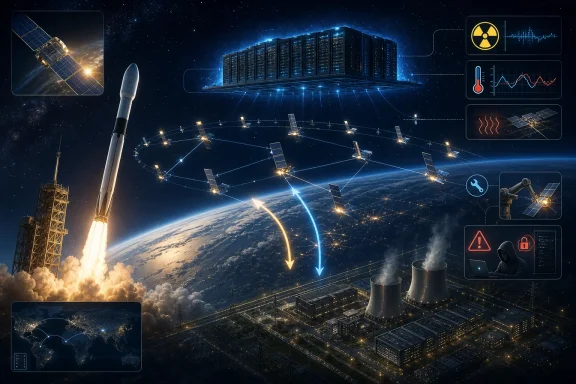 SpaceX Sells Scarcity, Not Just Rockets
The most generous version of the SpaceX pitch begins with a real constraint: AI compute is devouring power, land, chips, cooling capacity, and capital faster than conventional data center planning cycles were built to handle. Hyperscalers are already signing nuclear power deals, reviving old industrial sites, and fighting over grid interconnects because the bottleneck has moved from software talent to physical infrastructure.SpaceX looks at that terrestrial squeeze and sees an opening. If the company can launch hardware cheaply, operate fleets at scale, and draw near-continuous solar power above the atmosphere, then perhaps orbit becomes not a stunt but a new tier of compute infrastructure. In that telling, the company’s launch business is not the profit center; it is the enabling layer that lets SpaceX place energy-hungry machines where energy is more abundant.
That is the thesis investors are being asked to buy at a valuation that already assumes the company is much more than a rocket contractor. It is a bet that SpaceX’s lead in reusable launch, Starlink operations, and Musk-controlled AI demand can be fused into a vertically integrated machine: rockets lift hardware, satellites provide connectivity, AI workloads consume power, and customers pay for tokens.
The problem is not that this vision is impossible in the science-fiction sense. The problem is that public-market investors are being asked to underwrite it in the business-model sense, where watt-hours, latency, maintenance cycles, depreciation, and customer economics matter more than cinematic inevitability.
The Motley Fool Critique Lands Because the Logic Has a Missing Middle
The AOL-syndicated Motley Fool piece is right to isolate the weakest part of SpaceX’s sales pitch: the leap from “AI needs lots of energy” to “therefore AI compute belongs in orbit.” That move sounds plausible only if sunlight is the binding constraint and all other costs fade into the background. They do not.On Earth, solar power is intermittent, politically contested, and grid-constrained. But Earth also has cheap access, heavy equipment, labor pools, fiber networks, water rights negotiations, utility-scale batteries, natural gas backup, nuclear contracts, zoning lawyers, and repair trucks. These are messy, expensive, unglamorous systems, but they are also the systems that make data centers financeable.
In orbit, sunlight is more reliable, but every kilogram has to be launched, every component must survive radiation and thermal cycling, every failure is more expensive, and every upgrade cycle becomes a space logistics problem. A terrestrial GPU cluster can be re-cabled, re-cooled, swapped, expanded, or cannibalized. An orbital GPU cluster must be designed with the knowledge that the normal rituals of data center maintenance have been turned into aerospace operations.
That missing middle is where business plans either mature or collapse. SpaceX can credibly say it has reduced launch costs. It cannot simply assume that lower launch costs erase the penalty of moving compute out of the one environment where humans, fiber, substations, factories, and service technicians already exist.
Space Is a Terrible Place to Chase a Fast-Moving Chip Cycle
AI infrastructure is not like a telecom satellite designed to provide relatively stable service over a long orbital life. Frontier compute is defined by rapid hardware churn, uncertain utilization, brutal depreciation, and constant redesign around the newest accelerator, memory system, networking fabric, and cooling method. The most valuable AI hardware is often most valuable immediately after deployment, before the next generation resets the cost curve.That makes orbit a dangerous place to put bleeding-edge compute. If a satellite launches with a state-of-the-art payload, it begins aging the moment it clears the pad. If a better accelerator arrives six months later, the terrestrial operator can redesign racks and expand with the new part. SpaceX has to decide whether to launch replacement satellites, retrofit payloads through some unproven modular servicing scheme, or keep operating hardware that may be drifting down the performance-per-watt ranking.
The company’s own framing tries to turn this into a strength. SpaceX argues that access to launch could let it “activate” high-performing hardware faster than rivals constrained by terrestrial power and construction. That may be true in a narrow case where a satellite is already designed, manufactured, tested, licensed, insured, launched, commissioned, connected, and assigned workloads before a ground-based data center can complete a grid interconnect.
But AI infrastructure is not won by a single deployment race. It is won by relentless refresh cycles, procurement discipline, software optimization, and utilization. The more often hardware generations change, the more punishing orbit becomes.
Latency Is Not a Footnote When the Product Is Interaction
The orbital AI pitch also tends to blur different kinds of compute. Not every AI workload has the same latency profile. Some batch processing, synthetic data generation, model pretraining, and offline inference could tolerate more delay. Interactive consumer and enterprise applications, however, live and die by responsiveness.Starlink has already shown that low-Earth orbit can deliver impressive broadband performance relative to older satellite systems. That does not mean orbital data centers automatically compete with fiber-connected terrestrial facilities. A user query must reach the compute, be processed, and return. For many workloads, the network is not an afterthought; it is part of the product.
The issue becomes sharper when AI systems are chained to external data sources, enterprise databases, SaaS platforms, developer tools, identity systems, and security controls. Most of that digital gravity is still on Earth. Moving compute away from data can be as costly as moving data away from compute.
This is where the “free sunlight” argument becomes dangerously simplistic. Even if orbital power were cheaper on a narrow generation basis, the complete cost of service includes transport, latency, redundancy, security, compliance, and integration. A token is not merely a unit of compute. It is the output of a sprawling infrastructure stack.
SpaceX’s Real Business Is Stronger Than Its Grandest Story
The irony is that SpaceX does not need the orbital AI story to be a serious company. Its launch business changed the economics of access to orbit. Starlink created a satellite broadband network with real commercial, military, maritime, aviation, and emergency-response uses. The company has a formidable manufacturing culture and an unmatched cadence of operational learning.Those assets justify attention. They may justify a premium valuation. They do not automatically justify a valuation that depends on treating space-based AI infrastructure as the next dominant compute platform.
There is a more grounded version of the SpaceX bull case. In that version, Starlink continues to grow, defense and government contracts deepen, launch share remains dominant, Starship eventually lowers heavy-lift costs, and SpaceX sells connectivity and logistics into a larger space economy. AI can still matter, but mostly as a customer, software layer, or terrestrial data-center adjacency.
That grounded case is less glamorous than orbital compute at planetary scale. It is also much easier to evaluate. Investors can model broadband revenue, launch cadence, capex, churn, defense budgets, spectrum constraints, regulatory fights, and satellite replacement cycles. They may still disagree wildly on value, but at least they are arguing about businesses that exist.
The xAI Combination Turns Vertical Integration Into a Governance Problem
SpaceX’s AI pivot is inseparable from Musk’s broader empire. Folding xAI into the SpaceX narrative gives the company a captive demand story: enormous models need enormous compute, and SpaceX can build the infrastructure to serve them. It also raises the oldest question in conglomerate capitalism: whose interests come first?When the same controlling figure sits at the center of rockets, satellites, social data, AI models, compute demand, and public-market capital, vertical integration can look like genius or self-dealing depending on the transaction in front of you. A SpaceX shareholder may like the idea of guaranteed AI demand. The same shareholder should still ask whether capital is being allocated to the best risk-adjusted opportunities or to the most ambitious Musk-controlled ones.
This matters because orbital AI infrastructure would be capital intensive long before it is profitable. If internal AI demand becomes the justification for massive deployment, outside investors need confidence that pricing, capacity allocation, and strategic priorities are being set at arm’s length. A controlled-company structure does not make that impossible, but it does make trust more central.
The public market has seen this movie before. Visionary founders often receive latitude when growth is fast and the story is working. That latitude narrows abruptly when losses mount, timelines slip, or related-party logic becomes too complicated for investors to follow.
The Energy Argument Is Real, But the Conclusion Is Premature
AI’s power problem is not imaginary. Data centers are colliding with electricity markets, local politics, and infrastructure bottlenecks. In some regions, utilities cannot add capacity fast enough. In others, communities are asking why industrial-scale compute should receive priority over housing, manufacturing, or ordinary grid resilience.SpaceX is therefore right to frame energy as a strategic issue. The companies that solve power procurement, cooling, and deployment speed will have an advantage in AI. The mistake is presenting orbit as the “logical path forward” rather than one speculative branch on a very crowded tree.
The obvious alternatives remain powerful. Data centers can be built near stranded renewables, gas fields, hydro resources, nuclear plants, or cold climates. Chips can become more efficient. Models can become smaller, more specialized, and less wasteful. Inference can move closer to users. Training clusters can be scheduled around power availability. None of these options is easy, but none requires turning the data center into a spacecraft.
A serious orbital compute plan would need to show why it beats those alternatives after launch, insurance, failure rates, networking, thermal management, radiation hardening, deorbiting, regulatory approval, security, and hardware refresh are included. Until then, the thesis is not “sunlight is abundant.” It is “all the other penalties can be made small enough.” That is the claim still waiting for proof.
The Maintenance Problem Is the Business Model in Disguise
Every data center operator knows the glamour is in the chip announcement and the reality is in the maintenance budget. Fans fail. Power supplies fail. Cables get reseated. Cooling loops leak. Firmware updates go badly. Racks need to be rebalanced, secured, audited, and repaired.SpaceX can design for redundancy, but redundancy is not free. More redundancy means more mass, more launch cost, more power draw, and more capital tied up in idle capacity. In a business where compute utilization determines margins, overbuilding for orbital reliability can quietly consume the economic advantage that solar power supposedly creates.
The company’s defenders will argue that SpaceX already operates large constellations and understands satellite replacement at scale. That is true, but a broadband satellite is not a frontier AI data center. The density, thermal load, chip value, and operational tempo are different. A failed communications node is a network-planning problem. A failed cluster of high-end accelerators is a very expensive stranded asset.
This is why the repair-truck comparison is more than a joke. Terrestrial infrastructure benefits from the boring miracle of physical proximity. Orbit turns maintenance into design philosophy, launch scheduling, and fleet attrition.
Regulators Will Not Treat Orbital AI as Just Another Satellite Service
If SpaceX wants to place power-intensive AI infrastructure in orbit at meaningful scale, it will not merely be asking permission to launch hardware. It will be asking governments to tolerate a new class of orbital industrial activity with implications for spectrum, debris, national security, energy policy, export controls, surveillance, and market concentration.That could become a significant constraint. Starlink has already made satellite networks a geopolitical asset. AI compute would raise the stakes because compute capacity increasingly matters to defense, intelligence, cyber operations, and economic competitiveness. A privately controlled orbital AI network would be both a commercial platform and a strategic capability.
The regulatory questions are not limited to the United States. Ground stations, user traffic, data sovereignty, military uses, and export rules all cross borders. If orbital AI becomes real, countries will ask where data is processed, who can access it, how it is secured, and whether compute capacity can be denied during conflict or sanctions disputes.
SpaceX has often moved faster than regulators, and that speed has been part of its advantage. But public investors should not confuse regulatory delay with regulatory irrelevance. The larger the orbital AI ambition becomes, the more likely governments are to treat it as infrastructure that cannot be governed by launch licenses alone.
The Valuation Turns Optionality Into Obligation
At a modest valuation, orbital AI could be treated as a moonshot attached to a valuable launch and communications business. At a near-$2 trillion valuation, optionality begins to harden into obligation. Investors are no longer paying for the right to be pleasantly surprised; they are paying as if several hard things will work.That is the trap in mega-cap storytelling. The larger the market capitalization, the less room there is for poetry. SpaceX must not only remain dominant in launch, grow Starlink, execute on Starship, integrate AI assets, manage debt and capex, satisfy regulators, and retain customers; it must do so at a scale that supports one of the largest corporate valuations on Earth.
The orbital AI narrative helps bridge that gap because the addressable market sounds enormous. But enormous markets do not automatically produce enormous profits. They attract competitors, regulators, substitutes, and price compression. The cloud business became massive because its economics improved with scale and standardization. Space-based AI still has to prove that scale reduces cost rather than multiplying exotic failure modes.
This is why skepticism is not cynicism. It is valuation discipline. A company can be extraordinary and still be overpriced. A founder can be right about the direction of travel and wrong about the route, timing, or cost.
WindowsForum Readers Should See the Compute Stack, Not the Rocket Plume
For IT pros, the most interesting part of this story is not whether SpaceX can make a dramatic spacecraft render real. It is what the pitch says about the future of compute procurement. AI has pushed infrastructure back into the foreground. Power, cooling, interconnects, and geography now shape software strategy in ways that look familiar to anyone who has ever waited on a server refresh, a circuit install, or a facilities approval.The SpaceX thesis is an extreme version of a broader industry trend: compute is becoming physically scarce again. Cloud once trained customers to think capacity was abstract and elastic. AI has made it concrete. Behind every model endpoint is a fight over transformers, GPUs, land, water, substations, network capacity, and financing.
That matters for Windows administrators and enterprise architects because the next phase of AI adoption will not be decided only by model quality. It will be decided by where workloads run, how data moves, what latency users tolerate, which vendors can guarantee capacity, and how much governance enterprises require. The physics of infrastructure are re-entering the software conversation.
SpaceX’s orbital compute proposal may never become a mainstream enterprise platform. But it is a useful warning flare. When even a rocket company argues that the future of AI depends on power access and deployment logistics, IT buyers should stop treating AI as a simple licensing line item.
The Starlink Lesson Cuts Both Ways
Starlink is the strongest evidence for taking SpaceX seriously. Plenty of people once dismissed low-Earth-orbit broadband as too expensive, too difficult, or too niche. SpaceX turned launch cadence and satellite manufacturing into a network that now matters to consumers, airlines, ships, militaries, and disaster response.That precedent should humble critics. SpaceX has repeatedly done things that incumbents considered impractical. Its culture of rapid iteration, vertical integration, and willingness to destroy hardware in pursuit of learning has produced real advantages.
But Starlink also shows the difference between a hard infrastructure business and a magic money machine. Constellations require constant replenishment. Capacity is uneven. Spectrum fights matter. Terminals cost money. Regulators can slow deployment. Customer density changes economics. Even when the technology works, the business is a grind.
Orbital AI would inherit all of those challenges and add the brutal economics of high-performance compute. If Starlink is the proof that SpaceX can commercialize orbit, it is also the reminder that commercializing orbit does not suspend ordinary business constraints.
Musk’s Best Arguments Are Strategic, Not Financial
The strongest argument for orbital AI may not be near-term profitability. It may be strategic control. If AI becomes central to national power and corporate competitiveness, then the ability to place compute beyond terrestrial chokepoints could have value even when the spreadsheet looks ugly.That is not a trivial point. Governments fund capabilities that markets would not build on purely commercial timelines. Defense customers may pay for resilience, geographic independence, or survivability. A space-based compute layer could interest agencies that care less about cheapest-token economics and more about continuity under stress.
But that is a different investment thesis from “orbit will make AI cheaper because sunlight is free.” It suggests orbital compute may begin as a specialized, subsidized, strategic capability rather than a broad replacement for terrestrial data centers. That kind of business can be valuable, but it usually depends on procurement cycles, classification boundaries, political support, and customer concentration.
Public investors should demand clarity on which story they are buying. A strategic defense-adjacent orbital compute network and a mass-market AI inference platform are not the same business. They have different margins, risks, customers, and timelines.
The Case for Patience Is Stronger Than the Case for Dismissal
It would be easy to sneer at the SpaceX thesis as another Musk-era attempt to staple AI to an already expensive story. That would miss the more interesting reality. SpaceX has genuine assets, genuine technical advantages, and a record of forcing stale industries to move faster.The right response is not to declare the plan impossible. It is to separate the company’s demonstrated capabilities from its speculative claims. Reusable launch is demonstrated. Starlink is demonstrated. Orbital AI at commercial scale is not. The valuation question turns on how much investors are paying for the third category.
That distinction matters because public markets tend to flatten nuance. Bulls will point to SpaceX’s history of beating skeptics. Bears will point to the absurdity of launching data centers into orbit. Both can be partly right. The harder task is assigning probabilities and timelines without letting narrative substitute for evidence.
For now, the burden of proof belongs to SpaceX. If orbital AI is real, the company can show prototype economics, customer contracts, utilization data, failure rates, latency benchmarks, and refresh plans. Until then, the thesis should be treated as a high-risk option embedded inside a much more tangible space and connectivity business.
The Numbers Investors Should Watch Before Believing the Orbit Story
The next few years will reveal whether SpaceX’s AI pitch is a business plan or a valuation wrapper. The useful signals will not be the biggest market-size claims or the most dramatic launch videos. They will be the operational metrics that show whether orbit can compete with Earth after all-in costs are counted.- SpaceX needs to prove that orbital compute can deliver useful AI workloads with latency, bandwidth, and reliability that customers will pay for.
- The company needs to disclose enough unit economics to show that launch savings are not being overwhelmed by hardware hardening, redundancy, failure rates, and replacement cycles.
- Starship execution matters because the orbital AI thesis becomes far less credible if heavy-lift cadence, refueling, and payload deployment slip materially.
- Enterprise customers will need clear answers about data governance, security, jurisdiction, and service-level guarantees before treating orbital compute as production infrastructure.
- Investors should value SpaceX’s proven launch and Starlink businesses separately from orbital AI, because bundling them together makes speculation look like operating performance.
- The most credible early market for orbital compute may be strategic or government workloads, not ordinary commercial AI inference at internet scale.
References
- Primary source: aol.com
Published: 2026-06-21T07:50:08.284764
Loading…
www.aol.com - Related coverage: theatlantic.com
Loading…
www.theatlantic.com - Related coverage: techtarget.com
Loading…
www.techtarget.com - Related coverage: tomshardware.com
Loading…
www.tomshardware.com - Related coverage: techcrunch.com
Loading…
techcrunch.com - Related coverage: kiplinger.com
Loading…
www.kiplinger.com
- Related coverage: ainexusdaily.com
Loading…
www.ainexusdaily.com - Related coverage: thenextweb.com
Loading…
thenextweb.com - Related coverage: axios.com
SpaceX raises $75 billion in its IPO
It's the largest U.S. IPO ever, and makes SpaceX one of the world's most valuable companies.www.axios.com
- Related coverage: techi.com
Loading…
www.techi.com - Related coverage: indmoney.com
Loading…
www.indmoney.com - Related coverage: investing.com
Loading…
www.investing.com - Related coverage: perplexityaimagazine.com
Loading…
perplexityaimagazine.com - Related coverage: simplywall.st
Loading…
simplywall.st - Related coverage: cincodias.elpais.com
Loading…
cincodias.elpais.com - Related coverage: lemonde.fr
Loading…
www.lemonde.fr - Related coverage: content.spacex.com
- Related coverage: investra.com
Loading…
investra.com - Related coverage: wsws.org
Loading…
www.wsws.org