

Spanish Point’s announcredibilityed push into the UK market — paired with a newly public role as an authorised deliverer of Microsoft’s AI Transformation Programme — marks a deliberate scaling move by the Dublin‑headquartered engineering firm that combines product-led IP, Azure‑first delivery, and a stronger local sales and delivery presence for enterprise AI work. The expansion follows reported double‑digit compound growth and headcount increases, and it positions Spanish Point to compete for larger Microsoft‑centric digital transformation mandates in the UK market.
Spanish Point Technologies was founded in 2005 and has grown from a specialist software and ISV operator into a Microsoft‑aligned engineering and product business. The company now blends professional services (cloud migration, data modernisation, AI application delivery) with IP‑led products such as Smart AIM — an Azure DevOps accelerator and library of deployment patterns — and Matching Engine, an enterprise copyright solution platform used by collective management organisations. These products underpin the firm’s claims of cross‑market experience and repeatable delivery patterns. Over the last two reported financial years Spanish Point has said it achieved a 31% compound annual growth rate (CAGR) and increased headcount by roughly 50 employees, bringing its team size to about 110 people — growth the company attributes to investments in engineering, R&D and productisation. The firm also highlights awards and Microsoft recognitions (including national partner awards and Azure AI specialisation achievements) as evidence of platform credibility. The UK move comes amid a bullish market forecast: Grand View Research projects the UK digital transformation market will expand rapidly through 2030, with an estimated size of USD 235.69 billion and a CAGR of 27.7% from 2023 to 2030 — a macro tailwind Spanish Point cites in public commentary. While market forecasts are directional, they do underline the scale of opportunity for partners who can operationalise enterprise AI and data programmes.
For UK enterprises seeking a Microsoft‑centric partner who can combine IP, Azure engineering and domain experience, Spanish Point is a candidate worth evaluating; for procurement and technical teams the essential next steps are verification of Microsoft programme authorisations, review of customer references and case studies, and contractual protections that mitigate vendor‑lock, runaway cloud costs, and operational risk.
Spanish Point’s public materials and partner press releases provide the starting points for vendor selection, and independent market research (Grand View Research) supports the macro demand thesis that underpins the firm’s strategic timing — but rigorous reference checks and architecture validation remain the prudent path for any organisation considering a multi‑year AI transformation engagement.
Source: IT Brief UK https://itbrief.co.uk/story/spanish-point-expands-uk-footprint-with-microsoft-ai-role/
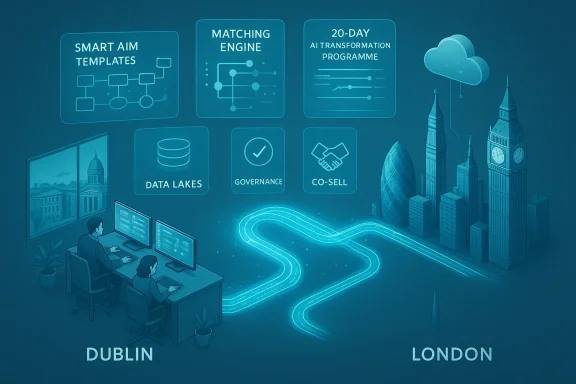 Background
Spanish Point Technologies was founded in 2005 and has grown from a specialist software and ISV operator into a Microsoft‑aligned engineering and product business. The company now blends professional services (cloud migration, data modernisation, AI application delivery) with IP‑led products such as Smart AIM — an Azure DevOps accelerator and library of deployment patterns — and Matching Engine, an enterprise copyright solution platform used by collective management organisations. These products underpin the firm’s claims of cross‑market experience and repeatable delivery patterns. Over the last two reported financial years Spanish Point has said it achieved a 31% compound annual growth rate (CAGR) and increased headcount by roughly 50 employees, bringing its team size to about 110 people — growth the company attributes to investments in engineering, R&D and productisation. The firm also highlights awards and Microsoft recognitions (including national partner awards and Azure AI specialisation achievements) as evidence of platform credibility. The UK move comes amid a bullish market forecast: Grand View Research projects the UK digital transformation market will expand rapidly through 2030, with an estimated size of USD 235.69 billion and a CAGR of 27.7% from 2023 to 2030 — a macro tailwind Spanish Point cites in public commentary. While market forecasts are directional, they do underline the scale of opportunity for partners who can operationalise enterprise AI and data programmes. What Spanish Point is selling in the UK: scope and promises
The Microsoft AI Transformation Programme role
Spanish Point says it is one of three UK partners authorised to deliver Microsoft’s AI Transformation Programme (a structured, consultative programme Microsoft runs with select partners). According to reporting by trade press the programme runs over a roughly 20‑day engagement window and includes:- a structured AI assessment and stakeholder workshops,
- evaluation of prospective AI use cases and technical feasibility,
- a Microsoft funding assessment and options for commercial support,
- a proposed implementation roadmap and an estimated ROI for prioritised use cases.
Products and IP that back delivery
Spanish Point’s go‑to‑market rests on three claims:- Smart AIM — presented as an Azure DevOps accelerator and library of templates and pipelines to speed migrations, CI/CD, and environment provisioning. Smart AIM is positioned as a reusable engineering foundation for cloud modernisation projects.
- Matching Engine — a cloud‑native copyright management and royalties distribution platform that Spanish Point markets to collective management organisations (CMOs). Spanish Point and partner CMOs state that Matching Engine supports distribution of more than €2.6 billion in royalties annually to over 758,000 rightsholders, and the product has been adopted by bodies such as IMRO and SOCAN in recent years. Those platform wins are a notable commercial credential in highly regulated, data‑sensitive workloads.
- Consulting and engineering capability — a delivery practice that combines Azure cloud engineering (App Service, AKS, Azure SQL/Cosmos DB), Data & AI patterns (data lakes, Synapse/Fabric, Azure OpenAI/Foundry usage), and Microsoft 365 / Copilot enablement for knowledge worker transformation. Spanish Point frames these capabilities as end‑to‑end.
Verification and independent corroboration
When a vendor announces market expansion and programme authorisations, buyers should check three things: (1) product claims, (2) partner authorisations, and (3) customer references.- Product claims: Spanish Point’s product pages, Matching Engine documentation and partner press releases detail the Matching Engine’s capabilities and list customer deployments; the company site and product microsites cite the annual royalties distributed figure (~€2.6bn) and rightsholder counts, and those numbers are echoed in press releases with customers such as IMRO and SOCAN. These are consistent company and partner statements but are, understandably, company‑controlled disclosures. Independent confirmation is available in partner press releases (SOCAN, IMRO) describing the implementation and expected improvements to royalty workflows.
- Programme authorisation: trade reporting documents Spanish Point’s role as an authorised deliverer of Microsoft’s AI Transformation Programme in the UK. Microsoft partner designations, capability badges, or Solutions Partner credentials may be verified through Microsoft’s public partner directory or Partner Center. Buyers should request formal confirmation of co‑sell eligibility, programme scope and any Microsoft funding levers before contracting.
- Market claims and growth figures: the broader market forecast cited by Spanish Point (Grand View Research UK digital transformation forecast) is a published market research projection and can be cross‑checked in independent research summaries; the numbers quoted align with Grand View Research’s published UK market press materials. Still, report figures are forecasts and should be treated as market context rather than a guaranteed demand signal.
Strategic analysis — strengths and differentiators
1. Productised delivery reduces pilot fatigue
One major problem in enterprise AI is the “pilot‑to‑nowhere” phenomenon: many PoCs never scale because the engineering foundation and operational controls are lacking. Spanish Point’s combination of Smart AIM libraries and the Matching Engine IP suggests the company has focused on repeatable engineering artefacts that accelerate the foundational work: landing zones, CI/CD pipelines, data ingestion patterns, and domain‑specific mapping tools. That reduces engineering rework and shortens the time to production‑grade delivery.2. Microsoft alignment is material for UK clients
For organisations already invested in Microsoft 365, Azure and Dynamics ecosystems, a partner with demonstrated Azure specialisations and data & AI competency can materially shorten procurement friction, unlock co‑sell and funding mechanics, and simplify integration with Microsoft Fabric, Azure OpenAI, and Copilot. Spanish Point’s awards and Azure specialisations add credibility in that channel.3. Domain credibility via Matching Engine references
Delivering mission‑critical royalty distributions for CMOs is a demanding use case: high throughput, complex metadata reconciliation, and strong auditability are required. Deployments with organisations such as SOCAN and IMRO underpin Spanish Point’s credibility for applications that require rigorous data provenance and correctness — useful evidence for public sector, regulated finance, or rights‑intensive clients.4. Measured growth and investment in talent
Public reporting of headcount growth and investment in R&D signals the firm is expanding delivery capacity rather than relying solely on subcontracted labour — a positive signal for clients seeking stable delivery teams. That said, exact hiring targets and local UK office footprints are still evolving according to press reporting.Risks, caveats and what buyers should require
Vendor and ecosystem concentration
- Vendor lock‑in risk. Heavy reliance on Microsoft Fabric, Azure OpenAI, Azure App Services and other Azure primitives increases deployment velocity but reduces architectural flexibility. Procurement teams should insist on migration/exit plans, clear data export guarantees, and multi‑cloud or on‑prem options where regulatory requirements demand them.
- Operational cost management. Generative AI and inference workloads can create unpredictable cloud spend. Capabilities like Smart AIM should include FinOps controls, model routing strategies, and cost‑forecasting governance to prevent runaway inference bills. Spanish Point promotes a FinOps‑informed Smart AIM approach in some announcements, but project contracts must stipulate cost management SLAs.
Programme and funding claims
- Microsoft funding and co‑sell eligibility are commercially useful but conditional. Buyers should require written evidence of eligibility for Microsoft funding assessments and co‑sell pipelines; these mechanics are commonly mediated by Microsoft account teams and have specific prerequisites. The claim that Spanish Point is “one of three” authorised UK deliverers should be validated in Partner Center or via Microsoft UK channel leadership for procurement.
Case‑study depth and independent validation
- While SOCAN and IMRO press releases confirm deployments, buyers should ask for: (1) performance SLAs demonstrated in production, (2) migration and reconciliation audit reports, and (3) measurable member‑facing outcomes (for Matching Engine scenarios). Company press materials are helpful starting points but should be supplemented with direct customer references and technical post‑implementation reviews.
Technical checklist for CIOs and procurement teams
When evaluating Spanish Point (or any Microsoft‑centric partner) for an enterprise AI transformation, ensure the proposals include the following:- Architecture diagrams showing how data flows are grounded (OneLake / Fabric / Synapse), how model calls are mediated (Azure OpenAI service or Foundry), and where audit logging and observability are implemented.
- A clear cost model and FinOps guardrails: tagged budgets, model‑routing policies, and monthly spend forecasts for inference workloads.
- Identity and governance: Entra ID configurations, managed identities for models, least‑privilege access, and Microsoft Purview or equivalent data classification and retention controls.
- Evidence of data residency and compliance approach for regulated data — especially important for public sector, health, and financial workloads.
- Proof of Microsoft co‑sell and funding entitlements where the partner claims programme access — request written confirmation or Partner Center evidence.
- Operational runbook and skills transfer plan: handover documentation, runbooks for model drift detection and retraining cycles, and staff training guarantees (or skills uplift budgets).
How Spanish Point’s UK expansion fits the broader vendor landscape
The market for AI transformation in the UK is crowded but stratified: large global system integrators sell scale and deep verticals, mid‑market firms offer rapid delivery and industry accelerators, and specialist ISVs (like Spanish Point) sell domain IP coupled with platform expertise. Spanish Point’s strategy — productised engineering assets plus targeted UK delivery capability — is a common and sensible path to scale in the Microsoft ecosystem. The key differentiator will be the firm’s ability to demonstrate repeatable outcomes at enterprise scale beyond pilot projects.Practical recommendations for IT leaders
- Treat the announcement as a procurement signal rather than a procurement decision. Ask Spanish Point for:
- customer references in the same industry and a willingness to allow technical due diligence,
- a draft delivery plan for the Microsoft AI Transformation Programme engagement, and
- clear evidence of co‑sell or funding access from Microsoft if the proposal relies on that funding.
- Require measurable KPIs in the statement of work (time‑to‑production, model accuracy/latency targets, cost per inference ceilings, data governance audits).
- When possible, demand a fixed‑price or capped‑cost initial phase for the 20‑day diagnostic + roadmap work so that the programme outcome delivers a clear decision gate (stop/iterate/scale).
- Insist on deliverables that matter operationally: a production‑ready data‑foundation backlog, a prioritized use‑case list with estimated ROI, and an operational runbook with SLAs for monitoring and incident response.
Conclusion
Spanish Point’s UK expansion and stated involvement in Microsoft’s AI Transformation Programme is a logical evolution for a productised Azure engineering firm with domain IP and recent Microsoft recognitions. The combination of Smart AIM engineering frameworks and a proven vertical product in Matching Engine gives them tangible credentials for both cloud modernisation and specialised enterprise workloads. Independent press coverage and partner press releases corroborate the company’s market claims and customer wins — but many of the headline numbers (growth rates, exact headcount, and partner authorisations) remain company‑reported, and should be validated through standard procurement checks.For UK enterprises seeking a Microsoft‑centric partner who can combine IP, Azure engineering and domain experience, Spanish Point is a candidate worth evaluating; for procurement and technical teams the essential next steps are verification of Microsoft programme authorisations, review of customer references and case studies, and contractual protections that mitigate vendor‑lock, runaway cloud costs, and operational risk.
Spanish Point’s public materials and partner press releases provide the starting points for vendor selection, and independent market research (Grand View Research) supports the macro demand thesis that underpins the firm’s strategic timing — but rigorous reference checks and architecture validation remain the prudent path for any organisation considering a multi‑year AI transformation engagement.
Source: IT Brief UK https://itbrief.co.uk/story/spanish-point-expands-uk-footprint-with-microsoft-ai-role/
