

State Street’s SPDR family has quietly sharpened its low‑cost arsenal while index flows and concentrated mega‑cap strength continue to reshape the S&P 500 ETF market — and the same market concentration that drives index returns is mirrored by an industry‑wide reshuffle in video games, where blockbuster franchises, hardware price dynamics and labor practices are generating both revenue and reputational headlines.
The recent market narrative is simple but consequential: investors are voting with dollars for lower‑cost S&P 500 wrappers, creating measurable asset rotations away from legacy funds even as the index itself is lifted by a small group of mega‑cap leaders. That product migration matters because it changes where liquidity pools sit, which ETFs trade most heavily, and which issuers benefit from passive‑management scale. The conversation around S&P 500 ETFs — expense ratios, fund architecture and creation/redemption mechanics — has real portfolio consequences for DIY investors, advisers and institutions. At the same time, December’s media cycle delivered a compact set of gaming industry headlines that underline how content hits, platform pricing and studio labor issues can move corporate reputations and, in some cases, shareholder value. From Circana’s November market snapshot to Bloomberg’s reporting on Naughty Dog labor practices and Warner Bros. Games’ announcement that Hogwarts Legacy surpassed 40 million units, the video‑game ecosystem is providing both fundamental signals and headline risks.
Practical success in both arenas requires triangulating product facts (expense ratios, fund structure, unit sale counts) with behavioral signals (flow patterns, consumer demand elasticity) and governance realities (studio labor practices, issuer disclosures). For investors and industry observers alike, the highest‑value skill is the ability to interpret headline numbers in context — to ask what the flows, price points and workforce stories imply about future cash flows and risk exposures, rather than mistaking a single metric for the whole story.
Source: Intellectia AI https://intellectia.ai/news/stock/sp-500-etfs-thrive-with-spdr-offering-lowest-expense-ratio/
 Background / Overview
The recent market narrative is simple but consequential: investors are voting with dollars for lower‑cost S&P 500 wrappers, creating measurable asset rotations away from legacy funds even as the index itself is lifted by a small group of mega‑cap leaders. That product migration matters because it changes where liquidity pools sit, which ETFs trade most heavily, and which issuers benefit from passive‑management scale. The conversation around S&P 500 ETFs — expense ratios, fund architecture and creation/redemption mechanics — has real portfolio consequences for DIY investors, advisers and institutions. At the same time, December’s media cycle delivered a compact set of gaming industry headlines that underline how content hits, platform pricing and studio labor issues can move corporate reputations and, in some cases, shareholder value. From Circana’s November market snapshot to Bloomberg’s reporting on Naughty Dog labor practices and Warner Bros. Games’ announcement that Hogwarts Legacy surpassed 40 million units, the video‑game ecosystem is providing both fundamental signals and headline risks. Why the SPDR pricing move matters: the S&P 500 ETF landscape
The numbers that changed the playing field
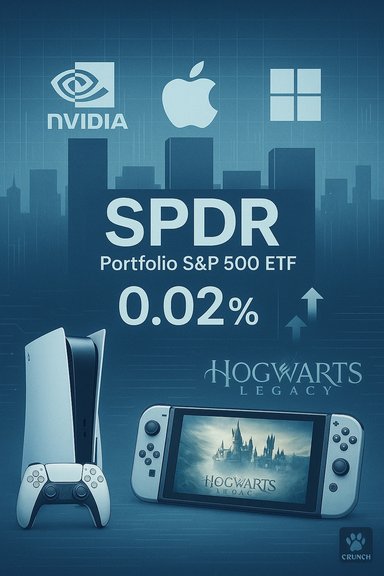
The big tactical fact is straightforward: a core SPDR Portfolio S&P 500 product now lists an expense ratio that undercuts the standard Vanguard and iShares S&P 500 ETFs. State Street’s SPDR Portfolio S&P 500 ETF shows a gross expense ratio of 0.02% on its factsheet, while the two dominant “core” competitors — Vanguard’s VOO and iShares’ IVV — commonly trade at 0.03%. The legacy SPDR S&P 500 ETF Trust (SPY) still carries a materially higher fee around 0.09%, a difference that becomes meaningful for buy‑and‑hold investors over long horizons. Two independent, verifiable points reinforce the importance of that gap:- Fee drag compounds: a 0.01% annual difference is small in any single year but, compounded across decades on large balances, translates into meaningful dollar amounts. Multiple ETF analysts and press comparisons show that lower expense ratios (0.02%–0.03%) are now standard among the cheapest S&P 500 wrappers, and that the older SPY structure is comparatively expensive.
- Product architecture matters: some funds are structured as unit investment trusts (UITs), others as open‑end funds. That architecture influences dividend treatment, securities‑lending revenue, and sometimes net expense ratio behavior — considerations beyond headline fee percentages that institutional allocators account for.
SPDR’s play: low cost without sacrificing brand
State Street has responded to a long‑running market dynamic: investors increasingly prefer low‑cost core building blocks. By positioning a SPDR Portfolio S&P 500 ETF at 0.02%, State Street narrows the last vestige of the fee argument in favor of Vanguard or iShares for fee‑sensitive investors, while preserving the SPDR brand’s deep liquidity pedigree in other product lines. This is a competitive, predictable move in an ETF industry where fees have steadily compressed.ETF flows, market microstructure and concentration risk
How flows reshape liquidity and tracking
ETF flows are not neutral bookkeeping events — they change who holds what and how index exposure is delivered to markets. When a large ETF such as SPY registers outflows while lower‑cost alternatives attract inflows, authorized participants (APs) and market makers must execute creation/redemption baskets that can temporarily affect trading volumes of the index’s largest constituents. That process can amplify moves in the most heavily weighted names and change intraday liquidity profiles for active traders. Recent reporting flagged notable short‑window SPY outflows and the broader migration toward cheaper wrappers as a structural theme of 2025. Independent trackers corroborate the broader trend even when single‑week numbers differ by vendor. This is not simply academic: funds preferred by short‑term traders (e.g., SPY) often trade at tighter spreads and deeper intraday liquidity, while cheaper open‑end ETFs (VOO, IVV, SPLG/SPYM) are positioned for buy‑and‑hold compounding. Investors should match vehicle choice to use case — trading or strategic allocation — not just headline fees.Concentration in mega‑caps: why index returns and flows can diverge
A paradox of modern markets is that an index can climb while breadth deteriorates. When a handful of mega‑cap tech names — Nvidia, Apple, Microsoft — lead returns, passive S&P 500 ETFs still show strong index returns even as many constituents lag. The result: flows sometimes shadow sentiment about a small subset of companies rather than broad economic improvement. Analysts have highlighted Nvidia’s outsized role in market moves and the way its valuation debates feed ETF allocations; these company‑level narratives therefore have outsized influence on index‑level capital movement.Practical investor takeaways: choosing among S&P 500 ETFs
- Match the product to the purpose:
- For tactical trading, tight spreads and deep intraday liquidity (historically SPY) remain valuable.
- For long‑term core exposure, the lowest ongoing expense ratio (SPLG/SPYM at 0.02% or VOO/IVV at 0.03%) compounds more favorably.
- Look beyond headline fees:
- Consider fund structure, dividend treatment, securities‑lending revenue sharing, and the issuer’s operational transparency.
- Watch flow tables and AP activity:
- Short windows of heavy redemptions create temporary dislocations; sustained flows indicate structural preference changes that could persist.
- Factor in concentration risk:
- If your portfolio is sensitive to single‑company outcomes, pair a cap‑weighted S&P ETF with equal‑weight S&P or sector/factor exposures to manage single‑name tail risk.
The video‑game month that mattered: sales, hardware weakness, and studio crunch
Circana’s November snapshot: spending and price pressure
Circana’s November 2025 market tracking captured a striking picture: overall U.S. video‑game spending slipped roughly 4% year‑over‑year to about $5.86 billion, driven by a 27% collapse in hardware dollar sales while content (software) edged up 1%. Hardware unit sales were especially weak — just 1.6 million consoles sold in November 2025, the lowest November total in decades — while the average price paid for a new unit reached a record November high near $439, up dramatically from $235 in November 2019. That price inflation in consoles helps explain the sharp drop in units sold and is a clear demand‑elasticity story. Key figures from Circana’s release:- Total U.S. video‑game spending (November 2025): ~$5.86B, down ~4% vs. prior year.
- Hardware: ~$695M, down ~27% vs. prior year.
- Units sold (Nov 2025): ~1.6M (lowest November since 1995).
- Average price paid per new unit (Nov 2025): ~$439 (all‑time November high).
Software winners: Call of Duty still wins the month
Despite a softer market overall, Call of Duty: Black Ops 7 was the best‑selling game of November 2025 in the U.S., continuing the franchise’s remarkable streak — the 18th consecutive year a Call of Duty title topped sales in its launch month. The title’s monthly performance, however, sits below the year‑to‑date leader Battlefield 6, underlining that launch‑month success does not automatically translate to the calendar‑year best‑seller. These data points were widely reported and derive from Circana’s retail/digital tracking.Platform dynamics: PS5 top in units and dollars, Switch 2 second
For the first time since the Switch 2’s market entry, Sony’s PlayStation 5 led November in both units and dollars, with Nintendo’s Switch 2 coming in second. The unusual combination of high prices and low unit sales creates a dichotomy: dollar sales can be disproportionately affected by price, masking weakening unit demand. That matters for hardware manufacturers and retailers in planning promotions and inventory.Naughty Dog crunch: labor risk and reputational fallout
Bloomberg’s reporting (via journalist Jason Schreier) revealed that Naughty Dog employees were subjected to mandatory overtime to finish a polished demo of their next title, Intergalactic: The Heretic Prophet, ahead of an internal review by Sony. Sources described a seven‑week period of logged overtime, a temporary return‑to‑office mandate, and a cap at roughly 60 hours per week for individuals — a return to “crunch” practices that Naughty Dog and other studios have publicly pledged to avoid. The episode is a reminder that labor practices at high‑profile studios can attract sustained media attention and scrutiny, with potential reputational and recruitment costs for the parent company.Corporate and investor implications: where gaming headlines meet markets
- Parent‑company exposure: Sony — as both hardware maker and publisher/owner of Naughty Dog — faces a nuanced set of tradeoffs. Hardware discounts that boost PS5 unit sales can support software ecosystems, but studio labor controversies can erode goodwill among developers and consumers. The market watches both revenue and brand risk.
- Content durability vs. short‑term sales: Hogwarts Legacy hitting 40 million units demonstrates the long‑tail value of high‑profile IP when a title is well executed and platform rollout is staged. Such hits materially increase the publisher’s content monetization optionality (DLC, sequels, cross‑platform ports) and support rights‑holder valuations.
- Reputational and regulatory risk: the industry’s labor practices and controversy over content can lead to consumer boycotts or regulatory scrutiny (e.g., in ESG frameworks). These are non‑trivial for publicly listed parents that rely on consistent developer pipelines and strong community relations.
Hogwarts Legacy: a blockbuster that still matters
Warner Bros. Games and Avalanche’s Hogwarts Legacy crossed a major milestone with reported lifetime sales above 40 million units across all platforms. The title’s sales trajectory (12M within weeks of launch in early 2023, 22M by year‑end 2023, 30M by late 2024, and incremental gains into 2025) places it among modern top sellers and underlines how a major IP and cross‑generation releases can create sustained revenue streams. The sales milestone also drives strategic decisions at Warner Bros. — sequels, DLC, and merchandising pipelines that convert a hit game into multi‑year cash flows. Caveat: while unit milestones are headline‑friendly, the revenue and profit contribution depends on discounts, platform revenue shares, bundling and any promotional free distributions (for example, temporary free offers on PC stores affect install counts but may be accounted for differently in revenue metrics). Investors should consider both unit sales and net revenue when assessing financial impact.Risks, caveats and items that need careful verification
- Single‑week flow figures: industry flow vendors sometimes publish differing weekly snapshots, and a precise five‑day net outflow number for SPY reported in one wrap could not be unambiguously verified across all public feeds. Treat such short‑window numbers as directionally meaningful but confirm with primary issuer AUM disclosures or dedicated flow providers before taking action.
- “Lowest expense ratio” framing: State Street’s SPDR Portfolio S&P 500 offering at 0.02% is among the cheapest widely distributed S&P 500 ETFs, and it undercuts VOO/IVV at 0.03%. However, a tiny number of niche or special‑purpose funds from other issuers or broker‑sponsored share‑class wrappers can sometimes match or undercut headline ratios in specific share classes — confirmation by issuer factsheets is prudent before asserting absolute primacy.
- Gaming sales reporting nuances: lifetime unit counts reported by publishers or verified via official X/Twitter posts are reliable for scale, but revenue recognition, sell‑through vs. shipments, and promotional giveaway mechanics vary by platform and can materially impact the publisher’s top‑line picture. Use publisher financial disclosures and GAAP/IFRS reporting as the authoritative revenue source.
- Labor reporting: journalism about internal studio practices relies on unnamed sources; the core facts (overtime requested, cap at 60 hours, demo deadlines) have been corroborated across reputable outlets, yet the long‑term organizational impact (attrition, culture shift) is harder to quantify publicly and may require insider testimony or subsequent official statements.
Tactical recommendations for investors and stakeholders
- For individual investors rebalancing into 2026:
- If your horizon is long and costs are the highest driver, favor the lowest‑fee open‑end S&P 500 ETFs (0.02%–0.03%) and ignore intraday trading frictions unless you trade frequently.
- If you actively trade or need immediate liquidity, evaluate the tradeoffs of SPY’s historical intraday liquidity versus the slightly better fee profile of other wrappers.
- For gaming industry watchers and corporate governance observers:
- Track studio labor developments and parent‑company communications: mandatory overtime episodes can re‑ignite scrutiny around workplace practices and developer retention.
- Distinguish unit milestones from revenue outcomes — big install numbers do not always translate to proportionate cash flow, particularly with heavy discounting, platform rev‑shares and promotional giveaways.
Conclusion: read product changes and cultural signals together
The twin stories of the day are linked by a common theme: structural shifts and concentrated winners are changing where value sits. In financial markets, the migration toward ultra‑low‑cost S&P 500 wrappers — including a 0.02% SPDR Portfolio offering — is reshaping ETF flows, liquidity profiles and the competitive set of index providers. In entertainment, perennial franchises and platform economics continue to drive outsized outcomes, while labor and reputational issues create asymmetric, non‑financial risks for major publishers and platform holders.Practical success in both arenas requires triangulating product facts (expense ratios, fund structure, unit sale counts) with behavioral signals (flow patterns, consumer demand elasticity) and governance realities (studio labor practices, issuer disclosures). For investors and industry observers alike, the highest‑value skill is the ability to interpret headline numbers in context — to ask what the flows, price points and workforce stories imply about future cash flows and risk exposures, rather than mistaking a single metric for the whole story.
Source: Intellectia AI https://intellectia.ai/news/stock/sp-500-etfs-thrive-with-spdr-offering-lowest-expense-ratio/
