

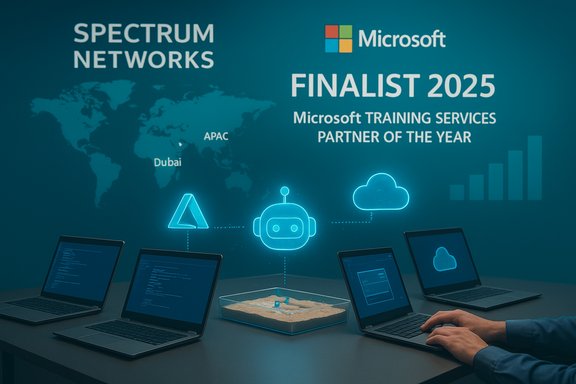
Spectrum Networks has been named a global finalist in the 2025 Microsoft Training Services Partner of the Year Awards, placing the Dubai‑based training specialist on a short list alongside established global providers and signaling Microsoft’s recognition of its outcomes‑driven skilling approach.
Background / Overview
Microsoft’s Partner of the Year Awards are an annual industry benchmark that recognize partners delivering measurable customer outcomes using Microsoft Cloud and AI technologies. In 2025 the program again drew a very large field—Microsoft reports receiving more than 4,600 nominations from around 100 countries—and winners and finalists were publicized in the run‑up to Microsoft Ignite. The company’s official partner blog and community channels provide the canonical list of winners and finalists for the 2025 cycle. The Training Services category specifically rewards partners that can deliver scalable, role‑based skilling across Microsoft’s cloud, AI, security and data portfolios, judged on learner outcomes, certification success, curriculum design, and the ability to tailor skilling to enterprise needs. In 2025 the category showed an intensified emphasis on AI and Copilot enablement—Microsoft’s evaluation favored partners who could produce rapid, measurable pathways to operationalize Copilot and Azure AI capabilities. Spectrum Networks’ announcement highlights the company’s role‑based curricula, blended delivery model (live instruction plus hands‑on labs), certification pipelines and an expressed focus on AI learning paths such as Microsoft Copilot and agentic AI. The company framed the finalist badge as validation of its Microsoft‑aligned skilling strategy.What the finalist recognition actually means
Being named a Microsoft Partner of the Year finalist is a meaningful credential—but it is a signal, not a proof of continuous operational compliance or production SLAs.- Practical upside for the partner: finalist status typically brings amplified field visibility with Microsoft account teams, improved co‑sell introductions, and marketing amplification around Microsoft events (for example, Ignite). These are immediate go‑to‑market advantages that help short‑list partners in procurement cycles.
- What it does not prove on its own: awards are based on submitted case studies and judged dossiers; they do not automatically validate ongoing operational telemetry, security attestations, or the granular contract artifacts procurement teams require before awarding enterprise work. Buyers should therefore treat the badge as a filter to identify capable partners, not as a procurement endpoint.
The evidence: what’s verifiable, and what still needs scrutiny
Verifiable items
- Spectrum Networks publicly announced the finalist placement on its newsroom and partner pages. Multiple trade outlets picked up the press release and syndicated it, reproducing the company’s announcement and highlighting its finalist status.
- Microsoft’s partner communications confirm the overall winners and finalists program mechanics (the nomination volume, the categories and the timing around Ignite). This corroborates the wider award context that Spectrum referenced.
Claims that require buyer validation
- Spectrum’s headline metric—“empowered 1,000,000+ professionals”—appears consistently in company material as a cumulative scale claim. This is a company‑declared number and, while possible, should be validated with named references, Partner Center exports, or voucher/certification redemption reports before it’s used as a procurement justification. Treat it as a vendor‑stated figure until independently proven.
- Program metrics cited in case studies (course completion rates, certification pass rates, skilling hours) are useful evidence but derive from internal reporting. Buyers should request access to anonymized cohort reports, voucher redemption logs, and third‑party audits where possible.
Why this matters for IT leaders, L&D teams and procurement
Training is a people‑risk control: enterprise projects (Azure migrations, Copilot rollouts, Fabric adoption) stall when users and operational teams lack the right skills. A Microsoft‑aligned training partner that can deliver role‑based curricula, hands‑on labs and certification pathways lowers adoption friction and shortens time‑to‑value.- Operational adoption: Vendors that tie skilling to measurable changes in operational performance (faster DevOps onboarding, higher certification conversion among target cohorts, or reduced runbook incident times) create real business value, not just seat‑sold metrics.
- Procurement leverage: Finalist recognition increases a partner’s visibility when teams assemble Microsoft‑aligned shortlists, and opens doors to co‑sell introductions and joint marketing with Microsoft. But procurement should still demand measurable KPIs, named references and contractual SLAs before awarding large programs.
Technical and security realities of hands‑on Microsoft training
Large‑scale, hands‑on labs are non‑trivial to operate securely and cost‑effectively. Practical buyers’ concerns include:- Lab isolation and tenancy: Effective labs require ephemeral subscriptions or sandbox tenants that are isolated from production datasets and networks. Without this, there’s a non‑trivial risk of accidental data exposure or identity escalation. Ask for lab architecture diagrams showing subscription boundaries, VNets, private endpoints and destruction/cleanup workflows.
- Identity and least privilege: Lab automation must use managed identities and enforce least privilege to avoid inadvertent privilege escalations into customer tenants. Contracts should specify how credentials and admin scopes are handled.
- Prompt & model privacy (Copilot / Azure OpenAI): Training that includes Copilot or Azure OpenAI demos can capture organizational prompts or sample PII. Confirm that default lab setups do not send customer prompts to unmanaged multi‑tenant endpoints and that data retention and model‑training permissions are explicitly controlled.
- Exam voucher and certification reporting: If a partner claims high certification conversion rates, request redemption proofs and anonymized pass‑rate breakdowns. Voucher management processes should be auditable.
- FinOps controls: Hands‑on lab VMs and model inference spend can escalate quickly. Require budget caps, tagging and monthly cost reports to prevent runaway bills during pilot phases.
Competitive context: who won, who else was shortlisted
The 2025 Training Services winner reported in public accounts is Koenig Solutions; Koenig’s own channels celebrate the win. Spectrum Networks was listed among finalists including Digital China and NetCom Learning, underscoring that the shortlist combined global incumbents and regional specialists. Microsoft’s partner blog and community channels provide the consolidated winners/finalists list announced around Ignite. Cross‑referencing Koenig’s claim with Microsoft’s partner announcements confirms the competitive outcome. This mix of finalists is telling: Microsoft’s judges appear to have favored partners that can demonstrate both scale and rapid AI‑era learning outcomes—specifically measured certification success, role‑based pathways, and Copilot/Azure AI enablement. That combination explains why both well‑established global training houses and regional specialists made the shortlist.Critical analysis — Spectrum’s strengths and plausible risks
Strengths signaled by the finalist badge
- Role‑based, hands‑on approach: Spectrum’s materials emphasize role‑based curricula and blended learning—best practices that map closely to Microsoft’s judging rubric for the category. These methods typically yield better retention and certification readiness.
- Regional reach: Spectrum’s presence across MENA and APAC is strategically valuable in markets that favor localized delivery, tailored language support, and government partnerships. Microsoft values partners that can scale localization and local market enablement.
- Evidence of outcome measurement: Spectrum has published a program case study (Microsoft AI Academy Program for Data Training) with concrete metrics—skilling hours, completion rates and certification outcomes—which is stronger evidence than high‑level marketing claims alone.
Potential risks and gaps buyers should probe
- Company‑declared scale metrics: Claims such as “1,000,000+ professionals empowered” are self‑reported. These headline numbers are useful as a marketing signal but require named references, Partner Center exports, and voucher/certification logs for procurement verification.
- Consistency at scale: Maintaining quality across instructor‑led, hybrid and on‑demand offerings is operationally hard. Procurement teams should request sample session audits, instructor credential lists, and quality assurance processes to confirm consistency.
- Governance in AI training: Training that omits governance, safe prompt design, and model‑use policies leaves enterprises exposed. For Copilot/agentic AI modules, ensure the curriculum includes governance, data handling rules, and incident playbooks.
- Operational proof vs. marketing: Awards validate that judges found compelling evidence in a submission; they do not replace contract‑level proofs—SOC 2, third‑party pen tests, or production telemetry—that enterprises typically need for mission‑critical deployments.
A procurement checklist: converting a finalist badge into a safe vendor short‑list
Use the finalist status to create a focused, verifiable short‑list. Insist on the following before awarding substantial work:- Provide a Partner Center export or an official Microsoft partner notification confirming finalist status and the submission period.
- Supply two named customer references that match your sector and scale, with measurable KPIs (certifications achieved, pre/post assessment improvements, adoption KPIs).
- Deliver anonymized voucher redemption and certification pass‑rate reports for the cohort(s) cited in the award submission.
- Present lab architecture diagrams that show sandboxing, subscription isolation, identity flows, and resource cleanup processes.
- Provide evidence of security/compliance posture: SOC 2 Type II or equivalent reports, and summaries of recent third‑party penetration tests on training platforms.
- Show content governance and refresh policies demonstrating how the partner keeps Copilot, Azure AI and Fabric content current.
- Include FinOps safeguards: tagging, budget alerts, monthly spend reports, and pre‑approved cost caps for pilot phases.
Strategic implications for Spectrum Networks
The finalist recognition will likely produce measurable go‑to‑market benefits for Spectrum Networks—greater visibility with Microsoft field teams, increased inbound demand across MENA and APAC, and recruitment momentum as candidates seek employers with Microsoft‑validated credentials. However, the long‑term commercial payoff depends on Spectrum’s ability to convert recognition into contract wins backed by verifiable delivery artifacts and robust operational controls.If Spectrum can provide procurement‑grade evidence (named references, voucher audits, lab architecture and security attestations), the finalist badge will become a durable commercial asset rather than a short‑lived marketing headline. Conversely, if those artifacts are absent or partial, prospective buyers should treat the shortlist entry as the starting point for deeper diligence rather than as an automatic selection criterion.
Wider market context and what to watch next
Microsoft’s 2025 awards reflect broader platform priorities: AI, Copilot adoption and governed agentic AI dominated the evaluation narrative. Partners that demonstrate platform‑native architectures, governance controls and measurable outcomes were favored. Expect other finalists and winners to publish more detailed case studies and operational playbooks in the weeks following Ignite; these disclosures will be useful for buyers comparing candidate partners.Key items to monitor:
- Whether finalist partners publish third‑party audits or more detailed voucher/certification telemetry.
- Evidence that training modules include governance and secure prompt design for Copilot/agentic AI.
- How Microsoft’s field teams and co‑sell channels operationalize finalist introductions (this determines how much business impact the finalist badge truly delivers).
Conclusion
Spectrum Networks being named a global finalist for the 2025 Microsoft Training Services Partner of the Year Award is a credible milestone that validates the company’s Microsoft‑aligned approach to role‑based, hands‑on skilling. The recognition raises Spectrum’s profile across MENA and APAC and should improve its standing on Microsoft‑centric procurement shortlists. At the same time, the finalist badge is a starting point for enterprise due diligence. Procurement teams should insist on verification—named references, voucher and certification audit trails, lab isolation diagrams, governance modules for AI training and security attestations—before committing to large skilling programs. When converted into contractual artifacts and pilot KPIs, the finalist recognition can become a powerful accelerator for organizational capability building; without those artifacts, it remains primarily a marketing signal.Spectrum’s public materials and the broader Microsoft winners roster indicate that the training market’s competitive edge in 2025 belongs to partners who combine platform alignment, governance and demonstrable learner outcomes. For enterprises embarking on Copilot or Azure AI initiatives, choosing a partner that can present both the award‑level narrative and the procurement‑grade evidence will materially increase the odds of a successful, secure rollout.
Source: The Malaysian Reserve https://themalaysianreserve.com/202...ining-services-partner-of-the-year-award/amp/
