

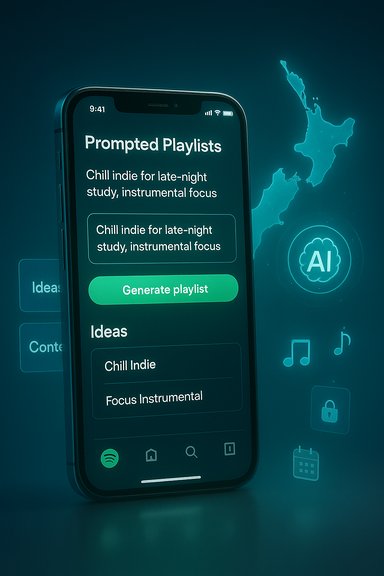
Spotify is handing listeners a new kind of control over discovery: a beta AI tool called Prompted Playlists that lets Premium subscribers describe, steer, and continuously update the algorithmic playlists they hear — starting in New Zealand and rolling out from there.
Spotify’s product roadmap has steadily pushed toward more personal, more controllable listening: Discover Weekly, Daily Mixes, the AI DJ experiments, and the bigger Wrapped moments have all nudged users into progressively richer personalization. Prompted Playlists is the next step in that arc — not just offering algorithmic prediction, but a language-driven dial that lets listeners specify rules, moods, eras, pacing, and even which part of their listening history to prioritize. This approach turns playlist creation into a conversational act: you describe what you want, and Spotify’s systems generate a living playlist that reflects both that instruction and your historical taste. Spotify frames the feature as giving listeners both control and convenience: it promises that users don’t have to learn query languages or playlist mechanics — plain English prompts are the interface. The company has positioned Prompted Playlists as an evolution that complements existing automated surfaces such as Discover Weekly, rather than replacing them outright.
Source: gHacks Technology News Spotify's Prompted Playlists will let you use AI to personalize the algorithm - gHacks Tech News
 Background
Spotify’s product roadmap has steadily pushed toward more personal, more controllable listening: Discover Weekly, Daily Mixes, the AI DJ experiments, and the bigger Wrapped moments have all nudged users into progressively richer personalization. Prompted Playlists is the next step in that arc — not just offering algorithmic prediction, but a language-driven dial that lets listeners specify rules, moods, eras, pacing, and even which part of their listening history to prioritize. This approach turns playlist creation into a conversational act: you describe what you want, and Spotify’s systems generate a living playlist that reflects both that instruction and your historical taste. Spotify frames the feature as giving listeners both control and convenience: it promises that users don’t have to learn query languages or playlist mechanics — plain English prompts are the interface. The company has positioned Prompted Playlists as an evolution that complements existing automated surfaces such as Discover Weekly, rather than replacing them outright. What Prompted Playlists does — the product at a glance
- Natural-language playlist creation: Type (or paste) a prompt describing tempo, mood, era, artist filters, and other rules; Spotify responds with a curated playlist that blends those constraints with your listening history.
- History-aware curation: Playlists are built using the full arc of your Spotify listening history, extending back to day one, so long-term taste signals matter as much as recent behavior.
- Editable prompts and refresh cadence: You can tweak the prompt to iterate on results, and you can schedule automatic refreshes (daily/weekly) so the playlist evolves over time.
- Ideas and presets: Spotify ships suggested prompts and editorially curated prompt templates to help users who aren’t sure what to ask the AI.
- Contextual explanations: For each recommended track Spotify will provide descriptions or context explaining why the song matched the prompt or your taste.
How it works (what Spotify is saying, and what to read into it)
Spotify describes Prompted Playlists as combining two primary inputs:- The user’s written prompt (constraints, mood, examples, rules).
- The user’s historical and ongoing listening signals (taste profile, saved tracks, followed artists, listening recency).
Why this matters: user benefits
- User agency over discovery: Instead of passively receiving a Discover Weekly, users can ask for it with constraints — for example, “top artists + deep cuts I haven’t heard” — and get something closer to their intent. This reduces friction between what listeners imagine and what the algorithm serves.
- Better for task-oriented listening: Runners, study sessions, road trips, or party set-ups can be tailored precisely — e.g., “30-minute 5K run: steady pace then cool-down” — and scheduled to refresh as training demands evolve. That turns playlists into dynamic tools, not static collections.
- Discovery with context: By including contextual card text explaining why songs were chosen, Spotify helps users understand new music rather than simply presenting a list of unfamiliar tracks. That framing is essential for converting recommendations into sustained listening and fandom.
- Editorial + algorithm hybrid: Spotify plans to include editorial prompt recipes and surfaced “Ideas,” which can accelerate discovery for users who want the convenience of AI but the craft of human curation.
Risks and trade-offs: privacy, fairness, and discoverability
Prompted Playlists is promising, but it raises meaningful concerns that deserve scrutiny.Privacy and data use
The feature explicitly relies on one of Spotify’s most sensitive assets: the full listening history of a user. That history can reveal tastes, routines, political or cultural interests, and even lifestyle signals. The direct use of that dataset to shape AI outputs increases the stakes for both transparency and control.- Spotify’s announcement states the feature uses listening history; it does not, in public messaging, specify data-retention, on-device vs. server-side computation, or whether prompts and resulting playlists are logged for model training. Those are core governance details users and regulators will want to see.
- Whether prompt text and resulting selections are retained for model improvement.
- Whether the feature is opt-in or opt-out for training data.
- How Private Session, Taste Profile exclusions, and data deletion controls affect Prompted Playlists’ behavior.
Algorithmic fairness and artist impact
Putting more control in users’ hands can help niche artists gain fans, but it can also entrench existing power dynamics.- If prompts favor “top artists” by default, mainstream acts could consolidate exposure; conversely, if prompts are tuned to surface deep cuts, independent artists might benefit.
- Spotify’s editorial prompt templates and ranking choices will shape the eventual economics. Artists, managers, and rights bodies will watch whether the feature redistributes streams toward more or fewer artists overall. Independent reporting indicates Spotify believes Prompted Playlists will help artists surface to “the right listeners,” but the business impact depends on ranking weights and catalog inclusion.
Manipulation and gaming
Any control mechanism is also an attack surface. Savvy users or third parties could craft prompts to game discoverability, and bad actors might attempt to reverse-engineer prompt phrasing that amplifies specific tracks or catalogs. Robust logging, randomness in ranking, and rate limits will be necessary to keep the surface honest.Model behavior and hallucination
Spotify promises contextual explanations for recommendations, but that depends on generative components. If those explanations are produced by language models, there is a risk of hallucinated rationales that sound plausible but are inaccurate. Spotify must ensure provenance and factuality before issuing explanatory text as if it’s objective truth.Practical user guide: how to use Prompted Playlists (beta)
- Open Spotify (mobile) when Prompted Playlists appears on Home (beta rollout is server-gated).
- Tap “Prompted Playlist” or the prompt box and type your instruction. Try simple-to-complex prompts:
- Simple: “Chill indie for late-night study, instrumental focus.”
- Intermediate: “Songs from my top artists in the last three years, include deep cuts I’ve never played.”
- Advanced: “45-minute progressive rock mix that starts mellow, peaks at minutes 20–30, includes at least three tracks from 1970–1979 and no more than one song per artist.”
- Edit the prompt iteratively to refine results; use “Ideas” if you need inspiration.
- Set refresh cadence (daily/weekly) if you want recurring updates, or create a one-off playlist to export or save.
- Be explicit about time and scope (e.g., “last five years” vs. “90s classics”).
- Define constraints (e.g., “no explicit lyrics,” “instrumental-only,” “include at least two tracks by local artists”).
- Use creative combos: task + era + energy level (e.g., “lo-fi beats for a 20-minute meditation, include songs with piano and under 70 BPM”).
For artists and rights holders: what to watch
- Catalog inclusion and opt-in: Confirm whether every label and publisher must opt into Prompted Playlists, and what metadata drives selection. Songs without full metadata or territorial licensing could be invisible.
- Attribution and royalty accounting: If Prompted Playlists increases plays for video- or film-associated tracks (a use case Spotify highlighted), rights holders should verify how plays are reported and monetized across audio-only and AI-driven playlist experiences.
- Transparency requests: Artist managers should ask for measurable signals about how prompts influence ranking — metadata influence, editorial boosts, and how “deep cut” vs “top artist” trade-offs are implemented. Those mechanics will determine whether the feature truly widens or narrows discovery.
The broader product context: video, pricing, and platform strategy
Prompted Playlists arrives amid a broader Spotify push toward richer media and monetization experiments. Spotify has expanded Music Videos in beta to Premium users in the U.S. and Canada, and it is actively adding video-specific playlists and viewing surfaces across mobile, desktop, and TV. That video expansion is intended to deepen engagement and create new revenue and advertising possibilities while increasing the case for Premium subscriptions. At the same time, news outlets report Spotify may raise subscription prices in the U.S. in early 2026 — a move observers link to investment in new content types (video) and rights spending. Those price conversations matter because they shape how new features are packaged (Premium-only vs. free-tier access) and how users perceive value for money. Prompted Playlists, like Music Videos, will be part of that calculus.Policy, regulation, and transparency — what Spotify needs to publish
If Prompted Playlists is to be trusted at scale, Spotify should publish the following items clearly and publicly:- Data governance policy for the feature: Are prompts and playlist outputs logged? Are they used to train models? Is there an opt-out for model training?
- Explainability parameters: What factors most influence ranking when prompts are ambiguous (e.g., recency vs. historical top artists)?
- Auditable logs for creators: A way for artists to see when their tracks were surfaced due to Prompted Playlists and under what prompt categories.
- Fairness audits: Periodic summaries showing whether the feature broadens discovery across catalogs or concentrates streams into a smaller set of hits.
Editorial evaluation: strengths and weak points
Strengths
- User-centric design: By letting listeners express intent in natural language, Spotify lowers the barrier to personalized discovery. This has the potential to increase satisfaction and session length.
- Task-oriented utility: Runners, commuters, and themed listening sessions gain a flexible tool that can replace manual playlist curation for many users.
- Editorial + algorithm synergy: The combination of AI prompts with editorial “Ideas” can surface creative listening concepts users wouldn’t invent on their own.
Weaknesses and open questions
- Opaque ranking heuristics: Spotify has not publicly enumerated the weightings between prompt match, historical taste, and editorial signals — a transparency gap that matters for artists and power users.
- Privacy clarity missing: The company needs to clarify logging, retention, and model-training practices for prompt text and user history.
- Risk of homogenization: If default heuristics emphasize “top artists” or current hits, Prompted Playlists could reinforce popularity bias rather than diversify listening. How Spotify configures defaults will determine the outcome.
Quick checklist for power users and administrators
- If you care about privacy: use Private Session or remove songs from your Taste Profile if you don’t want them to influence futures. Confirm with Spotify whether Private Session suppresses history for Prompted Playlists.
- Try conservative prompts first (energy, era, instrument) before layering on complex business rules (licensing, region-specific artist inclusion).
- Artists and managers should monitor referral and playlist reporting dashboards to see whether Prompted Playlists increases organic discovery for their catalogs.
Conclusion
Prompted Playlists is an intuitive, ambitious attempt to let listeners speak the algorithm into giving them exactly what they want. It blends long-term taste signals, editorial craft, and natural-language prompting into a single product that feels like the logical next step for a discovery-focused platform. Early reporting and Spotify’s own announcement confirm the Premium beta launch in New Zealand and the core product promises: history-aware curation, editable prompts, and scheduled refreshes. But the feature’s promise will only be fully realized if Spotify pairs usability with transparency. Users deserve clear controls over how their listening history is used, artists deserve visibility into how prompts map to exposure, and regulators will demand understandable guardrails as algorithmic curation grows more active. In short, Prompted Playlists can be a powerful tool for personalization — if it ships with strong privacy settings, clear documentation of ranking logic, and auditability for creators. The early beta is an important experiment; the outcome will hinge on product choices that balance convenience, fairness, and accountability.Source: gHacks Technology News Spotify's Prompted Playlists will let you use AI to personalize the algorithm - gHacks Tech News
