

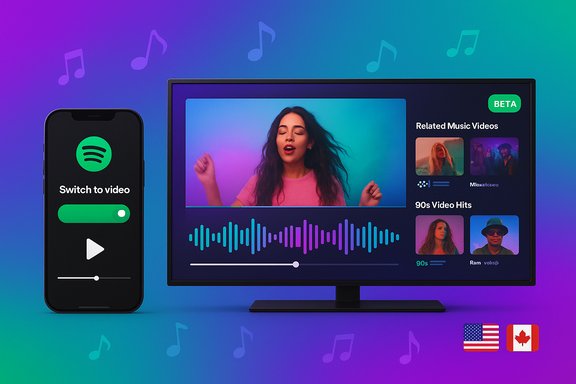
Spotify is rolling out official music videos in beta to Premium subscribers across the United States and Canada, bringing short-form and full-length artist videos into the same app many of us already use for day-to-day music listening. The feature is limited at launch — a compact catalog of official videos, live performances and covers — but it’s available now on TV, desktop, iOS and Android, and Spotify says the video library and discovery features will expand in the coming weeks and months. This move marks the company’s clearest effort yet to blend audio-first streaming with the visual formats that have dominated music discovery for the past decade.
When Spotify first began testing full-length music videos in early 2024, the pilot ran in roughly a dozen countries. Later that year the test expanded dramatically, adding dozens more markets so that by autumn the beta had reached nearly 100 territories. The U.S. and Canada were notable absences from that early expansion; the December rollout finally brings North American Premium subscribers into the experiment.
The current U.S./Canada launch arrives alongside a new licensing push aimed at ensuring publishers and songwriters can opt into audiovisual rights on the platform. Industry reports and Spotify’s own messaging highlight the commercial rationale: video formats boost engagement, and engagement is the lever Spotify needs to justify heavier investment in visual features and, potentially, higher subscription pricing. At the same time, the company faces a complex rights landscape in the U.S., where disputes over how Spotify classifies its Premium bundle and pays mechanical royalties remain politically and legally charged.
This measured approach is sensible from an engineering and licensing perspective, but it also creates immediate headwinds for competitive parity. Against incumbents that already host massive official-video catalogs, a tiny initial library limits the feature’s usefulness as a primary video destination.
This opt-in model addresses two priorities: it creates a clearer commercial path for publishers to earn from video, and it gives Spotify the contractual authority to host videos at scale without being blocked by legacy audio-only agreements.
The music video rollout is occurring in this fraught environment. On the one hand, expanded audiovisual deals promise new revenue lines; on the other hand, publishers remain vigilant about ensuring music streaming economics reflect the value of their works. That means licensing for video is not a simple checkbox — it is a negotiation with tangible effects on songwriter income.
YouTube benefits from decades of uploaded content, a massive creator economy and an extant video advertising stack. TikTok offers the rapid virality that drives single-track discovery. Spotify’s differentiated bet is that binding video to the audio experience inside a subscription environment — with direct artist revenue options and premium features — can create a unique value proposition for both fans and rights holders.
Success metrics to watch:
The launch delivers clear benefits: richer fan experiences, new revenue pathways for willing publishers, and a more unified app for listeners who already treat Spotify as the center of their music life. But the feature’s initial limitations — a narrow catalog and an ongoing rights landscape — mean Spotify must execute carefully to make video a core reason to choose its service over established video-first platforms.
Ultimately, success will be measured by three things: whether videos measurably increase meaningful engagement and retention, whether the content library grows fast enough to matter to mainstream listeners, and whether Spotify can navigate royalties and pricing without provoking widespread backlash from creators or subscribers.
For now, Premium users in the U.S. and Canada get access to a promising beta: an integrated watch-and-listen experience that hints at a richer future for music streaming, provided the company and rights holders can convert beta momentum into durable value for artists and listeners alike.
Conclusion
Spotify’s music-video beta is a pragmatic, strategically aligned expansion that brings visual storytelling into the platform’s discovery loop. It’s a necessary step if Spotify wants to stay relevant in an era where sight and sound move together. The path ahead requires careful handling of licenses, sensible product choices around discovery and performance, and transparent communication about what features cost consumers and creators. If executed well, music videos could become a meaningful differentiator; if handled poorly, they risk being another costly experiment that pleases a subset of fans while inflaming longstanding industry disputes.
Source: gHacks Technology News Spotify music videos are rolling out to Premium users in the U.S. and Canada - gHacks Tech News
 Background
When Spotify first began testing full-length music videos in early 2024, the pilot ran in roughly a dozen countries. Later that year the test expanded dramatically, adding dozens more markets so that by autumn the beta had reached nearly 100 territories. The U.S. and Canada were notable absences from that early expansion; the December rollout finally brings North American Premium subscribers into the experiment.The current U.S./Canada launch arrives alongside a new licensing push aimed at ensuring publishers and songwriters can opt into audiovisual rights on the platform. Industry reports and Spotify’s own messaging highlight the commercial rationale: video formats boost engagement, and engagement is the lever Spotify needs to justify heavier investment in visual features and, potentially, higher subscription pricing. At the same time, the company faces a complex rights landscape in the U.S., where disputes over how Spotify classifies its Premium bundle and pays mechanical royalties remain politically and legally charged.
How music videos work on Spotify: the user experience
One-tap switching between audio and video
- When a supported track is playing, Premium users will see a "Switch to video" toggle or option.
- Choosing that option replaces the audio-centric view with the official music video, which starts where the audio left off so users don’t lose their place.
- At any point users can return to background listening by tapping "Switch to audio."
Device support and orientation behavior
- Supported platforms at launch: TV apps, desktop clients, iOS, Android.
- On mobile, videos default to portrait presentation but can be enlarged to full-screen by rotating the device to landscape.
- On TV and desktop the video is shown in a larger window or full-screen view by default.
Discovery and navigation while watching
- A Related Music Videos section sits below the current video so viewers can scroll to discover alternate performances, covers, or other official clips.
- Spotify is launching curated video playlists by era and genre — examples include “90s Video Hits,” “Hip-Hop Throwbacks,” and “Latin Party” — to seed discovery and watch-session behavior.
- Artist profiles will include a Music tab where official music videos live alongside audio tracks, playlists, and other artist-facing features.
Catalog, scale and current limitations
Initial catalog and growth expectations
At launch the catalog is intentionally small. Spotify lists a handful of artists and highlights a mixture of mainstream pop, country, Latin and rising acts. The company has stated the library will grow “quickly” over the coming months, but the rollout plan is clearly phased: start with a curated sample, measure engagement, and expand content and label deals as the product matures.This measured approach is sensible from an engineering and licensing perspective, but it also creates immediate headwinds for competitive parity. Against incumbents that already host massive official-video catalogs, a tiny initial library limits the feature’s usefulness as a primary video destination.
What’s not available (and what’s still unknown)
- Offline downloads for videos are not confirmed in Spotify’s current messaging. At launch, video playback appears to be streaming-only.
- There is no public roadmap indicating when — or whether — the video experience will be extended to free-tier listeners across the U.S. and Canada (in some earlier test markets, certain video content was made available to free users).
- The company has not committed to a fixed schedule for adding specific artists or labels to the catalog; expansion depends on licensing negotiations and publisher opt-ins.
Business, rights and royalties: behind the scenes
New audiovisual licensing options
To support video ambitions, Spotify and music-publishing bodies have been negotiating arrangements that allow publishers to opt into expanded audiovisual rights. These deals are intended to open an additional revenue stream for songwriters and publishers when Spotify streams official music videos. In practical terms, that means publishers can elect to be paid for audiovisual uses separate from pure audio mechanicals and performance royalties.This opt-in model addresses two priorities: it creates a clearer commercial path for publishers to earn from video, and it gives Spotify the contractual authority to host videos at scale without being blocked by legacy audio-only agreements.
The royalty context and legal friction
Spotify’s broader business moves over the past 18–24 months — notably its decision to bundle audiobooks with Premium in some markets — triggered pushback from publishers and industry trade groups. The dispute centers on how bundled offerings are categorized for mechanical royalty calculations, a complex legal and regulatory area. While recent court outcomes have favored Spotify in at least one high-profile case, the debate continues to shape negotiation dynamics in the U.S.The music video rollout is occurring in this fraught environment. On the one hand, expanded audiovisual deals promise new revenue lines; on the other hand, publishers remain vigilant about ensuring music streaming economics reflect the value of their works. That means licensing for video is not a simple checkbox — it is a negotiation with tangible effects on songwriter income.
Strategic implications: Why Spotify is investing in video
Strengths and potential upside
- Engagement lift: Spotify cites data showing meaningful behavior changes when listeners encounter music video content: higher replay rates, increased saves and shares, and deeper downstream listening — the kind of metrics platforms sell to advertisers and use to justify product investment.
- Unified discovery: Integrating video into the main Spotify client reduces the friction of switching apps for music discovery and fan engagement. For casual listeners, that convenience can shorten the path from discovery to fandom.
- Artist tools alignment: Video complements existing artist features like Canvas, Clips and Countdown Pages, letting labels and managers build richer campaigns entirely inside Spotify’s ecosystem.
- Monetization optionality: Videos create a new product dimension for both subscription justification and ad inventory. Long-term, a more video-rich Spotify may be better positioned to monetize engagement through either subscription differentiation or ad-based formats tied specifically to video content.
- Competitive positioning: A video capability makes Spotify a more credible competitor to platforms that have long dominated music video consumption. It also helps defend Spotify against rivals that are expanding into audio spaces (podcasts, audiobooks) and social-native short-form video.
Risks and constraints
- Catalog depth: The value of a music-video hub scales with content breadth. Without major label and indie catalog buy-ins, Spotify’s video offering will remain niche for many users.
- Rights complexity and political risk: The U.S. legal environment for royalties and bundling is active. Any misstep or perceived shortfall in payments could provoke regulatory attention or further legal action from rights-holder groups.
- User backlash to pricing changes: The timing of increased visual features coincides with industry reports about possible subscription price increases. If users perceive video as an upsell used to justify higher monthly fees, Spotify risks negative sentiment among price-sensitive listeners.
- Bandwidth, battery and background play: Video playback consumes more data and power than audio. The inability to background a video without switching to audio may frustrate users who prefer audio-first listening during commutes or multitasking.
- Competition from entrenched platforms: YouTube’s catalog scale, creator ecosystem and recommendation engine remain formidable. TikTok’s short-form discovery loop is also unmatched for virality and bite-sized discovery. Spotify will need to offer differentiated discovery signals or better integration with artist marketing to capture user attention.
What it means for different stakeholders
For Premium listeners
- Immediate benefit: one app to both hear and watch many (but not all) official music videos.
- Better artist context: videos provide visual storytelling that can turn casual listeners into dedicated fans.
- Caveats: fewer titles than video-native platforms, and video playback will use more data when mobile.
For artists, labels and publishers
- Artists gain an additional distribution channel with native discovery and playlist placement.
- Labels and publishers can negotiate audiovisual deals to capture incremental revenue.
- Independent and smaller artists may initially see slower uptake until Spotify opens more expansive creator tools and ingestion pathways.
For developers and third-party integrators
- Expect APIs and SDK updates over time to accommodate video playback control and analytics in embedded contexts.
- DJ and live-performance integrations (Spotify has already expanded DJ integrations in 2025) could get new hooks to mix and trigger visual content in performance workflows.
Technical considerations and user guidance
- Video streams will likely be optimized for adaptive bitrate streaming similar to existing audio and podcast delivery: this balances quality and bandwidth.
- Expect a modest increase in local storage and cache use when switching between frequent video sessions on mobile or desktop.
- There’s no public indication that videos will be included in the existing lossless tier offerings; the company’s messaging ties lossless audio and video as separate product narratives.
Competitive landscape: Can Spotify rival YouTube?
Spotify’s advantage is its deep integration with music listening patterns: personalized playlists, Wrapped-style cultural moments, and a global subscriber base. However, matching the scale of YouTube’s video library and creator ecosystem is a long-term play, not a single-launch achievement.YouTube benefits from decades of uploaded content, a massive creator economy and an extant video advertising stack. TikTok offers the rapid virality that drives single-track discovery. Spotify’s differentiated bet is that binding video to the audio experience inside a subscription environment — with direct artist revenue options and premium features — can create a unique value proposition for both fans and rights holders.
Success metrics to watch:
- Daily and monthly active users who consume video content in addition to audio.
- Change in session length and replay behavior after a video-enabled discovery event.
- Uptake of audiovisual licensing opt-ins among publishers and the resulting revenue flows to songwriters.
- User churn or sentiment changes following any price adjustments that coincide with new features.
Risks to watch and unanswered questions
- Will Spotify open video to free-tier users in the U.S. and Canada, and if so, under what constraints?
- How quickly will major labels and indie publishers commit their catalogs to the audiovisual model versus retaining exclusives on other platforms?
- How transparent will Spotify be with creators about video-view metrics, attribution, and payment splits?
- Could regulatory scrutiny re-intensify if publishers or songwriter groups view video as a lever to rebalance royalty distributions?
What to expect next: a short roadmap
- Catalog expansion: more official music videos and live performances will be added to the library gradually over weeks and months.
- Rights adoption: more publishers and songwriters should be able to opt into audiovisual frameworks that promise incremental royalties.
- Product refinements: expect tweaks to recommendation surfaces, video playlists, and mobile UX based on beta usage data.
- Pricing conversations: as Spotify broadens the product, watch for formal announcements around subscription pricing and tier adjustments; industry reporting suggests pricing moves may be considered, but corporate confirmation will be explicit and timed.
- Cross-platform feature parity: TV, desktop, mobile parity will improve, and integrations with DJ and creator tools will likely follow as the company prioritizes pro uses.
Verdict: measured progress, meaningful ambition
Spotify’s introduction of music videos to Premium users in the U.S. and Canada is not a single heroic pivot — it’s a methodical feature expansion that plays to Spotify’s strengths in music discovery while acknowledging the hard realities of rights, catalog scale and intense competition in the video space.The launch delivers clear benefits: richer fan experiences, new revenue pathways for willing publishers, and a more unified app for listeners who already treat Spotify as the center of their music life. But the feature’s initial limitations — a narrow catalog and an ongoing rights landscape — mean Spotify must execute carefully to make video a core reason to choose its service over established video-first platforms.
Ultimately, success will be measured by three things: whether videos measurably increase meaningful engagement and retention, whether the content library grows fast enough to matter to mainstream listeners, and whether Spotify can navigate royalties and pricing without provoking widespread backlash from creators or subscribers.
For now, Premium users in the U.S. and Canada get access to a promising beta: an integrated watch-and-listen experience that hints at a richer future for music streaming, provided the company and rights holders can convert beta momentum into durable value for artists and listeners alike.
Conclusion
Spotify’s music-video beta is a pragmatic, strategically aligned expansion that brings visual storytelling into the platform’s discovery loop. It’s a necessary step if Spotify wants to stay relevant in an era where sight and sound move together. The path ahead requires careful handling of licenses, sensible product choices around discovery and performance, and transparent communication about what features cost consumers and creators. If executed well, music videos could become a meaningful differentiator; if handled poorly, they risk being another costly experiment that pleases a subset of fans while inflaming longstanding industry disputes.
Source: gHacks Technology News Spotify music videos are rolling out to Premium users in the U.S. and Canada - gHacks Tech News
