

Toys for Bob announced Spyro: A Realm Beyond at the Xbox Games Showcase on June 7, 2026, revealing a spring 2027 multiplatform revival for Activision’s purple dragon after the studio survived layoffs, office closure, and a spinout from Microsoft ownership. That is the surface-level comeback story. The more interesting one is that Spyro’s return now reads like a test case for a games business that keeps buying studios for their creativity, then smothering them with portfolio logic. If this revival works, it will not merely prove nostalgia still sells; it will prove that some studios may be more valuable outside the corporate machinery than trapped inside it.
The Xbox Games Showcase reveal was engineered for recognition: saturated color, playful creature design, a more expressive Spyro, and the unmistakable promise that the little dragon is no longer simply hopping, charging, and gliding through corridors. A Realm Beyond is being pitched as a genuine mechanical evolution, with full flight replacing the old glide-first platforming grammar that defined much of the original trilogy’s rhythm.
That matters because Spyro has always been a character whose appeal depends on movement as much as mascot charm. Sonic is speed, Mario is jump precision, Crash is comic punishment, and Spyro is the feeling of being just airborne enough to make a level feel larger than it is. Giving him full flight is not a cosmetic upgrade; it is a statement that Toys for Bob wants to expand the design language rather than merely polish the PS1 memory.
The reveal also carried the kind of cross-platform commercial logic that now defines Microsoft’s gaming strategy. A Realm Beyond is tied to Xbox, Activision, Game Pass, PC, PlayStation, and Nintendo Switch 2 messaging all at once. This is no longer the old console-war version of an Xbox showcase, where the point was to wall off excitement behind one piece of hardware.
But the studio name under the trailer is what gives the announcement its charge. Toys for Bob is not just returning to Spyro. Toys for Bob is returning from the brink, and the comeback has arrived at the exact moment Xbox’s wider studio strategy looks more fragile than its stage presentations suggest.
That machine was not always bad for the studio. Toys for Bob’s Activision era produced Skylanders, one of the defining commercial experiments of the early 2010s, and later Spyro Reignited Trilogy, a remake collection that helped prove there was still a large audience for bright, accessible, family-friendly 3D platforming. The studio also helped carry the Crash Bandicoot revival, making it one of the few teams in the industry with a credible claim to modern stewardship over multiple dormant mascot franchises.
Then came the gravity well: Call of Duty. After Warzone became a live-service colossus in 2020, Activision increasingly oriented its internal resources around the franchise’s constant appetite for content, support, QA, and seasonal production. Toys for Bob, like other Activision studios, was pulled into the orbit of bigger revenue priorities.
This is the quiet tragedy behind many studio acquisitions. A publisher buys a team because it has a distinctive identity, then gradually repurposes that team into a capacity unit for whatever franchise best satisfies the spreadsheet. The studio does not vanish overnight. It becomes less itself one support assignment at a time.
By the time Microsoft acquired Activision Blizzard, Toys for Bob’s value to players and its value to the corporate org chart were no longer obviously the same thing. To players, the studio represented Spyro, Crash, Skylanders, color, charm, and craft. To the machinery, it was another experienced development group available for allocation.
The basic logic was familiar: growth, acquisition, synergy, rationalization. In the first phase, buying studios signals ambition and reassures investors that the platform holder has content. In the second, the same studios become costs to be optimized, duplicated functions to be consolidated, or optional bets to be cut when the market turns.
For developers, the emotional whiplash is severe. A studio can spend years being told that its culture, history, and creative voice are the reason it was acquired, only to find itself later described in the colder vocabulary of efficiency. The danger is not just job loss, though that is serious enough. The danger is the destruction of institutional memory: the informal design habits, trust networks, technical shortcuts, and shared taste that make a studio more than a Slack workspace with a logo.
Toys for Bob’s escape route was unusual because it did not simply involve layoffs followed by scattered rehiring elsewhere. The studio spun out, preserved at least part of its identity, and kept a working relationship with Microsoft and Activision. That arrangement is messy, but it is also more imaginative than the default corporate options of absorption or closure.
It is worth pausing on that point. The great achievement here is not that Toys for Bob got to be “indie” in some romantic garage-band sense. It is that the studio found a way to separate creative control from total corporate ownership while still accessing the publishing muscle needed to make a major licensed sequel.
The more useful lesson is about leverage. As an internal support studio, Toys for Bob’s future could be subordinated to other priorities. As an independent partner with a credible pitch for a beloved franchise, the studio had a different kind of bargaining power. It could present itself not merely as a headcount block but as the team best positioned to turn dormant intellectual property into a commercially viable event.
That distinction matters across the industry. Many studios are not failing because they lack talent or audience goodwill. They are failing because their work does not fit the financial cadence demanded by parent companies that want predictable, scalable, repeatable returns. A 3D platformer revival, a stylish narrative action game, or an idiosyncratic mid-budget adventure can be strategically important to a platform’s identity while still looking awkward inside a financial model built around megahits and live-service annuities.
Independence does not remove those pressures. It changes who gets to negotiate them. An independent Toys for Bob still has to manage budgets, deadlines, publisher expectations, platform commitments, and fan scrutiny. But it can do so as a studio whose survival is tied to making the kind of game it is known for, rather than as a flexible resource pool inside someone else’s franchise factory.
That is why the Spyro announcement feels larger than Spyro. It represents a third path between total ownership and total abandonment. In a healthier industry, that path would not be radical. In this one, it feels almost subversive.
That makes Toys for Bob an awkward success story for Xbox. On one hand, Microsoft can point to A Realm Beyond as evidence that its Activision acquisition is producing crowd-pleasing results and that beloved franchises can return under the broader Xbox umbrella. On the other hand, the studio delivering that result had to leave the corporate structure to do it.
There is a lesson there Microsoft may not enjoy learning. If Xbox wants breadth — not just shooters, service games, and prestige tentpoles, but family games, experimental work, platformers, horror, narrative adventures, and genre oddities — it may need to stop treating ownership as the highest form of control. Sometimes the healthiest relationship between a platform holder and a studio is not acquisition. It is patronage with boundaries.
Game Pass complicates this further. A subscription service needs variety to feel alive: small games, strange games, old favorites, cozy experiments, kids’ titles, cult revivals, and prestige releases all help fill the calendar. But the economics of making those games can become murky when success is measured less by unit sales and more by engagement, retention, or platform value.
A revived Spyro is exactly the kind of game that makes a subscription library feel warmer and more varied. Yet if the studio making it needs independence to survive, Xbox’s strategy has to account for that. Otherwise the company risks creating a content ecosystem whose most interesting contributors are better off outside the walls.
Full flight changes the contract. Once a character can truly fly, the world must justify three-dimensional freedom. Levels can no longer rely solely on the old platforming trick of making the player wonder whether a gap is reachable. Designers must create reasons to climb, dive, bank, thread, chase, scout, and return.
That is risky. Flight can make a world feel magical, but it can also make it feel empty if the design does not keep pace. Open air is not automatically gameplay. The challenge for Toys for Bob will be to preserve Spyro’s readable, toy-like appeal while giving players a world spacious enough to make flight meaningful.
The trailer’s imagery of bridges, airborne collectibles, clouds, and looming threats suggests the studio understands the symbolic value of flight. But the real test will arrive in hands-on gameplay. Does flight become a constant expressive tool, or is it gated into special sequences? Does the world maintain platforming density, or does it stretch into spectacle? Does combat evolve around air movement, or does Spyro merely travel faster between familiar encounters?
This is where Toys for Bob’s history matters. The studio has already shown it can modernize beloved mascot design without sanding away all the oddness. Spyro Reignited Trilogy was conservative by nature, but it demonstrated affection and craft. Crash Bandicoot 4 was more assertive, willing to expand a classic formula while respecting its difficulty and identity.
A Realm Beyond appears to require the second instinct more than the first. This cannot simply be Reignited with a new subtitle. A full sequel after nearly two decades needs to convince old fans that Spyro grew up without becoming embarrassed by what he was.
Spyro’s particular advantage is that the original fantasy remains clean. He is not a lore labyrinth, not a grim reboot candidate, and not a franchise that requires a glossary before entry. The appeal is immediate: a small dragon in bright worlds collecting things, rescuing characters, defeating theatrical villains, and moving with satisfying physicality.
That simplicity is powerful in 2026 because much of mainstream gaming has become exhausting. Players are surrounded by battle passes, crafting economies, massive open worlds, seasonal FOMO, dark prestige narratives, and endless upgrade trees. A well-made Spyro game can feel countercultural precisely by being legible, joyful, and mechanically direct.
But “joy” is not the same as softness. The best mascot platformers are exacting machines disguised as toys. They succeed when animation, camera, level shape, collectible placement, enemy behavior, and sound feedback all conspire to make movement feel inevitable. If Toys for Bob gets that right, A Realm Beyond can be more than comfort food.
The danger is that the revival becomes overcorrected for modern expectations. A slightly more mature Spyro redesign is fine; a world with bigger stakes is fine; expanded mechanics are necessary. But the franchise should not be inflated into something it is not. Spyro does not need to become a cinematic open-world epic with RPG bloat. He needs a world that makes flying, charging, burning, exploring, and collecting feel good for ten or fifteen hours.
A Realm Beyond is the first kind of answer fans wanted: a beloved character, a suitable studio, a showcase slot, a modern release plan, and a visible attempt to make something new rather than merely repackage the old. But it also exposes how difficult back-catalog revival actually is. Intellectual property does not make games. Studios do.
A corporate owner can announce that it wants to revisit classic franchises, but without the right teams those revivals become outsourcing exercises or brand management projects. Toys for Bob has credibility with Spyro because it already handled the character carefully and because its aesthetic instincts align with the material. That is not easily replaceable.
This should make Microsoft cautious about treating studio closures as isolated cost decisions. Every shuttered or scattered team narrows the company’s future creative options. Once a studio with a particular culture disappears, a publisher may still own the franchise, the code, the trademark, and the marketing rights. What it loses is the group that knew how to make the thing feel alive.
The back catalog, in other words, is not a museum shelf. It is a garden. Without the right caretakers, old names do not bloom; they merely get licensed, rebooted, and quietly forgotten again.
These studios are not interchangeable with Toys for Bob, and their circumstances differ. But the emotional pattern is similar. Each represents a distinct creative identity that was supposed to benefit from platform-holder backing. Each now sits within a corporate environment where backing can become exposure, and exposure can become vulnerability.
Compulsion is especially instructive because South of Midnight was exactly the kind of game platform holders claim to want when they speak in public about diversity of content: stylish, culturally specific, not obviously designed by committee, and visually distinct. Ninja Theory, meanwhile, built the Hellblade series around psychological intensity, performance capture, and a scale that sat somewhere between indie and blockbuster. Double Fine is practically a monument to the idea that personality can survive inside production constraints.
If the future for such teams is closure, forced sale, or repeated restructuring, then the industry’s stated appetite for creativity is mostly decorative. Publishers will continue to celebrate distinctiveness on stage while disciplining it in budgets. Players will get reveal trailers that look varied and release calendars that slowly converge around the safest bets.
This is why Toys for Bob’s spinout matters beyond its own fate. It suggests that Microsoft and other large publishers may need a more flexible model for studios whose work is valuable but awkward within the central org. Better a living independent partner than a dead internal asset.
Toys for Bob had unusual advantages. It had a recognizable history, a strong association with a beloved IP, experienced leadership, and a plausible commercial pitch. Spyro is also a family-friendly franchise with broad platform potential, which makes it easier to imagine a publisher supporting a revived entry without betting the entire year’s strategy on it.
A studio like Ninja Theory faces different math. Its games are more expensive, more technologically demanding, and more tightly associated with cinematic production values. Compulsion’s work is more idiosyncratic and less obviously tied to a dormant megabrand. Double Fine has a beloved identity but often operates in the risky middle zone between cult appeal and mainstream scale.
Still, the model does not need to be universal to be important. The industry has spent years treating closure as the natural endpoint when corporate priorities shift. Toys for Bob shows another endpoint is possible: negotiated independence, continued publishing partnership, preserved creative identity, and a project that aligns studio strengths with market demand.
The lesson is not that every studio should leave its parent company. The lesson is that parent companies should stop behaving as though ownership gives them only two choices: total integration or disposal. There is a spectrum between those poles, and the future of many mid-sized creative teams may depend on whether that spectrum becomes normal.
A studio assigned to support a live-service franchise has different incentives than one building its own platformer. A team defending its existence inside a conglomerate takes fewer risks than one with a clear mandate and a publisher aligned around the project. A developer stretched across support work, layoffs, reorgs, and uncertain leadership cannot build with the same confidence as one protected by a coherent plan.
That does not mean independent studios are automatically freer or happier. Many are financially precarious, overworked, and dependent on publisher milestones. But creative alignment matters. When the people making the game, the people funding the game, and the audience waiting for the game all broadly want the same thing, the odds improve.
A Realm Beyond benefits from that alignment, at least on paper. Fans want a new Spyro. Toys for Bob wants to make colorful character-action platformers. Microsoft and Activision want to show that the acquisition can revive dormant value. Game Pass wants recognizable, family-friendly content. Other platforms want a game that can sell to nostalgic adults and younger players alike.
The risk, as always, is that alignment frays under production reality. Budgets tighten. Release windows shift. Feature ambition meets technical constraints. Marketing promises collide with controller feel. But the starting conditions are better than they looked when Toys for Bob’s future seemed to be support work, office closure, or disappearance.
Spyro’s return should be celebrated, but not as proof that the system works. It should be celebrated because a talented studio found a way around the system at the moment the system nearly consumed it. If A Realm Beyond lands in 2027 with the confidence its trailer suggests, the lesson for Microsoft and the rest of the industry will be hard to ignore: sometimes the best way to preserve a studio’s value is to stop owning all of it, and start trusting what made it worth buying in the first place.
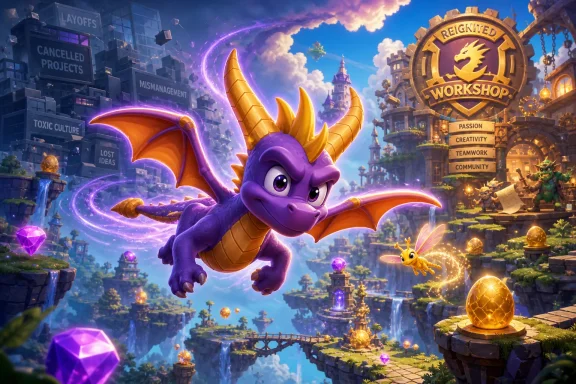 Spyro Returns as a Mascot, but Toys for Bob Returns as an Argument
The Xbox Games Showcase reveal was engineered for recognition: saturated color, playful creature design, a more expressive Spyro, and the unmistakable promise that the little dragon is no longer simply hopping, charging, and gliding through corridors. A Realm Beyond is being pitched as a genuine mechanical evolution, with full flight replacing the old glide-first platforming grammar that defined much of the original trilogy’s rhythm.That matters because Spyro has always been a character whose appeal depends on movement as much as mascot charm. Sonic is speed, Mario is jump precision, Crash is comic punishment, and Spyro is the feeling of being just airborne enough to make a level feel larger than it is. Giving him full flight is not a cosmetic upgrade; it is a statement that Toys for Bob wants to expand the design language rather than merely polish the PS1 memory.
The reveal also carried the kind of cross-platform commercial logic that now defines Microsoft’s gaming strategy. A Realm Beyond is tied to Xbox, Activision, Game Pass, PC, PlayStation, and Nintendo Switch 2 messaging all at once. This is no longer the old console-war version of an Xbox showcase, where the point was to wall off excitement behind one piece of hardware.
But the studio name under the trailer is what gives the announcement its charge. Toys for Bob is not just returning to Spyro. Toys for Bob is returning from the brink, and the comeback has arrived at the exact moment Xbox’s wider studio strategy looks more fragile than its stage presentations suggest.
The Studio Microsoft Could Have Lost Is Now Selling Its Showcase Joy
Toys for Bob’s story is unusually long by modern games-industry standards. Founded in 1989, the studio built a reputation on colorful, character-driven, systems-literate games long before “mascot platformer revival” became a reliable bullet point in a publisher’s quarterly deck. Star Control and Star Control II gave it early credibility; later licensed work kept the lights on; Activision acquisition put it inside one of the largest publishing machines in the business.That machine was not always bad for the studio. Toys for Bob’s Activision era produced Skylanders, one of the defining commercial experiments of the early 2010s, and later Spyro Reignited Trilogy, a remake collection that helped prove there was still a large audience for bright, accessible, family-friendly 3D platforming. The studio also helped carry the Crash Bandicoot revival, making it one of the few teams in the industry with a credible claim to modern stewardship over multiple dormant mascot franchises.
Then came the gravity well: Call of Duty. After Warzone became a live-service colossus in 2020, Activision increasingly oriented its internal resources around the franchise’s constant appetite for content, support, QA, and seasonal production. Toys for Bob, like other Activision studios, was pulled into the orbit of bigger revenue priorities.
This is the quiet tragedy behind many studio acquisitions. A publisher buys a team because it has a distinctive identity, then gradually repurposes that team into a capacity unit for whatever franchise best satisfies the spreadsheet. The studio does not vanish overnight. It becomes less itself one support assignment at a time.
By the time Microsoft acquired Activision Blizzard, Toys for Bob’s value to players and its value to the corporate org chart were no longer obviously the same thing. To players, the studio represented Spyro, Crash, Skylanders, color, charm, and craft. To the machinery, it was another experienced development group available for allocation.
The Near-Disaster Was Not a Fluke; It Was the Business Model Working as Designed
The reported near-collapse around Toys for Bob should not be treated as a freak accident. It was a predictable outcome of a consolidation cycle that promised safety through scale and then discovered scale has its own hunger. Microsoft’s 2024 gaming layoffs, including the closure of Toys for Bob’s physical office, arrived after years of expansion that had gathered Bethesda, Activision Blizzard, and a constellation of internal teams under one corporate roof.The basic logic was familiar: growth, acquisition, synergy, rationalization. In the first phase, buying studios signals ambition and reassures investors that the platform holder has content. In the second, the same studios become costs to be optimized, duplicated functions to be consolidated, or optional bets to be cut when the market turns.
For developers, the emotional whiplash is severe. A studio can spend years being told that its culture, history, and creative voice are the reason it was acquired, only to find itself later described in the colder vocabulary of efficiency. The danger is not just job loss, though that is serious enough. The danger is the destruction of institutional memory: the informal design habits, trust networks, technical shortcuts, and shared taste that make a studio more than a Slack workspace with a logo.
Toys for Bob’s escape route was unusual because it did not simply involve layoffs followed by scattered rehiring elsewhere. The studio spun out, preserved at least part of its identity, and kept a working relationship with Microsoft and Activision. That arrangement is messy, but it is also more imaginative than the default corporate options of absorption or closure.
It is worth pausing on that point. The great achievement here is not that Toys for Bob got to be “indie” in some romantic garage-band sense. It is that the studio found a way to separate creative control from total corporate ownership while still accessing the publishing muscle needed to make a major licensed sequel.
Independence Is Not Purity; It Is Leverage
There is a temptation to tell the Toys for Bob story as a simple morality play: big publisher bad, indie studio good, purple dragon saved by plucky creatives. That version is emotionally satisfying and mostly useless. Spyro: A Realm Beyond exists because Toys for Bob remained connected to Activision and Xbox, not because it fled into total isolation.The more useful lesson is about leverage. As an internal support studio, Toys for Bob’s future could be subordinated to other priorities. As an independent partner with a credible pitch for a beloved franchise, the studio had a different kind of bargaining power. It could present itself not merely as a headcount block but as the team best positioned to turn dormant intellectual property into a commercially viable event.
That distinction matters across the industry. Many studios are not failing because they lack talent or audience goodwill. They are failing because their work does not fit the financial cadence demanded by parent companies that want predictable, scalable, repeatable returns. A 3D platformer revival, a stylish narrative action game, or an idiosyncratic mid-budget adventure can be strategically important to a platform’s identity while still looking awkward inside a financial model built around megahits and live-service annuities.
Independence does not remove those pressures. It changes who gets to negotiate them. An independent Toys for Bob still has to manage budgets, deadlines, publisher expectations, platform commitments, and fan scrutiny. But it can do so as a studio whose survival is tied to making the kind of game it is known for, rather than as a flexible resource pool inside someone else’s franchise factory.
That is why the Spyro announcement feels larger than Spyro. It represents a third path between total ownership and total abandonment. In a healthier industry, that path would not be radical. In this one, it feels almost subversive.
Xbox’s New Problem Is That Its Best Story Is About Letting Go
The timing could hardly be more pointed. Reports around Xbox’s 2026 restructuring have put studios such as Ninja Theory, Compulsion Games, and Double Fine under a cloud of uncertainty, with talk of closures, spinouts, layoffs, or negotiations to avoid the worst outcomes. Whether every reported detail proves accurate or not, the pattern is familiar enough to be credible: expensive acquisitions followed by a strategic “reset,” with creative teams asked to justify their existence in a harsher climate.That makes Toys for Bob an awkward success story for Xbox. On one hand, Microsoft can point to A Realm Beyond as evidence that its Activision acquisition is producing crowd-pleasing results and that beloved franchises can return under the broader Xbox umbrella. On the other hand, the studio delivering that result had to leave the corporate structure to do it.
There is a lesson there Microsoft may not enjoy learning. If Xbox wants breadth — not just shooters, service games, and prestige tentpoles, but family games, experimental work, platformers, horror, narrative adventures, and genre oddities — it may need to stop treating ownership as the highest form of control. Sometimes the healthiest relationship between a platform holder and a studio is not acquisition. It is patronage with boundaries.
Game Pass complicates this further. A subscription service needs variety to feel alive: small games, strange games, old favorites, cozy experiments, kids’ titles, cult revivals, and prestige releases all help fill the calendar. But the economics of making those games can become murky when success is measured less by unit sales and more by engagement, retention, or platform value.
A revived Spyro is exactly the kind of game that makes a subscription library feel warmer and more varied. Yet if the studio making it needs independence to survive, Xbox’s strategy has to account for that. Otherwise the company risks creating a content ecosystem whose most interesting contributors are better off outside the walls.
Full Flight Is a Design Promise, Not Just a Trailer Moment
The most immediately exciting detail in A Realm Beyond is Spyro’s new flight system. Longtime players understand why. Classic Spyro’s glide was both freedom and constraint: a limited extension of jump distance that turned level geometry into a puzzle of ramps, ledges, arches, and distant platforms.Full flight changes the contract. Once a character can truly fly, the world must justify three-dimensional freedom. Levels can no longer rely solely on the old platforming trick of making the player wonder whether a gap is reachable. Designers must create reasons to climb, dive, bank, thread, chase, scout, and return.
That is risky. Flight can make a world feel magical, but it can also make it feel empty if the design does not keep pace. Open air is not automatically gameplay. The challenge for Toys for Bob will be to preserve Spyro’s readable, toy-like appeal while giving players a world spacious enough to make flight meaningful.
The trailer’s imagery of bridges, airborne collectibles, clouds, and looming threats suggests the studio understands the symbolic value of flight. But the real test will arrive in hands-on gameplay. Does flight become a constant expressive tool, or is it gated into special sequences? Does the world maintain platforming density, or does it stretch into spectacle? Does combat evolve around air movement, or does Spyro merely travel faster between familiar encounters?
This is where Toys for Bob’s history matters. The studio has already shown it can modernize beloved mascot design without sanding away all the oddness. Spyro Reignited Trilogy was conservative by nature, but it demonstrated affection and craft. Crash Bandicoot 4 was more assertive, willing to expand a classic formula while respecting its difficulty and identity.
A Realm Beyond appears to require the second instinct more than the first. This cannot simply be Reignited with a new subtitle. A full sequel after nearly two decades needs to convince old fans that Spyro grew up without becoming embarrassed by what he was.
Nostalgia Opens the Door, but Mechanics Decide Who Stays
The games industry has become exceptionally skilled at weaponizing recognition. A logo appears, a musical cue lands, a character turns toward the camera, and social feeds fill with the language of childhood recovered. That machinery works, but only briefly. Nostalgia is a launch trailer accelerant, not a design foundation.Spyro’s particular advantage is that the original fantasy remains clean. He is not a lore labyrinth, not a grim reboot candidate, and not a franchise that requires a glossary before entry. The appeal is immediate: a small dragon in bright worlds collecting things, rescuing characters, defeating theatrical villains, and moving with satisfying physicality.
That simplicity is powerful in 2026 because much of mainstream gaming has become exhausting. Players are surrounded by battle passes, crafting economies, massive open worlds, seasonal FOMO, dark prestige narratives, and endless upgrade trees. A well-made Spyro game can feel countercultural precisely by being legible, joyful, and mechanically direct.
But “joy” is not the same as softness. The best mascot platformers are exacting machines disguised as toys. They succeed when animation, camera, level shape, collectible placement, enemy behavior, and sound feedback all conspire to make movement feel inevitable. If Toys for Bob gets that right, A Realm Beyond can be more than comfort food.
The danger is that the revival becomes overcorrected for modern expectations. A slightly more mature Spyro redesign is fine; a world with bigger stakes is fine; expanded mechanics are necessary. But the franchise should not be inflated into something it is not. Spyro does not need to become a cinematic open-world epic with RPG bloat. He needs a world that makes flying, charging, burning, exploring, and collecting feel good for ten or fifteen hours.
The Activision Back Catalog Is a Test Microsoft Cannot Keep Avoiding
When Microsoft closed its Activision Blizzard acquisition, one of the recurring fan hopes was that dormant franchises might return. That hope was not irrational. Activision’s vault contains names with real cultural memory, from Spyro and Crash to Tony Hawk, Guitar Hero, Prototype, and beyond. The question was never whether the catalog had value. The question was whether Microsoft would build the conditions required to use it well.A Realm Beyond is the first kind of answer fans wanted: a beloved character, a suitable studio, a showcase slot, a modern release plan, and a visible attempt to make something new rather than merely repackage the old. But it also exposes how difficult back-catalog revival actually is. Intellectual property does not make games. Studios do.
A corporate owner can announce that it wants to revisit classic franchises, but without the right teams those revivals become outsourcing exercises or brand management projects. Toys for Bob has credibility with Spyro because it already handled the character carefully and because its aesthetic instincts align with the material. That is not easily replaceable.
This should make Microsoft cautious about treating studio closures as isolated cost decisions. Every shuttered or scattered team narrows the company’s future creative options. Once a studio with a particular culture disappears, a publisher may still own the franchise, the code, the trademark, and the marketing rights. What it loses is the group that knew how to make the thing feel alive.
The back catalog, in other words, is not a museum shelf. It is a garden. Without the right caretakers, old names do not bloom; they merely get licensed, rebooted, and quietly forgotten again.
The Compulsion and Ninja Theory Shadow Makes Spyro’s Glow Harder to Enjoy
The uncomfortable part of celebrating Spyro’s return is that it arrives amid another wave of anxiety around Xbox-owned studios. Compulsion Games, fresh off South of Midnight, has been discussed in reports about layoffs and uncertainty. Ninja Theory, after showing more Senua material at the 2026 showcase, has also been tied to reports about closure risk or buyer-seeking. Double Fine has appeared in similar conversations.These studios are not interchangeable with Toys for Bob, and their circumstances differ. But the emotional pattern is similar. Each represents a distinct creative identity that was supposed to benefit from platform-holder backing. Each now sits within a corporate environment where backing can become exposure, and exposure can become vulnerability.
Compulsion is especially instructive because South of Midnight was exactly the kind of game platform holders claim to want when they speak in public about diversity of content: stylish, culturally specific, not obviously designed by committee, and visually distinct. Ninja Theory, meanwhile, built the Hellblade series around psychological intensity, performance capture, and a scale that sat somewhere between indie and blockbuster. Double Fine is practically a monument to the idea that personality can survive inside production constraints.
If the future for such teams is closure, forced sale, or repeated restructuring, then the industry’s stated appetite for creativity is mostly decorative. Publishers will continue to celebrate distinctiveness on stage while disciplining it in budgets. Players will get reveal trailers that look varied and release calendars that slowly converge around the safest bets.
This is why Toys for Bob’s spinout matters beyond its own fate. It suggests that Microsoft and other large publishers may need a more flexible model for studios whose work is valuable but awkward within the central org. Better a living independent partner than a dead internal asset.
The Toys for Bob Model Is Promising, but It Is Not a Magic Door
It would be naïve to pretend every threatened studio can simply “do a Toys for Bob.” Spinouts require legal agreement, financing, leadership continuity, IP access, publishing commitments, and a project credible enough to anchor the transition. They also require a parent company willing to negotiate rather than burn everything down for short-term simplicity.Toys for Bob had unusual advantages. It had a recognizable history, a strong association with a beloved IP, experienced leadership, and a plausible commercial pitch. Spyro is also a family-friendly franchise with broad platform potential, which makes it easier to imagine a publisher supporting a revived entry without betting the entire year’s strategy on it.
A studio like Ninja Theory faces different math. Its games are more expensive, more technologically demanding, and more tightly associated with cinematic production values. Compulsion’s work is more idiosyncratic and less obviously tied to a dormant megabrand. Double Fine has a beloved identity but often operates in the risky middle zone between cult appeal and mainstream scale.
Still, the model does not need to be universal to be important. The industry has spent years treating closure as the natural endpoint when corporate priorities shift. Toys for Bob shows another endpoint is possible: negotiated independence, continued publishing partnership, preserved creative identity, and a project that aligns studio strengths with market demand.
The lesson is not that every studio should leave its parent company. The lesson is that parent companies should stop behaving as though ownership gives them only two choices: total integration or disposal. There is a spectrum between those poles, and the future of many mid-sized creative teams may depend on whether that spectrum becomes normal.
Players Should Care Because Studio Structure Becomes Game Design
It is easy for players to tune out corporate structure as inside baseball. Who owns what, which executive reports to whom, and whether a studio is internal or independent can feel distant from the simple question of whether a game is fun. But structure shapes games long before players touch a controller.A studio assigned to support a live-service franchise has different incentives than one building its own platformer. A team defending its existence inside a conglomerate takes fewer risks than one with a clear mandate and a publisher aligned around the project. A developer stretched across support work, layoffs, reorgs, and uncertain leadership cannot build with the same confidence as one protected by a coherent plan.
That does not mean independent studios are automatically freer or happier. Many are financially precarious, overworked, and dependent on publisher milestones. But creative alignment matters. When the people making the game, the people funding the game, and the audience waiting for the game all broadly want the same thing, the odds improve.
A Realm Beyond benefits from that alignment, at least on paper. Fans want a new Spyro. Toys for Bob wants to make colorful character-action platformers. Microsoft and Activision want to show that the acquisition can revive dormant value. Game Pass wants recognizable, family-friendly content. Other platforms want a game that can sell to nostalgic adults and younger players alike.
The risk, as always, is that alignment frays under production reality. Budgets tighten. Release windows shift. Feature ambition meets technical constraints. Marketing promises collide with controller feel. But the starting conditions are better than they looked when Toys for Bob’s future seemed to be support work, office closure, or disappearance.
The Purple Dragon Now Carries More Than a Franchise Revival
The concrete facts are simple enough, but the implications stretch wider than one mascot’s return. Spyro: A Realm Beyond is a new game, a studio survival story, and a business experiment wrapped in one brightly colored trailer.- Spyro: A Realm Beyond is scheduled for spring 2027 and is being positioned as a full new entry rather than another remake.
- Toys for Bob’s independence is central to the story because the studio’s creative identity had been diluted by support work before its spinout.
- The new flight mechanic is the design change most likely to determine whether the revival feels genuinely modern or merely nostalgic.
- Microsoft’s handling of other Xbox studios will determine whether Toys for Bob becomes a model or an exception.
- The revival underscores that owning old IP is not enough; publishers need the right teams with the right incentives to make those worlds matter again.
Spyro’s return should be celebrated, but not as proof that the system works. It should be celebrated because a talented studio found a way around the system at the moment the system nearly consumed it. If A Realm Beyond lands in 2027 with the confidence its trailer suggests, the lesson for Microsoft and the rest of the industry will be hard to ignore: sometimes the best way to preserve a studio’s value is to stop owning all of it, and start trusting what made it worth buying in the first place.
References
- Primary source: Windows Central
Published: 2026-06-28T13:52:10.384070
Spyro is back with a new game, but the team bringing him to life had to overcome a near‑collapse to finish the project | Windows Central
Toys for Bob was on the chopping block at Activision. Instead of being shut down, they escaped the Call of Duty machine and went independent — proving there is another path for other XBOX studios at risk of closure.www.windowscentral.com - Related coverage: gamesradar.com
As Xbox studios brace for a "reset," South of Midnight developers from Compulsion Games begin looking for work | GamesRadar+
Some devs have been with the studio for yearswww.gamesradar.com - Related coverage: pcgamer.com
It's not layoffs, but you can see them from here: Numerous Compulsion Games employees are looking for new jobs | PC Gamer
The sudden influx of "open to work" posts suggests that fears of major Xbox layoffs in the near future are well founded.www.pcgamer.com - Related coverage: news.xbox.com
XBOX Games Showcase 2026 Recap: The Return of Exclusives, World Premieres, and Anniversary Hardware - XBOX Wire
XBOX Game Showcase 2026 just concluded. Find out everything announced - from the return of exclusives, to anniversary hardware, to games from XBOX and our partners – inside.news.xbox.com - Related coverage: games.gg
Spyro: A Realm Beyond revealed at Xbox Games Showcase | GAMES.GG
Spyro: A Realm Beyond is officially coming to Xbox Series X/S, PS5, PC, and Nintendo Switch 2 in spring 2027, developed by Toys for Bob in Unreal Engine 5.games.gg - Related coverage: techtimes.com
Xbox Studio Closures Confirmed: Ninja Theory Shut Down Nine Days After Showcase
Xbox studio closures 2026 hit Ninja Theory, Double Fine, and Compulsion Games as Microsoft’s Reset executes its first cuts. The Hellblade studio was told Monday it is closing, just nine days afterwww.techtimes.com
- Related coverage: purexbox.com
- Related coverage: gematsu.com
Bloomberg: Several Xbox studios in negotiations to avoid closure - Gematsu
Several studios within Xbox are in active negotiations to spin off from the company in order to avoid closure, including Compulsion Games…www.gematsu.com - Related coverage: mondoxbox.com
Spyro: A Realm Beyond announced at XBOX Games Showcase: the purple dragon returns in 2027 - MondoXbox
During the XBOX Games Showcase 2026, Microsoft and Toys for Bob officially announced Spyro: A Realm Beyond, the first new installment in the series in over 20 years. The title marks the return in style of the iconic purple dragon, which will debut in spring 2027 and will be available on day one...www.mondoxbox.com
- Related coverage: theguardian.com
Spyro the Dragon returns with a new game after almost two decades | Games | The Guardian
90s PlayStation fans, rejoice: California studio Toys for Bob is making Spyro: Realms Beyond, intended to ‘inspire love, joy and laughter’www.theguardian.com - Related coverage: shacknews.com
For Spyro to live again, Toys for Bob had to go indie | Shacknews
Spyro: A Realm Beyond came as a surprise during Sunday's Xbox Games Showcase, one that likely wouldn't have happened without Toys for Bob.www.shacknews.com - Related coverage: techradar.com
Amid reports of closures to Ninja Theory and Compulsion Games, Xbox Game Studios CEO Craig Duncan is stepping down from the role after less than two years | TechRadar
Xbox Game Studios CEO Craig Duncan is reportedly stepping down from his position after less than two years in the role.www.techradar.com