

On a Queensland summer afternoon, when air‑conditioners surge and demand spikes, Stanwell Corporation is quietly doing something different: it has folded artificial intelligence into the operational heart of a government‑owned generator, using a cloud‑hosted platform to steer batteries, trading and forecasting — a shift that could reshape how utilities manage reliability, costs and the transition away from coal.
Stanwell Corporation is a Queensland Government‑owned electricity generator and one of the state’s largest energy companies. The business has long been known for large thermal stations, but in recent years it has been building a sizeable portfolio of battery storage and renewable projects as it transitions toward a cleaner, more flexible asset mix. Stanwell’s own materials and public filings confirm the company’s strategy to convert legacy generation sites into “clean energy hubs” and to deliver large utility‑scale Battery Energy Storage Systems (BESS) as a central plank of that strategy.
Two of the most visible projects under construction or commissioning in Queensland — the Tarong BESS and the Stanwell BESS — demonstrate the scale of the transformation. Stanwell’s Tarong project is a 300 MW, two‑hour (600 MWh) BESS built with Tesla Megapack 2XL units and delivered by Yurika; project documentation and reporting place it on a mid‑2025 commissioning timetable. Separately, Stanwell’s larger Stanwell BESS program — described in press coverage and project statements — aims to deliver several hundred megawatts and, collectively with other projects, help the company reach its multi‑GW storage ambitions. These projects are already changing how the business participates in the National Electricity Market (NEM).
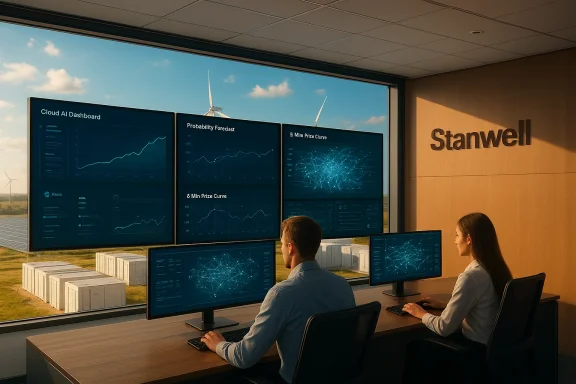
Against that operational backdrop, Stanwell has built a software stack — the Stanwell Modelling Platform (SMP) — designed to centralise data, run predictive models and host AI services in the cloud. Job postings and corporate material reference both the platform and an increasing use of cloud tools (including Microsoft Azure) across the company’s modelling and analytics work, indicating that SMP is not a laboratory experiment but a production‑grade platform tied into Stanwell’s day‑to‑day decision processes.
Public job listings and Stanwell communications corroborate the existence of a discrete “Modelling Platform” and emphasise Azure experience as a preferred skill set for engineers who support it, which is consistent with the use of cloud‑native services for heavy compute and model hosting. That alignment suggests SMP is designed to scale compute resources elastically, deliver reproducible model runs and manage user access and governance across teams.
External precedents make this clear: grid operators and major utilities have migrated simulation and forecasting workloads to the cloud to reduce run times, broaden scenario coverage and scale on demand. These efforts parallel Stanwell’s approach in principle — moving from slow, costly on‑prem batch processing to rapid cloud compute that enables more frequent and nuanced decisioning.
Stanwell has moved forecasting and optimisation workflows into SMP so traders can test many more “what‑if” scenarios and run probabilistic optimisation that blends weather forecasts, price curves and battery state‑of‑charge constraints. The business rationale is straightforward: better short‑term optimisation improves commercial performance, while portfolio‑level optimisation increases the ability to absorb surplus renewables and reduce price volatility for consumers. This is the same class of capability other modern utilities are pursuing as they pair storage with market optimisation.
That kind of uplift is headline‑grabbing, but it needs careful interpretation. The claim likely refers to a relative increase in a narrowly defined commercial metric — for example, revenue per cycle, utilisation during high‑value dispatch windows, or a specific ancillary‑service revenue stream — rather than a 200 percent increase in physical energy throughput or round‑trip efficiency. I was unable to find independent public verification of the exact “200 percent” figure in other corporate filings or regulator submissions at the time of reporting; that figure currently appears to be an internal metric Stanwell shared in the feature. Readers should treat the number as an operator‑reported result rather than an independently replicated measurement.
Why an AI model can have outsized impact: when a battery is small relative to the variability in price signals, simple rule‑based dispatch (e.g., charge at midday, discharge at evening peak) can miss numerous short high‑value windows or fail to coordinate with grid constraints. An optimiser that ingests high‑resolution weather, price spreads, forecast errors and network constraints can capture value by timing dispatch down to minutes and by reserving state‑of‑charge for expected future peaks. In markets with high price volatility, these improvements compound — and in purely commercial terms, modest absolute gains in price capture can equal large percentage improvements on baseline returns.
Independent sources confirm that moving to cloud‑native data pipelines and ML tooling typically yields material forecast gains for organisations that previously relied on siloed models and coarse weather inputs. However, the precise numeric improvement depends heavily on the baseline model, the forecast horizon and which error metric is used (MAE, MAPE, RMSE, etc.). Without access to Stanwell’s baseline and test definitions, the 30 percent improvement should be viewed as a meaningful internal outcome but not an independently audited result.
At the same time, some of the most eye‑catching numbers remain company‑reported and have not yet been corroborated in public audits or regulator documents. Responsible scrutiny is therefore warranted: operators, regulators and civil society should insist on transparent metrics, governance frameworks and safety controls as AI expands its role in power systems.
If Stanwell’s early claims prove robust under independent review, the platform will offer a practical template for other utilities: match hardware investment with a disciplined software and data strategy, use cloud scale to run richer scenarios, and govern deployment rigorously to protect reliability and consumers. That is a significant lesson for the NEM and for any system balancing rapid renewable growth with a mandate to keep the lights on affordably.
Source: Microsoft Source AI Sparks a Power Shift at Stanwell - Source Asia
 Background / Overview
Stanwell Corporation is a Queensland Government‑owned electricity generator and one of the state’s largest energy companies. The business has long been known for large thermal stations, but in recent years it has been building a sizeable portfolio of battery storage and renewable projects as it transitions toward a cleaner, more flexible asset mix. Stanwell’s own materials and public filings confirm the company’s strategy to convert legacy generation sites into “clean energy hubs” and to deliver large utility‑scale Battery Energy Storage Systems (BESS) as a central plank of that strategy.Two of the most visible projects under construction or commissioning in Queensland — the Tarong BESS and the Stanwell BESS — demonstrate the scale of the transformation. Stanwell’s Tarong project is a 300 MW, two‑hour (600 MWh) BESS built with Tesla Megapack 2XL units and delivered by Yurika; project documentation and reporting place it on a mid‑2025 commissioning timetable. Separately, Stanwell’s larger Stanwell BESS program — described in press coverage and project statements — aims to deliver several hundred megawatts and, collectively with other projects, help the company reach its multi‑GW storage ambitions. These projects are already changing how the business participates in the National Electricity Market (NEM).
Against that operational backdrop, Stanwell has built a software stack — the Stanwell Modelling Platform (SMP) — designed to centralise data, run predictive models and host AI services in the cloud. Job postings and corporate material reference both the platform and an increasing use of cloud tools (including Microsoft Azure) across the company’s modelling and analytics work, indicating that SMP is not a laboratory experiment but a production‑grade platform tied into Stanwell’s day‑to‑day decision processes.
What Stanwell says it built: the Stanwell Modelling Platform (SMP)
An “intelligent command centre” in the cloud
According to Stanwell’s description, SMP is an enterprise modelling environment that consolidates the company’s data, exposes model tooling to analysts and engineers, and runs AI‑assisted workflows that influence trading, asset dispatch and operational planning. The architecture reportedly leverages cloud compute to move from ad hoc batch runs to near‑real‑time modelling, enabling more scenarios and faster decision cycles.Public job listings and Stanwell communications corroborate the existence of a discrete “Modelling Platform” and emphasise Azure experience as a preferred skill set for engineers who support it, which is consistent with the use of cloud‑native services for heavy compute and model hosting. That alignment suggests SMP is designed to scale compute resources elastically, deliver reproducible model runs and manage user access and governance across teams.
Why the cloud matters for modelling and AI
The energy transition is fundamentally a computational problem: integrating weather‑dependent resources, fast five‑minute price signals in the NEM, distributed resources and new market instruments creates enormous data volumes and complex decision surfaces. Utilities increasingly turn to cloud platforms to host the data lakes, time‑series stores and GPU/CPU capacity needed for modern machine learning and optimisation workloads.External precedents make this clear: grid operators and major utilities have migrated simulation and forecasting workloads to the cloud to reduce run times, broaden scenario coverage and scale on demand. These efforts parallel Stanwell’s approach in principle — moving from slow, costly on‑prem batch processing to rapid cloud compute that enables more frequent and nuanced decisioning.
Where AI is already being applied inside Stanwell
Trading and market participation
One of the most consequential uses for SMP is energy trading. In a market that rebids and settles in five‑minute intervals, the timing of charge/discharge actions for batteries — and the decision to bid generation into the spot market or contract it through PPAs — requires millisecond‑to‑minute responsiveness and the ability to absorb vast amounts of price, weather and asset telemetry data.Stanwell has moved forecasting and optimisation workflows into SMP so traders can test many more “what‑if” scenarios and run probabilistic optimisation that blends weather forecasts, price curves and battery state‑of‑charge constraints. The business rationale is straightforward: better short‑term optimisation improves commercial performance, while portfolio‑level optimisation increases the ability to absorb surplus renewables and reduce price volatility for consumers. This is the same class of capability other modern utilities are pursuing as they pair storage with market optimisation.
Battery asset optimisation: the headline claim
Stanwell has reported that AI models running on SMP now guide when a major battery charges and discharges, producing substantially higher asset performance. The feature that announced the SMP story claimed improvements in battery asset performance “by more than 200 percent” when the AI model was used to optimise charging/discharging windows.That kind of uplift is headline‑grabbing, but it needs careful interpretation. The claim likely refers to a relative increase in a narrowly defined commercial metric — for example, revenue per cycle, utilisation during high‑value dispatch windows, or a specific ancillary‑service revenue stream — rather than a 200 percent increase in physical energy throughput or round‑trip efficiency. I was unable to find independent public verification of the exact “200 percent” figure in other corporate filings or regulator submissions at the time of reporting; that figure currently appears to be an internal metric Stanwell shared in the feature. Readers should treat the number as an operator‑reported result rather than an independently replicated measurement.
Why an AI model can have outsized impact: when a battery is small relative to the variability in price signals, simple rule‑based dispatch (e.g., charge at midday, discharge at evening peak) can miss numerous short high‑value windows or fail to coordinate with grid constraints. An optimiser that ingests high‑resolution weather, price spreads, forecast errors and network constraints can capture value by timing dispatch down to minutes and by reserving state‑of‑charge for expected future peaks. In markets with high price volatility, these improvements compound — and in purely commercial terms, modest absolute gains in price capture can equal large percentage improvements on baseline returns.
Forecasting and planning
Stanwell reports improved demand forecasting accuracy after migrating models into SMP and augmenting datasets. The figure quoted — a 30 percent improvement in forecast accuracy “for certain time frames” — again appears to be an operator result, likely tied to specific horizons (e.g., day‑ahead or intraday forecasts) or seasonal windows.Independent sources confirm that moving to cloud‑native data pipelines and ML tooling typically yields material forecast gains for organisations that previously relied on siloed models and coarse weather inputs. However, the precise numeric improvement depends heavily on the baseline model, the forecast horizon and which error metric is used (MAE, MAPE, RMSE, etc.). Without access to Stanwell’s baseline and test definitions, the 30 percent improvement should be viewed as a meaningful internal outcome but not an independently audited result.
Evidence and verification: what is confirmed, and what is internal
- Confirmed facts with multiple independent sources:
- Stanwell is a Queensland government–owned electricity generator undertaking a transition to include large battery projects and renewable capacity.
- The Tarong BESS is a 300 MW, two‑hour (600 MWh) project built using Tesla Megapack 2XL units; Yurika and Stanwell fact sheets document the Megapack deployment and construction milestones.
- Stanwell is delivering a larger Stanwell BESS program that involves hundreds of Megapack units and multi‑hour storage ambitions; industry coverage and company briefings describe milestone deliveries and energisation.
- Job ads and corporate material reference a “Modelling Platform” and list Microsoft Azure experience as desirable for staff working on modelling and cloud systems, supporting the proposition that SMP runs on or alongside Azure cloud services.
- Operator‑reported claims that require caution:
- The specific numeric claims about “more than 200 percent” improvement in battery asset performance and “30 percent” forecast accuracy improvement come from Stanwell’s own communications describing outcomes from SMP‑driven models. At the time of writing, these figures are reported by the company and by the feature that publicised the SMP story; I could not locate an independent, third‑party audit or regulator filing that confirms the exact percentage values. These numbers should therefore be treated as material company‑reported results rather than independently verified facts.
Why Stanwell’s approach matters (and who gains)
For the grid and consumers
If SMP genuinely increases battery revenue capture and improves forecast accuracy at scale, the benefits cascade: better‑run batteries soak up excess daytime solar, supply the evening peak more reliably, and reduce reliance on emergency peaking plants. That translates to smoother price curves, reduced spot‑price spikes and potentially lower wholesale prices — benefits that can, over time, pass through to consumers. These are the same macro benefits regulators and market designers expect from well‑integrated storage fleets.For the company
Operational improvements mean higher asset yields, better risk management and a stronger position when negotiating PPAs and ancillary service contracts. Running more scenarios faster also reduces exposure to rare but costly events; Stanwell’s ability to run more frequent “what‑if” simulations in cloud environments reduces compute time and cost, enabling a more proactive risk posture.For the wider industry
Stanwell’s adoption of a cloud‑hosted modelling platform and AI‑driven optimisation — whether based on Microsoft Azure or another cloud — is a textbook example of how legacy generators can modernise. For other utilities watching the NEM’s fast evolution, the main lesson is that software and data architecture can be as impactful as hardware investments in shaping commercial outcomes.Technical anatomy (what the platform needs to do)
A production modelling and optimisation platform for an energy generator must satisfy several technical requirements. Stanwell’s described use cases imply SMP addresses these:- Robust data ingestion pipelines for:
- High‑resolution market prices and bids
- Weather and solar irradiance forecasts
- Real‑time telemetry from generators and battery inverters
- Market participant and contractual data
- Scalable compute and model orchestration:
- On‑demand cloud compute for large ensemble forecasts and stochastic optimisation
- Containerised model environments for reproducibility
- Job scheduling, prioritisation and cost controls
- Model zoo and optimisation engines:
- Probabilistic demand and price forecasting models
- Constraint‑aware battery dispatch optimisers (mixed‑integer or convex formulations)
- Reinforcement learning or short‑horizon optimisers for minute‑level dispatch
- Governance, audit and security:
- Version control and model audit trails
- Role‑based access, secrets management and data encryption
- Cybersecurity protections for asset control interfaces and operational SCADA integrations
Risks, limits and governance — the inconvenient realities
AI and cloud optimisation can unlock value, but they also create new dependencies and risks that utilities must manage.1. Model risk and overfitting
Machine‑learning models trained on historical patterns can fail when market regimes change abruptly (for example, large new renewable capacity, a major interconnector outage, or policy shifts). Utilities need robust model monitoring, backtesting, and hold‑out procedures to detect performance degradation early.2. Data quality and sensor trustworthiness
Optimisation is only as good as its inputs. Telemetry errors, missing sensor data, or misaligned timestamps can produce incorrect dispatch signals. Resilient pipelines, anomaly detection and human‑in‑the‑loop checks are essential.3. Cybersecurity and operational integrity
Connecting optimisers to asset control permits automation but raises attack surface. Robust identity controls, network segmentation, secure gateways and strict change management are prerequisites. Microsoft’s public guidance on responsible and secure AI engineering underscores these responsibilities; large enterprises are increasingly pairing AI adoption with governance frameworks to manage trust and safety.4. Market and regulatory scrutiny
Automated optimisation that materially changes bidding behaviour can attract regulatory attention. Market operators and competition regulators are rightly concerned about strategies that might exploit market design features in unintended ways. Operators must ensure their optimisation respects market rules, system security and fairness.5. Vendor and cloud dependency
Reliance on a single cloud vendor or managed AI service raises questions of vendor lock‑in, data portability, and long‑term costs. While cloud platforms reduce capital expenditure and speed deployment, organisations must design portability layers and vendor‑agnostic abstractions where possible.Responsible deployment: practical safeguards Stanwell and peers should adopt
- Establish a model governance board that includes trading, operations, legal and compliance representatives; require pre‑deployment risk assessments and post‑deployment monitoring.
- Adopt explainable optimisation outputs: present human‑readable rationales for dispatch recommendations and surface confidence intervals or scenario ranges.
- Implement strong change control and anomaly detection to prevent erroneous automated dispatch from reaching control systems.
- Maintain a continuous audit trail of model versions, training data snapshots and decision logs to support post‑incident investigation and regulator inquiries.
- Build redundancy: ensure key optimisation decisions can be executed locally if cloud connectivity is lost, with safe fallbacks and manual override. These are practical steps consistent with best practice across regulated industries using AI.
The competitive and societal implications
Stanwell’s effort is notable not simply because a utility is using AI, but because the organisation is pairing large‑scale BESS hardware investments with a data‑centric control layer that can squeeze more value from those assets. This combination matters for three reasons:- It can improve the commercial case for storage earlier in the transition, accelerating retirements of coal assets without threatening reliability.
- It raises the bar for competitors and new entrants: utilities that lack similar modelling capabilities may be commercially disadvantaged when bidding for PPAs or responding to fast price signals.
- It forces policy and governance questions into the open: how should market rules adapt to fleets of optimised storage that respond algorithmically to five‑minute price signals?
What to watch next
- Independent verification of reported gains: operators and market watchers should look for audit‑grade documentation or regulator filings that validate the specific numeric claims (the >200 percent battery performance uplift and the 30 percent forecasting improvement). Until such documents are published, treat these headline figures as company‑reported outcomes.
- Wider roll‑out of AI optimisation across Stanwell’s growing fleet: if SMP’s gains materialise and can be reliably reproduced, Stanwell is likely to extend AI optimisation from one battery to a portfolio‑level approach that coordinates multiple assets across the wholesale market.
- Market engagement and regulator dialogue: as AI changes bidding patterns and asset operation, expect market operators and regulators to refine guidance and rules to preserve system security and competitive balance.
Conclusion — cautious optimism
Stanwell’s Stanwell Modelling Platform, deployed alongside major battery projects, is a clear example of what modern utilities can achieve when they merge cloud scale, advanced analytics and domain knowledge. The operational and commercial benefits Stanwell reports — faster scenario runs, improved forecasts, and materially better battery dispatch economics — underscore the potential for AI to reduce waste, stabilise prices and accelerate the energy transition.At the same time, some of the most eye‑catching numbers remain company‑reported and have not yet been corroborated in public audits or regulator documents. Responsible scrutiny is therefore warranted: operators, regulators and civil society should insist on transparent metrics, governance frameworks and safety controls as AI expands its role in power systems.
If Stanwell’s early claims prove robust under independent review, the platform will offer a practical template for other utilities: match hardware investment with a disciplined software and data strategy, use cloud scale to run richer scenarios, and govern deployment rigorously to protect reliability and consumers. That is a significant lesson for the NEM and for any system balancing rapid renewable growth with a mandate to keep the lights on affordably.
Source: Microsoft Source AI Sparks a Power Shift at Stanwell - Source Asia