

Starbucks Wants to Own the Workflow, Not Every Layer
The most important part of Starbucks’ plan is not that the company is using artificial intelligence. Almost every large enterprise is now experimenting with AI-assisted development, virtual assistants or workflow automation. The consequential part is that Starbucks reportedly wants to use AI to recreate functions it currently buys from established enterprise vendors.
According to the internal company presentation reviewed by Bloomberg and cited by American Bazaar, Starbucks is building an alternative to a Microsoft inventory-management system and another to an IBM maintenance platform. Those are not peripheral creative tools. Inventory and equipment maintenance sit close to the operating core of a retail chain whose stores must keep ingredients available, machines working and employees moving through tightly sequenced tasks.
That makes this an exercise in AI-assisted insourcing. Instead of asking Microsoft or IBM to customize a broad commercial platform, Starbucks is betting that its own developers can assemble narrower applications around the company’s particular stores, data and processes.
The distinction matters because enterprise software is usually purchased for more than its visible features. A license also buys upgrades, documentation, integration support, compliance controls, security patches, service commitments and a vendor organization that remains responsible when something breaks. Generative AI may reduce the labor required to write an initial application, but it does not automatically reproduce that surrounding institutional machinery.
Starbucks is therefore challenging two assumptions at once. The first is that commercial enterprise applications are too expensive and cumbersome to reproduce internally. The second is that customers will continue paying for broad suites when they may need only a carefully selected fraction of their functions.
A $400 Million Software Bill Makes Experimentation Rational
Chief Technology Officer Anand Varadarajan told employees that Starbucks spends roughly $400 million annually on software, according to the source material. At that scale, even a modest percentage reduction can justify a substantial internal development program.
The figure also explains why the company is looking beyond ordinary contract negotiation. Large enterprises routinely attempt to consolidate licenses, remove unused seats and pressure vendors for better terms, but those efforts eventually reach a floor. To reduce spending more aggressively, a customer must either eliminate a workflow, move it to a cheaper supplier or build an alternative.
AI-assisted coding changes the calculation by reducing the apparent cost of that third option. Developers can use generative systems to draft interfaces, tests, integration code, documentation and routine business logic more quickly. Teams may also be able to prototype several approaches before committing to a production design.
But faster code production is not the same as cheaper software ownership. An internally built system needs product managers, security review, data pipelines, testing environments, deployment tooling, incident response and long-term maintenance. The cost that disappears from a vendor invoice can reappear as payroll, cloud consumption, consulting, technical debt and operational risk.
Starbucks’ advantage is that it has an unusually repetitive operating environment. Stores perform many of the same activities every day, from counting ingredients to resolving equipment issues. A custom application can be designed around that narrower environment rather than carrying the options, abstractions and configuration layers required by a product sold to many industries.
Its disadvantage is scale. A process that works in a controlled test can behave differently across North American stores with varied layouts, equipment, staffing levels, lighting, connectivity and inventory practices. Starbucks has already received a costly demonstration of that gap.
Four Systems Reveal a Strategy That Is More Complicated Than “Replace Microsoft”
The company’s current and recent initiatives do not amount to a single migration away from outside technology. They show Starbucks experimenting with several combinations of commercial software, vendor-developed AI, internal applications and cloud platforms.
| System or initiative | Operational role | Technology origin | Reported status | Central risk or opportunity |
|---|---|---|---|---|
| Microsoft inventory-management system | Inventory management | Microsoft enterprise software | In-house alternative under development | Lower licensing costs and tighter customization |
| IBM maintenance platform | Equipment maintenance | IBM enterprise software | In-house alternative under development | Greater control over maintenance workflows |
| Automated Counting | Physical inventory counting | Developed with Seattle-based NomadGo | Discontinued across North America earlier in 2026 | Inaccurate counts and inconsistent operational improvement |
| Green Dot Assist | Employee and manager assistance | Built on Microsoft’s Azure OpenAI platform | Being tested | Faster access to operational knowledge and staffing support |
This comparison exposes the flaw in describing Starbucks’ strategy as a wholesale rejection of Microsoft. The company may replace a Microsoft application while using Microsoft’s Azure OpenAI platform to power Green Dot Assist. It is potentially reducing dependence at one layer while retaining, or even increasing, dependence at another.
That is a familiar pattern in enterprise technology. A company can stop buying a packaged application yet continue paying the same vendor for cloud hosting, identity, databases, developer tooling, security services or AI model access. The revenue shifts from the finished application to the platform used to build its replacement.
For Microsoft, that makes Starbucks both a warning and a validation. The warning is that AI coding tools may make customers less willing to tolerate expensive, generalized business applications. The validation is that those customers may still construct their replacements on Microsoft infrastructure.
IBM faces a similar tension, although the source material does not identify the maintenance product or specify how much of it Starbucks intends to reproduce. Maintenance platforms often connect equipment records, service histories, work orders, parts and technician activity. Replacing the visible workflow is one task; reconstructing its accumulated integrations and operational controls can be far harder.
Automated Counting Is the Warning Label on the New Plan
Starbucks’ discontinued Automated Counting system is the strongest reason to treat the new initiative as an experiment rather than an inevitable victory over enterprise software vendors. Earlier in 2026, the company retired Automated Counting across North America less than a year after its rollout.
The system was developed with NomadGo, a Seattle-based technology company, and was intended to automate physical inventory counts. According to the source material, Starbucks concluded that it produced inaccurate stock counts and failed to deliver consistent operational improvements.
That failure is particularly relevant because inventory is one of the functions Starbucks now wants to address with an internally developed alternative to a Microsoft system. The two projects may operate at different parts of the inventory process, and the available reporting does not establish that the proposed application will reproduce Automated Counting. Nevertheless, they share a basic constraint: inventory data is useful only when it corresponds reliably to what is actually in the store.
A language model can help developers produce software more quickly, but it cannot make a noisy physical environment deterministic. Milk containers can be placed differently, labels can be obscured, products can be moved and employees can follow procedures inconsistently. An application may be technically functional while generating operational records that store workers do not trust.
The retirement also demonstrates why pilot results must be separated from production value. A system may appear accurate under selected conditions and still create extra work when deployed broadly. If employees routinely verify or correct automated output, the technology has not removed the task; it has inserted a second task in front of it.
This is the central danger for Starbucks’ new development program. The company could produce attractive software rapidly and still fail to improve store operations. Enterprise applications are judged not by the speed at which their code was generated but by whether people can depend on them during an equipment failure, a delivery discrepancy or a busy shift.
The lesson from Automated Counting should not be that Starbucks is incapable of deploying AI. It is that store operations impose a higher evidentiary standard than software demonstrations. A tool that touches inventory or maintenance must survive the disorder of actual retail work.
Timeline
Earlier in 2026 — Starbucks discontinued Automated Counting across North America after inaccurate stock counts and inconsistent operational results, less than a year after the NomadGo-developed system was rolled out.
July 9, 2026 — Reporting based on an internal company presentation disclosed that Starbucks is developing AI-assisted alternatives to a Microsoft inventory-management system and an IBM maintenance platform.
By the end of 2027 — Some of the internally developed AI-powered applications could begin rolling out if testing is successful.
Green Dot Assist Shows Where Microsoft May Still Win
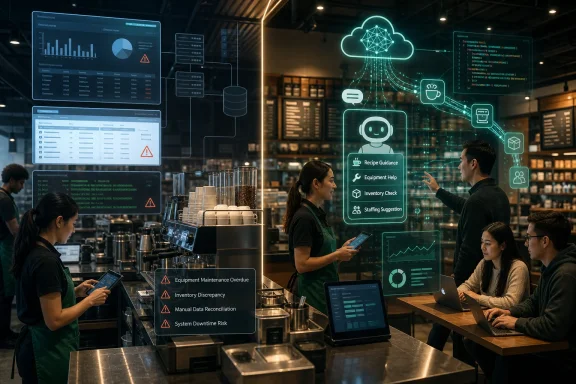
While Starbucks prepares to challenge a Microsoft inventory application, it is testing Green Dot Assist on Microsoft’s Azure OpenAI platform. The virtual assistant is designed for baristas and store managers rather than corporate software developers.
Green Dot Assist is intended to help employees access drink recipes, troubleshoot equipment problems and identify possible ingredient substitutions. It can also assist store managers with staffing decisions. Starbucks has framed the assistant as a system that supports employees rather than replaces them.
That scope makes Green Dot Assist a more natural generative-AI application than Automated Counting. It retrieves and presents knowledge, interprets operational questions and helps users navigate documented procedures. Those are tasks for which a conversational interface can reduce the time spent searching through manuals or separate applications.
The risk profile is still significant. A wrong recipe answer may create waste or a poor customer experience, while incorrect equipment guidance could delay service or worsen a fault. Staffing recommendations can also influence working conditions, making the quality and transparency of the underlying information important even if a manager retains final authority.
Yet the assistant does not have to achieve full autonomy to deliver value. If it consistently finds the correct document, summarizes a procedure and directs an employee to the appropriate next step, it can shorten interruptions without becoming the system of record. The employee remains in the loop, and the AI operates as an interface to company knowledge rather than an unquestioned source of truth.
This is why Starbucks is not making a clean break with Microsoft. It appears to be deciding, workflow by workflow, where a packaged application adds enough value to justify its cost and where Microsoft’s underlying AI platform is more valuable than Microsoft’s finished software.
That distinction could define the next phase of competition in enterprise technology. Vendors may lose some application revenue while gaining infrastructure consumption from customers building their own tools. The strongest platforms will not necessarily preserve every legacy product; they may instead profit from helping customers dismantle those products selectively.
The Application Layer Is Becoming Negotiable
For decades, enterprise software vendors benefited from the high cost of replacing them. A company might dislike a product’s licensing model or interface, but migration required a large implementation project, extensive customization and years of organizational disruption.
Generative AI does not eliminate those barriers, but it can weaken them. It reduces the effort required to create prototypes, translate requirements into code and connect existing services. It also allows a business to build smaller applications around specific workflows instead of commissioning one enormous replacement program.
That is a threat to Microsoft, IBM and Oracle, all named in the source material as vendors potentially affected by the broader enterprise shift toward custom business software. The threat is not that corporations will suddenly reproduce every database, productivity suite and resource-planning system themselves. It is that customers can begin extracting the most expensive or frustrating workflows from those platforms.
A retailer might build its own inventory interface while leaving financial records in a commercial system. A manufacturer could replace a maintenance-request portal without recreating every asset-management function beneath it. A company might introduce an AI assistant that spans several applications, reducing the number of employees who ever open the vendors’ original interfaces.
Each removal weakens the logic of per-user and per-module licensing. If employees perform their work through a custom AI layer, executives may question why the organization is still paying for every underlying seat or feature. Vendors will have to demonstrate value in the systems of record, governance, integration and infrastructure that remain difficult to reproduce.
The result is unlikely to be the death of enterprise software. It is more plausibly a redistribution of value. Generic interfaces and routine workflow logic become cheaper, while reliable data, security, operational continuity and platform services become more important.
Starbucks Is Trading Vendor Lock-In for Engineering Lock-In
Packaged software is frequently criticized for lock-in, but custom software produces its own form of dependence. Once an internal application becomes central to inventory or maintenance, Starbucks must retain the people, knowledge and infrastructure required to operate it.
The original developers may move to other projects or leave the company. AI-generated code may be difficult to understand if teams accept large volumes of output without enforcing architecture and documentation standards. Integrations can break when surrounding systems change, even if the custom application itself has not been modified.
Security responsibilities also shift. A commercial vendor normally supplies patches, vulnerability handling and product-level access controls, although customers still have substantial configuration duties. With an internal system, Starbucks becomes responsible for the application’s secure development lifecycle and for responding when flaws are discovered.
The company must also decide how AI-generated components are reviewed. Code that appears plausible can contain subtle errors, unsafe assumptions or dependencies that are unsuitable for production. The productivity advantage of automated development can disappear if review, testing and remediation are treated as optional work to be performed later.
Then there is support. Store employees cannot pause operations while an engineering team debates whether a failure belongs to the network, the application, the model, the data pipeline or a connected enterprise system. They need a clear escalation path and a dependable fallback process.
This is where the economics become less flattering than the initial licensing comparison. The annual software bill is visible and easy to target. The cost of sustaining a portfolio of proprietary applications is fragmented across engineering teams, cloud accounts, security operations, help desks and store labor.
The maintenance burden does not disappear; it changes owners. Starbucks can still come out ahead, particularly if it replaces unusually expensive products with narrow applications that fit its operations better. But the savings must be measured over the full life of the system, not merely against the cost of its first release.
The Barista Is the Final Integration Test
The success of Starbucks’ technology program will be determined behind the counter rather than in an executive presentation. A tool can satisfy technical requirements and still fail if it adds taps, interrupts established routines or produces answers employees must repeatedly verify.
Baristas and store managers already operate in a dense environment of orders, recipes, equipment, cleaning procedures, ingredient availability, staffing constraints and customer expectations. Any new application competes for attention with the immediate physical work of preparing drinks and keeping a store moving.
That makes simplicity an operational requirement rather than an aesthetic preference. An internally developed system can be more focused than a general enterprise platform, but only if Starbucks resists using its newfound development speed to add unnecessary functions.
Green Dot Assist illustrates the more promising model. Instead of demanding that employees learn another complex business application, it aims to bring recipes and troubleshooting information into a conversational interface. Its value will depend on whether answers arrive faster and more reliably than the existing method, not on how sophisticated the underlying AI appears.
Inventory and maintenance systems face an even harder test because they modify records that drive later decisions. A mistake can propagate into ordering, product availability, service scheduling or equipment downtime. Employees who lose confidence in the system will create parallel processes, handwritten notes or manual checks, defeating the goal of simplification.
Starbucks therefore needs to evaluate adoption as carefully as accuracy. A system can be statistically impressive but operationally useless if workers avoid it. Conversely, a modest tool that reliably removes one irritating task can produce more durable value than an ambitious platform that promises complete automation.
“Back to Starbucks” Gives Technology a Narrower Mission
CEO Brian Niccol’s Back to Starbucks transformation plan is focused on improving operational efficiency, simplifying store operations and reducing costs. The technology initiative must ultimately serve that agenda rather than become a separate corporate campaign organized around AI adoption.
That requirement is healthy. Companies often begin with a technology and search for places to deploy it. Starbucks has a clearer set of operational problems: keeping products available, maintaining equipment, helping employees find information and making staffing decisions under real-world constraints.
The danger is that cost reduction and simplification can pull in opposite directions. Removing a commercial product may lower licensing expenses while creating a more complicated internal support environment. Automating a task may reduce planned labor while introducing exceptions that require greater employee attention.
Niccol’s plan also emphasizes the human experience of Starbucks stores. Green Dot Assist’s stated purpose—to support employees rather than replace them—fits that framing. If the assistant reduces time spent searching for information, employees can devote more attention to customers and drink preparation.
But that promise must be tested against actual behavior. An assistant that interrupts employees with excessive prompts or unreliable suggestions would move the company further from the coffeehouse experience it says it wants. Technology becomes useful to Back to Starbucks only when it recedes into the operation.
The reported plan to roll out some applications by the end of 2027, if testing succeeds, gives Starbucks time to avoid another compressed deployment cycle. The company should use that time to run adversarial tests, observe stores with different operating conditions and preserve manual fallbacks until the new systems have earned trust.
Enterprise IT Should Copy the Discipline, Not the Headline
Other companies will be tempted to interpret Starbucks’ move as proof that AI can replace Microsoft, IBM or Oracle products. That is too broad a conclusion. The useful lesson is that generative AI can justify reopening build-versus-buy decisions that may not have been examined for years.
The strongest candidates for internal development are usually narrow workflows that are expensive, stable and highly specific to the business. They have clearly defined inputs and outputs, and failure can be detected before it causes serious harm. The weakest candidates are sprawling systems of record with extensive compliance, integration and availability requirements.
Enterprises should also distinguish between replacing a user experience and replacing an entire platform. A custom application may sit on top of a commercial database, identity system or maintenance repository. That can deliver a better workflow without forcing the company to rebuild every underlying capability.
A phased architecture may be more realistic than a declared vendor exit. An organization can begin with a read-only assistant, then add controlled actions and finally assume responsibility for selected records once the system has demonstrated reliability. Each stage creates evidence for the next decision.
Action checklist for admins
- Inventory the full cost of the existing application, including licenses, integration, support, training and internal administration.
- Map every system, device, identity service and data source connected to the workflow before approving a replacement.
- Separate functions that merely display or summarize information from those that modify operational records.
- Establish accuracy thresholds, fallback procedures and clear stop conditions before beginning a production pilot.
- Require security review, automated testing, logging, version control and human approval for AI-generated code.
- Pilot across different store or site conditions rather than selecting only the easiest locations.
- Measure employee corrections, workarounds and support calls in addition to development speed and license savings.
- Assign a permanent product owner and support budget before retiring the vendor application.
Windows Shops Will Inherit the Consequences at the Endpoint
For Windows administrators, the significance of this trend lies less in the brand names being displaced than in how custom applications reach employees. Internally developed software still needs authentication, endpoint compatibility, deployment, updates, telemetry and support.
A packaged application typically arrives with documented system requirements and an established update mechanism. An internal application may rely on a browser, a mobile device or a desktop component, but the organization remains responsible for verifying that changes do not conflict with device policies, identity controls or local workflows.
Custom AI interfaces can also obscure where a transaction occurs. An employee may ask one assistant to retrieve information from several systems or initiate an operational action. Administrators need logs that show which user made the request, what data was accessed, which service performed the action and whether a person approved the result.
Identity becomes particularly important when conversational tools begin moving beyond advice. Reading a recipe is not equivalent to adjusting inventory, changing staffing information or opening a maintenance request. Each capability should respect the same role and authorization boundaries that applied before the AI interface existed.
Help desks will need visibility across the entire chain. “The assistant is wrong” could describe outdated source data, a retrieval failure, an application bug, a model response or a permissions problem. Without diagnostic separation, support teams will struggle to determine which group owns the incident.
For enterprise Windows environments, this is the practical meaning of AI-assisted software development: potentially more applications, shorter release cycles and a wider range of internal owners. Development may accelerate, but endpoint and operational governance cannot be compressed to the same degree without increasing risk.
The Road to the End of 2027 Runs Through Boring Engineering
Starbucks’ reported rollout target is conditional. Some AI-powered applications could begin arriving by the end of 2027 if testing is successful. The words if testing is successful carry most of the weight.
The next phase will not be won by the team that generates the most code. It will be won by teams that can define requirements, control data, test edge cases, manage releases and respond to failures. Those are conventional engineering disciplines, and AI does not make them obsolete.
Starbucks will also have to decide what success means. Reducing software invoices is one measure, but an application that saves licensing costs while increasing store labor or equipment downtime is not cheaper in any meaningful sense. The accounting must include operational consequences.
The company should be especially cautious about declaring savings before retiring the commercial systems. Parallel operation is expensive, but it provides evidence and a fallback. Automated Counting shows the value of retaining a path back when a new system does not perform consistently at scale.
Microsoft and IBM, meanwhile, have an opportunity to defend their positions by emphasizing the parts of enterprise software that are hardest to reproduce: dependable integrations, governance, support and accumulated domain knowledge. They can also respond by making their platforms easier to extend, allowing customers to build custom interfaces without abandoning the underlying products.
This is why Starbucks’ experiment is more strategically important than its immediate effect on any single vendor contract. It tests whether AI allows a large non-technology company to move from configuring software to owning it—and whether that ownership creates durable savings rather than a new category of hidden cost.
The Real Signal in Starbucks’ Software Rebellion
Starbucks is neither abandoning outside technology nor betting everything on autonomous AI. It is testing whether a company with a large software budget and highly specific operations can selectively own more of its application layer.
- Starbucks reportedly spends roughly $400 million annually on software.
- It is building alternatives to a Microsoft inventory-management system and an IBM maintenance platform.
- Some applications could begin rolling out by the end of 2027 if testing succeeds.
- The retirement of Automated Counting shows that technical ambition does not guarantee store-level reliability.
- Green Dot Assist demonstrates that Starbucks can replace Microsoft software in one area while continuing to build on Microsoft’s Azure OpenAI platform elsewhere.
- The decisive calculation is total lifetime ownership cost, not development speed or avoided license fees alone.
Starbucks’ project will matter far beyond coffee shops if it proves that generative AI can turn enterprise application development into a practical capability for ordinary corporations rather than a privilege reserved for software vendors. But the company’s own recent history supplies the necessary caution: producing an application is becoming easier, while operating one reliably across a large physical business remains brutally difficult. By the end of 2027, the most revealing result may not be whether Starbucks has replaced a Microsoft or IBM screen, but whether it has built the engineering institution required to stand behind that replacement for years.
References
- Starbucks builds AI software to replace Microsoft, IBM tools The American Bazaar · 2026-07-09T21:30:14.764112