

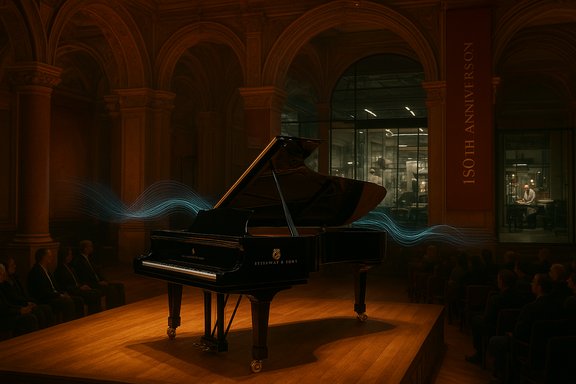
Steinway Hall London marks 150 years as a living crossroads of craftsmanship, performance and technological innovation, a sesquicentennial celebration that folds the institution’s Victorian roots into a modern story of digital playback pianos, artist residencies and bespoke restorations.
Steinway & Sons began in New York in 1853 and expanded to Europe in the late 19th century; the company established a showroom presence in London in the 1870s and opened what would become known as Steinway Hall in 1875, the first European home for the brand. This Hall was conceived not simply as a retail space but as a cultural venue — a place to exhibit instruments, host recitals and support an artist community. Steinway’s continental manufacturing footprint arrived shortly thereafter: a Hamburg factory opened in 1880 to serve European demand, and today the firm still builds its handcrafted concert grands only in two factories — Hamburg and New York. That dual-factory model underpins Steinway’s claim to artisanal consistency and global distribution.
The Hall’s longevity is powered by craftsmanship, artist trust and an ability to adapt. Yet anniversaries also invite scrutiny: factual precision around dates, limited-edition releases and personnel changes matters to historians, journalists and buyers alike. Where reporting presents claims that are not yet corroborated in primary Steinway releases (for example, a brand-new 2025 “150th Anniversary Limited Edition” model specifically for the Hall), those claims should be treated as provisional until Steinway or Steinway Hall publishes official confirmations.
As an operational institution, Steinway Hall continues to bind past and future: conservators keep old instruments sounding their best, artists push repertoire and technique forward, and technologies like Spirio | r extend the reach of live performance without sacrificing nuance. For anyone invested in Steinway Hall London, whether as performer, patron or observer, the sesquicentennial is at once a celebration and an invitation — to play, to listen, and to consider how a 150-year-old institution will steward the next 150 years of musical life.
Source: Luxurious Magazine Steinway Hall London Celebrates 150 Years Of Musical Heritage And Innovation
 Background
Steinway & Sons began in New York in 1853 and expanded to Europe in the late 19th century; the company established a showroom presence in London in the 1870s and opened what would become known as Steinway Hall in 1875, the first European home for the brand. This Hall was conceived not simply as a retail space but as a cultural venue — a place to exhibit instruments, host recitals and support an artist community. Steinway’s continental manufacturing footprint arrived shortly thereafter: a Hamburg factory opened in 1880 to serve European demand, and today the firm still builds its handcrafted concert grands only in two factories — Hamburg and New York. That dual-factory model underpins Steinway’s claim to artisanal consistency and global distribution. What the sesquicentennial actually celebrates
This 150th-anniversary milestone is twofold in meaning. On one axis it is the commemoration of Steinway Hall London — the building and the institution that has been a focal point for pianists, technicians and the public since the 19th century. On another, it implicitly recalls Steinway & Sons’ broader history of technical innovation and artist partnerships that helped the company become synonymous with concert standards. The recent coverage of the Hall’s anniversary highlights performances, the Hall’s restoration workshop, rehearsal spaces and the introduction of modern tools such as the Spirio | r player-piano system into the Hall’s program.A living archive: artists, anecdotes and provenance
The John Lennon connection — what can be verified
One of the most resonant anecdotes tied to Steinway’s London story is the connection to John Lennon’s famous “Imagine” piano. Multiple independent sources confirm that John Lennon composed and developed “Imagine” on a walnut-finished Steinway Model Z upright that he purchased in December 1970; that instrument has a well-documented provenance (including ownership by George Michael and extended public display at Liverpool’s Beatles Story and the Strawberry Field exhibition). The Model Z upright and its history remain among the most cited single-instrument stories in modern pop-cultural piano lore. The Luxurious Magazine piece ties Lennon’s creative moment to Steinway Hall — noting that the Model Z was crafted in Hamburg and associated with Steinway’s London workshop culture — a narrative that resonates with the Hall’s status as a nexus for instrument maintenance, artist rehearsal and public presentation. That cultural connection between object and place is strong, but specific claims linking the physical moment of composition inside the Hall itself should be treated carefully: available public records show Lennon bought his Model Z through Steinway and that it was associated with Steinway’s London operations, but not every retelling specifies the exact room or city where a particular phrase was first written. In short: Lennon’s use of the Model Z is well documented; the claim that he composed “Imagine” on an instrument “crafted on site” at Steinway Hall London reflects the real ties between the artist and Steinway, but the precise logistics of where each phrase was penned can be hard to reconstruct from secondary reporting alone.Steinway Artists, recital life and the Hall’s roster
Steinway Hall has long functioned as a hub for world-class pianists. Contemporary Steinway Artists such as Martha Argerich and Lang Lang are closely associated with the brand and its recital programming, and Steinway’s own artist roster and communications repeatedly highlight these long-standing partnerships. The Hall’s recital and rehearsal facilities remain a draw for artists who prefer the instrument consistency and the technical support Steinway provides.Craftsmanship, longevity and the workshop at the Hall
Steinway’s manufacturing story is a central piece of the Hall’s identity. Corporate and industry sources consistently describe the Hamburg and New York factories as the two centers where Steinway grands are handcrafted; build cycles require extensive manual labour and long lead times, often measured in months to a year for a concert grand, with timber seasoning and precision regulation accounting for much of that timeline. Those facts help explain the company’s premium positioning and why the Hall’s restoration workshop remains necessary for maintaining instruments at concert-quality levels.- Steinway grands are built exclusively in Hamburg and New York.
- High-precision craftwork, drying and finishing mean each grand typically takes many months — commonly documented as roughly a year — from initial assembly to finished instrument.
Innovation in the Hall: Spirio | r and Spiriocast
The sesquicentennial coverage emphasises not just the Hall’s past but how it embraces modern presentation and distribution technologies, most notably the SPIRIO | r system and the related Spiriocast live-broadcast capability. SPIRIO | r is Steinway’s high-resolution player-piano technology that records and reproduces the full nuance of performance (hammer velocity, pedalling, timing) and enables live data streaming to other Spirio | r instruments. Spiriocast extends that capability into a synchronized, multimedia live-broadcast system: a pianist can play in Hamburg or New York and be “heard” — with the keys and pedals moving in perfect sync — on Spirio | r instruments in showrooms or private living rooms elsewhere. Steinway’s product pages and showroom announcements describe both the hardware models (Model M, B, D) and the Spiriocast functionality in detail. Why this matters for the Hall: integrating Spirio | r converts Steinway Hall from a place that preserves live performance into a node that can broadcast and preserve it at the highest fidelity. For artists and institutions, it’s a way to extend audience reach and preserve a performance’s micro-dynamics in a way that traditional audio/video streaming cannot replicate acoustically. The technology also presents new revenue and access models for recitals, masterclasses and archival projects.Programming and public engagement: what the Hall offers now
Steinway Hall’s modern program mixes heritage events with forward-looking activations. The anniversary programming described in recent coverage highlights:- Intimate recitals and artist residencies in the Hall’s smaller performance spaces.
- Demonstrations and hands-on displays of Spirio | r technology, including Spiriocast events that have been staged globally.
- Workshops and restoration demonstrations in the in-house technical facilities, a practical education resource for conservators and aspiring technicians.
The 150th-anniversary instrument — separating fact from promotional flourish
The Luxurious Magazine article reports that Steinway unveiled a “150th Anniversary Limited Edition piano” crafted in Hamburg for the Hall’s milestone. Steinway’s corporate history and dealer network do have a long precedent of producing commemorative limited-edition models — for example, the company issued formal “150th Anniversary” limited editions around 2003 to mark Steinway & Sons’ founding in 1853, with art-case re-creations and Karl Lagerfeld’s commemorative design among those releases. However, an explicit, independently verifiable Steinway press release or manufacturer page for a specially commissioned 2025 “150th Anniversary Limited Edition” tied to Steinway Hall London was not located in the searches conducted for this article. In other words: the concept of a limited-edition anniversary piano is historically consistent with Steinway practice, but the specific 2025 instrument described in some reports requires additional confirmation from Steinway’s official channels or the Hall’s press office. Until such a primary announcement is published, references to a new commemorative piano for 2025 should be considered plausible but not fully documented. (Clarification added: the Steinway company celebrated its 150th corporate anniversary in 2003 and released limited-edition instruments then; that is a separate milestone from the Hall’s 150th anniversary in 2025.Leadership, staffing and the modern Hall: claims and verification
The Luxurious article names Nicola Le as the newly appointed Director of Sales & Marketing at the Hall and celebrates the Glazebrook family’s ongoing association. Company directories and showroom staff pages are periodically updated; searches of Steinway’s UK pages and public-facing staff lists did not surface a corroborating entry for Nicola Le as of November 15, 2025. The Hall’s staff listings historically show Glazebrook family members in senior technical and sales roles across decades, and third-party historical and technical profiles corroborate Glazebrook family involvement in London’s Steinway operations — but the specific personnel appointment for Nicola Le should be verified directly with Steinway Hall’s press office or the Hall’s official communications for absolute certainty. This article flags that as a claim requiring primary confirmation.Why the Hall still matters — five strategic strengths
- Institutional continuity: the Hall is a continuous, physical bridge between Steinway’s 19th-century showroom model and today’s global artist network.
- Technical infrastructure: in-house restoration and concert preparation preserve instruments to the highest standards, supporting international touring and recording needs.
- Artist relationships: Steinway Artists such as Martha Argerich and Lang Lang underline the Hall’s ongoing role as a platform for elite performers.
- Adoption of new technologies: Spirio | r and Spiriocast embed the Hall within contemporary distribution and archival ecosystems, enabling remote live broadcasts with acoustic fidelity.
- Cultural and commercial resonance: the Hall’s address, programming and instrument provenance stories (e.g., the Lennon Model Z narrative) sustain public interest beyond specialist audiences.
Risks, tensions and questions worth asking
- Preservation vs. accessibility: high-value instruments like historic Steinways attract demand for both public display and touring; balancing conservation with access is an ongoing curatorial challenge. The Model Z’s global tour history illustrates how an instrument’s public role can be managed but is resource-intensive and not friction-free.
- Technology and the live experience: Spirio | r expands access but raises artistic and commercial questions. Will streamed, reproduced performances cannibalize local attendance? Or can Spiriocast be an additive revenue and education channel that enlarges audiences without replacing live recital economics? Early demonstrations suggest complementarity, but organized evaluation is required.
- Marketing vs. historic accuracy: anniversary coverages sometimes conflate corporate and site-specific milestones (company founding vs. Hall founding) or present unverified “limited-edition” claims as definitive. Journalistic and institutional transparency about dates, provenance and production runs matters for long-term trust. The 2003 company 150th and the Hall’s 2025 sesquicentennial are separate historical markers; careful messaging should respect that distinction.
- Verifiability of personnel changes: as with the claim about a new Director of Sales & Marketing, public-facing directories and press releases should be kept current to avoid confusion. Independent verification is recommended before relying on staff appointments as facts in institutional histories.
Practical takeaways for musicians, institutions and enthusiasts
- For touring artists and orchestral venues: Steinway Hall’s restoration and piano bank are an operational resource; booking lead times should account for Hall scheduling and restoration slots.
- For collectors and private buyers: limited-edition Steinways (including past 150th Anniversary models) are treated as both instruments and art objects; provenance and serial-number documentation materially affect future value. Research historic release dates (e.g., 2003 corporate anniversary editions) when evaluating market claims.
- For music educators and students: Spirio | r and Spiriocast present new pedagogical opportunities — remote masterclasses with acoustically faithful reproduction of teacher performances are now feasible. Institutions should evaluate integration plans for curriculum and recital programming.
Conclusion
Steinway Hall London’s 150th anniversary is a meaningful cultural milestone: it celebrates a physical place where instrument-making, high-level performance and technical stewardship intersect. The Hall remains both a repository of musical memory — from the Model Z upright associated with John Lennon to the signatures of generations of Steinway technicians — and a testbed for contemporary innovations like Spirio | r and Spiriocast that recast how piano performance can be experienced and preserved.The Hall’s longevity is powered by craftsmanship, artist trust and an ability to adapt. Yet anniversaries also invite scrutiny: factual precision around dates, limited-edition releases and personnel changes matters to historians, journalists and buyers alike. Where reporting presents claims that are not yet corroborated in primary Steinway releases (for example, a brand-new 2025 “150th Anniversary Limited Edition” model specifically for the Hall), those claims should be treated as provisional until Steinway or Steinway Hall publishes official confirmations.
As an operational institution, Steinway Hall continues to bind past and future: conservators keep old instruments sounding their best, artists push repertoire and technique forward, and technologies like Spirio | r extend the reach of live performance without sacrificing nuance. For anyone invested in Steinway Hall London, whether as performer, patron or observer, the sesquicentennial is at once a celebration and an invitation — to play, to listen, and to consider how a 150-year-old institution will steward the next 150 years of musical life.
Source: Luxurious Magazine Steinway Hall London Celebrates 150 Years Of Musical Heritage And Innovation