

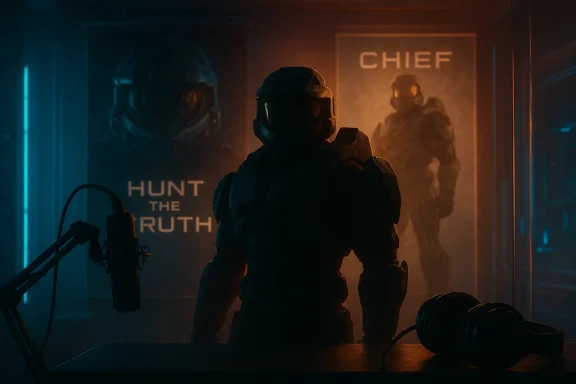
Steve Downes — the gravel-voiced actor who has been Master Chief for more than two decades — has quietly reopened one of Halo’s thorniest conversations by confirming what many players suspected: the promotional campaign for Halo 5: Guardians painted a story the shipped game did not deliver, and recording those trailers put him in an uncomfortable position between studio direction and character fidelity.
Background
Halo began as the flagship first-person shooter for Microsoft’s Xbox in 2001, and the franchise has since evolved into one of gaming’s most recognisable properties. Halo: Combat Evolved established not only a gameplay template but a mythic protagonist in Master Chief, whose stoic presence has anchored the series’ narrative identity since November 2001.Halo 5: Guardians launched on October 27, 2015, following an aggressive multimedia marketing push that included cinematic trailers, a serialized audio drama titled Hunt the Truth, and live-action teasers that foregrounded a manhunt narrative — Master Chief as something other than a straightforward hero and Fireteam Osiris, led by Spartan Locke, as the hunters. The game was a commercial success on release, registering a record first-week launch for the franchise and generating hundreds of millions of dollars in early sales.
Yet the game's campaign reception proved divisive. Critics and many long-time fans praised Halo 5’s multiplayer and technical achievements but were disappointed by a campaign that felt tonally different — and narratively sparser — than the marketing suggested. That disparity between promotional narrative and in-game reality has been one of the franchise’s most durable controversies.
What Steve Downes actually said
In a recent YouTube Q&A, Steve Downes reflected on his experience during the Halo 5 era and singled out the promotional recordings as especially difficult. Downes explained that trailers and marketing content suggested a narrative direction that did not match the final game, and that performing lines for those trailers made it hard to remain “true to the character” while also meeting the production’s immediate demands. He described feeling that “the Chief was being pushed in a direction that I didn’t feel was particularly right,” and said the dichotomy between keeping the director happy and staying faithful to Master Chief was more pronounced than in previous projects.Those comments echo earlier reporting and retrospectives that identified the same tension: the marketing campaign, particularly the Hunt the Truth audio series and cinematic teasers, promised a darker, more conspiratorial tone and a direct feud between Chief and Locke — a promise that many felt the final campaign did not keep. Downes’ remarks are consequential because they come from the performer most identified with the character; his discomfort validates player perceptions that something in the message-to-product pipeline was amiss.
The marketing-versus-development problem: how did it happen?
The Halo 5 case is a classic example of misalignment between marketing teams, external creative partners, and internal development. Multiple post-release accounts from developers and industry observers point to several contributing factors:- Marketing campaigns were sometimes produced by external agencies that had access only to partial story outlines or were operating on early creative concepts. This allowed provocative, standalone narrative pieces like Hunt the Truth to flourish independently of the finalized campaign script.
- Trailers and audio dramas were developed and released on a schedule that didn’t allow for iterative alignment with an evolving campaign. In other words, marketing timelines outpaced the narrative’s finalization, producing content that reflected early or alternate drafts.
- Internal ambition and feature scope can force studios to prioritise systems (multiplayer modes, live service mechanics, Forge, etc.) over narrative polishing. When narrative resources are constrained, the risk rises that external marketing will over-promise or misrepresent what the final product can deliver.
Why the disconnect mattered: trust, expectation, and the player experience
Marketing sells promises. When a campaign implies a specific emotional or narrative payoff and the product doesn’t deliver, three things happen:- Players feel misled. That sense of betrayal undermines goodwill even when core gameplay remains strong; it’s why many fans praised Halo 5’s multiplayer yet still felt deeply disappointed by the campaign.
- Canon confusion emerges. Halo is a lore-rich universe. When marketing implies large-scale conspiracies and shifted motivations for major characters, but the game itself provides a different account, both casual and dedicated fans struggle to reconcile the two. This dilutes narrative cohesion.
- Brand credibility erodes. Repeated misalignment can condition fans to be sceptical of future marketing, increasing the PR and community-management load for subsequent releases. The Halo community continues to reference Halo 5 as a watershed moment for franchise trust.
Cross-checking the record: what independent sources confirm
To ensure accuracy, Steve Downes' remarks and the broader marketing controversy were cross-referenced across multiple outlets:- Windows Central summarised Downes’ Q&A and quoted him directly on the trailer/game disconnect and his struggle to “keep the director happy and also be true to the character.”
- GamesRadar and Yahoo echoed the same quotes and context from the YouTube AMA, corroborating Windows Central’s reporting.
- Retrospectives and developer interviews in Forbes and VideoGamer explore how the Hunt the Truth campaign and marketing trailers diverged from the final story, including statements from developers describing independent marketing decisions and internal frustration.
- Microsoft and Xbox Wire materials confirm the marketing assets’ existence and the official messaging timeline around Halo 5’s launch. Those primary-source marketing announcements show how Hunt the Truth and teaser trailers were centrally used to frame the game pre-release.
Where the theories go off-track (and what remains unproven)
Several fan theories emerged after Halo 5’s launch: that significant campaign content was cut late, that the trailers represented scrapped storylines, or that developers actively subverted marketing narratives. While those theories are compelling and circulate widely, they remain in part speculative.- There is evidence that some marketing assets were developed by external agencies with a degree of creative autonomy. Developers interviewed after launch acknowledged being surprised by certain marketing pieces. That supports the idea of disconnection but does not prove large-scale, last-minute narrative cuts that would fully explain the mismatch.
- Assertions that core game missions or entire plot arcs were removed late in development are harder to substantiate without access to internal build history, design documents, or formal developer admissions. Public developer interviews and retrospectives point to scope and resource pressures, not a single canonical “deleted plot” explanation. Readers should treat claims of specific cut content as plausible but not conclusively proven.
The creative ethics angle: Downes on voice cloning and AI
Downes’ AMA did not only revisit Halo 5; he also weighed in on a pressing industry issue: AI voice cloning. He stated explicitly his opposition to using generative AI to replicate his voice without consent, calling it a boundary he is uncomfortable crossing. He said he would prefer that no one create clones of his voice — an ethical stance that aligns with wider industry conversations about labor, consent, and creative control.That position has practical ramifications for IP holders and studios:
- Voice actors are increasingly organised through unions and industry groups to secure rights and protections around synthetic replication and compensation.
- Developers and publishers face a policy choice: whether to adopt industry-standard protections, to treat AI as an assistive tool only with actor consent, or to push toward more permissive internal uses of synthetic vocal elements. Downes’ public comments add pressure to the “consent-first” approach.
What this means for Halo, 343 Industries, and AAA marketing
The Halo 5 episode is not just an isolated marketing misfire; it’s a case study in how creative silos, production timelines, and external marketing can change a franchise’s trajectory.Key takeaways that studios and marketing teams should consider:
- Synchronise narrative and marketing timelines early. Marketing assets that heavily reinterpret characters or plot should be gated until the core narrative is locked, or clearly labelled as speculative or alternate-universe content.
- Improve cross-team communication. Ensure marketing agencies, external partners, and internal creative leads have shared checkpoints and signoff processes. This reduces the chance of contradictory public messaging.
- Respect performers’ character stewardship. Long-standing performers who embody a property’s core identity (like Steve Downes for Master Chief) are valuable creative stewards; their concerns about character portrayal should weigh into promotional record-making.
- Build contingency narratives that allow creativity without overpromising. Marketing can still be bold, but it should avoid committing to specific plot beats that the game cannot deliver.
A closer look: practical recommendations (for studios and community managers)
- Establish “narrative locking” milestones. Require explicit narrative signoff from the creative director before narrative-driven marketing can be published.
- Create a marketing‑dev liaison role. This person would be embedded in both teams to ensure fidelity and manage creative trade-offs.
- Use transparent marketing labels. If a trailer or audio drama is a speculative or "alternate take," call it that publicly to set expectations.
- Fund narrative QA. Allocate dedicated resources for playtesting and narrative consistency checks, not just systems QA.
- Treat key performers as creative partners. Their input should be sought on how trailers and promos portray the ethos of long‑standing characters.
The player's perspective: how communities process mismatch
Gamers are not passive consumers in modern AAA ecosystems; they are active narrators. When a franchise’s marketing and product disagree, communities do three things almost immediately:- They compare and catalogue inconsistencies (trailers vs. script vs. audio dramas).
- They create lore-filling content (fan fiction, timeline reworkings, hypothesis forums).
- They assign blame and create narratives about studio competence or intent.
Conclusion: what Steve Downes’ comments change — and what they don’t
Steve Downes’ recent reflections are significant because they come from inside a core creative role: the long-time voice of Master Chief. His candour confirms that Halo 5’s marketing-versus-game mismatch was not just a player grievance but a lived production tension that affected the people creating the marketing itself.The incident is a reminder of the fragile architecture of modern AAA storytelling: promotional creativity can amplify a game’s cultural reach, but if it diverges from the product, the fallout goes beyond disappointed players — it affects the trust that underwrites a franchise’s future. For studios, the lesson is to build communication systems, contractual norms, and ethical guardrails (especially around AI and voice use) that respect both the art and the audience.
Finally, when assessing specific claims about cut content or conspiracies behind the trailers, readers should distinguish between well-documented production friction and speculative reconstructions that lack firm documentary support. Public interviews, developer retrospectives, and primary marketing materials make a persuasive case for misalignment; they stop short of proving every fan hypothesis.
Steve Downes’ honesty helps close one of the circle’s loops: it confirms the discomfort many players felt and re-centres a necessary conversation about creative responsibility in an era where marketing, external agencies, and emergent technologies (like generative AI) all shape the stories we are promised and the ones we receive.
Source: Windows Central Master Chief voice actor speaks out on Halo 5
