Stibo and Microsoft Unveil AI Personal Shopper at NRF 2026 Grounded in MDM

  • Thread Author
Stibo Systems’ announcement that it will demo AI-powered “personal shopper” agents at NRF 2026 — built by pairing Microsoft Copilot Studio and Microsoft Fabric with Stibo’s master data management (MDM) platform — is a concrete example of how vendors are racing to turn generative AI from a proof‑of‑concept into a commerce engine. The vendor claims these first‑party agents, grounded in Stibo’s product information, can deliver up to a 15% lift in conversions and an eightfold increase in “high‑intent behaviors” such as initiating checkout; Microsoft’s Copilot and catalog‑enrichment templates provide the agent primitives and payment partners (PayPal, Shopify, Stripe) provide the delegated checkout plumbing that turns discovery into purchase.

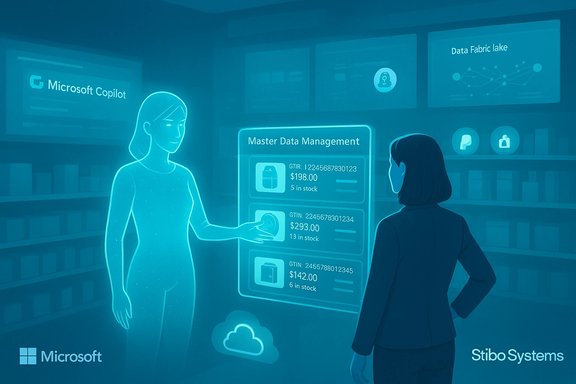
Two professionals review a holographic Master Data Management dashboard in a Microsoft Copilot setting.Background​

What Stibo announced and why it matters​

Stibo Systems said it will showcase an integrated stack at NRF 2026 that combines its product data platform with Microsoft Copilot Studio and Microsoft Fabric to power conversational personal‑shopper agents. These agents are positioned to offer real‑time recommendations, bundling and post‑purchase support — features that vendors argue convert browsing into buying and reduce friction at the point of intent. The announcement is framed around two linked value propositions: (1) better product metadata eliminates hallucination and recommendation errors in AI agents, and (2) Microsoft’s agent templates and Copilot Checkout make it possible to complete transactions inside the conversational surface.

The wider wave: agentic commerce and Copilot Checkout​

Microsoft’s retail push at NRF centers on three platform primitives: Copilot Studio (the low‑code authoring surface), Azure AI Foundry/Agent Service (the runtime and governance layer), and Microsoft Fabric (the data orchestration and analytics backbone). The company publicly introduced Copilot Checkout — a delegated, tokenized checkout experience that lets shoppers confirm purchases inside the Copilot conversation while payments and settlement are handled by partners like PayPal, Shopify and Stripe. Independent reporting confirms Microsoft demonstrated these capabilities at NRF 2026 and that partner integrations and merchant enrollment models are rolling out in the U.S.

Why master data management (MDM) is suddenly front‑and‑center​

The data problem agents amplify​

Conversational agents rely on two things to be useful: accurate natural‑language models and accurate, authoritative data. When an agent recommends a product, it must be able to link that recommendation to a canonical product record that contains up‑to‑date inventory, GTINs, SKU variants, pricing, shipping windows and image assets. Missing or inconsistent metadata leads to poor customer experiences, product mismatches, return spikes and liability risks. Stibo’s pitch — and the broader market narrative — is that MDM provides the “single source of truth” agents need to play safely and predictably in commerce flows.

Vendor claims vs. independent verification​

Stibo and Microsoft cite conversion uplifts and behavior changes as expected outcomes of well‑implemented agentic experiences, but these are vendor‑supplied figures and should be treated as directional until independently audited. Stibo’s press materials present an “up to 15%” conversion increase and an “eightfold rise” in high‑intent actions; those are plausible when friction is reduced, but the exact magnitude will depend on use case, customer base and measurement window. Where possible, procurement teams should require named case studies, baseline and post‑deployment KPIs, and a plan for independent verification before accepting headline numbers at face value.

Technical anatomy — how the stack is intended to work​

Core components (what retailers would stitch together)​

  • Microsoft Copilot Studio: low‑code/no‑code canvas for assembling multi‑agent workflows, brand agents and personalization templates.
  • Azure AI Foundry / Agent Service: model catalog, runtime safety, observability and multi‑agent orchestration.
  • Microsoft Fabric / OneLake: unified data layer for catalog ingestion, ETL pipelines, embeddings and analytics.
  • Stibo Systems MDM / Product Information Management (PIM): canonical product records, variant management, syndication and governance.
  • Payment partners (PayPal, Shopify, Stripe): delegated checkout/tokenization and settlement; merchants remain the merchant of record.

Typical data flows​

  • Product ingestion: merchants publish machine‑readable feeds (SKUs, images, GTINs, inventory, shipping windows) into the MDM/PIM.
  • Catalog enrichment: an agentic pipeline extracts attributes (from descriptions and images), normalizes taxonomies and fills missing metadata to produce enriched, structured records used for retrieval.
  • Agent orchestration: Copilot Studio composes a personalized shopping agent that retrieves relevant catalog records via Fabric/OneLake and serves conversational recommendations.
  • Delegated checkout: when the customer confirms purchase, Copilot requests a short‑lived checkout session or token; the PSP (PayPal/Stripe/Shopify) completes payment, settlement and fraud checks.

Strengths: what makes this combination compelling for retailers​

1. Faster time to trial and reduced integration friction​

Prebuilt agent templates (catalog enrichment, personalized shopping, store ops) reduce the engineering lift required to prototype agent experiences. Copilot Studio’s low‑code surface lets product and merchandising teams iterate without waiting for months of backend development. This lowers the barrier to entry and shortens the path from idea to measurable pilot.

2. Reduced hallucination risk when agents are grounded​

Agents that can point to canonical product records and authenticated inventory sources are less likely to hallucinate non‑existent SKUs or incorrect prices. The combination of MDM (authoritative records) and fabricized data pipelines (obvious provenance and lineage) mitigates one of the biggest operational risks with generative agents in commerce.

3. Conversion optimization by collapsing discovery and checkout​

Removing the redirect between discovery and checkout reduces friction; early demonstrations from multiple vendors suggest in‑chat checkout materially shortens purchase journeys. Tokenization patterns and delegated checkout keep merchants in control of pricing, fulfillment and dispute handling while enabling Copilot to host the conversation and UI. This design addresses a fundamental commercial goal: convert intent at the moment it appears.

4. Better frontline productivity and store experience​

Store‑operations agents (inventory lookups, policy guidance, next‑best actions) can reduce average handle times and improve on‑shelf availability. Practical, measurable benefits here are easier to obtain than sweeping consumer personalization wins because they focus on operational KPIs (time‑to‑answer, task completion times, error rates).

Risks and limitations — what retailers must plan for now​

Data quality is the gating factor​

Vendor messaging and independent industry commentary both repeat the same point: AI multiplies whatever data it’s fed. If product metadata is fragmented, inconsistent, or stale, agents will produce bad recommendations, incorrect availability signals and costly returns. The PR cites industry figures claiming a significant portion of leaders see data quality as a barrier; whether that precise number comes from a public, peer‑reviewed study is unclear, but the core point is widely corroborated across industry surveys. Retailers must accept that a rigorous MDM program is a prerequisite, not an optional add‑on.

Vendor claims need contractual teeth​

Headlines about “15% conversion lift” or “eightfold increases” are vendor claims until validated. Procurement teams should require measurable SLAs for data freshness, audit logs, and agreed‑upon A/B test protocols. Insist on pre‑deployment metrics baselines, a statistically valid measurement plan, and the right to audit telemetry and sample orders.

Governance, safety and auditability​

Agentic systems introduce new failure modes: an agent that “helps” a customer but makes an erroneous inventory reservation, or one that recommends restricted products. Microsoft provides primitives for agent identity, observability and AgentOps, but operational governance — role‑based approvals, hard stops for financial actions, human escalation paths and continuous red‑teaming — must be instituted by the retailer. Don’t treat the platform’s governance features as sufficient; they are tools that must be integrated into the merchant’s operational playbooks.

Portability and vendor lock‑in​

Building many mission‑critical flows tightly coupled to Copilot Studio, Microsoft Fabric and Azure AI Foundry creates migration risk. If the retailer later wants to switch models, clouds or agent frameworks, exportability of agent logic, training artifacts, and enriched catalogs must be contractually guaranteed. Negotiate data export formats, model artifacts, and SLAs that ensure business continuity.

Compliance and payment risk​

Delegated checkout reduces Copilot’s exposure to raw card data, but merchants still face fraud, chargebacks and regulatory obligations. Merchants must verify who is the merchant of record, who owns receipts and dispute handling, and what protections apply to in‑chat purchases. The PSPs (PayPal/Stripe/Shopify) will have their own terms that must be reconciled with merchant obligations.

Practical implementation checklist for retailers​

  • Establish a canonical product data model and ownership chart. Define one team (or CoE) accountable for SKU authority, variant rules, and GTIN hygiene.
  • Run a catalog audit: measure missing attributes, image quality, taxonomy mismatches, and out‑of‑date inventory flags. Only expand agent actions after hitting minimum thresholds (e.g., 95% of SKUs have complete price/inventory metadata).
  • Prototype with a narrow set of SKUs and a controlled audience. Use Copilot Studio templates and Stibo’s PIM to test personalization workflows before scaling to all categories.
  • Define hard stops for action‑capable behaviors. Initially, make agents recommend and reserve (read‑only) rather than execute refunds or inventory transfers. Require human sign‑off for any financial reversal.
  • Instrument telemetry and set KPIs: conversion lift, checkout initiation rate, average order value (AOV), returns rate, error rate and escalation frequency. Track both business and safety KPIs.
  • Contractual protections: require data export rights, portability of agent definitions, and independent validation clauses for vendor‑reported lifts. Include incident response SLAs and evidence of security/compliance certifications.

Governance and operational readiness​

AgentOps and human‑in‑the‑loop​

Scaling agentic commerce requires an operational discipline similar to DevOps: AgentOps. That includes versioning agent policies, continuous monitoring for drift, periodic red‑teaming of responses, and clear human escalation pathways. The technology vendors provide observability and identity primitives, but the retailer must define the runbooks that make those primitives actionable.

Privacy, consumer trust and transparency​

Conversational checkout and personalization hinge on trust. Retailers must be explicit about how agent recommendations are generated (for example, disclosing that a recommendation uses inventory data, reviews, or sponsored placements) and ensure privacy controls and consent mechanisms are baked into the experience. Customers must have clear options to opt out of agentic personalization and to access human support.

Realistic ROI expectations and measurement​

  • Short‑term wins are most likely in operational areas: reduced handle time for associates, fewer returns caused by inaccurate product information, and faster product onboarding through catalog enrichment automation.
  • Customer‑facing personalization can drive AOV and conversion, but results vary widely by category, brand affinity and the baseline checkout friction. Treat vendor uplift numbers as starting hypotheses to validate with robust measurement.

Final analysis — balancing optimism and discipline​

Stibo Systems’ NRF 2026 demo — integrating its MDM with Microsoft’s Copilot Studio and Fabric to create first‑party personal‑shopper agents — exemplifies the pragmatic pivot vendors are making: shift attention from pure model capabilities to grounding, catalog quality and orchestration. The promise is real: agents that can recommend, explain and complete purchases without broken links answer a long‑standing friction point in e‑commerce. Microsoft’s Copilot Checkout and catalog enrichment templates materially lower the technical bar for many retailers, while Stibo’s MDM claims to provide the authoritative product data agents require. Yet the practical reality remains that data quality, operational governance and contractual rigor determine whether these pilots translate into durable business value. Vendor headlines about double‑digit lifts should be validated through controlled experiments and audit‑grade telemetry. Retailers should prioritize data foundation, start with narrow, high‑value pilots, and build AgentOps capabilities before widening agent responsibilities. When implemented with discipline, the combination of MDM and agentic platforms can reduce friction, improve conversion and deliver measurable customer experience gains — but only when the technical promise is matched by operational maturity.
Conclusion
The integration of Stibo Systems’ master data with Microsoft’s Copilot Studio and Fabric represents a practical leap toward agentic commerce that is grounded in data — the exact missing piece that has held back many early AI commerce pilots. For retailers, the opportunity is significant: faster, more personalized shopping journeys and new conversion channels inside conversational surfaces. For IT and operations teams, the challenge is equally significant: clean your catalogs, define AgentOps, lock down governance and insist on measurable, auditable KPIs. Done right, the result is not just a flash of AI novelty, but a sustained capability that turns intent into reliable revenue.

Source: The AI Journal Stibo Systems Drives Higher Retail Customer Satisfaction Through Integration of Microsoft AI and Master Data Management Solutions | The AI Journal
 

PayPal and Microsoft have quietly stitched together two of the most consequential moves in AI-powered commerce to date: PayPal will power payments and product discovery surfacing for Microsoft’s new Copilot Checkout, enabling shoppers to find, decide, and complete purchases inside the Copilot experience without being redirected to merchant websites.

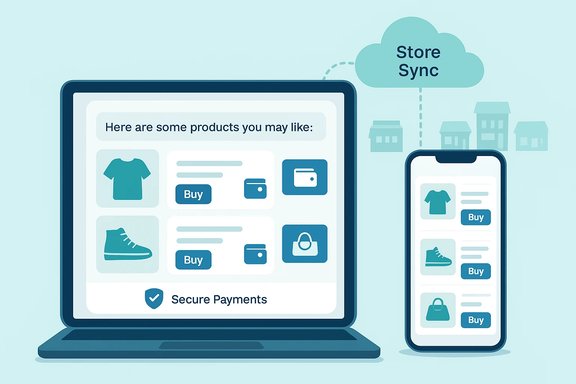
Online store UI showing product recommendations on laptop and phone with cloud sync.Background​

Copilot Checkout is part of Microsoft’s broader push to convert Copilot from an assistant into an agentic commerce platform — a place where AI not only recommends products but also executes purchases on behalf of the user. Microsoft says Copilot Checkout is available in the U.S. on Copilot.com and that trusted partners at launch include PayPal, Shopify and Stripe, with retailers such as Urban Outfitters, Anthropologie, Ashley Furniture and Etsy sellers participating in initial rollouts. PayPal has positioned the collaboration as an extension of its recently announced agentic commerce services, which include a capability called store sync that makes merchants’ product catalogs discoverable to AI channels and connects orders back into merchants’ existing fulfillment and management systems. PayPal’s investor and corporate announcements detail that the PayPal integration will support merchant inventory surfacing, branded checkout, guest checkout and credit card payments for Copilot Checkout. This partnership follows PayPal’s broader strategy of embedding its wallet into multiple AI platforms — a strategy that includes prior deals to power checkout within other agentic platforms — and Microsoft’s drive to embed commerce capabilities directly into conversational AI surfaces. The move signals a pivot from “search and click-through” to “search and pay” inside conversational agents.

What Copilot Checkout Is — and What It Isn’t​

The product at a glance​

  • Copilot Checkout: a checkout flow surfaced inside Copilot where users can select a product presented by Copilot’s discovery engine and complete payment within the same interface.
  • Initial availability: rolling out on Copilot.com in the U.S., with plans to expand to other Copilot-enabled channels and devices.

Key capabilities announced​

  • Merchant inventory surfacing: Products from participating merchants are discoverable inside Copilot via PayPal’s store sync and catalog plumbing.
  • Branded checkout: Merchants retain a branded checkout experience rather than a generic portal, keeping the merchant as the merchant-of-record for orders.
  • Guest checkout and card payments: PayPal will support guest checkouts and credit card payments in addition to PayPal wallet funding options.
  • Integration partners: Shopify merchants will be automatically enrolled (post opt-out window), and Stripe and Shopify are named partners alongside PayPal for payments orchestration.

What Copilot Checkout does not replace (yet)​

Copilot Checkout does not replace a merchant’s backend systems: PayPal’s store sync and Microsoft’s agentic storefronts are designed to route orders back into merchants’ fulfillment and order management systems so sellers remain the merchant of record. That continuity is a deliberate design choice intended to preserve brand control and customer communications.

Why PayPal? What the Integration Brings​

Payments expertise and trust​

PayPal brings decades of consumer payment relationships, existing wallets and multiple funding rails (bank balance, cards, wallet) — a payment stack Microsoft says is well-suited to minimize friction inside Copilot Checkout. PayPal is also promising to extend its buyer and seller protections to eligible transactions completed through Copilot Checkout.

Agentic commerce plumbing: store sync explained​

Store sync is PayPal’s mechanism to make merchant product catalogs discoverable across agent platforms with a single integration. The payoff for merchants is one-to-many discovery: integrate once with PayPal’s store sync and appear across multiple AI shopping surfaces without bespoke integrations per platform. PayPal positions store sync as compatible with leading e-commerce platforms and data partners so merchants can preserve order flows and customer relationships.

Faster conversion funnel​

Both companies claim that AI-led journeys convert more effectively: PayPal’s press materials reference Microsoft data showing Copilot-led journeys produce materially higher conversion rates and faster purchase behavior — for example, an assertion included in PayPal’s announcement states Copilot interactions produced 53% more purchases within 30 minutes and 194% higher conversions where shopping intent was present. These figures are attributed to Microsoft internal data and marked observational; they should be treated as vendor-supplied metrics rather than independently audited industry benchmarks.

How Merchants Benefit — And What They Need to Know​

Immediate advantages​

  • Access to high-intent customers: Copilot surfaces buyers while intent is fresh, and Microsoft claims Copilot journeys lead to higher near-term conversion rates.
  • Lower integration overhead: PayPal’s store sync promises rapid onboarding for merchants using supported platforms (Shopify, Wix integrations mentioned), letting them show up in Copilot with minimal technical lift.
  • Preserved merchant-of-record status: Orders completed in Copilot Checkout route back to sellers’ fulfillment operations, allowing merchants to retain ownership of branding, returns, and customer communication.

Operational and commercial considerations​

  • Merchants should audit how product data is synced and whether inventory, pricing, and promotions map reliably from their systems into store sync. Discrepancies could cause over-selling or inconsistent shopper experiences.
  • Merchants must confirm terms for seller and buyer protections when transacting through Copilot Checkout; PayPal states protections apply to eligible transactions and that limits do apply. Merchants should review eligibility criteria and dispute workflows.
  • Shopify merchants will be auto-enrolled after an opt-out period, which means some sellers may appear in Copilot by default unless they explicitly opt out — a governance detail that requires merchant attention.

Pricing and fees — the unknowns​

Neither company has disclosed a detailed fee schedule for Copilot Checkout routing via PayPal. Merchants should assume standard PayPal processing fees will apply unless contractual arrangements state otherwise. Until explicit pricing is published, merchants should factor processing cost variability into ROI calculations for agentic channels. This is an area PayPal promises to support via the PayPal.ai onboarding channel, but fee transparency will be crucial for merchant adoption decisions.

The Consumer Experience: Convenience vs. Visibility​

What shoppers will see​

From the consumer’s perspective, Copilot will produce curated, context-aware product results and present “Buy” or “Details” actions that surface an in-line purchase flow. The endpoint is a branded-looking checkout completed within Copilot, with PayPal as a payment option alongside card and guest checkout. Microsoft positions this as a frictionless alternative to opening multiple retailer pages.

Benefits for consumers​

  • Speed: Fewer redirects, fewer fields to fill, and payment options saved in PayPal can accelerate time-to-purchase.
  • Choice: Consumers can choose PayPal wallet, cards, or guest checkout according to preference.
  • Protections: Eligible buyer protections from PayPal remain available, which could reduce friction for higher-value purchases.

Trade-offs and visibility concerns​

  • Less storefront browsing: Consumers interacting in Copilot may miss brand storytelling, upsell opportunities, or product detail pages merchants traditionally use to inform decisions. This can be a pro for speed but a con for deep product discovery or cross-sell experiences.
  • Data visibility: Consumers should understand which entity stores their purchase data — merchant-of-record remains the seller, but PayPal and Microsoft will process and, in some cases, store transaction details to power agentic experiences. Clearer user notices and privacy controls will be needed as Copilot expands.

Technical Architecture and Payment Orchestration​

How the flow likely works (high level)​

  • Copilot queries integrated merchant catalogs via PayPal’s store sync and Microsoft’s catalog enrichment agents.
  • Copilot presents curated product results with action buttons.
  • On “Buy,” PayPal provides a checkout widget or payment orchestration layer handling wallet, card tokenization, guest checkouts and fraud checks before routing the purchase to the merchant’s fulfillment system so the merchant remains merchant of record.

Interoperability and protocols​

Microsoft and PayPal both emphasize an open approach to agentic protocols and compatibility across AI platforms. This suggests support for standardized agentic commerce APIs and potential adoption of common data formats to avoid one-off integrations for every AI surface. Standardization will be important if brands want to reach users across Copilot, ChatGPT, Perplexity, and other agents without duplicating effort.

Fraud, risk controls and compliance​

Payments inside conversational AI raise new fraud vectors — from manipulated agent prompts to spoofed checkout flows. PayPal’s involvement brings mature anti-fraud tooling, KYC and chargeback orchestration, but firms should not assume the same control model as traditional web checkout. Merchants and platform operators will need to refine rules for agent-initiated transactions, tokenization lifecycles, and dispute resolution workflows. PayPal’s announcements indicate protections extend to eligible Copilot Checkout transactions, though coverage is subject to terms and limits.

Market Impact: Competition, Platforms and Retailers​

A turning point for conversational commerce​

Embedding payments into AI agents moves conversational commerce from a novelty into a mainstream channel. Microsoft’s Copilot, with a vast Windows and Office ecosystem and a growing Copilot.com presence, instantly gains a shopping surface where intent and payment meet in one interface. This is likely to accelerate adoption of agentic storefronts among major retailers and platforms.

Competitive responses​

Retail giants and marketplaces will evaluate how agentic discovery affects traffic, ad spend and loyalty programs. Past examples show retailers are protective when platforms encroach on checkout flows: similar in-chat checkout features have drawn scrutiny and pushback from large retailers wary of platform intermediaries capturing purchase intent. Expect competition and negotiation around data-sharing, fees and merchant control.

Payments industry posture​

The involvement of PayPal, Stripe and Shopify as launch partners indicates the payments industry sees composable, agentic checkout as an opportunity rather than a threat. Payment providers that can orchestrate multiple funding rails, tokenize cards for agent reuse and provide dispute and protection services will be best positioned to win merchant trust.

Regulatory, Privacy and Antitrust Considerations​

Data privacy and consent​

Copilot Checkout raises immediate privacy questions: which data is shared between Microsoft, PayPal, and merchants, and how long is it retained for personalization? Transparency and granular consent will be essential if regulators scrutinize how agentic platforms profile shoppers for targeted commerce. Merchants and platforms must provide clear notices on data usage and implement opt-outs where appropriate.

Antitrust and competition risk​

Consolidating discovery and checkout inside a dominant platform can compress retail competition if platforms control discoverability and take a revenue share. Large retailers and regulators may question whether AI-driven surfaces favor platform-affiliated merchants or the platform’s own commerce interests. Watch for inquiry into preferential routing, default enrolments (Shopify’s automatic enrollment is notable), and competitive parity.

Financial compliance​

Agentic checkout still requires AML, KYC, tax and customs compliance. PayPal’s payments infrastructure brings compliance controls, but merchants must confirm tax handling, cross-border rules and reporting flows for agent-initiated orders — especially as Copilot expands beyond the U.S.

Risks and Caveats — What to Watch For​

  • Vendor-provided metrics need independent verification. The conversion uplift numbers cited by Microsoft and PayPal are drawn from internal observational data and should be validated by independent tests before treating them as universal.
  • Auto-enrollment mechanics. Shopify merchants will be auto-enrolled following an opt-out window, which could surface merchants who prefer not to participate; clarity around the opt-out process is important.
  • Fee transparency. No public detailed fee schedule for Copilot Checkout commerce via PayPal has been published; merchants should confirm economics before committing resource allocation.
  • Control of brand experience. While merchants remain merchant-of-record, the initial discovery and product presentation occur within Microsoft’s UI — brands may lose some control of the contextual narrative that traditionally aids conversion.
  • New fraud vectors. Agentic flows introduce novel fraud scenarios; robust tokenization, fraud modeling and dispute procedures will be required.

Practical Guidance for Merchants​

  • Audit product data quality now. Clean, accurate catalogs improve discovery and reduce returns; store sync will surface whatever you publish.
  • Review terms for buyer/seller protections. Understand eligibility boundaries and dispute processes before scaling agentic channels.
  • Confirm pricing and settlements. Ask PayPal and Microsoft for precise fee schedules, settlement windows, and any revenue-sharing terms for Copilot Checkout.
  • Plan for brand presentation. Prepare condensed, high-impact product copy and enriched images to perform well inside curated agentic results.
  • Monitor KPIs closely during rollout. Test conversion lift, return rates, fraud incidence and customer-satisfaction metrics against your traditional channels. Treat Copilot Checkout as an experimental channel initially.

Strategic Implications — Beyond the Launch​

The PayPal–Microsoft tie-up accelerates the mainstreaming of agentic commerce: conversational AI is moving off demo screens and into transactional rails. For PayPal, the integration extends wallet relevance into a new class of AI-driven interfaces. For Microsoft, in-line checkout makes Copilot genuinely transactional, not just instructive. For the industry, the implications are profound: product discovery, pricing elasticity, advertising models and fulfillment strategies will all adapt to an agent-first discovery model. However, the exercise is nascent in many technical and commercial respects. Merchant experiences will vary depending on the fidelity of catalog syncs and the clarity of terms for fees and protections. Regulators and retail giants will scrutinize how this changes market dynamics. The companies involved have the technical capability to make agentic commerce workable at scale, but broad adoption will depend on transparent economics, robust fraud controls and consumer trust.

Conclusion​

PayPal’s role in powering Copilot Checkout marks a major step in the commercialization of conversational AI. The integration leverages PayPal’s payments infrastructure and new agentic commerce tooling to make merchant inventories purchasable inside Copilot, promising speed and reduced friction for consumers while offering merchants access to high-intent buyers. Yet several practical and regulatory questions remain — from fee transparency and fraud risk to data governance and merchant control of the customer experience.
Merchants and brands should approach Copilot Checkout with a strategic test-and-learn posture: prepare catalogs, clarify commercial terms, verify protections, and measure outcomes rigorously. If the early gains Microsoft and PayPal report hold up under independent scrutiny, Copilot Checkout could reshape where and how purchases are made — shifting a meaningful chunk of retail intent into agentic surfaces where discovery and payment are tightly coupled. Until the marketplace produces independent performance audits and regulators weigh in on emerging platform dynamics, the adoption curve will hinge on tangible, verifiable merchant economics and consumer trust.
Source: FintechNews CH PayPal Partners Microsoft to Enable Checkout in Copilot - Fintech Schweiz Digital Finance News - FintechNewsCH
 

Back
Top