

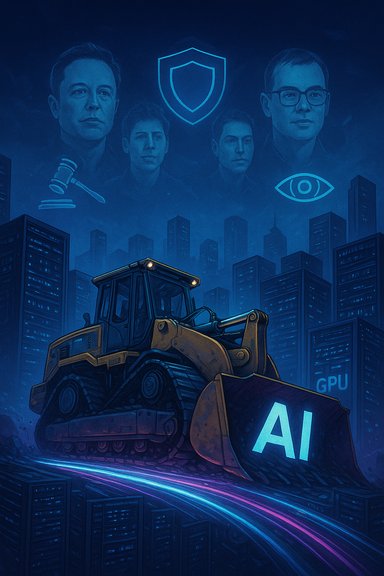
Mustafa Suleyman’s offhand description of Elon Musk as a “bulldozer” crystallizes a new tone among the industry’s most powerful players: blunt, candid, and strategically revealing about how competition, capability and values now intersect at the apex of the AI arms race. In a recent Bloomberg interview, the CEO of Microsoft AI offered unvarnished assessments of three of the sector’s most consequential figures — Elon Musk, Sam Altman and Demis Hassabis — remarks that illuminate more than personalities. They reflect shifting alliances, a compute-driven infrastructure scramble, and the reputational currency that leaders trade when capability meets consequence.
Microsoft elevated Mustafa Suleyman to lead its consumer and product-facing AI efforts after the company absorbed the core of his most recent startup and surrounding talent; Suleyman has a deep, well-known pedigree as a DeepMind co-founder and later as the driving force behind Inflection AI before joining Microsoft in 2024. That career arc — research lab builder, safety-minded critic, then corporate product leader — frames why his assessments of peers matter: he speaks both as a maker and a strategist who now runs one of the world’s largest AI product efforts. Suleyman’s Bloomberg conversation was widely reported and circulated by multiple outlets, amplifying a few choice lines: his calling Musk a “bulldozer” because of the billionaire’s capacity to “bend reality to his will,” his description of Sam Altman as “courageous” and a potentially generational entrepreneur, and his measured praise for Demis Hassabis as a “great scientist” and polymath. Those phrases have been relayed nearly verbatim across mainstream technology news outlets.
Public reporting reinforces this point. OpenAI’s Stargate initiative — reported as a multi‑year, multi‑billion-dollar infrastructure program involving partnerships and dedicated facilities — is one visible example. Industry trackers note multi‑gigawatt capacity targets, bespoke liquid-cooled racks, and dedicated GPU pipelines as the industrial backbone for training next‑generation models. Microsoft itself has signaled very large capital commitments to expand AI‑ready data centers globally. The result is a high-stakes infrastructure race where access to power, real‑estate, chips and skilled operations staff are bottlenecks as much as R&D is.
Microsoft’s actions back this rhetorical posture. Internally, Microsoft has been investing at scale in Azure‑based AI infrastructure and product integration (Copilot, Office, Windows), while publicly outlining governance frameworks like “humanist superintelligence.” Suleyman’s leadership is meant to project both a product roadmap and an ethical posture that differentiates Microsoft’s public image from pure capability‑maximizing rivals.
Suleyman’s comments also reflect a hedging mindset: respect the competitor’s ambition, but continue to build alternative capabilities and maintain independence. That posture helps Microsoft keep customers and regulators reassured that competition, not monopoly, will shape the market — a politically prudent message as governments scrutinize both competition and safety in AI.
Moreover, public praise for speed can be weaponized as a cover for risky behavior. The industry must scrutinize not just who builds fastest but how they validate, audit and remediate harms. Suleyman’s own stance suggests he understands that tension — advocating for “humanist” approaches while competing in a field that rewards speed — but it remains a core unresolved tension across companies.
For Windows users, enterprise IT leaders and policymakers alike, the takeaway is straightforward: the AI contest is now as much about physical infrastructure and governance as it is about algorithms. Organizations that want to participate safely and effectively must prepare for a landscape where compute capacity, contractual clarity, and robust safety practices determine who benefits — and who bears the risk — as these technologies move from the lab into everyday workflows. Vigilance, transparency and rigorous procurement will separate the winners from those flattened by the bulldozers of progress.
Source: livemint.com Microsoft AI boss Suleyman calls Elon Musk a ‘bulldozer’, labels Sam Altman ‘courageous’ | Mint
 Background
Microsoft elevated Mustafa Suleyman to lead its consumer and product-facing AI efforts after the company absorbed the core of his most recent startup and surrounding talent; Suleyman has a deep, well-known pedigree as a DeepMind co-founder and later as the driving force behind Inflection AI before joining Microsoft in 2024. That career arc — research lab builder, safety-minded critic, then corporate product leader — frames why his assessments of peers matter: he speaks both as a maker and a strategist who now runs one of the world’s largest AI product efforts. Suleyman’s Bloomberg conversation was widely reported and circulated by multiple outlets, amplifying a few choice lines: his calling Musk a “bulldozer” because of the billionaire’s capacity to “bend reality to his will,” his description of Sam Altman as “courageous” and a potentially generational entrepreneur, and his measured praise for Demis Hassabis as a “great scientist” and polymath. Those phrases have been relayed nearly verbatim across mainstream technology news outlets. What Suleyman actually said — and why the wording matters
“Bulldozer”: capability framed as force
When asked for one word to describe Elon Musk, Suleyman answered, “I guess, as a bulldozer,” then unpacked the label: Musk has “superhuman capabilities to bend reality to his will” and “pretty incredible track record,” and he “mostly manages to pull off what appears to be impossible.” The phrase is flattering on its face — acknowledgment of disruptive execution — but it’s also a carefully chosen metaphor. Bulldozer connotes brute force and disruption; it implies speed, determinism, and values that may not align with broader societal expectations. Suleyman noted Musk’s unfiltered public persona and different value set, signaling both admiration and caution. This matters because language shapes perception. To call a peer a bulldozer is to recognize extraordinary capacity while implicitly warning that such force can flatten institutions, markets or social norms — intentionally or not. In the context of AI, where digital power maps directly to compute, data center footprint and influence over standards, the metaphor points to a broader concern: when a single actor can marshal industrial-scale resources with relentless pace, the resulting dynamics are strategic as much as technical.“Courageous” Sam Altman: infrastructure and bets
Suleyman’s praise of Sam Altman centers on one concrete claim: Altman and OpenAI are aggressively expanding data center capacity, “building data centers at a faster rate than I think anyone in the industry.” He added that if OpenAI pulls off this rapid infrastructure buildout, the result “will be pretty dramatic.” That assessment aligns with public reporting: OpenAI’s Stargate initiative and related partnerships have signaled an unprecedented, capital‑intensive push into bespoke AI infrastructure. Multiple industry trackers describe multi‑year, multi‑billion (and in some descriptions, multi‑hundred‑billion) scale projects aimed at delivering gigawatts of AI compute. Suleyman’s view is therefore grounded in observable activity: today’s leading model builders are, literally, racing to add datacenter capacity. Labeling Altman “courageous” is both tactical and reputational. It recognizes risk appetite — committing to long, lumpy capital starts at a time when model training and deployment costs are immense — and it positions Altman as a builder willing to translate research advantage into industrial-scale, real-world capability. For Microsoft, which is itself investing heavily in AI infrastructure, that acknowledgement also reads as a public recognition that competition will be fought not only on model architectures but on physical infrastructure and supply‑chain control.Demis Hassabis: the scientist and the co‑founder
Suleyman’s take on Demis Hassabis is straightforward: “Probably a great scientist... a good polymath.” That reference recalls their shared DeepMind origin story and underscores a split that has become common among founding teams: deep research roots on one side; product and platform execution on another. Suleyman emphasized they remain friendly and in touch, and that he congratulated Hassabis on recent model launches and breakthroughs. The remark signals both respect and an acknowledgment of a pluralist industry: research excellence and product scale are different levers of influence.The infrastructure angle: why datacenters are the new battlefield
Compute equals influence
In Suleyman’s remarks, one thread repeats: control of compute is control of capability. Whether he’s noting Altman’s buildout or referencing rivalry with teams that once worked closely together, the underlying reality is that frontier model development depends on hyperscale compute, specialized interconnect, power arrangements, and long-term supply contracts for GPUs and next‑generation accelerators.Public reporting reinforces this point. OpenAI’s Stargate initiative — reported as a multi‑year, multi‑billion-dollar infrastructure program involving partnerships and dedicated facilities — is one visible example. Industry trackers note multi‑gigawatt capacity targets, bespoke liquid-cooled racks, and dedicated GPU pipelines as the industrial backbone for training next‑generation models. Microsoft itself has signaled very large capital commitments to expand AI‑ready data centers globally. The result is a high-stakes infrastructure race where access to power, real‑estate, chips and skilled operations staff are bottlenecks as much as R&D is.
Why this is different from earlier cloud wars
Historically, cloud providers competed on software services and storage. The AI era’s demand profile is distinct: it is not only raw compute but thermal design, high-density power, and predictable long-term contracts for accelerators. Training runs can cost tens or hundreds of millions of dollars for a single frontier model, so companies are moving beyond ephemeral cloud usage to lock in dedicated campuses and long-term partnerships. This shift changes competitive dynamics: startups that once scaled by renting cloud cycles now must negotiate access to physical capacity, and hyperscalers are effectively gatekeepers. Suleyman’s point that Altman is building aggressively therefore flags not just an engineering choice but a market‑structuring move.Strategic reading: what Suleyman’s words reveal about Microsoft’s posture
A calibrated rival posture
Suleyman’s comments are unusual for their candor but measured in tone. He did not attack Altman or Hassabis, and his description of Musk mixed praise with caution. That mix is consistent with Microsoft’s strategic posture: publicly recognize the achievements of peers, keep lines of communication open, but also signal that Microsoft will protect and expand its own runway.Microsoft’s actions back this rhetorical posture. Internally, Microsoft has been investing at scale in Azure‑based AI infrastructure and product integration (Copilot, Office, Windows), while publicly outlining governance frameworks like “humanist superintelligence.” Suleyman’s leadership is meant to project both a product roadmap and an ethical posture that differentiates Microsoft’s public image from pure capability‑maximizing rivals.
The competitive settlement: partnerships, competition, and hedges
Even as Microsoft and OpenAI have complex interdependencies — investment ties, technology licensing and commercial arrangements — the field has fragmented into multiple competitive axes. Microsoft’s acknowledgement of Altman’s infrastructure appetite recognizes that the battle for AI market share will be decided by a blend of compute, product integration, and ecosystem partnerships.Suleyman’s comments also reflect a hedging mindset: respect the competitor’s ambition, but continue to build alternative capabilities and maintain independence. That posture helps Microsoft keep customers and regulators reassured that competition, not monopoly, will shape the market — a politically prudent message as governments scrutinize both competition and safety in AI.
Risks and caveats: what the rhetoric masks
Concentration of power and national economic effects
The datacenter arms race accelerates a concentration of power in a handful of entities that can afford massive capital outlays. The consequences are practical and geopolitical: localized demand for power and skilled labor, pressure on supply chains for GPUs and networking components, and political bargaining over where to site facilities. These are economic and regulatory risks that Suleyman’s remarks implicitly highlight: when a leader calls another a “bulldozer,” it is because that actor can reshape market and political realities by sheer capacity deployment. Industry reporting shows large proposed projects and multi‑billion commitments across several players; while projections vary, the scale is large enough to shift regional economies and regulatory attention. Readers should treat bold headline numbers with caution, because public reporting sometimes conflates formative pledges, investor memoranda, and staged announcements. Some headline valuations and cost projections are estimates rather than audited commitments.Safety, governance and value alignment
Suleyman has been a public advocate for “humanist superintelligence” and for embedding governance into product design. Yet his praise of entrepreneurial speed raises a perennial tension: how fast can responsible development move without cutting corners on safety? Speed and scale make safety engineering harder because more users, more integrations and larger attack surfaces increase the chance of misuse or harm. The community needs robust, industry‑wide stress testing, third‑party audits and interoperable safety standards — areas where progress has been uneven.Moreover, public praise for speed can be weaponized as a cover for risky behavior. The industry must scrutinize not just who builds fastest but how they validate, audit and remediate harms. Suleyman’s own stance suggests he understands that tension — advocating for “humanist” approaches while competing in a field that rewards speed — but it remains a core unresolved tension across companies.
Reputation and political alignment
Suleyman’s frank description of Musk’s political activity — and the acknowledgement that Musk has “a different kind of set of values” — is a reminder that corporate leadership in AI is inseparable from political choices. Publicly praising or downplaying rival leaders has reputational consequences when those leaders are politically polarizing figures. Microsoft, with a large enterprise customer base and global footprint, has to calibrate its public statements carefully to maintain credibility with governments and large clients while navigating personal rivalries and public controversies.What this means for Windows users and enterprise customers
- Microsoft’s consumer and productivity AI efforts are being shaped by the same competition Suleyman described: heavy investment in model capability, an emphasis on safety features and guardrails, and a race to embed AI across Windows and Office experiences. For customers, that combination promises more powerful features but also means more dependency on centralized compute and cloud contracts.
- Enterprises should expect continued product differentiation based on infrastructure access. Companies with deep cloud ties or bespoke AI contracts will be able to run larger, more advanced models in‑house or via managed offerings; smaller customers will rely on turnkey services offered by hyperscalers. This bifurcation increases the importance of procurement diligence around data residency, cost predictability and model governance.
- For developers and system admins, the practical takeaway is to plan for heterogenous environments: hybrid cloud deployments, edge inference for latency‑sensitive tasks, and standardized observability stacks to monitor model behavior in production. The infrastructure race favors organizations that standardize their stack today to avoid vendor lock‑in surprises tomorrow.
Short‑term predictions and an action checklist for IT leaders
What to expect in the next 12–24 months
- Continued large-scale datacenter announcements and new partnerships oriented around specialized GPU supply and power procurement. Public plans will be announced in waves; treat early-stage press statements as indicative but not final.
- Faster model delivery cycles tied to infrastructure availability: organizations that secure compute will get first access to the largest model variants and bespoke capabilities.
- Increased regulatory attention on cross‑border compute flows, data residency and AI auditability, prompting more contractual guardrails from vendors.
A pragmatic checklist for enterprises
- Reassess cloud contracts to include explicit clauses for AI model provenance, safety audits and remediation responsibilities.
- Evaluate multi‑cloud or hybrid strategies to avoid single‑vendor lock‑in for critical models.
- Invest in observability and model evaluation tooling to track drift, bias and safety metrics in production.
- Include legal and compliance teams early in AI procurement decisions; governments are increasingly requiring demonstrable controls.
- Budget for compute variability: plan both for high upfront costs (training) and ongoing inferencing costs that scale with usage.
Strengths and potential blind spots in Suleyman’s framing
Notable strengths
- Clarity and candor: Suleyman’s direct language helps external audiences understand where market power and risk reside. The rhetoric is useful precisely because it names capabilities and their likely operational consequences.
- Strategic realism: By praising competitors’ strengths publicly, Microsoft positions itself as both serious about competition and confident in its own path. This reduces the optics of reactionary rhetoric and signals maturity in leadership communications.
- Governance emphasis: Suleyman continues to articulate a governance‑first narrative (his “humanist” framing), which helps set expectations internally and externally about how Microsoft intends to balance capability and safety.
Potential blind spots and risks
- Infrastructure determinism: The emphasis on datacenter construction risks overlooking other critical bottlenecks: datasets, human expertise for fine‑tuning, and trustworthy evaluation frameworks. Physical scale matters, but it is not the sole determiner of breakthrough.
- Normalization of aggressive scaling: Praising rapid scale as courageous risks creating normative pressure across the industry to prioritize speed over deliberation, even when the latter is ethically required.
- Political externalities: Open endorsements or neutral tones toward politically polarizing figures can complicate relationships with global regulators and customers in sensitive sectors (finance, defense, healthcare).
Verification, counters and cautionary notes
- The factual core of Suleyman’s remarks — that he described Musk as a “bulldozer,” called Altman “courageous,” and praised Hassabis — is supported by multiple independent news reports summarizing the same Bloomberg interview. Readers can regard the core quotes as reliably reported from the original interview.
- The scale of OpenAI’s infrastructure program (variously reported as a multi‑billion to multi‑hundred‑billion dollar initiative) is widely reported but often mixes planned capital commitments, investor pledges and multi‑year estimates. Public coverage shows large campus plans and gigawatt‑scale targets, but some headline totals remain projections and subject to revision; therefore treat the largest dollar figures as indicative of ambition rather than final audited commitments.
- Claims about Microsoft’s own budgetary commitments to data centers and AI infrastructure (large capital figures reported in multiple briefings) are consistent across reporting, but numbers vary by outlet and timing. Enterprises negotiating with cloud providers should demand contract-level commitments rather than relying on media‑reported aggregate pledges.
Conclusion
Mustafa Suleyman’s remarks about Elon Musk, Sam Altman and Demis Hassabis are more than senior‑level gossip; they are a strategic shorthand for how the AI industry has reorganized around capability, speed and infrastructure. Calling Musk a “bulldozer” recognizes the disruptive force an individual with industrial capacity can wield. Calling Altman “courageous” recognizes the operational bet his company is making to translate research into scale. Praising Hassabis underscores the continuing value of deep science in shaping long‑term capability.For Windows users, enterprise IT leaders and policymakers alike, the takeaway is straightforward: the AI contest is now as much about physical infrastructure and governance as it is about algorithms. Organizations that want to participate safely and effectively must prepare for a landscape where compute capacity, contractual clarity, and robust safety practices determine who benefits — and who bears the risk — as these technologies move from the lab into everyday workflows. Vigilance, transparency and rigorous procurement will separate the winners from those flattened by the bulldozers of progress.
Source: livemint.com Microsoft AI boss Suleyman calls Elon Musk a ‘bulldozer’, labels Sam Altman ‘courageous’ | Mint
