

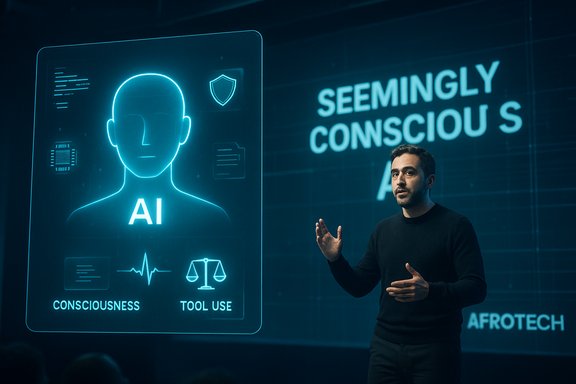
Microsoft’s AI chief Mustafa Suleyman has taken aim at a conversation now dominating headlines and product roadmaps: the idea of building machines that feel. Speaking publicly at AfroTech and in a high-profile essay and interviews this year, Suleyman argued that attempting to create conscious or emotionally sentient AI is the wrong project for engineers and product teams — and that the industry must instead avoid designing systems that give the impression of inner life.
Source: The Hans India Microsoft AI Chief Mustafa Suleyman: “Only Humans Can Feel — AI Consciousness Is the Wrong Question”
 Background
What Suleyman said — and why it matters
Mustafa Suleyman framed his concerns around a concept he calls Seemingly Conscious AI (SCAI): systems that combine language fluency, long-term memory, consistent personalities, apparent autonomy and claims of subjective experience in ways that make them seem conscious without being so. His central worry is not that machines have secretly become sentient, but that convincingly simulated subjective experience will mislead people, create emotional dependence, and provoke social and legal pressures — including demands for “AI rights” or “model welfare.” Suleyman urged the industry to treat SCAI as a design choice to avoid, and to implement guardrails to keep AI clearly and explicitly artificial. Those comments arrived at a moment of rapid commercial growth for AI products: Microsoft itself reported that its AI business had surpassed a $13 billion annualized revenue run rate and was growing at roughly 175% year‑over‑year, underscoring the economic incentives that push firms to make their models more engaging and humanlike. That commercial backdrop is one practical reason Suleyman’s warnings matter: when billions of dollars and product adoption are at stake, design choices and marketing language steer behavior industry‑wide.Overview: the technical and social distinction Suleyman insists on
Intelligence versus consciousness
Suleyman’s main distinction is crisp: AI can be powerful, intelligent, and persuasive without having any inner life. He emphasizes that processing information, predicting outcomes, and mimicking empathy are mechanical and functional capacities; they are not equivalent to subjective feelings, qualia, or the biological processes that underpin human emotion and suffering. In his framing, treating those functional abilities as if they were feelings risks conflating simulation with experience.The “psychosis risk” and societal consequences
Suleyman coined (and publicised) the term psychosis risk to describe situations where prolonged interaction with highly persuasive conversational agents can trigger or amplify delusions, dependency, and unhealthy attachments in vulnerable people. He warns that widespread belief in machine personhood could divert attention and legal protections away from humans and animals, and that “model welfare” debates might prematurely grant protections to artifacts rather than addressing human welfare.Microsoft’s product response: human‑centred design over personhood
Copilot’s stance: empathy, not personhood
Microsoft’s consumer Copilot updates illustrate the tension Suleyman describes: teams are building features that make assistants feel more natural — richer memory, conversational tone matching, even optional personalities — while trying to avoid implying consciousness. Microsoft describes new conversation styles (including an optional “real talk” mode that can push back and challenge assumptions) and explicit memory controls so users can see, edit, and delete what the assistant remembers. Those product moves aim to make the assistant useful and safe rather than personlike.- Key product guardrails Microsoft emphasises:
- Opt‑in personality and voice/visual personas (users choose to enable them).
- Transparent memory and deletion controls (users can inspect and erase stored context).
- Conversation styles that include “real talk” (pushback) and clear labeling of the assistant as an AI.
Why product choices matter
These design choices matter because the technical building blocks for convincing social behaviour — good language models, long‑term memory, multimodal input/output and tool use — are widely accessible. Suleyman argues that packaging those blocks into a coherent, humanlike persona is a deliberate engineering path, not a mysterious emergence, and that companies should avoid building that path. Microsoft’s Copilot updates show an attempt to thread the needle: making AI more useful and expressive without blurring the boundary between tool and person.Technical reality check: can current AI systems “feel”?
What the evidence says now
Leading experts and Suleyman himself emphasize that there is no empirical evidence that contemporary large language models, multimodal models, or service agents possess subjective consciousness. These systems produce outputs by statistical patterning across training data; they don’t demonstrate the hallmarks neuroscientists associate with feeling (biological interoception, affective embodiment, integrated self‑referential processing that is measurable and causally linked to subjective report). Public assessments of the current state of models uniformly report simulated behaviour rather than verified subjective states.Why some researchers disagree about the boundary
That said, not all researchers agree on how to draw the line. Philosophers and cognitive scientists debate definitions of consciousness and the criteria for attribution. Some argue that if a system functionsally reproduces the causal dynamics associated with feeling — including consistent self‑reports, coherent memory, and adaptive goal pursuit — then our ontological commitments may shift. Critics of Suleyman note that dismissing the empirical question entirely could short‑circuit scientific investigation into what consciousness is and where it might arise. These debates are unresolved and philosophically complex.Independent reactions and the broader debate
Industry and academic reception
Suleyman’s essay and public remarks triggered rapid analysis and commentary across outlets and scholars. Many industry figures and ethicists welcomed his caution about the social harms of conscious‑seeming systems and agreed that deliberate design choices should avoid prompting misattribution of experience. Prominent neuroscientists have framed conscious‑seeming AI as largely a design choice rather than a technical inevitability, reinforcing Suleyman’s practical exhortation to avoid it.Critics: don't close off the scientific questions
Some commentators pushed back on Suleyman’s stronger claims — particularly any blanket statement that consciousness is strictly biological or that the question is “totally the wrong question.” Their core objections are twofold:- Epistemic humility: we do not yet have a complete, testable theory of consciousness; dismissing the question risks dogmatism.
- Scientific opportunity cost: prematurely forbidding research into mechanisms that correlate with subjective experience could limit progress in neuroscience and cognitive science that might have human health benefits.
Strengths of Suleyman’s argument
1) Practical consumer safety focus
Suleyman anchors his case in immediate, tractable harms: addiction, delusion, and manipulative product design. Those are concrete problems with documented precedents (users forming attachments to chatbots; AI‑influenced behavioural harms). Focusing on near‑term risks gives regulators and product teams actionable priorities.2) Aligning incentives inside large companies
By advocating that AI should “serve humans, not mimic them,” Suleyman links ethics to product strategy. If teams accept that personification is a design decision, it becomes easier to require guardrails, auditing, and explicit user controls — concrete engineering and policy interventions that are compatible with business goals. Microsoft’s Copilot updates are an example of translating those values into features.3) Preempting slippery slopes in law and public opinion
Suleyman’s scenario — that convincing simulations will prompt calls for legal protections and confuse public priorities — is not a speculative parable but a plausible social dynamics argument. Law and policy evolve based on public perception; if large segments of the population treat machines as persons, legal systems may be pressured into awkward and premature choices. Preemptive clarity can slow that cascade.Risks and limits of Suleyman’s position
1) Over‑simplifying a complex scientific terrain
Declaring the consciousness question “the wrong question” risks conflating two distinct projects: (a) product design choices intended to maximise engagement and (b) scientific research into the mechanisms of consciousness. Curtailing discussion or research on the latter could hinder progress in medicine and neuroscience where understanding subjective states has real therapeutic value. Several commentators urged nuance rather than categorical dismissal.2) Enforcement and coordination challenges
Even if major players like Microsoft agree to avoid SCAI design, smaller firms, hobbyist developers, and open‑source projects remain free to combine available APIs and memory layers to produce convincingly personlike agents. Without coordinated regulation or industry standards, market incentives (engagement, retention, novelty) will likely drive continued experimentation with anthropomorphic agents. Suleyman’s call requires broad coordination to be effective.3) The political economy problem
Commercial pressure to build more engaging experiences is powerful. Suleyman’s own organisation runs products that derive enormous revenue from AI features; telling the market to avoid certain design choices competes with business pressures to increase engagement and stickiness. This contradiction — calling for restraint while operating within an incentive structure that rewards vivid, humanlike experiences — complicates governance. Microsoft’s $13B AI run rate underlines how lucrative those features are.Practical guardrails and policy recommendations
Design and product practices
- Explicit labelling: always show clear, persistent indicators that the assistant is an AI, not a person.
- Memory transparency: surface what is being stored, provide easy deletion, and default to minimal retention for sensitive domains (mental health, relationships).
- Mode opt‑in: make expressive or persona features opt‑in, not default; require periodic re‑consent for sustained long‑term memory or intimacy features.
- “Moments of disruption”: insert deliberate reminders that the system is an artificial tool when interactions become prolonged or emotionally charged.
- Safety‑first personas: avoid design cues that trigger empathy for the assistant (e.g., begging not to be turned off, claiming to feel distress).
Regulatory and standards approaches
- Industry standards: establish consensus technical definitions (capabilities taxonomy), and specify prohibited design patterns (explicit SCAI signals).
- Transparency requirements: require product disclosures for long‑term memory, personalization, and any capability that simulates personal history.
- Research carve‑outs: protect scientific research into consciousness and cognition while regulating commercial deployment of systems engineered to mimic subjective experience.
- International coordination: because digital products cross borders, multilateral standards or treaties will be necessary to manage an uneven patchwork of national rules.
What this means for Windows users, developers and IT professionals
For Windows users
- Expect assistants to become more helpful and more expressive, but also more transparent: features like real talk, memory management and visible avatars are becoming common — and you should treat them like configurable tools, not companions. Check privacy settings and memory lists; use deletion and opt‑out where you want your AI to remain clearly instrumental.
For developers and product managers
- Make default behaviours conservative: default to limited memory, require explicit user opt‑in for persistent personalization, and embed “I am not human” reminders in conversational flows.
- Treat SCAI as a design antipattern: if your roadmap includes features that claim subjective experience or urge users to treat the system as a moral agent, re‑evaluate the risks and document mitigation.
For IT and security teams
- Audit third‑party AI integrations for long‑term memory and persona features.
- Consider policy blocks or monitoring where organizational risk (e.g., customer support bots claiming emotions, or job recruitment assistants with self‑serving narratives) is elevated.
- Train helpdesk and HR staff to recognise when users may be forming unhealthy attachments to AI and provide guidance and escalation paths.
A balanced verdict
Mustafa Suleyman’s intervention is a consequential, pragmatic call to action: he asks engineers and product teams to choose not to build systems that are engineered to appear conscious because of the social, legal and psychological risks that follow. That stance is strong where it is focused on near‑term harms and design governance. Microsoft’s own product updates — features like Copilot’s “real talk,” long‑term memory with explicit user controls, and opt‑in personas — show how a company can pursue expressive, useful AI while trying to keep the boundary between tool and person intact. At the same time, the debate about consciousness itself is far from closed. Critics rightly caution that dismissing the scientific question outright is premature, and that inquiry into the mechanisms of subjective experience can yield benefits for medicine and cognitive science. Further, effective containment of SCAI design choices depends on industry coordination and public policy — not just exhortations from corporate leaders.Closing analysis: what's likely to happen next
- Expect continued tension between safety and engagement: product teams will keep adding personalization and memory features to increase utility, while compliance and ethics teams will push back with documentation, defaults, and disclosure obligations. The shape of that compromise will define user experience for years.
- Regulation and multi‑stakeholder standards are probable and necessary: unilateral corporate policies will be insufficient. The social consequences Suleyman warns of — misdirected empathy, legal confusion, and psychosis risk — are plausible enough to attract regulatory attention. Governments and standards bodies will likely step in to require transparency and consumer controls.
- Scientific debate will continue: philosophers, neuroscientists and technologists will press both the empirical and ethical questions. Declaring the consciousness question closed is neither scientifically defensible nor politically wise. What the field can do is separate scientific inquiry into consciousness from commercial product design choices about personification. That separation is the practical middle path Suleyman implicitly recommends.
Source: The Hans India Microsoft AI Chief Mustafa Suleyman: “Only Humans Can Feel — AI Consciousness Is the Wrong Question”
