

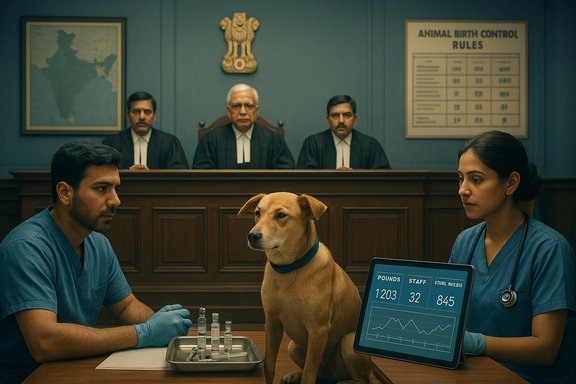
The Supreme Court will deliver its order in the high‑profile stray dogs case on November 7 after hearing chief secretaries from the states and Union Territories and pressing for urgent compliance with the Animal Birth Control rules amid mounting public‑safety and animal‑welfare concerns.
The issue reached the Supreme Court after the bench took suo motu cognisance of alarming media reports about stray‑dog attacks and a reported child fatality, launching nationwide judicial scrutiny in late July 2025. The top court’s intervention began as a local public‑health crisis in the National Capital Region but was quickly expanded to all states and Union Territories because the underlying problems — vaccination shortfalls, limited sterilisation capacity, weak capture‑and‑release infrastructure, and poorly coordinated municipal responses — are not confined to one city. Two consequential interim directions by the Court set the stage for the current enforcement push. An early August order that instructed authorities in Delhi‑NCR to capture and not release picked‑up strays provoked wide debate and litigation; the bench later modified that approach, ruling that sterilised and vaccinated animals should generally be returned to their original localities while excluding animals that are rabid or overtly aggressive. That modification underscored the legal tension between the existing Animal Birth Control framework and a court‑led drive to protect public safety. The present hearing cycle has placed a narrow, operational question at the centre: have state and municipal authorities actually complied with the Court’s August directions and the long‑standing Animal Birth Control (ABC) rules — and can they demonstrate the infrastructure, personnel and budgets needed for a credible national programme? The answer so far, the Court has said, is uneven.
There is also a governance dimension: animal management sits at the intersection of municipal public health, urban services, veterinary infrastructure, and civil‑society activism. The Court’s insistence that chief secretaries answer for compliance elevates the issue to the highest administrative level — which is necessary — but judicial pressure alone cannot substitute for the budgetary choices and political prioritisation the work requires.
Yet the Court cannot close the final mile. The most serious risk remains a mismatch between judicially‑mandated outcomes and municipal capacity. If the November order emphasises compliance without simultaneously unlocking resources and clarified SOPs, the result could be more litigation, ad hoc local measures (including culling), and continued community friction.
What will make November 7 decisive is whether the order pairs accountability with implementable support: clear standards, funding signals, national‑level technical assistance and monitored targets. If the Court sets those expectations and the executive branches respond with concrete plans and budgets, the verdict could mark the start of a durable programme that reduces dog‑bite injuries while preserving humane treatment. If not, the cycle of orders, affidavits and short‑term fixes will likely continue.
The coming week will show whether India’s courts and governments can translate legal commands into public‑health practice at the scale the crisis requires.
Source: Storyboard18 Supreme Court to deliver order in stray dogs case on November 7
 Background / Overview
The issue reached the Supreme Court after the bench took suo motu cognisance of alarming media reports about stray‑dog attacks and a reported child fatality, launching nationwide judicial scrutiny in late July 2025. The top court’s intervention began as a local public‑health crisis in the National Capital Region but was quickly expanded to all states and Union Territories because the underlying problems — vaccination shortfalls, limited sterilisation capacity, weak capture‑and‑release infrastructure, and poorly coordinated municipal responses — are not confined to one city. Two consequential interim directions by the Court set the stage for the current enforcement push. An early August order that instructed authorities in Delhi‑NCR to capture and not release picked‑up strays provoked wide debate and litigation; the bench later modified that approach, ruling that sterilised and vaccinated animals should generally be returned to their original localities while excluding animals that are rabid or overtly aggressive. That modification underscored the legal tension between the existing Animal Birth Control framework and a court‑led drive to protect public safety. The present hearing cycle has placed a narrow, operational question at the centre: have state and municipal authorities actually complied with the Court’s August directions and the long‑standing Animal Birth Control (ABC) rules — and can they demonstrate the infrastructure, personnel and budgets needed for a credible national programme? The answer so far, the Court has said, is uneven. Why November 7 matters: what the Court is deciding
The bench — comprising Justices Vikram Nath, Sandeep Mehta and N. V. Anjaria — listed the matter “for orders” on November 7 after noting the appearance of chief secretaries (or senior state representatives) and indicating that many states had filed compliance affidavits. The Court also directed the Animal Welfare Board of India be added as a party to the proceedings and said that chief secretaries will not be required to appear personally in future unless their state fails to comply with directions. That November 7 order will likely be consequential for three reasons:- It will set expectations for uniform national implementation of sterilisation‑and‑vaccination programmes under the ABC Rules, clarifying whether the Court intends to enforce national standards or leave operational detail to states.
- It could formalise penalties or compliance timelines for defaulting authorities — an enforcement posture the Court has already telegraphed through sharp rebukes of state inaction.
- It may define the legal status and scope of local measures such as designated feeding zones, the role of NGOs and volunteers, and the acceptable thresholds for removal, monitoring, or humane euthanasia for “dangerous” animals. Previous interim directions already touched on these topics; November 7 could refine them into lasting principles.
The legal framework at play: Animal Birth Control rules and judicial directions
The ABC rules: the statutory baseline
The primary statutory regime governing stray‑dog management in India is the Animal Birth Control (Dogs) Rules, framed under the Prevention of Cruelty to Animals Act, 1960. The Rules require that street dogs be sterilised, vaccinated and released back to the same locality, and they set humane‑care and recordkeeping standards for dog pounds, kennels and municipal capture operations. The legal text emphasises veterinary oversight, humane treatment, and identification of sterilised animals before release. Media coverage around the Court’s hearings has sometimes referred to more recent rule sets or amendments; in practice, the ABC Rules (2001), with subsequent amendments, remain the operative legal instrument and the touchstone for the Court’s scrutiny. Where reporting mentions “ABC Rules, 2023” or local authorities speak of updated implementation guidelines, those are administrative iterations rather than wholesale statutory replacements — and such references should be treated carefully until a formal central rule change is published in the official gazette. That distinction matters legally and operationally.What the Court has already ordered
- Immediate clarification that sterilised, vaccinated dogs (absent signs of rabies or aggression) should normally be returned to their home localities rather than permanently relocated — reversing a short‑lived August directive to mass‑relocate animals. This shift aligns the Court with the ABC Rules’ neuter‑and‑release principle while preserving an exception for dangerous animals.
- A nationwide expansion of the case beyond Delhi‑NCR because the Court concluded the issues are systemic and likely to recur in other states. The bench accordingly asked states and municipal bodies to file affidavits detailing resources and action plans.
- Directions requiring municipal authorities to furnish granular data: number of dog pounds, veterinary staff, dog‑catching squads, specialised vehicles and cages, sterilisation capacity, budgets allocated and outcomes measured. The Court has framed this as a data‑driven compliance exercise.
What common public reports say — and what independent verification shows
Press and agency reporting provide a consistent picture of judicial impatience with state governments. The Supreme Court publicly rebuked defaulting administrations, using phrases that conveyed frustration about how recurring dog‑bite incidents were reflecting badly on the country in international reportage. Several national outlets reported that chief secretaries were summoned and that most had been compelled to appear unless they complied by filing affidavits. Independent press agency coverage confirms the Court’s operational pivot: after initial “relocate all picked up dogs” directions triggered widespread outcry and feasibility concerns, the regime settled on capture‑sterilise‑vaccinate‑release as the default, with narrow exceptions. That balance is intended to reconcile two legitimate public interests — animal welfare and human safety — but implementing it at scale is a different challenge. Reuters and the Associated Press charted the modification and also flagged public‑health data and logistical hurdles that informed the Court’s change of course. A critical verification point: some widely circulated summaries or repeat reporting inaccurately dated the Court’s suo motu action. Authoritative court orders and contemporaneous press from late July 2025 show the suo motu cognisance began on July 28, 2025. Reports that place the judicial trigger in 2022 do not match the official docket or primary‑reporting timelines and should be treated as erroneous. Careful sourcing matters when the date of judicial intervention conditions the legal record.On the ground: data, capacity and the perennial gaps
Media and municipal releases offer a sobering operational picture. In several cities and municipalities the number of dedicated dog‑sterilisation centres, dog‑catching vehicles and trained veterinarians is small relative to the scale of the problem, producing chronic backlogs. Some municipal programmes sterilise only a few thousand animals per year while city populations of street dogs — and bite incidents — run far higher. In some localities, reporting cites surge figures of thousands of reported bites in a year; in others, municipal censuses indicate tens of thousands of street dogs. Health data reported in agency dispatches raise equal concern: one widely circulated account noted hundreds to thousands of bite incidents daily in urban centres and reported rabies cases in the months preceding the Court’s intervention. That public‑health footprint explains the Court’s urgency but also highlights a policy paradox: scaling sterilisation and vaccination rapidly enough to blunt bite incidence requires resources, coordination and time — and the public cannot be left defenseless while those systems are built.Strengths of the Court’s approach
- National coordination and visibility. By expanding the scope of the matter beyond Delhi‑NCR and insisting on chief‑secretary‑level accountability, the Court has forced a national conversation and compelled local authorities to produce operational data that ordinarily remains fragmented across towns and municipal zones. That transparency is a prerequisite for systemic fixes.
- Balancing animal welfare and public safety. The modified August direction — returning sterilised and vaccinated dogs to their home localities while removing rabid or demonstrably aggressive animals — aligns legal principle (humane, non‑lethal control) with pragmatic safety exceptions.
- Data‑driven compliance. Demanding affidavits and inventories (dog pounds, crews, vehicles, vets) creates an auditable baseline against which outcomes can be measured; it creates leverage for future funding or central assistance if states are shown to be resource‑constrained.
Risks, weaknesses and unintended consequences
- Capacity mismatch and perverse incentives. The default to release‑after‑sterilisation works only if sterilisation and vaccination coverage reach epidemiologically meaningful levels. If implementation stalls, the Court’s order may merely reposition animals without reducing bite risk — and in the short term could encourage local authorities to pursue stop‑gap relocation or even culling in the perceived absence of shelter capacity. Historical and contemporary reporting shows such unintended responses in jurisdictions with low infrastructure.
- Operational ambiguities. Terms such as “aggressive” or “dangerous” are not self‑defining. Without clear behavioural protocols, capture and confinement decisions may be inconsistent and vulnerable to legal challenge or public backlash.
- Funding and human resources. Sterilisation is resource‑ and labour‑intensive. Many municipal corporations operate with constrained budgets, limited vehicle fleets and few trained veterinarians — and the Court cannot run municipal capture operations. Unless states allocate funds or central schemes provide support, compliance affidavits will remain paperwork without field impact.
- Community backlash and enforcement friction. The Court’s restrictions on public feeding and creation of “feeding zones” can provoke social conflict with caregivers and NGOs used to informal feeding, risking obstruction, protests and legal friction unless policy is accompanied by outreach and alternative humane‑care options.
What a robust compliance plan should include
The Court’s demand for numbers and infrastructure is an operational opportunity if acted upon properly. A practical compliance playbook for states and municipal bodies would include:- Immediate inventory and public dashboard:
- A verified, geocoded inventory of dog pounds, sterilisation centres, trap‑and‑transport vehicles, veterinary staff and dog‑catching squads.
- Rapid capacity scaling:
- Short‑term contracts with accredited NGOs and private veterinary clinics to expand sterilisation throughput, with transparent performance metrics and CCTV/recording for accountability.
- Vaccination and bite‑response escalation:
- Mass vaccination drives for free‑roaming dogs tied to door‑to‑door human bite‑report response and expanded rabies PEP (post‑exposure prophylaxis) access at primary health centres.
- Clear operational definitions and SOPs:
- Evidence‑based behavioural criteria for identifying animals to be confined, medically assessed or euthanised (humane methods only), and a documented appeals or review process for disputed captures.
- Community engagement and alternative feeding logistics:
- Formalised feeding zones, training for feeders, and integration of citizen volunteers in post‑op recovery monitoring to decrease obedience infractions and obstruction incidents.
- Funding mechanisms:
- State budget allocations or central conditional grants tied to measurable outputs (sterilisation numbers, vaccination coverage, bite‑incidence reduction).
- Transparent reporting:
- Quarterly public reports indexed to the Court’s direction: number of captures, sterilised animals, vaccinations, dog deaths, and reasons for removal.
Practical advice for municipal policymakers (short checklist)
- Prioritise hotspots: Use bite‑incidence mapping to sequence sterilisation and vaccination drives.
- Partner pragmatically: Engage accredited AWOs and private clinics to surge capacity; contract terms must include audit and non‑lethality clauses unless directed by veterinarian diagnostics.
- Document everything: Maintain chain‑of‑custody, surgical logs, vaccine batch records and release coordinates; the Court has signalled it will treat such records as part of compliance.
- Protect staff: Ensure dog‑catching teams operate with safety equipment, training and clear legal cover to avoid obstruction prosecutions or public hostility.
What to watch for on November 7
The hearing scheduled for November 7 can change the implementation landscape in specific ways:- Will the Court lay down a fixed compliance timetable or endorse state‑led phased plans?
- Will it mandate funding or simply require evidence of budgets and action plans — thereby shifting the burden to state treasuries?
- Will the judgment provide detailed operational definitions for categorising dogs as “aggressive” or “rabid” and for humane euthanasia standards, or will it leave those to clarification through committee reports and administrative rules?
- Will the Court authorise a central monitoring mechanism — possibly run by the Animal Welfare Board of India — to audit state returns and report compliance publicly?
Where reporting has been unclear — flagged points
- Several early summaries misstated the timeline of judicial action. The suo motu cognisance that triggered the case took place on July 28, 2025; earlier references to 2022 are inconsistent with the official docket and contemporaneous reporting and should be treated as erroneous.
- Reporting sometimes invokes an “ABC Rules, 2023” formulation. While administrative updates and local guidelines have been publicised, the principal statutory instrument remains the Animal Birth Control (Dogs) Rules, 2001, as amended; any assertion that the 2001 Rules have been wholly replaced must be verified against the official gazette. Readers should treat claims of a brand‑new central rule with caution until the government publishes a formal notification.
The broader policy challenge: humane dog control at scale
The stray‑dog question is a test case for state capacity and humane public‑policy design. Sterilisation‑and‑vaccination programmes are internationally recognised as effective non‑lethal control strategies when they reach critical coverage levels and are combined with community participation. But they are slow and resource‑intensive; turning them from pilots into mass programmes requires sustained investment, logistics, and human capital.There is also a governance dimension: animal management sits at the intersection of municipal public health, urban services, veterinary infrastructure, and civil‑society activism. The Court’s insistence that chief secretaries answer for compliance elevates the issue to the highest administrative level — which is necessary — but judicial pressure alone cannot substitute for the budgetary choices and political prioritisation the work requires.
Bottom line: what the public should expect
- Expect an order on November 7 that tightens compliance requirements, formalises the Animal Welfare Board’s role in oversight, and underscores state accountability for operational delivery.
- Expect continued debate and litigation over the fine line between humane release and public‑safety removal for specific animals; precise operational definitions will determine how that trade‑off plays out in practice.
- Expect that real progress will depend on measurable increases in sterilisation and vaccination throughput, visible budget commitments, and transparent public reporting by municipal bodies. Without those elements, compliance affidavits will risk becoming a paper exercise rather than a pathway to safer streets.
Final analysis: strengths, caveats and the path ahead
The Court’s intervention is constructive in principle: it reframes stray‑dog control as a national systems problem, demands operational transparency, and attempts to marry animal‑welfare principles with urgent human‑health protections. The modification permitting release after sterilisation is legally and ethically defensible — provided that sterilisation and vaccination are actually accomplished at scale.Yet the Court cannot close the final mile. The most serious risk remains a mismatch between judicially‑mandated outcomes and municipal capacity. If the November order emphasises compliance without simultaneously unlocking resources and clarified SOPs, the result could be more litigation, ad hoc local measures (including culling), and continued community friction.
What will make November 7 decisive is whether the order pairs accountability with implementable support: clear standards, funding signals, national‑level technical assistance and monitored targets. If the Court sets those expectations and the executive branches respond with concrete plans and budgets, the verdict could mark the start of a durable programme that reduces dog‑bite injuries while preserving humane treatment. If not, the cycle of orders, affidavits and short‑term fixes will likely continue.
The coming week will show whether India’s courts and governments can translate legal commands into public‑health practice at the scale the crisis requires.
Source: Storyboard18 Supreme Court to deliver order in stray dogs case on November 7
