

Suralink announced on June 3, 2026, that it is expanding its agentic automation platform for accounting firms with a new Agent Library, Cloud Testing Suite, Excel-based Workpaper Suite Intelligence, and native integrations for Microsoft Copilot and Anthropic’s Claude users and clients. The pitch is not simply that accountants get more AI buttons to press. Suralink is arguing that the real bottleneck in audit and advisory work sits before the spreadsheet, before the workpaper, and before the reviewer ever opens a file. If that argument is right, the accounting AI race is moving from model selection to workflow control.
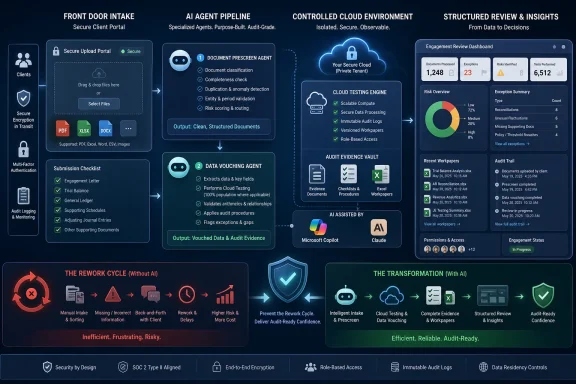
The most important phrase in Suralink’s announcement is not agentic AI. It is “front door.” The company describes itself as the place where client data first enters the accounting firm, and that positioning matters more than the branding around agents.
Most enterprise AI announcements still begin at the wrong end of the process. They assume that the data is already usable, that documents are complete, that naming conventions make sense, and that the work begins when an analyst asks a model to summarize, test, or reconcile something. Anyone who has worked around audit, tax, or client-service operations knows that this is fantasy with a software license attached.
Suralink’s claim is that firms lose time not because their professionals lack intelligence, but because client submissions arrive incomplete, inconsistent, or simply wrong. The company calls this the “Client Readiness Gap,” and the repeated cleanup it causes the “Rework Cycle.” Those names are marketing language, but the problem underneath is painfully familiar: firms ask for evidence, clients upload what they have, staff discover defects, and everyone repeats the loop under deadline pressure.
That is why the announcement deserves attention beyond the accounting software niche. Suralink is not just adding a Copilot connector or letting Claude query a repository. It is trying to move AI closer to the intake point, where bad data can be detected before it metastasizes into a workpaper problem.
Suralink says its new Agent Library includes five agents, with two of them — the Document Prescreen Agent and Data Vouching Agent — packaged into a new Cloud Testing Suite. The stated goal is to prescreen client data at upload and complete initial testing without firm users manually pushing the process along. That is a more concrete promise than the usual “AI assistant for productivity” line.
The distinction matters. A general-purpose AI assistant waits for a user to ask a question. An accounting agent, at least in Suralink’s framing, sits inside a defined workflow, watches for a specific class of artifact, applies a bounded procedure, and returns a result that can be reviewed. That does not make it risk-free, but it does make the automation more auditable than a free-form chat session.
The accounting profession has spent years building systems around request lists, PBC packages, secure file exchange, workpapers, review notes, and sign-offs. Suralink’s bet is that the next efficiency leap does not come from bolting a large language model onto the end of those systems. It comes from inserting machine judgment into the handoff between client and firm.
In accounting, a model that confidently processes incomplete evidence can increase the blast radius of a client mistake. It may produce plausible classifications, summaries, or test outputs that look orderly enough to move downstream, only for a reviewer to discover later that the underlying package was defective. At that point, the firm has not saved time; it has converted a simple intake failure into a review-stage failure.
That is the hidden cost in many AI deployments. The software accelerates motion, but not necessarily progress. When the input is unready, acceleration simply moves the error to a more expensive stage of the engagement.
Suralink’s “Rework Cycle” framing is therefore strategically clever. It reframes AI adoption away from the question vendors prefer — how smart is the model? — and toward the question firms actually live with — when does the system know enough to act? In a profession built around evidence and reviewability, that second question is the one that matters.
Microsoft wants Copilot to be the interface layer for work across Office, Windows, Teams, and business applications. Anthropic wants Claude to be a reasoning and agent platform that can operate against trusted tools and data. Vendors like Suralink increasingly want their systems to be callable from those AI environments without surrendering control over domain-specific workflows.
That is the emerging bargain. Horizontal AI platforms provide the conversational surface and model ecosystem. Vertical software companies provide the data, permissions, audit trail, and process logic. The winners will be the products that can meet users where they already work without turning sensitive professional workflows into an ungoverned prompt bazaar.
For WindowsForum readers, the Microsoft angle is especially relevant. Copilot is no longer just an assistant floating above the operating system or Office ribbon. In business settings, it is becoming a broker for actions across SaaS systems, documents, and line-of-business data. The quality of those actions will depend less on the sparkle of the Copilot UI and more on whether the connected systems expose clean, governed, context-rich operations.
Suralink’s announcement fits that direction neatly. It treats Copilot not as a replacement for accounting software, but as another way to reach it. That is probably the more durable model for enterprise AI: not one giant assistant that knows everything, but a mesh of specialized systems that let general assistants act safely within defined boundaries.
That reality makes Excel integration a forcing function for serious accounting automation. If AI cannot operate where preparers and reviewers actually spend their time, it becomes another portal to check, another workflow to reconcile, and another adoption campaign for already busy professionals. The path to productivity often runs through the least glamorous surface.
Workpapers are also where the profession’s tolerance for ambiguity narrows. A model may help summarize a lease, identify missing support, or compare submitted data against a testing procedure, but the result has to land in a structure that human reviewers trust. Excel is not merely a grid in this context. It is a control surface, a record of judgment, and often the common language between staff, managers, partners, and clients.
Suralink’s broader Request-to-Review positioning depends on this bridge. Intake intelligence is useful only if the resulting evidence and exceptions flow naturally into the review process. Otherwise, the firm still ends up stitching together request management, document storage, testing, comments, workpapers, and client follow-up by hand.
The company’s advantage, if it has one, comes from the fact that accounting engagements already require a structured choreography of requests, uploads, approvals, evidence, and review. That gives Suralink a natural place to define permissions, capture context, and maintain an audit trail. Those are not optional niceties when AI starts touching client financial data.
This is where many generic AI tools struggle. A model can read a document and produce a useful answer, but firms need to know which document, from which client, for which engagement, under which request, at what point in the workflow, and with what level of human review. Without that context, AI output becomes operationally awkward and potentially risky.
The larger enterprise lesson is clear. AI agents will be judged not only by what they can infer, but by what they can prove about their own work. In accounting, that proof has to be tied to evidence. In healthcare, it has to be tied to patient context. In legal work, it has to be tied to matter records and privilege boundaries. The vertical details change, but the governance problem is the same.
Suralink’s integrations with Copilot and Claude therefore raise the stakes. The more accessible the platform becomes from external AI work surfaces, the more important its internal controls become. The convenience of asking an assistant to retrieve, test, or summarize engagement data must be matched by strict limits on what that assistant can see and do.
That is why Suralink’s move is part of a broader industry shift. The question for enterprise SaaS companies is no longer whether they have an AI feature. It is whether their product can participate in an AI-mediated workplace while preserving the domain logic that made the product valuable in the first place.
For Microsoft, this is exactly the ecosystem dynamic Copilot needs. The more business systems that connect to Copilot, the more Copilot becomes a work hub rather than a novelty. For vendors, the incentive is equally obvious: if users are going to ask Copilot for help with engagement status, client documents, exceptions, or testing progress, the system of record wants to be the place Copilot calls.
But there is a subtle power shift here. When the interface layer belongs to Microsoft or Anthropic, vertical vendors must compete not only on features, but on how well their data and workflows can be exposed to outside agents. That rewards vendors with clean APIs, strong permission models, and well-structured process metadata. It punishes products whose value is trapped inside screens and manual rituals.
Suralink appears to understand that the integration story is not a sidecar. It is part of the product strategy. A request platform that cannot talk to Copilot, Claude, or whatever assistant a firm standardizes on will feel increasingly isolated. A platform that talks to them without guardrails will feel reckless.
Anthropic has positioned Claude strongly around reasoning, long-context work, coding, and enterprise safety. Microsoft, despite its deep OpenAI relationship, has also been moving toward a more plural model environment in parts of its AI portfolio. Customers are learning the same lesson vendors have already absorbed: different models are better at different tasks, and today’s leaderboard is not tomorrow’s architecture.
For accounting firms, that means the winning architecture is unlikely to be “choose one assistant and pour everything into it.” It is more likely to be a governed platform that can expose the right data and workflow to the right model through the right interface. Suralink’s native Copilot and Claude integrations point in that direction.
This also gives firms negotiating leverage. If a workflow can operate through multiple AI surfaces, firms are less likely to be trapped by one provider’s pricing, latency, policy changes, or model regressions. In the agentic era, portability is not just a developer preference. It is an operational hedge.
Still, multi-model access creates its own complexity. Security teams need to understand where data flows, administrators need policy controls, and engagement leaders need clarity about which outputs are authoritative. More AI choices do not automatically mean better governance. They mean governance has to become more explicit.
Accounting is also a market where AI theater has limited shelf life. Firms may experiment with flashy tools, but busy-season pressure quickly exposes anything that adds clicks, creates review uncertainty, or fails to fit the engagement model. A tool that saves five minutes in a demo can lose an hour in the field if it creates another reconciliation point.
That is why Suralink’s focus on client readiness is more credible than a generic claim about AI productivity. The client side of the workflow is messy, uneven, and often outside the firm’s direct control. If software can reduce ambiguity at that boundary, the payoff can be larger than automating a task that was already well-contained.
But this is also where the promise will be hardest to prove. Client behavior is not a deterministic system. Upload patterns vary. Evidence quality varies. The same client may be disciplined in one engagement and chaotic in another. AI can prescreen, flag, classify, and test, but it cannot magically make clients organized.
The real test for Suralink will be whether its agents reduce the number of back-and-forth cycles in live engagements. Not whether they can identify a missing file in a controlled demo. Not whether they can summarize a document in polished prose. The metric that matters is whether staff spend less time chasing, rechecking, and reworking client submissions.
The near-term opportunity is not replacing auditors or tax professionals. It is taking low-value friction out of the engagement so scarce human judgment is not wasted on avoidable cleanup. In that sense, Suralink’s AI agents are less like digital accountants and more like tireless intake reviewers.
That distinction matters for adoption. Professionals are more likely to trust automation that catches missing support, validates structure, or performs initial testing than automation that claims to render professional judgment. The former helps them get to the real work faster. The latter threatens to blur responsibility.
Firms will still need to decide how outputs are reviewed, who signs off, and how exceptions are escalated. They will need training not only on what the agents can do, but on where the agents are likely to fail. The best AI deployments in accounting will make responsibility clearer, not more diffuse.
There is also a talent dimension. Junior staff traditionally learn by doing some of the tedious work that automation now targets. Firms will have to redesign learning paths so early-career professionals still develop skepticism, pattern recognition, and procedural fluency. Automating drudgery is good. Automating away apprenticeship without replacing it is not.
Where is the data processed? Which documents can Copilot or Claude access? Are prompts and outputs logged? Can firms restrict access by engagement, role, or client? How are model responses reviewed before they become part of the audit trail? These are the questions that determine whether a product is production-ready or merely demo-ready.
Suralink’s existing role as a secure client collaboration and request-management platform gives it a better starting point than a standalone AI wrapper. Still, every integration expands the governance surface. Native connectors are powerful because they reduce friction, but friction sometimes exists for a reason.
For Windows and Microsoft 365 administrators, this is part of a larger operational shift. AI governance is becoming identity governance, data governance, app governance, and endpoint governance all at once. A Copilot integration is not just an app setting; it is a new path through which users may initiate actions against business data.
That means IT teams will need to treat agentic accounting tools like production systems, not productivity experiments. They will need documentation, logs, permission mapping, retention policies, incident response plans, and clear ownership between the vendor, the firm’s IT organization, and engagement leadership. The firms that get value fastest may be the ones that make governance boring early.
A coherent Request-to-Review stack tries to treat the engagement as one continuous process. A request is issued. A client responds. The submission is checked. Evidence is associated with a procedure. Testing begins. Exceptions are routed. Review happens. Follow-up returns to the client with context intact.
That continuity is where AI can be useful. Agents need context, and fragmented workflows starve them of it. If the system knows what was requested, what was uploaded, what the prior-year evidence looked like, what the testing objective is, and who must review the result, the agent has a fighting chance of doing bounded work responsibly.
The broader lesson applies outside accounting. AI is most powerful where workflow data is already structured and where the next action can be constrained. It is weakest where organizations expect a model to compensate for years of process neglect. Suralink is effectively arguing that the accounting firm’s front-office workflow can become structured enough for agents to operate meaningfully.
That is an ambitious claim, but not an absurd one. Accounting engagements are repetitive enough to automate pieces of the process and varied enough to require human review. That is exactly the terrain where well-designed agents may prove more useful than broad, unsupervised assistants.
That does not mean Suralink will displace workpaper platforms, audit suites, ERP systems, or document management tools overnight. Enterprise software rarely moves that cleanly. But it does mean the intake and collaboration layer may become more strategic than it used to be.
Historically, request-list software could be treated as a convenience: a cleaner way to avoid email chaos. In an agentic model, the request platform becomes the point where engagement intent, client evidence, user identity, document metadata, and procedural automation meet. That is a much more valuable position.
Incumbents will respond by adding their own agents, deepening Microsoft integrations, and emphasizing embedded workflows. The market will then have to separate real process automation from AI decoration. A button that sends a document to a model is not the same thing as an agent that understands the request, tests the response, records the outcome, and routes exceptions.
For customers, the competitive pressure is welcome. Accounting firms need vendors to fight over reducing actual engagement friction, not merely over who can produce the most impressive AI announcement. The firms should demand proof in cycle times, review quality, client responsiveness, and reduced rework.
That shift is less glamorous, but more important. The frontier for business AI is not only smarter models. It is better preparation of the work those models are asked to do. In accounting, that preparation starts with clients who submit complete, accurate, and usable evidence.
This is why the Client Readiness Gap is more than a vendor slogan. It captures the central problem with AI adoption in professional services: automation can only transform a workflow if the workflow supplies trustworthy inputs. Otherwise, AI becomes a faster way to discover that the process was broken all along.
Suralink’s Agent Library, Cloud Testing Suite, Workpaper Suite Intelligence, and Copilot and Claude integrations all point toward the same thesis. The firm that controls intake context can make AI more useful downstream. The firm that treats AI as a review-stage magic trick may simply automate confusion.
 Suralink Is Selling the Front Door, Not the Chatbot
The most important phrase in Suralink’s announcement is not agentic AI. It is “front door.” The company describes itself as the place where client data first enters the accounting firm, and that positioning matters more than the branding around agents.Most enterprise AI announcements still begin at the wrong end of the process. They assume that the data is already usable, that documents are complete, that naming conventions make sense, and that the work begins when an analyst asks a model to summarize, test, or reconcile something. Anyone who has worked around audit, tax, or client-service operations knows that this is fantasy with a software license attached.
Suralink’s claim is that firms lose time not because their professionals lack intelligence, but because client submissions arrive incomplete, inconsistent, or simply wrong. The company calls this the “Client Readiness Gap,” and the repeated cleanup it causes the “Rework Cycle.” Those names are marketing language, but the problem underneath is painfully familiar: firms ask for evidence, clients upload what they have, staff discover defects, and everyone repeats the loop under deadline pressure.
That is why the announcement deserves attention beyond the accounting software niche. Suralink is not just adding a Copilot connector or letting Claude query a repository. It is trying to move AI closer to the intake point, where bad data can be detected before it metastasizes into a workpaper problem.
Agentic AI Gets Its Accounting Trial by Paperwork
“Agentic” has become one of the most overused words in technology marketing, but accounting is a useful test case because the work is procedural, evidence-heavy, and unforgiving. A bad chatbot answer is annoying. A bad audit workflow can produce duplicated effort, missed exceptions, or misplaced confidence.Suralink says its new Agent Library includes five agents, with two of them — the Document Prescreen Agent and Data Vouching Agent — packaged into a new Cloud Testing Suite. The stated goal is to prescreen client data at upload and complete initial testing without firm users manually pushing the process along. That is a more concrete promise than the usual “AI assistant for productivity” line.
The distinction matters. A general-purpose AI assistant waits for a user to ask a question. An accounting agent, at least in Suralink’s framing, sits inside a defined workflow, watches for a specific class of artifact, applies a bounded procedure, and returns a result that can be reviewed. That does not make it risk-free, but it does make the automation more auditable than a free-form chat session.
The accounting profession has spent years building systems around request lists, PBC packages, secure file exchange, workpapers, review notes, and sign-offs. Suralink’s bet is that the next efficiency leap does not come from bolting a large language model onto the end of those systems. It comes from inserting machine judgment into the handoff between client and firm.
The Rework Cycle Is Where AI Can Make Things Worse
Suralink’s most interesting assertion is also its most sobering: applying AI to bad client data can create even more rework. That is a useful corrective to the current market mood, where automation is often treated as an unqualified good.In accounting, a model that confidently processes incomplete evidence can increase the blast radius of a client mistake. It may produce plausible classifications, summaries, or test outputs that look orderly enough to move downstream, only for a reviewer to discover later that the underlying package was defective. At that point, the firm has not saved time; it has converted a simple intake failure into a review-stage failure.
That is the hidden cost in many AI deployments. The software accelerates motion, but not necessarily progress. When the input is unready, acceleration simply moves the error to a more expensive stage of the engagement.
Suralink’s “Rework Cycle” framing is therefore strategically clever. It reframes AI adoption away from the question vendors prefer — how smart is the model? — and toward the question firms actually live with — when does the system know enough to act? In a profession built around evidence and reviewability, that second question is the one that matters.
Copilot and Claude Are Becoming Work Surfaces, Not Destinations
The native integrations with Microsoft Copilot and Anthropic’s Claude are the part of the announcement that will attract the broadest technology audience. They also show how the enterprise AI stack is settling into a recognizable pattern.Microsoft wants Copilot to be the interface layer for work across Office, Windows, Teams, and business applications. Anthropic wants Claude to be a reasoning and agent platform that can operate against trusted tools and data. Vendors like Suralink increasingly want their systems to be callable from those AI environments without surrendering control over domain-specific workflows.
That is the emerging bargain. Horizontal AI platforms provide the conversational surface and model ecosystem. Vertical software companies provide the data, permissions, audit trail, and process logic. The winners will be the products that can meet users where they already work without turning sensitive professional workflows into an ungoverned prompt bazaar.
For WindowsForum readers, the Microsoft angle is especially relevant. Copilot is no longer just an assistant floating above the operating system or Office ribbon. In business settings, it is becoming a broker for actions across SaaS systems, documents, and line-of-business data. The quality of those actions will depend less on the sparkle of the Copilot UI and more on whether the connected systems expose clean, governed, context-rich operations.
Suralink’s announcement fits that direction neatly. It treats Copilot not as a replacement for accounting software, but as another way to reach it. That is probably the more durable model for enterprise AI: not one giant assistant that knows everything, but a mesh of specialized systems that let general assistants act safely within defined boundaries.
Excel Remains the Place Where Automation Must Prove Itself
The mention of Excel-based Workpaper Suite Intelligence may sound less futuristic than agents and Claude integrations, but it may be the most pragmatic part of the release. Accounting firms do not abandon Excel just because a vendor announces a platform. They stretch it, govern it, protect it, and complain about it, but they keep using it.That reality makes Excel integration a forcing function for serious accounting automation. If AI cannot operate where preparers and reviewers actually spend their time, it becomes another portal to check, another workflow to reconcile, and another adoption campaign for already busy professionals. The path to productivity often runs through the least glamorous surface.
Workpapers are also where the profession’s tolerance for ambiguity narrows. A model may help summarize a lease, identify missing support, or compare submitted data against a testing procedure, but the result has to land in a structure that human reviewers trust. Excel is not merely a grid in this context. It is a control surface, a record of judgment, and often the common language between staff, managers, partners, and clients.
Suralink’s broader Request-to-Review positioning depends on this bridge. Intake intelligence is useful only if the resulting evidence and exceptions flow naturally into the review process. Otherwise, the firm still ends up stitching together request management, document storage, testing, comments, workpapers, and client follow-up by hand.
The Platform Claim Is Really a Governance Claim
Suralink calls its offering an agentic automation platform, and the word “platform” is doing a lot of work. In enterprise software, platform claims are cheap. Governance claims are harder.The company’s advantage, if it has one, comes from the fact that accounting engagements already require a structured choreography of requests, uploads, approvals, evidence, and review. That gives Suralink a natural place to define permissions, capture context, and maintain an audit trail. Those are not optional niceties when AI starts touching client financial data.
This is where many generic AI tools struggle. A model can read a document and produce a useful answer, but firms need to know which document, from which client, for which engagement, under which request, at what point in the workflow, and with what level of human review. Without that context, AI output becomes operationally awkward and potentially risky.
The larger enterprise lesson is clear. AI agents will be judged not only by what they can infer, but by what they can prove about their own work. In accounting, that proof has to be tied to evidence. In healthcare, it has to be tied to patient context. In legal work, it has to be tied to matter records and privilege boundaries. The vertical details change, but the governance problem is the same.
Suralink’s integrations with Copilot and Claude therefore raise the stakes. The more accessible the platform becomes from external AI work surfaces, the more important its internal controls become. The convenience of asking an assistant to retrieve, test, or summarize engagement data must be matched by strict limits on what that assistant can see and do.
Microsoft’s AI Strategy Gives Vertical Vendors a New Opening
Microsoft’s Copilot strategy creates both opportunity and pressure for software vendors. If customers increasingly expect to work through Copilot, vendors need to connect or risk being treated as data silos. But if they connect badly, they risk flattening their specialized workflows into generic chat responses.That is why Suralink’s move is part of a broader industry shift. The question for enterprise SaaS companies is no longer whether they have an AI feature. It is whether their product can participate in an AI-mediated workplace while preserving the domain logic that made the product valuable in the first place.
For Microsoft, this is exactly the ecosystem dynamic Copilot needs. The more business systems that connect to Copilot, the more Copilot becomes a work hub rather than a novelty. For vendors, the incentive is equally obvious: if users are going to ask Copilot for help with engagement status, client documents, exceptions, or testing progress, the system of record wants to be the place Copilot calls.
But there is a subtle power shift here. When the interface layer belongs to Microsoft or Anthropic, vertical vendors must compete not only on features, but on how well their data and workflows can be exposed to outside agents. That rewards vendors with clean APIs, strong permission models, and well-structured process metadata. It punishes products whose value is trapped inside screens and manual rituals.
Suralink appears to understand that the integration story is not a sidecar. It is part of the product strategy. A request platform that cannot talk to Copilot, Claude, or whatever assistant a firm standardizes on will feel increasingly isolated. A platform that talks to them without guardrails will feel reckless.
The Claude Connection Signals a Multi-Model Future
The Claude integration is just as important as the Copilot one because it undercuts the idea that enterprise AI will settle into a single-vendor monoculture. Firms may standardize their productivity suite around Microsoft, but model choice is becoming a separate layer of decision-making.Anthropic has positioned Claude strongly around reasoning, long-context work, coding, and enterprise safety. Microsoft, despite its deep OpenAI relationship, has also been moving toward a more plural model environment in parts of its AI portfolio. Customers are learning the same lesson vendors have already absorbed: different models are better at different tasks, and today’s leaderboard is not tomorrow’s architecture.
For accounting firms, that means the winning architecture is unlikely to be “choose one assistant and pour everything into it.” It is more likely to be a governed platform that can expose the right data and workflow to the right model through the right interface. Suralink’s native Copilot and Claude integrations point in that direction.
This also gives firms negotiating leverage. If a workflow can operate through multiple AI surfaces, firms are less likely to be trapped by one provider’s pricing, latency, policy changes, or model regressions. In the agentic era, portability is not just a developer preference. It is an operational hedge.
Still, multi-model access creates its own complexity. Security teams need to understand where data flows, administrators need policy controls, and engagement leaders need clarity about which outputs are authoritative. More AI choices do not automatically mean better governance. They mean governance has to become more explicit.
Accounting Firms Are a Harsh Audience for AI Theater
Suralink says it serves more than half of the top 100 accounting firms, and it points to customer growth data and public customer examples as evidence that its platform is producing business value. Those claims are vendor-provided, but the market logic is plausible. Large firms have capacity problems, margin pressure, talent constraints, and a relentless need to get clients to deliver usable information on time.Accounting is also a market where AI theater has limited shelf life. Firms may experiment with flashy tools, but busy-season pressure quickly exposes anything that adds clicks, creates review uncertainty, or fails to fit the engagement model. A tool that saves five minutes in a demo can lose an hour in the field if it creates another reconciliation point.
That is why Suralink’s focus on client readiness is more credible than a generic claim about AI productivity. The client side of the workflow is messy, uneven, and often outside the firm’s direct control. If software can reduce ambiguity at that boundary, the payoff can be larger than automating a task that was already well-contained.
But this is also where the promise will be hardest to prove. Client behavior is not a deterministic system. Upload patterns vary. Evidence quality varies. The same client may be disciplined in one engagement and chaotic in another. AI can prescreen, flag, classify, and test, but it cannot magically make clients organized.
The real test for Suralink will be whether its agents reduce the number of back-and-forth cycles in live engagements. Not whether they can identify a missing file in a controlled demo. Not whether they can summarize a document in polished prose. The metric that matters is whether staff spend less time chasing, rechecking, and reworking client submissions.
The Labor Story Is About Capacity, Not Replacement
Suralink’s marketing line about helping professionals “escape the limits of capacity” lands in a profession that has been wrestling with staffing shortages, workload compression, and burnout. That makes AI attractive, but it also makes the replacement narrative too simplistic.The near-term opportunity is not replacing auditors or tax professionals. It is taking low-value friction out of the engagement so scarce human judgment is not wasted on avoidable cleanup. In that sense, Suralink’s AI agents are less like digital accountants and more like tireless intake reviewers.
That distinction matters for adoption. Professionals are more likely to trust automation that catches missing support, validates structure, or performs initial testing than automation that claims to render professional judgment. The former helps them get to the real work faster. The latter threatens to blur responsibility.
Firms will still need to decide how outputs are reviewed, who signs off, and how exceptions are escalated. They will need training not only on what the agents can do, but on where the agents are likely to fail. The best AI deployments in accounting will make responsibility clearer, not more diffuse.
There is also a talent dimension. Junior staff traditionally learn by doing some of the tedious work that automation now targets. Firms will have to redesign learning paths so early-career professionals still develop skepticism, pattern recognition, and procedural fluency. Automating drudgery is good. Automating away apprenticeship without replacing it is not.
Security and Trust Will Decide Whether Agents Leave the Pilot Phase
The most sensitive part of Suralink’s announcement is not the AI; it is the data. Accounting firms handle payroll records, bank statements, contracts, tax documents, internal controls evidence, and other material that clients expect to remain tightly governed. Adding agents and external AI integrations raises predictable questions.Where is the data processed? Which documents can Copilot or Claude access? Are prompts and outputs logged? Can firms restrict access by engagement, role, or client? How are model responses reviewed before they become part of the audit trail? These are the questions that determine whether a product is production-ready or merely demo-ready.
Suralink’s existing role as a secure client collaboration and request-management platform gives it a better starting point than a standalone AI wrapper. Still, every integration expands the governance surface. Native connectors are powerful because they reduce friction, but friction sometimes exists for a reason.
For Windows and Microsoft 365 administrators, this is part of a larger operational shift. AI governance is becoming identity governance, data governance, app governance, and endpoint governance all at once. A Copilot integration is not just an app setting; it is a new path through which users may initiate actions against business data.
That means IT teams will need to treat agentic accounting tools like production systems, not productivity experiments. They will need documentation, logs, permission mapping, retention policies, incident response plans, and clear ownership between the vendor, the firm’s IT organization, and engagement leadership. The firms that get value fastest may be the ones that make governance boring early.
The Request-to-Review Stack Is the New Battleground
Suralink’s “Request-to-Review” language is a useful description of where accounting software is headed. The old workflow was fragmented: request lists in one system, documents in another, workpapers in Excel, comments in email, status in meetings, and institutional memory in someone’s head. AI does not fix that fragmentation automatically. In some cases, it makes it more visible.A coherent Request-to-Review stack tries to treat the engagement as one continuous process. A request is issued. A client responds. The submission is checked. Evidence is associated with a procedure. Testing begins. Exceptions are routed. Review happens. Follow-up returns to the client with context intact.
That continuity is where AI can be useful. Agents need context, and fragmented workflows starve them of it. If the system knows what was requested, what was uploaded, what the prior-year evidence looked like, what the testing objective is, and who must review the result, the agent has a fighting chance of doing bounded work responsibly.
The broader lesson applies outside accounting. AI is most powerful where workflow data is already structured and where the next action can be constrained. It is weakest where organizations expect a model to compensate for years of process neglect. Suralink is effectively arguing that the accounting firm’s front-office workflow can become structured enough for agents to operate meaningfully.
That is an ambitious claim, but not an absurd one. Accounting engagements are repetitive enough to automate pieces of the process and varied enough to require human review. That is exactly the terrain where well-designed agents may prove more useful than broad, unsupervised assistants.
The Announcement Is Also a Warning to Incumbents
Suralink’s release should make legacy accounting software vendors uncomfortable. The center of gravity is moving toward systems that control workflow context, not just systems that store finished work. If the client intake layer becomes intelligent, it can influence everything downstream.That does not mean Suralink will displace workpaper platforms, audit suites, ERP systems, or document management tools overnight. Enterprise software rarely moves that cleanly. But it does mean the intake and collaboration layer may become more strategic than it used to be.
Historically, request-list software could be treated as a convenience: a cleaner way to avoid email chaos. In an agentic model, the request platform becomes the point where engagement intent, client evidence, user identity, document metadata, and procedural automation meet. That is a much more valuable position.
Incumbents will respond by adding their own agents, deepening Microsoft integrations, and emphasizing embedded workflows. The market will then have to separate real process automation from AI decoration. A button that sends a document to a model is not the same thing as an agent that understands the request, tests the response, records the outcome, and routes exceptions.
For customers, the competitive pressure is welcome. Accounting firms need vendors to fight over reducing actual engagement friction, not merely over who can produce the most impressive AI announcement. The firms should demand proof in cycle times, review quality, client responsiveness, and reduced rework.
The Accounting AI Race Moves Upstream
Suralink’s launch is part of a broader correction in enterprise AI. The first wave of enthusiasm centered on generation: write the memo, summarize the meeting, draft the email, produce the code. The next wave is about upstream control: make sure the data is ready, the workflow is governed, and the action is bounded before the model starts producing anything.That shift is less glamorous, but more important. The frontier for business AI is not only smarter models. It is better preparation of the work those models are asked to do. In accounting, that preparation starts with clients who submit complete, accurate, and usable evidence.
This is why the Client Readiness Gap is more than a vendor slogan. It captures the central problem with AI adoption in professional services: automation can only transform a workflow if the workflow supplies trustworthy inputs. Otherwise, AI becomes a faster way to discover that the process was broken all along.
Suralink’s Agent Library, Cloud Testing Suite, Workpaper Suite Intelligence, and Copilot and Claude integrations all point toward the same thesis. The firm that controls intake context can make AI more useful downstream. The firm that treats AI as a review-stage magic trick may simply automate confusion.
Suralink’s Bet Comes Down to Fewer Loops, Not Louder AI
The practical meaning of this announcement is narrower than the marketing language and more important than the buzzwords. Suralink is trying to make accounting AI useful at the point where client evidence first becomes firm work.- Suralink announced a new Agent Library, Cloud Testing Suite, Excel-based Workpaper Suite Intelligence, and native integrations with Microsoft Copilot and Anthropic’s Claude.
- The company’s core argument is that AI must address incomplete and inaccurate client submissions before they create downstream rework.
- The Cloud Testing Suite combines document prescreening and data vouching to automate early intake checks and initial testing.
- The Copilot and Claude integrations reflect a broader enterprise shift toward AI assistants acting as work surfaces for specialized SaaS platforms.
- The success of the platform will depend less on the phrase “agentic AI” than on measurable reductions in client follow-up, staff cleanup, and review-stage surprises.
- Accounting firms should evaluate these tools through governance, auditability, permissions, and workflow fit rather than demo polish alone.
References
- Primary source: Morningstar
Published: Wed, 03 Jun 2026 11:00:00 GMT
- Related coverage: suralink.com
Audit & Accounting Automation Platform | Suralink
Suralink is the agentic automation platform for accounting firms. Unify requests, automate workpaper prep and review, and elevate every client engagement. www.suralink.com
- Official source: blogs.microsoft.com

Introducing the First Frontier Suite built on Intelligence + Trust - The Official Microsoft Blog
Today Microsoft is announcing: Wave 3 of Microsoft 365 Copilot Expanded model diversity with Claude and next-gen OpenAI models available today General availability of Agent 365 on May 1 for $15 per user General availability of the new Microsoft 365 E7: The Frontier Suite on May 1 for $99 per... blogs.microsoft.com
- Related coverage: kpmg.com
- Official source: news.microsoft.com

Introducing the Frontier Suite - Source EMEA
 news.microsoft.com
- Related coverage: businesswire.com

- Related coverage: nasdaq.com
- Related coverage: globenewswire.com
Comply Launches Financial Services' First Agentic Compliance Platform MCP Server, Enabling Teams to Build Custom AI Agents Without Developers
Today, Comply announced the ComplyAI MCP Server, RegTech’s first enterprise grade Model Context Protocol server built for financial services compliance....www.globenewswire.com
- Related coverage: chartmill.com
- Related coverage: onestream.com

OneStream Unlocks Agentic AI for the Office of the CFO with Finance Agentic Layer; Announces General Availability of Sensible AI Agents | OneStream Software
OneStream is the leading enterprise Finance management platform that unifies finance and operational data with AI, increasing the strategic impact of the CFO.www.onestream.com
- Related coverage: news.cognizant.com
