

On June 27, 2026, MakeUseOf revisited three Microsoft products the company built, refined, and then abandoned: Surface Duo, Zune HD, and the Pocket PC/Windows Mobile lineage that tried to put desktop Windows in a pocket. The interesting part is not that Microsoft failed. Microsoft fails often, as every large technology company does. The interesting part is that these were not lazy failures; they were glimpses of futures Microsoft could describe before it could sustain them.
Microsoft’s graveyard is usually treated as comedy: Clippy, Kin, Windows RT, Groove, Cortana, Windows Phone, Mixer, and the long tail of branded experiments that survived just long enough to become punchlines. But that framing misses the more uncomfortable pattern. Many of Microsoft’s most interesting abandoned products were not wrong about where computing was headed; they were wrong about timing, packaging, ecosystem power, or Microsoft’s own patience.
The Surface Duo understood that mobile productivity was constrained by the single slab. The Zune HD understood that music ownership was giving way to subscription access. Pocket PC understood that phones were becoming general-purpose computers before the iPhone made that sentence obvious. Each product failed for different reasons, but together they tell a familiar Microsoft story: the company can be early, technically clever, and strategically correct, yet still lose because the market does not reward an idea until the whole system around it works.
The old caricature says Microsoft is a fast follower: a company that waits for others to invent categories, then arrives with distribution muscle and enterprise lock-in. That is true often enough to be useful. It is not true enough to explain Zune HD, Surface Duo, Courier, Kinect, or Pocket PC.
Microsoft has repeatedly shown it can imagine plausible alternate futures. Sometimes those futures are productivity-centric, sometimes entertainment-led, sometimes developer-driven, and sometimes frankly weird. The company’s problem has less often been the blank page than the second, third, and fourth chapters.
That distinction matters because abandoned Microsoft hardware tends to look better in hindsight than it did at launch. Surface Duo was clumsy as a phone, but its core proposition — two app spaces, hinged like a notebook, optimized for cross-app work — still feels more intellectually serious than many foldables that merely chase tablet screen area. Zune HD was doomed commercially, but its interface language and subscription model aged beautifully. Pocket PC was awkward and stylus-bound, but it anticipated a world in which the phone became a pocket computer, dashboard, media library, messaging terminal, and work device.
The tragedy is that Microsoft often reached the right neighborhood by the wrong road. Instead of turning early insight into durable platform advantage, it shipped products that needed more ecosystem support, more pricing discipline, more developer confidence, or simply more time than Microsoft was willing to spend. Then, when the market eventually validated part of the idea, someone else owned the category.
The device’s best moments were genuinely distinctive. Reading on it could feel like holding a tiny book. Running Outlook beside Teams, or OneNote beside a browser, made more sense than constantly app-switching on a slab phone. The hinge allowed postures that ordinary phones could not match, and Microsoft’s app-pair concept turned multitasking into a first-class gesture rather than a hack.
But the Duo was also a phone that seemed embarrassed to be a phone. It had no outside display, so every quick glance demanded opening the device. Its camera compromises were difficult to defend at flagship pricing. Its software arrived rough, and rough software on an experimental form factor is not a cosmetic problem; it is the difference between “new interaction model” and “why did my $1,400 device just hesitate?”
Microsoft tried again with Surface Duo 2 in October 2021, and the sequel fixed several obvious problems. It added 5G, a proper rear camera system, better displays, a faster Snapdragon chip, NFC, and a slightly more phone-like posture toward modern expectations. It also started at roughly $1,499, which meant Microsoft had improved the product while preserving the category’s biggest barrier: asking buyers to pay ultra-premium money for a device whose future depended almost entirely on Microsoft’s continued commitment.
That commitment did not last. The original Surface Duo reached the end of its support window in September 2023, and Surface Duo 2 followed in October 2024. In mobile, where security updates are not optional and platform trust is part of the purchase, that ending matters. Microsoft did not merely stop making a quirky device; it reminded customers why many were nervous about buying one in the first place.
Duo’s dual-screen approach had advantages over a single folding display. It avoided the fragility and crease anxiety of early foldable panels. It created a natural separation between tasks. It made the device feel like a pocket Moleskine for people who thought in documents, messages, notes, and browser tabs.
But consumers do not buy philosophical clarity. They buy daily convenience. A foldable with a cover display can behave like a normal phone until the user wants more room. Surface Duo demanded that users accept its difference constantly. That was a heavy ask in a market where the phone is the most frequently handled device a person owns.
There is a lesson here for Windows users and IT buyers: form factor innovation is not enough when the software model and support story are uncertain. Surface Duo’s hardware invited enterprise imagination — field notes, line-of-business apps, dual-pane workflows, mobile Microsoft 365 — but its short support life made it difficult to recommend as anything more than a niche pilot. The device felt like a prototype Microsoft decided to sell at flagship prices.
The most generous interpretation is that Duo was a research project that escaped into retail. The harsher one is that Microsoft wanted credit for rethinking mobile without paying the full platform cost of competing in mobile. Either way, the result was familiar: a good idea became someone else’s opportunity.
The Zune HD mattered because it previewed the design language that would later become Metro. Before Windows Phone’s live tiles became a cult favorite and then a commercial dead end, Zune showed that Microsoft could make software feel modern without copying Apple. Its interface was fluid, text-forward, and dramatically less cluttered than the Windows aesthetic of the period.
The device also sat beside the Zune Pass, one of the more underappreciated consumer-service ideas Microsoft ever shipped. Long before streaming subscriptions became the default mode of music consumption, Microsoft was selling a monthly music plan that pointed away from album-by-album ownership and toward access. The details changed over time, but the basic instinct was correct: the future of music was not a hard drive full of purchased files.
That is why Zune HD inspires such peculiar nostalgia. People do not merely remember it as a failed iPod competitor. They remember it as evidence that Microsoft briefly saw a consumer future more clearly than the market gave it credit for. It was not enough.
Apple had already turned the iPod into a cultural object, and the iPhone had begun absorbing the standalone music player’s reason to exist. By the time Microsoft had its most polished Zune hardware, the category was already moving into the phone. Microsoft’s answer, eventually, was to fold Zune ideas into Windows Phone — another elegant product that arrived late to a market hardening around iOS and Android.
The iPod succeeded because it was more than a player. It was iTunes, retail presence, accessories, cultural cachet, and a simple mental model: buy music, sync music, carry music. By 2009, the iPhone was turning that stack into something broader. Music was becoming one app among many on a device people already carried everywhere.
Microsoft was trying to win a device war just as the device war was being absorbed into a platform war. That is a subtle but fatal timing error. The Zune HD could beat an iPod nano on interface charm and still lose because the real fight was no longer about dedicated media players.
This is where Microsoft’s consumer weakness showed. The company could build good software and good hardware, but it struggled to create the social inevitability that Apple seemed to generate almost casually. Owning a Zune was, for many buyers, an argument. Owning an iPod was simply what people did.
Yet Zune’s afterlife is everywhere in Microsoft’s design history. Metro shaped Windows Phone, influenced Windows 8, and left traces in Xbox and later Microsoft interfaces. The subscription logic that looked odd in the Zune era became normal in Spotify, Apple Music, YouTube Music, and the broader service economy. Zune failed as a business, but it was not a dumb product. It was a smart product trapped in the wrong strategic moment.
The hardware variety was intoxicating. HTC, HP, Samsung, Dell, and others built devices with styluses, resistive touchscreens, directional pads, tilting displays, slide-out keyboards, and miniature productivity dreams. The best of them looked like props from a future in which everyone carried a little workstation.
The software was the problem. Microsoft’s instinct was to shrink Windows rather than rethink computing for fingers, motion, sensors, and intermittent attention. Start menus, tiny controls, nested settings, desktop metaphors, and stylus dependence made sense to users who already thought like Windows power users. They made less sense to normal people who wanted a phone to feel immediate.
This is the critical distinction between being early and being right. Pocket PC was early to the pocket-computer idea, but Apple and Google were closer to right about the operating model that would make pocket computers mass-market devices. The iPhone did not win because it was more like a PC. It won because it made the phone feel like its own category of computer.
Microsoft eventually tried to correct course with Windows Phone 7 in 2010, making a clean break from Windows Mobile. That break produced one of the most distinctive mobile interfaces ever shipped by a major platform vendor. It also stranded old assumptions, old apps, and old developers. By the time Microsoft had stopped shrinking Windows and started designing for mobile on mobile’s terms, iOS and Android had already built the gravitational field.
Windows Mobile devices often felt like tiny PCs because Microsoft believed continuity with Windows was an advantage. For enterprise users, it sometimes was. Line-of-business apps, field-service workflows, inventory systems, and corporate email deployments gave Windows Mobile a serious foothold in places where consumer polish mattered less than manageability and software availability.
But consumer technology rarely stays contained. Once employees began bringing iPhones and Android phones into work, IT departments had to respond to devices that users actually wanted. The old enterprise-first model weakened. Microsoft, which had spent years assuming mobile productivity would extend from Windows outward, found itself competing against platforms that extended from consumer desire inward.
That inversion shaped the next decade. The phone became the authentication device, camera, scanner, chat terminal, navigation tool, hotspot, payment card, and endpoint security concern. Microsoft remained powerful in productivity and cloud services, but it lost the operating system layer on the device that increasingly mediated daily life.
For WindowsForum readers, that loss still matters. It is why Microsoft Authenticator, Outlook, OneDrive, Teams, Edge, Intune, and Microsoft 365 must live as guests on Android and iOS. It is why Windows integration with phones has become a bridge rather than a homecoming. Pocket PC’s failure did not just kill a product line; it helped determine where Microsoft would and would not control the modern endpoint.
Microsoft Band was another fascinating misfire. It packed health and environmental sensors into a wearable before the category fully settled around watches, rings, and fitness bands. It was not beautiful, and comfort mattered more than Microsoft seemed to appreciate, but the ambition was real. The company saw the wrist as a data platform before it found a reason consumers would tolerate the object.
Kinect may be the most commercially successful of the abandoned-cool lineage, at least initially. As an Xbox accessory, it turned bodies into controllers and made computer vision feel accessible in the living room. For a moment, it looked like Microsoft had opened a new human-computer interface.
Then the story bent in the usual direction. Kinect became bundled ambition, then Xbox One baggage, then a developer and research curiosity, then a discontinued consumer product whose underlying ideas lived on in machine vision, depth sensing, robotics, and mixed reality work. It was both overhyped and genuinely important, which is a very Microsoft combination.
The broader pattern is not that Microsoft cannot innovate. The pattern is that Microsoft often struggles to decide whether an innovation is a product, a platform, a feature, a research project, or a strategic hedge. When that decision wobbles, customers notice. Developers notice faster.
Surface Duo needed Android app developers to care about dual screens, Microsoft to polish the device relentlessly, carriers and retailers to explain it, and buyers to trust that version three and four would arrive. Zune HD needed Microsoft to beat not merely Apple’s hardware, but Apple’s music stack and cultural position, just as phones were absorbing media players. Pocket PC needed the Windows familiarity advantage to outweigh the usability penalty of carrying desktop assumptions into a pocket.
In each case, the idea was easier than the system. This is why Apple’s most successful products can look obvious in retrospect. The iPod was not the first MP3 player. The iPhone was not the first smartphone. The Apple Watch was not the first wearable. The difference was that Apple often waited until it could align hardware, software, services, retail, developer incentives, and marketing into one coherent push.
Microsoft, by contrast, has often exposed the seams. It ships a brilliant interface without the app ecosystem. It ships a strange device without the support horizon. It ships a platform reset that burns compatibility. It ships a service that anticipates the future but lacks the consumer magnetism to define it.
This is not only a consumer problem. Enterprise buyers are conservative for rational reasons. A sysadmin can forgive an odd form factor if the roadmap is credible, the management story is strong, and the support window is long. But Microsoft’s history with pocketable hardware made every new experiment carry the burden of old exits.
That burden is self-reinforcing. Customers hesitate because they fear abandonment. Sales disappoint because customers hesitate. Microsoft sees disappointing sales and abandons the product. The next experiment begins with even less trust.
Phone Link is useful, and Microsoft has done meaningful work connecting Windows PCs to Android devices. But it is a bridge across someone else’s river. The deepest integration belongs to Apple’s iPhone-Mac ecosystem on one side and Google’s Android-ChromeOS services on another. Microsoft can integrate, but it must negotiate.
That makes the abandoned products more than nostalgia. Surface Duo was a possible answer to the question of what a Microsoft-native mobile productivity device might look like in the Android era. Windows Phone was a possible answer before that. Pocket PC was the primitive ancestor. Each exit narrowed the company’s control over the personal device stack.
The irony is that Microsoft adapted brilliantly at the services layer. Under Satya Nadella, the company stopped treating Windows as the center of every universe and pushed Office, Teams, OneDrive, Edge, Xbox services, and Azure identity across platforms. That strategy worked commercially. It may have saved Microsoft from fighting a lost mobile OS war indefinitely.
But adaptation is not the same as victory. Microsoft became indispensable on devices it does not define. For IT pros, that means the Microsoft estate is now inherently cross-platform, whether management teams like it or not. The endpoint is Windows plus Android plus iOS plus browser plus cloud identity, and the clean old dream of a Microsoft-controlled client stack is gone.
That matters because platform trust is cumulative. A person who bought a Zune learned something. A developer who built for Windows Phone learned something. A company that piloted Surface Duo learned something. Even when the lesson is not “never trust Microsoft,” it may become “wait for version three,” “avoid niche Surface hardware,” or “do not build around a Microsoft consumer platform until adoption is undeniable.”
This is particularly damaging in categories that require ecosystem courage. Developers support new platforms when they believe users will arrive. Users buy new platforms when they believe apps and support will arrive. Hardware partners commit when they believe the platform owner will keep pushing through the awkward middle years. Abandonment breaks that loop.
Microsoft is not alone here. Google has its own famous product graveyard. Amazon, Meta, Samsung, and others have abandoned ambitious hardware and services. But Microsoft’s case is distinctive because it combines deep enterprise credibility with oddly fragile consumer trust. The company that can support Windows compatibility across geological time can also leave a $1,500 mobile device feeling like an orphan within a few years.
That contrast is jarring. Windows succeeds partly because Microsoft understands backward compatibility as a covenant. Many of its coolest abandoned products failed because customers never felt a similar covenant existed.
Microsoft’s graveyard is usually treated as comedy: Clippy, Kin, Windows RT, Groove, Cortana, Windows Phone, Mixer, and the long tail of branded experiments that survived just long enough to become punchlines. But that framing misses the more uncomfortable pattern. Many of Microsoft’s most interesting abandoned products were not wrong about where computing was headed; they were wrong about timing, packaging, ecosystem power, or Microsoft’s own patience.
The Surface Duo understood that mobile productivity was constrained by the single slab. The Zune HD understood that music ownership was giving way to subscription access. Pocket PC understood that phones were becoming general-purpose computers before the iPhone made that sentence obvious. Each product failed for different reasons, but together they tell a familiar Microsoft story: the company can be early, technically clever, and strategically correct, yet still lose because the market does not reward an idea until the whole system around it works.
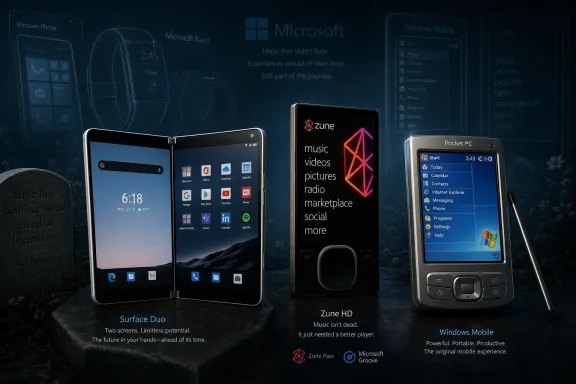 Microsoft’s Real Problem Wasn’t Imagination
The old caricature says Microsoft is a fast follower: a company that waits for others to invent categories, then arrives with distribution muscle and enterprise lock-in. That is true often enough to be useful. It is not true enough to explain Zune HD, Surface Duo, Courier, Kinect, or Pocket PC.Microsoft has repeatedly shown it can imagine plausible alternate futures. Sometimes those futures are productivity-centric, sometimes entertainment-led, sometimes developer-driven, and sometimes frankly weird. The company’s problem has less often been the blank page than the second, third, and fourth chapters.
That distinction matters because abandoned Microsoft hardware tends to look better in hindsight than it did at launch. Surface Duo was clumsy as a phone, but its core proposition — two app spaces, hinged like a notebook, optimized for cross-app work — still feels more intellectually serious than many foldables that merely chase tablet screen area. Zune HD was doomed commercially, but its interface language and subscription model aged beautifully. Pocket PC was awkward and stylus-bound, but it anticipated a world in which the phone became a pocket computer, dashboard, media library, messaging terminal, and work device.
The tragedy is that Microsoft often reached the right neighborhood by the wrong road. Instead of turning early insight into durable platform advantage, it shipped products that needed more ecosystem support, more pricing discipline, more developer confidence, or simply more time than Microsoft was willing to spend. Then, when the market eventually validated part of the idea, someone else owned the category.
Surface Duo Was a Notebook Disguised as a Phone
Surface Duo may be the cleanest example of Microsoft building something fascinating and asking consumers to forgive too much. Released in September 2020 at a starting price of $1,399, the original Duo arrived as a dual-screen Android device with two 5.6-inch displays joined by a 360-degree hinge. It was a Surface in spirit: thin, precise, productivity-minded, and slightly allergic to normal consumer behavior.The device’s best moments were genuinely distinctive. Reading on it could feel like holding a tiny book. Running Outlook beside Teams, or OneNote beside a browser, made more sense than constantly app-switching on a slab phone. The hinge allowed postures that ordinary phones could not match, and Microsoft’s app-pair concept turned multitasking into a first-class gesture rather than a hack.
But the Duo was also a phone that seemed embarrassed to be a phone. It had no outside display, so every quick glance demanded opening the device. Its camera compromises were difficult to defend at flagship pricing. Its software arrived rough, and rough software on an experimental form factor is not a cosmetic problem; it is the difference between “new interaction model” and “why did my $1,400 device just hesitate?”
Microsoft tried again with Surface Duo 2 in October 2021, and the sequel fixed several obvious problems. It added 5G, a proper rear camera system, better displays, a faster Snapdragon chip, NFC, and a slightly more phone-like posture toward modern expectations. It also started at roughly $1,499, which meant Microsoft had improved the product while preserving the category’s biggest barrier: asking buyers to pay ultra-premium money for a device whose future depended almost entirely on Microsoft’s continued commitment.
That commitment did not last. The original Surface Duo reached the end of its support window in September 2023, and Surface Duo 2 followed in October 2024. In mobile, where security updates are not optional and platform trust is part of the purchase, that ending matters. Microsoft did not merely stop making a quirky device; it reminded customers why many were nervous about buying one in the first place.
The Foldable Market Validated the Question, Not Microsoft’s Answer
The awkward thing about Surface Duo is that its premise did not become absurd. Foldables kept improving. Samsung’s Galaxy Z Fold line made the large-screen phone more mainstream, Google entered the category, and other manufacturers experimented with thinner bodies, better hinges, and more usable outer displays. The market did not reject the idea that phones needed more screen space. It rejected Microsoft’s specific implementation and the compromises attached to it.Duo’s dual-screen approach had advantages over a single folding display. It avoided the fragility and crease anxiety of early foldable panels. It created a natural separation between tasks. It made the device feel like a pocket Moleskine for people who thought in documents, messages, notes, and browser tabs.
But consumers do not buy philosophical clarity. They buy daily convenience. A foldable with a cover display can behave like a normal phone until the user wants more room. Surface Duo demanded that users accept its difference constantly. That was a heavy ask in a market where the phone is the most frequently handled device a person owns.
There is a lesson here for Windows users and IT buyers: form factor innovation is not enough when the software model and support story are uncertain. Surface Duo’s hardware invited enterprise imagination — field notes, line-of-business apps, dual-pane workflows, mobile Microsoft 365 — but its short support life made it difficult to recommend as anything more than a niche pilot. The device felt like a prototype Microsoft decided to sell at flagship prices.
The most generous interpretation is that Duo was a research project that escaped into retail. The harsher one is that Microsoft wanted credit for rethinking mobile without paying the full platform cost of competing in mobile. Either way, the result was familiar: a good idea became someone else’s opportunity.
Zune HD Was Microsoft’s Best Argument Against Its Own Reputation
If Surface Duo was too strange for its price, Zune HD was too late for its market. Released in 2009, the Zune HD was elegant, compact, and visually confident in a way that still surprises people who remember Microsoft as the company of beige corporate defaults. It had a sharp OLED display, Wi-Fi, HD radio, and a user interface that treated typography as architecture rather than decoration.The Zune HD mattered because it previewed the design language that would later become Metro. Before Windows Phone’s live tiles became a cult favorite and then a commercial dead end, Zune showed that Microsoft could make software feel modern without copying Apple. Its interface was fluid, text-forward, and dramatically less cluttered than the Windows aesthetic of the period.
The device also sat beside the Zune Pass, one of the more underappreciated consumer-service ideas Microsoft ever shipped. Long before streaming subscriptions became the default mode of music consumption, Microsoft was selling a monthly music plan that pointed away from album-by-album ownership and toward access. The details changed over time, but the basic instinct was correct: the future of music was not a hard drive full of purchased files.
That is why Zune HD inspires such peculiar nostalgia. People do not merely remember it as a failed iPod competitor. They remember it as evidence that Microsoft briefly saw a consumer future more clearly than the market gave it credit for. It was not enough.
Apple had already turned the iPod into a cultural object, and the iPhone had begun absorbing the standalone music player’s reason to exist. By the time Microsoft had its most polished Zune hardware, the category was already moving into the phone. Microsoft’s answer, eventually, was to fold Zune ideas into Windows Phone — another elegant product that arrived late to a market hardening around iOS and Android.
Zune Lost Because the Device Was No Longer the Center
Zune HD’s failure was not primarily a hardware failure. The hardware was good. The interface was arguably great. The service model was forward-looking. The problem was that the center of gravity had moved.The iPod succeeded because it was more than a player. It was iTunes, retail presence, accessories, cultural cachet, and a simple mental model: buy music, sync music, carry music. By 2009, the iPhone was turning that stack into something broader. Music was becoming one app among many on a device people already carried everywhere.
Microsoft was trying to win a device war just as the device war was being absorbed into a platform war. That is a subtle but fatal timing error. The Zune HD could beat an iPod nano on interface charm and still lose because the real fight was no longer about dedicated media players.
This is where Microsoft’s consumer weakness showed. The company could build good software and good hardware, but it struggled to create the social inevitability that Apple seemed to generate almost casually. Owning a Zune was, for many buyers, an argument. Owning an iPod was simply what people did.
Yet Zune’s afterlife is everywhere in Microsoft’s design history. Metro shaped Windows Phone, influenced Windows 8, and left traces in Xbox and later Microsoft interfaces. The subscription logic that looked odd in the Zune era became normal in Spotify, Apple Music, YouTube Music, and the broader service economy. Zune failed as a business, but it was not a dumb product. It was a smart product trapped in the wrong strategic moment.
Pocket PC Saw the Smartphone Coming and Brought the Desktop With It
Pocket PC and Windows Mobile occupy a stranger place in Microsoft history because they were not one product so much as an ecosystem of devices, partners, and compromises. Long before the modern smartphone settled into the black-rectangle template, Microsoft’s mobile software powered PDAs, phone-PDA hybrids, rugged handhelds, sliding-keyboard devices, and tiny machines that looked like cyberpunk office equipment.The hardware variety was intoxicating. HTC, HP, Samsung, Dell, and others built devices with styluses, resistive touchscreens, directional pads, tilting displays, slide-out keyboards, and miniature productivity dreams. The best of them looked like props from a future in which everyone carried a little workstation.
The software was the problem. Microsoft’s instinct was to shrink Windows rather than rethink computing for fingers, motion, sensors, and intermittent attention. Start menus, tiny controls, nested settings, desktop metaphors, and stylus dependence made sense to users who already thought like Windows power users. They made less sense to normal people who wanted a phone to feel immediate.
This is the critical distinction between being early and being right. Pocket PC was early to the pocket-computer idea, but Apple and Google were closer to right about the operating model that would make pocket computers mass-market devices. The iPhone did not win because it was more like a PC. It won because it made the phone feel like its own category of computer.
Microsoft eventually tried to correct course with Windows Phone 7 in 2010, making a clean break from Windows Mobile. That break produced one of the most distinctive mobile interfaces ever shipped by a major platform vendor. It also stranded old assumptions, old apps, and old developers. By the time Microsoft had stopped shrinking Windows and started designing for mobile on mobile’s terms, iOS and Android had already built the gravitational field.
The Stylus Wasn’t the Sin; the Mental Model Was
It is tempting to summarize Pocket PC’s failure as “Microsoft used a stylus and Apple used fingers.” That is too simple. The stylus was not inherently doomed; Samsung’s Galaxy Note line later proved that pen input could become a mainstream differentiator when paired with a touch-first operating system. The real issue was that Pocket PC treated the stylus as a workaround for interface density rather than as a tool for expression.Windows Mobile devices often felt like tiny PCs because Microsoft believed continuity with Windows was an advantage. For enterprise users, it sometimes was. Line-of-business apps, field-service workflows, inventory systems, and corporate email deployments gave Windows Mobile a serious foothold in places where consumer polish mattered less than manageability and software availability.
But consumer technology rarely stays contained. Once employees began bringing iPhones and Android phones into work, IT departments had to respond to devices that users actually wanted. The old enterprise-first model weakened. Microsoft, which had spent years assuming mobile productivity would extend from Windows outward, found itself competing against platforms that extended from consumer desire inward.
That inversion shaped the next decade. The phone became the authentication device, camera, scanner, chat terminal, navigation tool, hotspot, payment card, and endpoint security concern. Microsoft remained powerful in productivity and cloud services, but it lost the operating system layer on the device that increasingly mediated daily life.
For WindowsForum readers, that loss still matters. It is why Microsoft Authenticator, Outlook, OneDrive, Teams, Edge, Intune, and Microsoft 365 must live as guests on Android and iOS. It is why Windows integration with phones has become a bridge rather than a homecoming. Pocket PC’s failure did not just kill a product line; it helped determine where Microsoft would and would not control the modern endpoint.
Courier, Band, and Kinect Prove the Pattern Was Bigger Than Mobile
The three products highlighted by MakeUseOf are only part of the story. Microsoft Courier, killed before release, imagined a dual-screen digital journal with pen and touch input years before foldables became a premium hardware category. It remains one of the great “what if” devices in Microsoft lore because it seemed to understand creativity, reading, clipping, and note-taking as a tactile workflow rather than a file-management problem.Microsoft Band was another fascinating misfire. It packed health and environmental sensors into a wearable before the category fully settled around watches, rings, and fitness bands. It was not beautiful, and comfort mattered more than Microsoft seemed to appreciate, but the ambition was real. The company saw the wrist as a data platform before it found a reason consumers would tolerate the object.
Kinect may be the most commercially successful of the abandoned-cool lineage, at least initially. As an Xbox accessory, it turned bodies into controllers and made computer vision feel accessible in the living room. For a moment, it looked like Microsoft had opened a new human-computer interface.
Then the story bent in the usual direction. Kinect became bundled ambition, then Xbox One baggage, then a developer and research curiosity, then a discontinued consumer product whose underlying ideas lived on in machine vision, depth sensing, robotics, and mixed reality work. It was both overhyped and genuinely important, which is a very Microsoft combination.
The broader pattern is not that Microsoft cannot innovate. The pattern is that Microsoft often struggles to decide whether an innovation is a product, a platform, a feature, a research project, or a strategic hedge. When that decision wobbles, customers notice. Developers notice faster.
The Ecosystem Is Where Cool Ideas Go to Be Judged
A cool Microsoft product rarely fails alone. It fails inside an ecosystem that is too small, too late, too expensive, too confusing, or too uncertain. That is the common thread connecting Surface Duo, Zune HD, and Pocket PC.Surface Duo needed Android app developers to care about dual screens, Microsoft to polish the device relentlessly, carriers and retailers to explain it, and buyers to trust that version three and four would arrive. Zune HD needed Microsoft to beat not merely Apple’s hardware, but Apple’s music stack and cultural position, just as phones were absorbing media players. Pocket PC needed the Windows familiarity advantage to outweigh the usability penalty of carrying desktop assumptions into a pocket.
In each case, the idea was easier than the system. This is why Apple’s most successful products can look obvious in retrospect. The iPod was not the first MP3 player. The iPhone was not the first smartphone. The Apple Watch was not the first wearable. The difference was that Apple often waited until it could align hardware, software, services, retail, developer incentives, and marketing into one coherent push.
Microsoft, by contrast, has often exposed the seams. It ships a brilliant interface without the app ecosystem. It ships a strange device without the support horizon. It ships a platform reset that burns compatibility. It ships a service that anticipates the future but lacks the consumer magnetism to define it.
This is not only a consumer problem. Enterprise buyers are conservative for rational reasons. A sysadmin can forgive an odd form factor if the roadmap is credible, the management story is strong, and the support window is long. But Microsoft’s history with pocketable hardware made every new experiment carry the burden of old exits.
That burden is self-reinforcing. Customers hesitate because they fear abandonment. Sales disappoint because customers hesitate. Microsoft sees disappointing sales and abandons the product. The next experiment begins with even less trust.
Windows Users Still Live With the Consequences
The death of Microsoft’s mobile ambitions is not ancient history for Windows users. It shaped the modern PC. Windows today is a desktop operating system increasingly surrounded by mobile-first behaviors it does not own: messaging, app notifications, biometric identity, location context, camera workflows, and app-store habits forged elsewhere.Phone Link is useful, and Microsoft has done meaningful work connecting Windows PCs to Android devices. But it is a bridge across someone else’s river. The deepest integration belongs to Apple’s iPhone-Mac ecosystem on one side and Google’s Android-ChromeOS services on another. Microsoft can integrate, but it must negotiate.
That makes the abandoned products more than nostalgia. Surface Duo was a possible answer to the question of what a Microsoft-native mobile productivity device might look like in the Android era. Windows Phone was a possible answer before that. Pocket PC was the primitive ancestor. Each exit narrowed the company’s control over the personal device stack.
The irony is that Microsoft adapted brilliantly at the services layer. Under Satya Nadella, the company stopped treating Windows as the center of every universe and pushed Office, Teams, OneDrive, Edge, Xbox services, and Azure identity across platforms. That strategy worked commercially. It may have saved Microsoft from fighting a lost mobile OS war indefinitely.
But adaptation is not the same as victory. Microsoft became indispensable on devices it does not define. For IT pros, that means the Microsoft estate is now inherently cross-platform, whether management teams like it or not. The endpoint is Windows plus Android plus iOS plus browser plus cloud identity, and the clean old dream of a Microsoft-controlled client stack is gone.
Abandonment Has a Cost Beyond the Balance Sheet
Companies should kill products. Not every experiment deserves indefinite funding, and technology history is littered with zombie platforms that consumed resources long after their strategic purpose expired. The issue with Microsoft is not that it kills things. The issue is that it often asks users, developers, and partners to invest emotionally and operationally before it has earned enough trust.That matters because platform trust is cumulative. A person who bought a Zune learned something. A developer who built for Windows Phone learned something. A company that piloted Surface Duo learned something. Even when the lesson is not “never trust Microsoft,” it may become “wait for version three,” “avoid niche Surface hardware,” or “do not build around a Microsoft consumer platform until adoption is undeniable.”
This is particularly damaging in categories that require ecosystem courage. Developers support new platforms when they believe users will arrive. Users buy new platforms when they believe apps and support will arrive. Hardware partners commit when they believe the platform owner will keep pushing through the awkward middle years. Abandonment breaks that loop.
Microsoft is not alone here. Google has its own famous product graveyard. Amazon, Meta, Samsung, and others have abandoned ambitious hardware and services. But Microsoft’s case is distinctive because it combines deep enterprise credibility with oddly fragile consumer trust. The company that can support Windows compatibility across geological time can also leave a $1,500 mobile device feeling like an orphan within a few years.
That contrast is jarring. Windows succeeds partly because Microsoft understands backward compatibility as a covenant. Many of its coolest abandoned products failed because customers never felt a similar covenant existed.
The Three Ghosts Microsoft Still Hasn’t Fully Buried
The most concrete lesson from Surface Duo, Zune HD, and Pocket PC is not that Microsoft should stop experimenting. It is that experiments become products only when the company commits to the unglamorous years after launch. The first version proves imagination. The next versions prove seriousness.- Surface Duo showed that dual-screen mobile productivity could be compelling, but Microsoft priced and supported it like a premium category winner before it had earned that position.
- Zune HD showed that Microsoft could build beautiful consumer hardware and anticipate subscription music, but it arrived after the dedicated media player had already begun losing strategic importance.
- Pocket PC showed that Microsoft understood phones would become computers, but it carried too much desktop Windows thinking into a device class that needed a new interaction model.
- Courier, Band, and Kinect suggest the pattern extended beyond phones and music players into journals, wearables, gaming, sensors, and human-computer interaction.
- The practical risk for buyers is not merely that a Microsoft experiment might fail, but that its failure can arrive before the ecosystem has time to mature.
References
- Primary source: MakeUseOf
Published: Sun, 28 Jun 2026 17:00:18 GMT
Loading…
www.makeuseof.com - Official source: learn.microsoft.com
Loading…
learn.microsoft.com - Related coverage: techspot.com
Loading…
www.techspot.com - Related coverage: techcrunch.com
Loading…
techcrunch.com - Related coverage: windowscentral.com
Loading…
www.windowscentral.com - Related coverage: cbsnews.com
Loading…
www.cbsnews.com
- Related coverage: axios.com
Microsoft officially surrenders on Windows Phone
A top executive says the company plans to fix bugs and security issues, but doesn't plan new features for the phone version of Windows 10.www.axios.com
- Official source: news.microsoft.com
Loading…
news.microsoft.com - Related coverage: tomsguide.com
Loading…
www.tomsguide.com - Related coverage: phys.org
Loading…
phys.org - Official source: support.microsoft.com
Loading…
support.microsoft.com - Related coverage: howtogeek.com
Loading…
www.howtogeek.com - Related coverage: tomshardware.com
Loading…
www.tomshardware.com - Related coverage: unbxtech.com
Loading…
www.unbxtech.com - Official source: microsoft.fandom.com
Loading…
microsoft.fandom.com - Related coverage: phonearena.com
Loading…
www.phonearena.com