
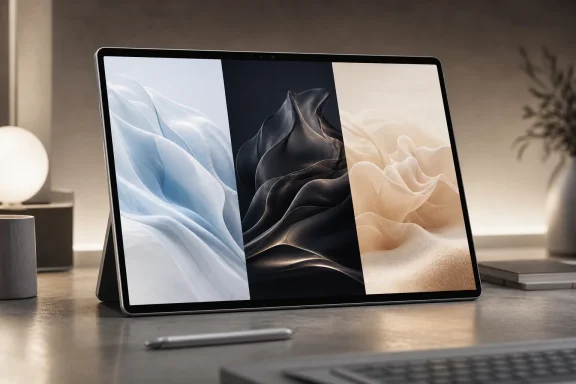
Microsoft’s 2026 Surface Pro wallpaper bundle arrived alongside the new 13-inch Surface Pro with Snapdragon X2 processors, offering three full-resolution 2880 × 1920 abstract backgrounds color-matched to Platinum, Black, and Dune hardware finishes. That sounds like a small accessory story, but it is really a Surface story in miniature. Microsoft is once again selling the idea that hardware, Windows, AI silicon, and visual identity should feel like one continuous product. The wallpapers are free decoration; the message behind them is not.
The article being summarized is straightforward on its face: Microsoft has new Surface devices, and those devices come with new wallpapers. The Surface Pro 2026 wallpaper set reportedly includes three abstract, fluid, material-style images designed to echo the colors of the device lineup. The files are described as full-resolution images at 2880 × 1920, a familiar 3:2 Surface-friendly canvas.
That resolution matters because Surface Pro is not a conventional laptop panel squeezed into a tablet shell. Microsoft has spent years making the 3:2 display feel like part of the Surface identity: taller than 16:9, better for documents, and closer to a digital sheet of paper. A wallpaper made for that shape is not just decorative; it reinforces the product’s proportions every time the lock screen lights up.
The article also frames the wallpapers as descendants of the Windows 11 Bloom aesthetic. That comparison is apt. Microsoft’s post-Windows 10 design language has leaned heavily on soft folds, translucent gradients, and abstract shapes that imply depth without becoming literal objects. These Surface Pro wallpapers appear to continue that tradition: less “photo background,” more ambient brand texture.
That detail is the article’s most important context, even though the headline is about wallpapers. Surface wallpapers are rarely isolated from the hardware generation they ship with. They become visual shorthand for a particular moment in the product line: Surface Pro X had its thin Arm-first mystique, Surface Pro 8 marked the modernized chassis era, and the Copilot+ generation used imagery to soften the transition to AI-branded PCs.
Here, the wallpaper bundle is attached to Microsoft’s continuing Arm bet. The Surface Pro has been the company’s most visible Windows-on-Arm showcase, and Snapdragon X2 keeps that strategy moving. The wallpapers may be abstract, but the launch they accompany is concrete: Microsoft wants users to associate the new Surface generation with premium materials, AI acceleration, and a more mature Arm-based Windows experience.
Surface began as a productivity provocation: a kickstand, a detachable keyboard, a tablet that insisted it was also a PC. Over time, it became more fashion-conscious. Alcantara covers, muted metal finishes, and color-matched accessories turned Surface from a reference device into something closer to a lifestyle object for Windows users.
That evolution explains why the wallpapers matter. Apple has long understood that default wallpapers help define the emotional temperature of a device. Microsoft has been slower, and sometimes less consistent, but Surface is where it tries hardest. A Dune Surface with a Dune-tuned abstract wallpaper is not merely a computer displaying an image; it is a retail-table composition extended into software.
Microsoft’s Surface Pro line has already been moving toward premium display positioning, and the 2880 × 1920 wallpaper resolution matches the high-density 13-inch Surface panel class. In practical terms, that means these wallpapers should look sharp on the Surface Pro itself and remain usable on many other PCs, tablets, and external displays. On smartphones, as the source article notes, the 3:2 aspect ratio means cropping is unavoidable.
That cropping caveat is worth spelling out. A 2880 × 1920 image is wide by phone standards and tall by laptop standards, depending on how it is rotated or framed. Users applying these wallpapers to iPhones or Android phones will likely need to choose which part of the abstract composition they want visible. The wallpapers may be “full resolution,” but they are not universally native to every screen.
The article says the Surface Pro can be configured with up to 64GB of RAM and 1TB of storage. That upper memory ceiling matters for the kind of buyer Microsoft is chasing at the premium end: developers, creators, analysts, and professionals who want tablet flexibility without giving up workstation-adjacent headroom. It also supports the broader Copilot+ PC narrative, where local AI features and heavier multitasking need more memory than budget Windows devices typically provide.
Still, the wallpaper framing softens the harder question underneath. Surface Pro remains a premium device in a Windows market full of cheaper, faster-refreshing, and more repair-friendly alternatives. Microsoft’s challenge is not simply to ship better silicon or prettier default art. It has to persuade buyers that the whole package feels coherent enough to justify the Surface tax.
But this habit also shows how hardware launches now spill beyond hardware owners. The wallpaper becomes shareable marketing. It travels through blogs, Telegram channels, Reddit posts, wallpaper apps, and cloud drives. People who never touch the new Surface Pro still see its colors, its visual motifs, and its implied premium identity.
That is why Microsoft keeps making these images carefully. A default wallpaper is one of the few marketing assets users voluntarily install on competing machines. In an age when paid ads are blocked, ignored, or resented, a good wallpaper is brand propagation by consent.
The article points readers to app-based downloads for iPhone and Android as well as a Google Drive option. That is a typical distribution pattern for wallpaper blogs, though it requires the usual caution. Users should make sure they are downloading image files rather than installers, archives, or suspicious redirects. Wallpaper downloads are generally harmless, but the web around them is not always as clean as the images themselves.
For Windows users, the workflow is simple: download the image, open Settings, go to Personalization, and set it as the desktop or lock screen background. For mobile users, the image can be selected from the gallery or downloads folder, then assigned to the home screen, lock screen, or both. The only real adjustment is cropping.
That restraint is useful. The best default wallpapers do not fight the icons, widgets, or taskbar. They create atmosphere without becoming the center of attention. If the 2026 Surface Pro wallpapers follow the Bloom-like language described in the article, they are designed to sit behind the work rather than compete with it.
There is a larger Windows design lesson here. Microsoft has struggled at times to make Windows feel visually unified across legacy control panels, modern Settings pages, web-powered widgets, and AI overlays. Surface wallpapers are one of the few places where the company can present a clean, controlled aesthetic. They show the version of Windows Microsoft wants users to feel, even when the operating system itself still contains older seams.
The catch is that Windows on Arm still lives or dies by compatibility, performance consistency, and user trust. Wallpapers can help establish a launch mood, but they cannot solve app friction. IT administrators and power users will judge the new Surface Pro by driver support, management behavior, VPN compatibility, security tooling, and how well emulated apps perform under real workloads.
For consumers, the calculus is simpler but still demanding. If the device is expensive, it has to feel fast, polished, and effortless. The wallpaper may set the stage, but the first week of use determines whether the Surface Pro feels like the future of Windows or merely another attractive premium machine with compromises.
 Microsoft’s Smallest Surface Launch Asset Carries the Biggest Branding Job
The article being summarized is straightforward on its face: Microsoft has new Surface devices, and those devices come with new wallpapers. The Surface Pro 2026 wallpaper set reportedly includes three abstract, fluid, material-style images designed to echo the colors of the device lineup. The files are described as full-resolution images at 2880 × 1920, a familiar 3:2 Surface-friendly canvas.That resolution matters because Surface Pro is not a conventional laptop panel squeezed into a tablet shell. Microsoft has spent years making the 3:2 display feel like part of the Surface identity: taller than 16:9, better for documents, and closer to a digital sheet of paper. A wallpaper made for that shape is not just decorative; it reinforces the product’s proportions every time the lock screen lights up.
The article also frames the wallpapers as descendants of the Windows 11 Bloom aesthetic. That comparison is apt. Microsoft’s post-Windows 10 design language has leaned heavily on soft folds, translucent gradients, and abstract shapes that imply depth without becoming literal objects. These Surface Pro wallpapers appear to continue that tradition: less “photo background,” more ambient brand texture.
The Wallpaper Story Is Really a Snapdragon X2 Story
Before introducing the downloads, the article walks through the 2026 Surface Pro’s hardware highlights. The new model is described as a 13-inch Surface Pro powered by Qualcomm’s Snapdragon X2 platform, with Snapdragon X2 Plus and Snapdragon X2 Elite configurations. The Plus chip is presented as a 10-core option, while the Elite variant is described as a 12-core part.That detail is the article’s most important context, even though the headline is about wallpapers. Surface wallpapers are rarely isolated from the hardware generation they ship with. They become visual shorthand for a particular moment in the product line: Surface Pro X had its thin Arm-first mystique, Surface Pro 8 marked the modernized chassis era, and the Copilot+ generation used imagery to soften the transition to AI-branded PCs.
Here, the wallpaper bundle is attached to Microsoft’s continuing Arm bet. The Surface Pro has been the company’s most visible Windows-on-Arm showcase, and Snapdragon X2 keeps that strategy moving. The wallpapers may be abstract, but the launch they accompany is concrete: Microsoft wants users to associate the new Surface generation with premium materials, AI acceleration, and a more mature Arm-based Windows experience.
Color-Matched Hardware Is Microsoft’s Quiet Admission That Surface Is Fashion Too
The article says Microsoft is offering the new Surface Pro in Platinum, Black, and Dune. The wallpapers reportedly follow the same color logic, with each variant designed to complement a particular finish. This is a small point, but it says a lot about where Surface sits in Microsoft’s hardware imagination.Surface began as a productivity provocation: a kickstand, a detachable keyboard, a tablet that insisted it was also a PC. Over time, it became more fashion-conscious. Alcantara covers, muted metal finishes, and color-matched accessories turned Surface from a reference device into something closer to a lifestyle object for Windows users.
That evolution explains why the wallpapers matter. Apple has long understood that default wallpapers help define the emotional temperature of a device. Microsoft has been slower, and sometimes less consistent, but Surface is where it tries hardest. A Dune Surface with a Dune-tuned abstract wallpaper is not merely a computer displaying an image; it is a retail-table composition extended into software.
The Display Spec Makes the Wallpaper Pitch More Plausible
The article notes that the 13-inch Surface Pro can be configured with an optional OLED display. That is relevant because abstract wallpapers live or die by contrast, color separation, and smooth gradients. A wallpaper that looks merely pleasant on an average LCD can become much more striking on OLED, where blacks deepen and saturated tones carry more punch.Microsoft’s Surface Pro line has already been moving toward premium display positioning, and the 2880 × 1920 wallpaper resolution matches the high-density 13-inch Surface panel class. In practical terms, that means these wallpapers should look sharp on the Surface Pro itself and remain usable on many other PCs, tablets, and external displays. On smartphones, as the source article notes, the 3:2 aspect ratio means cropping is unavoidable.
That cropping caveat is worth spelling out. A 2880 × 1920 image is wide by phone standards and tall by laptop standards, depending on how it is rotated or framed. Users applying these wallpapers to iPhones or Android phones will likely need to choose which part of the abstract composition they want visible. The wallpapers may be “full resolution,” but they are not universally native to every screen.
Microsoft’s Camera and Memory Claims Sit Behind the Aesthetic
The article also highlights a 1440p Quad HD front camera with an ultrawide field of view and a 10MP rear camera. Those specs fit Microsoft’s Surface pitch in the post-pandemic PC market, where video calls remain a core productivity use case. A good front camera is no longer a nice flourish on a premium Windows device; it is part of the baseline expectation.The article says the Surface Pro can be configured with up to 64GB of RAM and 1TB of storage. That upper memory ceiling matters for the kind of buyer Microsoft is chasing at the premium end: developers, creators, analysts, and professionals who want tablet flexibility without giving up workstation-adjacent headroom. It also supports the broader Copilot+ PC narrative, where local AI features and heavier multitasking need more memory than budget Windows devices typically provide.
Still, the wallpaper framing softens the harder question underneath. Surface Pro remains a premium device in a Windows market full of cheaper, faster-refreshing, and more repair-friendly alternatives. Microsoft’s challenge is not simply to ship better silicon or prettier default art. It has to persuade buyers that the whole package feels coherent enough to justify the Surface tax.
Wallpaper Downloads Are the Harmless End of a Bigger Ecosystem Habit
There is nothing wrong with downloading official device wallpapers. Enthusiasts have done it for decades, treating default backgrounds as tiny collectibles from hardware they may never buy. A Surface wallpaper on a non-Surface device is a low-stakes way to borrow a little of Microsoft’s industrial design language.But this habit also shows how hardware launches now spill beyond hardware owners. The wallpaper becomes shareable marketing. It travels through blogs, Telegram channels, Reddit posts, wallpaper apps, and cloud drives. People who never touch the new Surface Pro still see its colors, its visual motifs, and its implied premium identity.
That is why Microsoft keeps making these images carefully. A default wallpaper is one of the few marketing assets users voluntarily install on competing machines. In an age when paid ads are blocked, ignored, or resented, a good wallpaper is brand propagation by consent.
The Download Link Is the Least Interesting Part of the Story
The source article’s practical advice is simple: use the provided download links rather than saving the preview images. That warning is important because preview images on wallpaper sites are usually compressed, resized, or watermarked for layout. Anyone who wants the original 2880 × 1920 files should avoid grabbing the inline previews.The article points readers to app-based downloads for iPhone and Android as well as a Google Drive option. That is a typical distribution pattern for wallpaper blogs, though it requires the usual caution. Users should make sure they are downloading image files rather than installers, archives, or suspicious redirects. Wallpaper downloads are generally harmless, but the web around them is not always as clean as the images themselves.
For Windows users, the workflow is simple: download the image, open Settings, go to Personalization, and set it as the desktop or lock screen background. For mobile users, the image can be selected from the gallery or downloads folder, then assigned to the home screen, lock screen, or both. The only real adjustment is cropping.
The Surface Pro 2026 Image Set Shows Microsoft Still Believes in Device Mood
This wallpaper set is not revolutionary, and it does not pretend to be. The images are abstract, polished, and predictable in the way modern first-party wallpapers often are. But predictability is part of the point: Microsoft wants Surface to feel calm, premium, and unmistakably Windows without returning to the loud glassiness of older Windows eras.That restraint is useful. The best default wallpapers do not fight the icons, widgets, or taskbar. They create atmosphere without becoming the center of attention. If the 2026 Surface Pro wallpapers follow the Bloom-like language described in the article, they are designed to sit behind the work rather than compete with it.
There is a larger Windows design lesson here. Microsoft has struggled at times to make Windows feel visually unified across legacy control panels, modern Settings pages, web-powered widgets, and AI overlays. Surface wallpapers are one of the few places where the company can present a clean, controlled aesthetic. They show the version of Windows Microsoft wants users to feel, even when the operating system itself still contains older seams.
The Surface Pro Remains Microsoft’s Favorite Argument for Windows on Arm
The 2026 Surface Pro’s Snapdragon X2 positioning is the hardware backdrop for this small wallpaper release. Microsoft is no longer merely experimenting with Arm-based Windows PCs; it is trying to normalize them at the high end. Surface Pro is the device where that argument is easiest to understand: thin, mobile, battery-conscious, camera-forward, and increasingly AI-branded.The catch is that Windows on Arm still lives or dies by compatibility, performance consistency, and user trust. Wallpapers can help establish a launch mood, but they cannot solve app friction. IT administrators and power users will judge the new Surface Pro by driver support, management behavior, VPN compatibility, security tooling, and how well emulated apps perform under real workloads.
For consumers, the calculus is simpler but still demanding. If the device is expensive, it has to feel fast, polished, and effortless. The wallpaper may set the stage, but the first week of use determines whether the Surface Pro feels like the future of Windows or merely another attractive premium machine with compromises.
The Three Wallpapers Tell Buyers Which Surface Microsoft Wants Them to See
The most concrete facts in the article are easy to separate from the launch gloss. The wallpapers are presented as full-resolution Surface Pro 2026 backgrounds, and the new Surface Pro is framed as a Snapdragon X2-powered 13-inch device with premium display and memory options. The broader meaning is that Microsoft is trying to bind the visual identity of Surface more tightly to the hardware generation.- The Surface Pro 2026 wallpaper set reportedly includes three abstract designs matched to the Platinum, Black, and Dune color options.
- The wallpapers are described as 2880 × 1920 images, making them a natural fit for Surface-style 3:2 displays.
- The new Surface Pro is presented with Snapdragon X2 Plus and Snapdragon X2 Elite chip options.
- The 13-inch model can reportedly be configured with an optional OLED display, up to 64GB of RAM, and up to 1TB of storage.
- Users should download the full files rather than saving preview images, because previews are not original quality.
- Smartphone users can apply the wallpapers, but they should expect cropping because the images were not primarily shaped for phone screens.
References
- Primary source: YTECHB
Published: 2026-06-18T07:25:06.905388
Loading…
www.ytechb.com - Related coverage: techradar.com
Microsoft reveals new Surface Pro and Surface Laptop with big graphics upgrades from Snapdragon X2 CPUs — but they're seriously pricey | TechRadar
Around an up to 50% boost in graphics performancewww.techradar.com - Related coverage: windowscentral.com
Surface will have Snapdragon X2 in business and consumer models — so what are the differences? | Windows Central
Surface for Business PCs will be available with Snapdragon X2 chips starting next month. Here's what separates those systems from their consumer-focused counterparts.www.windowscentral.com - Official source: learn.microsoft.com
Tech specs—Surface Pro for Business, Copilot+ PC, Snapdragon X Series processor, 11th Edition - Surface
See technical specifications for Surface Pro 11th Edition with Snapdragon processors, including display, battery life, and ports.learn.microsoft.com - Related coverage: phonearena.com
Loading…
www.phonearena.com - Official source: microsoft.com
Loading…
www.microsoft.com
- Related coverage: tomshardware.com
Microsoft debuts Surface Pro and Surface Laptop with new jade green color and Qualcomm Snapdragon X2 chips — refreshed devices start at $1,499 with 16GB of RAM | Tom's Hardware
The Laptop features Microsoft's new haptic touchpad.www.tomshardware.com - Official source: blogs.windows.com
Introducing the next Surface Pro and Surface Laptop, built for performance and flexibility
For more than 13 years, Surface has been shaped by the people who use it. Architects sketch buildings, developers train models, students build startups and field engineers solve problems that rarely make headlines. We didn't intend to design for onblogs.windows.com - Related coverage: notebookcheck.net
New Microsoft Surface Pro 12 detailed with Snapdragon X2, 32 GB RAM and over 10% longer battery life than older model - Notebookcheck News
The launch of new consumer Surface PCs is on the horizon. According to a reliable leaker, the Surface Pro 12 is arriving globally in June 2026. Not only that, but the leak has described multiple upgrades from the existing Surface Pro 11. www.notebookcheck.net
- Official source: news.microsoft.com
Loading…
news.microsoft.com - Related coverage: na.ingrammicro.com