

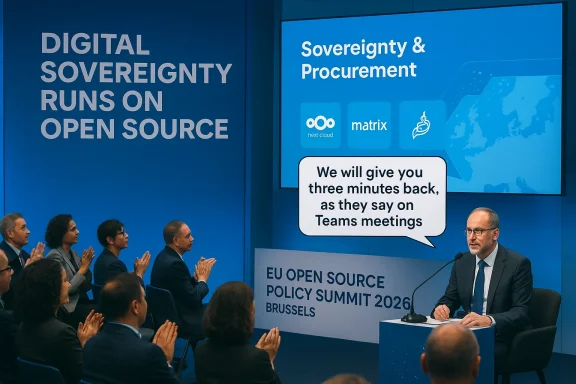
The moment a SUSE executive closed a Brussels policy panel with the throwaway line “We’ll give you three minutes back, as they say on Teams meetings” did more than draw a chuckle — it punctured a central narrative of Europe’s Open Source Policy Summit and raised hard questions about who actually runs on open source.
The EU Open Source Policy Summit 2026 convened policymakers, foundation leaders and industry executives under the banner “Digital Sovereignty Runs on Open Source.” The programme included a late-afternoon panel titled Sovereignty & Procurement, a conversation squarely about how procurement policy can shape markets and reduce strategic dependency. SUSE was one of the event’s gold sponsors and Dominic Laurie, identified on the summit programme as Senior Director of Corporate Communications, SUSE, sat on that panel. (summit.openforumeurope.org)
When the panel wrapped early, Laurie’s casual “as they say on Teams meetings” drew an audible reaction from other panellists — notably Polish MEP Michał Kobosko, who quipped that the line “was a bit of a giveaway.” The moment was captured in reporting by The Register, which framed the slip as emblematic of a broader tension: that leading FOSS vendors often pay for — and rely on — proprietary collaboration and email platforms.
Why is this relevant? Because when a vendor proactively migrates its own operations into its product ecosystem, it accrues skills, surface-area knowledge and priorities that are hard to replicate through marketing alone. That matters whether the vendor is Microsoft, Apple, or an open-source company: internal use sharpens product quality and operational competence. If a FOSS vendor does not use open-source alternatives for mainstream functions such as collaboration, identity, or mail, it forfeits that reinforcement loop.
Tactical (quick wins, 3–9 months):
When an influencer or vendor slips on-stage and reveals internal reliance on a foreign proprietary collaboration stack, it becomes a teaching moment: procurement policy must include operational congruence — a requirement that advocates and suppliers align their own procurement practices with the standards they ask of buyers. Otherwise policy becomes a one-way demand rather than a mutual marketplace realignment. (summit.openforumeurope.org)
Policymakers and procurement officers should demand evidence, not slogans. Vendors should treat their internal stacks as strategic assets that validate their claims. And the open-source community should view this as an operational challenge, not a moral failing: the tools and people exist to reduce dependence on proprietary collaboration platforms, but turning that potential into practice requires sustained investment and leadership.
If open source is to be the foundation of digital sovereignty, the companies that make their living from it need to run on it — not just preach it. The summit’s theme was right; the next step is for the ecosystem to prove it.
Source: theregister.com SUSE exec blurts that the company uses Teams
 Background: the summit, the line, and why it landed like a stone
The EU Open Source Policy Summit 2026 convened policymakers, foundation leaders and industry executives under the banner “Digital Sovereignty Runs on Open Source.” The programme included a late-afternoon panel titled Sovereignty & Procurement, a conversation squarely about how procurement policy can shape markets and reduce strategic dependency. SUSE was one of the event’s gold sponsors and Dominic Laurie, identified on the summit programme as Senior Director of Corporate Communications, SUSE, sat on that panel. (summit.openforumeurope.org)When the panel wrapped early, Laurie’s casual “as they say on Teams meetings” drew an audible reaction from other panellists — notably Polish MEP Michał Kobosko, who quipped that the line “was a bit of a giveaway.” The moment was captured in reporting by The Register, which framed the slip as emblematic of a broader tension: that leading FOSS vendors often pay for — and rely on — proprietary collaboration and email platforms.
Overview: what was revealed, and what we can actually verify
- What we can verify:
- Dominic Laurie spoke on the “Sovereignty & Procurement” panel and is listed on the official summit programme as a SUSE communications executive. (summit.openforumeurope.org)
- SUSE was a gold-level sponsor of the summit; the organiser’s materials and social posts list SUSE alongside Red Hat and other major organisations. (summit.openforumeurope.org)
- The Register reported the Teams remark and the panel reaction as described above.
- What remains observational and not fully proved by public record:
- Whether SUSE (or any other vendor mentioned) uses Microsoft Teams or Microsoft 365 as their corporate collaboration platform at scale. The on-stage remark and subsequent reports are strong signals, but public confirmation from the vendor would be required to treat this as a formal company-wide claim. The Register asked SUSE, Red Hat and Canonical for comment; no substantive public denials or confirmations were published at the time of writing.
Why the gaffe matters: procurement, trust and strategic signalling
At its heart the incident is about credibility. When a vendor sells the idea that digital sovereignty depends on open source, but its own internal operations appear to rely on a multinational proprietary platform, several practical and reputational problems arise:- Strategic inconsistency. Procurement guidance aimed at public bodies and enterprises becomes harder to sell if the vendor championing that advice simultaneously depends on rival cloud providers and closed-source collaboration services. The optics feed narratives about open washing — the claim that an organisation advocates openness while relying on proprietary suppliers. (summit.openforumeurope.org)
- Vendor lock-in hypocrisy. Advising clients to prefer open stacks while subscribing to services from a dominant proprietary vendor weakens arguments about avoiding lock-in and preserving local control. That tension is especially sensitive in European policy circles focused on supply-chain resilience and strategic autonomy. (summit.openforumeurope.org)
- Procurement credibility. Public sector procurement officers often face political pressure to show impartiality, value for money, and reduced geopolitical exposure. If a supplier’s own procurement choices favour distant public-cloud ecosystems or closed collaboration suites, those officers may reasonably ask whether the supplier has resolved the same trade-offs it asks its customers to accept. (summit.openforumeurope.org)
Dogfooding, and why it is a practical lever — not just marketing
“Dogfooding” — the practice of using your own products internally — is widely viewed by product-focused companies as a way to uncover real-world gaps, stress-test features, and improve developer empathy. Microsoft’s own history is illustrative: internal migrations have shaped product roadmaps and hardened infrastructure. The LinkedIn engineering team’s public account of migrating most of LinkedIn’s fleet to Azure Linux is a modern example of a big vendor undertaking internal migration to reshape its stack. Microsoft’s Hotmail-to-Windows transition in the late 1990s and early 2000s is another historical case often cited as formative for Windows Server development.Why is this relevant? Because when a vendor proactively migrates its own operations into its product ecosystem, it accrues skills, surface-area knowledge and priorities that are hard to replicate through marketing alone. That matters whether the vendor is Microsoft, Apple, or an open-source company: internal use sharpens product quality and operational competence. If a FOSS vendor does not use open-source alternatives for mainstream functions such as collaboration, identity, or mail, it forfeits that reinforcement loop.
The practical trade-offs for FOSS vendors
Running a company on entirely FOSS tooling is desirable from a principled and strategic perspective, but it is not costless. The trade-offs vendors face typically include:- Integration and usability: mainstream employees and partners expect polished user experiences in email, chat, calendars and videoconferencing. Some open-source stacks have matured dramatically, but integration and endpoint usability remain non-trivial projects.
- Support and operational burden: turnkey proprietary SaaS often shifts operational risk to the vendor; operating a comparable in-house FOSS groupware stack requires staff time and engineering investment.
- Feature parity and ecosystem lock-in: some closed platforms combine features (search, AI, integrated identity, third-party marketplace) in ways that are convenient for knowledge workers or customers.
Alternatives exist — and they are maturing
One reason the gaffe landed hard is that the open-source ecosystem now contains credible alternatives for core collaboration functions. European and global projects — both standalone and integrated stacks — provide a pathway away from closed suites. Examples of categories and representative projects:- Email and calendaring:
- SoGo, Kolab, Zimbra, Open-Xchange, Citadel (and vendor-hosted derivatives). These projects offer mature mail+calendaring stacks that can be run on-premises or in a regional cloud.
- File sync and docs:
- Nextcloud, ownCloud, Collabora/LibreOffice integrations for collaborative editing.
- Chat and conferencing:
- Matrix (Element), Jitsi, BigBlueButton and other tools increasingly integrate with identity systems and SSO.
- Integrated “open M365” initiatives:
- European-led projects (openDesk-style efforts) aim to orchestrate multiple OSS components into a cohesive suite that mimics the combined feature surface of large SaaS providers. The openDesk concept, and similar public procurement pilots, are proof that integrators can deliver usable alternatives.
Security, privacy and regulation — the sovereignty dimension
Procurement decisions are not just about features or price; they are about risk. When public bodies consider vendor selection, they evaluate:- Data residency and lawful access
- Supply-chain integrity
- Dependency and resilience (can a service be turned off or cut off?)
- Compliance with procurement and security frameworks
Strengths, risks, and reputational effects for FOSS vendors
Strengths of the current ecosystem:- Open-source companies drive innovation, standards and ecosystems that governments want to tap into; their technical credibility remains high.
- The vendor community is broad and increasingly capable of assembling production-grade stacks for email, chat, docs and collaboration — particularly in Europe where digital-sovereignty initiatives are politicised and well funded.
- Perceived hypocrisy: public contradictions between marketing and practice invite media scrutiny and political pushback.
- Competitive leakage: using competitor SaaS providers funnels operational spend and user habits to companies that may, in turn, capture market share or lock data into their ecosystems.
- Policy friction: vendors who do not align their own procurement with their policy advocacy may lose leverage when pushing for public-sector adoption.
Practical recommendations: what open-source vendors should do next
A constructive agenda for any FOSS vendor that wants to retain policy credibility and practical resilience should include both tactical and strategic measures.Tactical (quick wins, 3–9 months):
- Run an internal audit of externally hosted collaboration tools and identify high-value migration candidates.
- Pilot a regional FOSS collaboration stack for a single large department (e.g., engineering or R&D) to demonstrate feasibility.
- Publish a short-term transparency note: explain current choices, timelines for change, and measurable goals (e.g., “We will migrate 40% of internal collaboration to FOSS solutions within 12 months”).
- Allocate dedicated product/engineering resources to create polished integrations between mail, chat, docs and identity — aim for one internal stack that is demonstrably production-grade.
- Engage with regional open-source integration consortia and procurement pilots to create credible reference deployments for governments.
- Use procurement budgets to buy FOSS integration work from regional vendors and contribute back operational code — converting vendor spend into public-good improvements.
- They convert rhetorical advocacy into operational credibility.
- They keep spend within the open-source ecosystem, strengthening suppliers who build the alternatives.
- They create reference implementations that ease procurement risk for public bodies.
A checklist for procurement officers and buyers
When evaluating vendor claims about “running on open source” or advocating open procurement, ask for:- A plain-English document listing the organization’s primary collaboration, identity and mail services, and whether they are proprietary SaaS, hosted open source, or in-house FOSS. (Transparency is the point.)
- Evidence of internal pilot projects or migrations (logs, technical case studies, anonymised metrics).
- Roadmaps and timelines for any public-facing promises about digital sovereignty alignment.
- A security and patching plan for any self-hosted FOSS components (turnaround time for critical fixes, SLA commitments, and responsible-disclosure reporting).
What this means for Europe’s digital-sovereignty agenda
The Open Source Policy Summit’s framing — that digital sovereignty runs on open source — is strategically sound: open development patterns, transparency and collaborative maintenance reduce hidden dependencies and foster local capability. But policy success depends on credibility and alignment between what advocates say and what they do.When an influencer or vendor slips on-stage and reveals internal reliance on a foreign proprietary collaboration stack, it becomes a teaching moment: procurement policy must include operational congruence — a requirement that advocates and suppliers align their own procurement practices with the standards they ask of buyers. Otherwise policy becomes a one-way demand rather than a mutual marketplace realignment. (summit.openforumeurope.org)
Conclusion: hypocrisy or realism — and how to close the gap
The SUSE “Teams” moment is both a human slip and a signal of a broader, solvable problem. Large open-source vendors have valid operational reasons to pick convenience where it exists; they also have strong incentives to lead by example. The pathway forward is clear: convert rhetoric into demonstrable practice by investing in migration, integration and support for open alternatives — and be transparent about the trade-offs along the way.Policymakers and procurement officers should demand evidence, not slogans. Vendors should treat their internal stacks as strategic assets that validate their claims. And the open-source community should view this as an operational challenge, not a moral failing: the tools and people exist to reduce dependence on proprietary collaboration platforms, but turning that potential into practice requires sustained investment and leadership.
If open source is to be the foundation of digital sovereignty, the companies that make their living from it need to run on it — not just preach it. The summit’s theme was right; the next step is for the ecosystem to prove it.
Source: theregister.com SUSE exec blurts that the company uses Teams
