
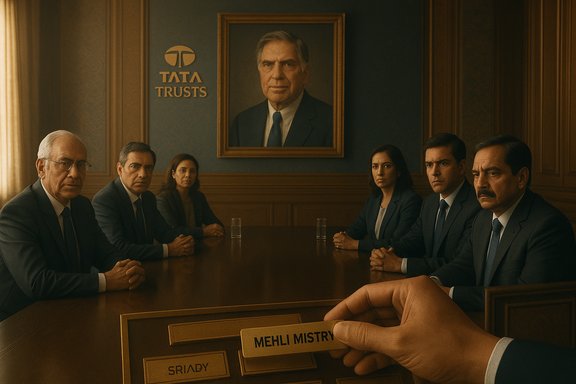
The removal of Mehli Mistry from the executive ranks of the Tata Trusts has opened a rare, public fissure inside one of India’s most respected corporate-philanthropic ecosystems — and Ratan Tata’s half‑sisters say the move puts the group’s founding values “under threat.”
Background
The Tata Trusts occupy an outsized role in the governance of the Tata Group: together they own a controlling stake in Tata Sons, the holding company that sits above household names such as Tata Motors, Tata Steel and Tata Consultancy Services. That structure makes trustee appointments not merely a philanthropic matter but a strategic lever for the governance and future trajectory of a global conglomerate valued at roughly $180 billion. Ratan Tata, the group’s long‑time custodian and moral touchstone, named a small group of close confidants and family members as executors and guardians of his philanthropic legacy. Those appointments and Ratan Tata’s insistence on professional merit within the Trusts have been invoked repeatedly in recent statements by his half‑sisters, Shireen and Deanna Jejeebhoy. Their comments — made to reporters and summarized in a leading business daily — are the first public, family-sourced denunciations since the trustees’ vote that ended Mehli Mistry’s trusteeship. Conversations about these developments have not been confined to mainstream outlets; they have also been widely tracked in industry forums and topical feeds that record the steady stream of Tata‑related governance headlines in late 2025.What happened: the removal of Mehli Mistry
The vote and the immediate facts
Late October reporting shows that the terms of Mehli Mistry — a long‑time confidant of Ratan Tata and an executor-designated trustee — were not renewed by a majority of trustees on the boards of the Sir Dorabji Tata Trust (SDTT) and the Sir Ratan Tata Trust (SRTT). According to reporting, Noel Tata, Venu Srinivasan and trustee Vijay Singh did not support extending Mistry’s tenure, and a majority vote across both trusts effectively ended his time as a trustee. Multiple outlets captured the same basic sequence: a non‑renewal, a majority backing for the decision and clear signs of factional alignment among trustees. The specific boards at the time of the vote included the following membership lists that have been reported in press coverage:- Sir Dorabji Tata Trust (SDTT): Noel Tata, Venu Srinivasan, Vijay Singh, Mehli Mistry, Pramit Jhaveri, Darius Khambata.
- Sir Ratan Tata Trust (SRTT): Noel Tata, Venu Srinivasan, Vijay Singh, Jimmy Tata, Jehangir HC Jehangir, Mehli Mistry, Darius Khambata.
What the sisters said
Shireen and Deanna Jejeebhoy spoke publicly with a business daily and expressed deep worry about the direction of the Trusts. Their key points included:- Concern that the Trusts’ governance and the legacy entrusted to them by Ratan Tata are now in flux following the removal of someone close to their brother.
- An assertion that Mehli Mistry was trusted by Ratan Tata and that he could openly disagree with Ratan while remaining devoted to the Trusts’ governance principles.
- Emphasis on Ratan Tata’s preference for meritocracy rather than family exclusivity in Trust leadership — a principle they argued is now threatened by factional maneuvering.
Why this matters: governance, control and precedent
The Trusts’ dual role — philanthropy and corporate influence
The Tata Trusts operate at the intersection of philanthropy and corporate control. A controlling share in Tata Sons gives the Trusts practical influence over board composition and long‑term strategy across major commercial businesses. That coupling is what elevates trustee appointments into high‑stakes decisions: trustee votes can translate into corporate board seats and strategic outcomes for group companies. The decision to remove or retain a trustee therefore has implications for corporate governance far beyond grantmaking.The breaking of unanimity, and why that’s significant
Historically, the Trusts have often approached sensitive appointments with an emphasis on consensus. Several reports note that the majority vote against Mistry’s reappointment represented a departure from unanimity; that procedural change amplifies the political aspect of trustee management and signals that formal voting majorities — not only informal consensus — can now determine outcomes. When a long‑standing norm of unanimity gives way to majority votes, the Trusts’ internal dynamics and the predictability of trustee tenure can change quickly.A longer institutional memory: echoes of earlier conflicts
Observers have drawn parallels to previous high‑profile Tata disputes — most notably the 2016–2018 Cyrus Mistry episode — as reminders that governance fractures inside a large conglomerate can become protracted, public, and disruptive. The circumstances are not identical, but the larger lesson is familiar: when governance mechanisms fail to contain factionalism, both reputational and operational consequences follow. Recent press coverage has explicitly flagged the possibility of a protracted governance contest if the parties do not close ranks.Detailed analysis: what the move likely reveals
1) Consolidation of influence around specific trustees
The non‑renewal of Mistry’s term appears to consolidate influence around a smaller circle of trustees who prefer to set the Trusts’ course without the dissenting voice Mistry represented. That consolidation could produce:- Faster decision‑making when the aligned trustees agree on a direction.
- Less internal debate and thus a higher risk of groupthink or narrower strategic horizons.
- A clearer linkage between the Trusts’ choices and Noel Tata’s emerging leadership role.
2) A clash of governance philosophies: family ties vs meritocratic stewardship
Shireen and Deanna’s public remarks underline an ideological divide: whether the Trusts should prioritize merit and external trustees — the model Ratan Tata championed, according to his sisters — or whether family and aligned trustees should keep tighter control to preserve perceived continuity. Each approach has trade‑offs:- Meritocratic trusteeship brings external expertise and independent oversight, but can complicate internal consensus.
- Family/aligned trustee models can simplify alignment with historic values but risk insulating decision‑making and sidelining independent voices.
3) Reputational risk and the philanthropic brand
The Tata Trusts’ philanthropic brand enjoys high public trust; a widely publicized internal fight threatens that reputation. Donors, public stakeholders, regulators and beneficiaries watch how governance issues are handled. If public perceptions shift to view the Trusts as internally fractious or politicized, the Trusts could face:- Scrutiny from regulators and public officials asking for greater transparency.
- Pressure from civil society and partners for clearer, independent governance mechanisms.
- Erosion of moral authority when the Trusts comment on social causes.
What’s verifiable, and what remains uncertain
The following points are supported by multiple independent outlets:- Mehli Mistry’s term as a trustee was not renewed and he exited the executive trustee role after a majority vote.
- Several trustees — Noel Tata, Venu Srinivasan and Vijay Singh — declined to approve an extension to Mistry’s term.
- The Jejeebhoy sisters publicly expressed distress and concern for the Trusts’ future, and described Ratan Tata’s preference for merit-based trustee appointments.
- Motive: The sisters described the removal as retaliatory; that is a family interpretation and is not independently verified. Reporting identifies factional differences and strategic disagreements, but attributing a singular motive to the vote requires internal documentary evidence that has not been made public. Treat motive statements as allegation / interpretation, not settled fact.
- Private deliberations and vote breakdowns: Press accounts cite “a majority” but do not publish detailed voting records or trustee minutes. The Trusts are private charitable entities; complete public disclosure of internal minutes is not required under current law, so reconstructing the full deliberative record is difficult without access to internal documents.
Potential scenarios and likely near‑term outcomes
- Reconciliation and transparency push
- The Trusts and key family figures may work to contain fallout by issuing joint statements, instituting governance reviews, or publishing clearer trustee appointment criteria. This path preserves reputation and reduces legal or regulatory friction.
- Consolidation with reduced public debate
- The aligned trustees continue to set the Trusts’ course with less visible dissent. Faster decisions follow, but long‑term questions about pluralism and independence remain unresolved.
- Protracted governance contest
- If dissenting trustees or external stakeholders press for changes, the issue could become protracted, potentially involving legal actions, regulatory queries, or political interest. That would mirror past Tata governance battles in public intensity.
- External oversight or regulatory inquiry
- Given the Tata Group’s systemic importance to the Indian economy and the public interest in how philanthropic control translates into corporate governance, a formal or informal request for disclosure or independent review cannot be ruled out. Reuters’ reporting indicates previous government interest in resolving Trust disputes — a sign that authorities are attentive to the risks of prolonged internal conflict.
What the Trusts, corporate boards and stakeholders should consider now
- Reiterate and document governance principles. The Trusts should publish a clear statement of trustee appointment criteria and term protocols to reduce ambiguity and reassure stakeholders about alignment with Ratan Tata’s stated preference for meritocracy.
- Increase transparency where possible. Even absent legal obligations to reveal minutes, the Trusts can publish high‑level rationales for major governance decisions and create an external advisory panel to review sensitive appointment processes.
- Institutionalize dispute resolution. A formal internal mechanism for resolving trustee disagreements — third‑party mediation or a standing subcommittee — would reduce the chance that personnel disputes spill into public controversy.
- Protect philanthropic continuity. The Trusts should emphasize continuity of program funding and long‑term grant commitments; beneficiaries should not be collateral damage in governance disputes.
- Engage neutral auditors or governance experts. Independent reviews of governance practices — made public in summary form — can restore confidence when internal trust erodes. These steps align with best practices for major philanthropic institutions that hold systemic corporate influence.
What the family’s public intervention means
The Jejeebhoy sisters’ decision to speak publicly is itself a historic and meaningful act: it brings private family views into the public record and signals that internal disagreements have crossed a threshold where silence is no longer acceptable to some custodians of Ratan Tata’s legacy. Their framing — emphasizing Ratan’s preference for meritocracy and the worry that values are under threat — will shape public interpretation, media coverage and stakeholder expectations in the near term.Broader lessons for conglomerate-linked philanthropies
- When philanthropic entities hold controlling stakes in commercial groups, trustee selection is governance critical, not procedural. Decisions reverberate across boards, investors and the public.
- Norms matter. Long‑standing informal practices — such as unanimity or deference to named executors — become governance anchors; when those norms shift, institutions must actively manage the transition.
- Public trust is fragile. Philanthropy rests on moral credibility. Visible factional fights can erode that credibility faster than balance sheets or program metrics can restore it.
- Family voices remain powerful. Even in professionally run institutions, family members who are public about their concerns change the political economy of trustee governance.
Conclusion
Mehli Mistry’s removal from the Tata Trusts is more than a personnel change. It is a flashpoint that reveals competing philosophies about stewardship, the mechanics of power inside a conglomerate‑backed philanthropic system, and the consequences when long‑held norms give way to formal majorities. The Jejeebhoy sisters have placed the debate plainly: they view the action as a threat to the values Ratan Tata stood for — particularly meritocracy and the independence of trusteeship. Those who manage, support and rely on the Trusts now face a choice: repair public trust through clearer, more transparent governance; consolidate quietly and risk reputational erosion; or see the dispute become a drawn‑out contest with wider economic and social implications. Independent reporting and the Trusts’ own responses in the coming weeks will determine whether this episode becomes a contained governance correction or a protracted institutional crisis.Source: Storyboard18 Ratan Tata’s sisters question removal of Mehli Mistry, say Tata Group values ‘under threat’
