

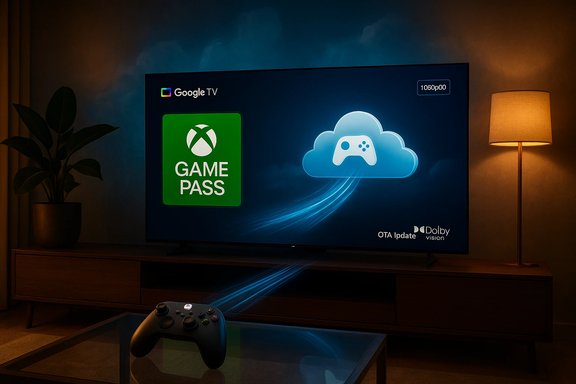
TCL’s CES-era reveal that the Xbox app will arrive on its new X11L Google TV line later this year marks the clearest signal yet that Google TV is finally being folded into Xbox Game Pass’s living-room playbook — an over‑the‑air update for TCL’s flagship models will convert those sets into console‑free gaming screens and closes a conspicuous gap between Google’s platform and rival TV ecosystems already hosting Microsoft’s streaming app.
Microsoft’s Xbox Cloud Gaming layer, surfaced inside the Xbox app, streams gameplay from Azure-hosted Xbox hardware to client devices so players can run modern titles without a local console or PC. That streaming surface is a central component of Xbox Game Pass’s “console‑free” proposition: pair a controller, sign in, and a wide swath of the Game Pass library is playable in minutes. Microsoft now advertises broad TV support — Samsung, LG and Amazon Fire TV are already on board — and is actively expanding the TV footprint as part of a deliberate “Xbox everywhere” strategy. For Google TV, the TCL announcement represents the first confirmed OEM pathway that will ship the Xbox app on a Google TV device via an OTA update. TCL’s own product materials name the TCL X11L SQD‑Mini LED series and explicitly list the “Xbox Game Pass App for Gaming Without a Console (OTA)” among the X11L’s features; the company frames cloud gaming as part of a premium TV hardware and services bundle. This move matters because TV apps are the low‑friction funnel for Game Pass subscribers who don’t own an Xbox console: the living room screen is where many households prefer to play, and a preinstalled or OTA‑delivered Xbox TV app eliminates hardware cost and setup complexity for new users. Recent industry coverage and internal reporting show Microsoft continues to treat TV integrations as a growth lever for Game Pass and cloud gaming.
Source: findarticles.com Xbox Game Pass Comes to Google TV This Year
 Background / Overview
Microsoft’s Xbox Cloud Gaming layer, surfaced inside the Xbox app, streams gameplay from Azure-hosted Xbox hardware to client devices so players can run modern titles without a local console or PC. That streaming surface is a central component of Xbox Game Pass’s “console‑free” proposition: pair a controller, sign in, and a wide swath of the Game Pass library is playable in minutes. Microsoft now advertises broad TV support — Samsung, LG and Amazon Fire TV are already on board — and is actively expanding the TV footprint as part of a deliberate “Xbox everywhere” strategy. For Google TV, the TCL announcement represents the first confirmed OEM pathway that will ship the Xbox app on a Google TV device via an OTA update. TCL’s own product materials name the TCL X11L SQD‑Mini LED series and explicitly list the “Xbox Game Pass App for Gaming Without a Console (OTA)” among the X11L’s features; the company frames cloud gaming as part of a premium TV hardware and services bundle. This move matters because TV apps are the low‑friction funnel for Game Pass subscribers who don’t own an Xbox console: the living room screen is where many households prefer to play, and a preinstalled or OTA‑delivered Xbox TV app eliminates hardware cost and setup complexity for new users. Recent industry coverage and internal reporting show Microsoft continues to treat TV integrations as a growth lever for Game Pass and cloud gaming. What TCL announced (and what it actually means)
X11L’s hardware and the Xbox app promise
TCL’s CES 2026 press release and showroom materials position the X11L as a top‑end flagship: a new SQD‑Mini LED panel, up to 20,000 dimming zones, extremely high peak brightness figures, Dolby Vision 2 support via future OTA, and Google TV with Gemini integration. Crucially for gamers, TCL listed the Xbox Game Pass App (OTA) among the X11L feature set — a direct OEM claim that the Xbox TV experience will be delivered to X11L owners by software update. Pricing and pre‑order SKUs were published alongside the launch. That phrasing matters: TCL is the launch partner for Google TV in this case, and the rollout is an OEM‑level decision (an OTA update to TCL hardware), not a Google‑wide platform push yet. TCL’s announcement does not by itself guarantee Xbox app availability on every Google TV product or on Chromecast with Google TV — those platform‑level moves will require additional certification, app store listings, and testing. The TCL reveal is a clear first step, not a universal platform rollout.Why TCL built this into a flagship story
TCL’s marketing aligns the Xbox app with high refresh rates, HDMI 2.1 ports and low‑latency gaming modes in the X11L line. For premium display products, OEMs increasingly see cloud‑gaming apps as a value add that justifies higher price tiers and keeps buyers inside the vendor’s software ecosystem — a common strategy among TV makers today. That’s why manufacturers are courting services like Game Pass as much as they are promoting panel specs.What the Xbox app brings to Google TV owners
Core functionality and requirements
When available, the Xbox app turns a supported Google TV device into a console‑free access point for Xbox Cloud Gaming. The basic requirements for cloud play are:- An active Xbox Game Pass membership that includes cloud access (most commonly Game Pass Ultimate for the broadest features).
- A Microsoft account and sign‑in to the Xbox app.
- A compatible Bluetooth or USB controller.
- A stable, low‑latency network connection; Microsoft recommends at least 20 Mbps for smooth play on TV and suggests wired Ethernet or a fast 5 GHz / Wi‑Fi 6 connection where possible.
Controller and input support
Xbox’s TV integrations generally support the Xbox Wireless Controller and a range of mainstream Bluetooth controllers (DualSense, DualShock 4 and other third‑party pads), but compatibility depends on the TV’s Bluetooth stack and certification. Expect the familiar mix: standard Bluetooth controllers work in many cases, while Xbox Wireless (proprietary RF) support depends on OEM hardware. For the best experience, use a controller explicitly called out by Microsoft in the Xbox app’s compatibility documentation.How this changes the Google TV landscape
Closing the ecosystem gap
Before TCL’s announcement, Google TV lagged behind Samsung’s Gaming Hub and LG’s webOS rollouts: Microsoft’s Xbox app has been available on Samsung since 2022 and has been actively rolling out to LG and Amazon Fire TV devices in 2024–2025. TCL’s X11L gives Google TV its first explicit OEM‑backed path to host the Xbox TV app via an OTA update, narrowing the device gap between Google’s platform and its competitors. Industry trackers rank Android TV / Google TV among the top smart TV platforms by shipments, which means that extending Game Pass to that user base could materially grow cloud‑gaming reach — if and when broader Google TV support follows TCL’s lead. OEM initiatives like TCL’s are commonly the wedge that brings platform‑wide app support later, but platform‑level adoption still requires Google and other OEMs to embrace the app in their stores or agree to system updates.What remains uncertain
TCL’s press materials only name the X11L series specifically. Google has not issued a platform‑wide announcement and Microsoft has not confirmed a blanket Google TV rollout. That leaves several open questions:- Will the Xbox app arrive on Chromecast with Google TV and lower‑cost Google TV sticks?
- Will older Google TV‑branded sets (including some Sony Bravia models that use Google TV) be eligible, or will certification be limited to new flagship hardware?
- How will regional licensing and app‑store policies affect availability and timing?
Performance, limits and practical expectations
Resolution, frame‑rate and data usage
- Baseline TV targets are typically 1080p at 60 fps for many stock Xbox TV apps; the service adapts quality dynamically to available bandwidth and device capabilities. Microsoft recommends around 20 Mbps as a realistic minimum for stable 1080p streaming on TVs; higher tiers and experimental modes may use bitrates that peak well above that.
- Data consumption is non‑trivial: expect several gigabytes per hour at 1080p60 and significantly more at higher resolution/bitrate profiles. Users on metered or capped ISP plans should monitor usage and budget accordingly. Independent testing and cloud‑gaming guides typically cite figures in the range of ~5–10 GB/hr at 1080p depending on codec and bitrate.
Latency and game type suitability
Cloud streaming solves many friction points, but latency still matters. For fast‑twitch competitive shooters or fighting games, even well‑tuned streaming can introduce perceptible input lag compared with a local console or PC. For slower genres (turn‑based, strategy, many RPGs and platformers), cloud play is usually indistinguishable from native performance for most players. Expect the usual tradeoffs: convenience and instant access versus the absolute lowest input latency.Capacity, regional rollouts and catalog gates
Microsoft’s rollouts for TV apps and higher‑quality streaming modes are staged: device certification, publisher technical validation (especially around anti‑cheat and cloud‑safe builds), and rights/licensing checks all affect what appears on any given TV app at launch. Not all Game Pass titles will be immediately eligible for high‑quality cloud profiles; some publishers require additional work for their games to be offered as cloud streams. Expect staggered regional rollouts and per‑title variability.How to get your Google TV ready for Game Pass (practical checklist)
If you plan to use Game Pass via Google TV once the Xbox app lands on your set, prepare now to minimize friction:- Upgrade your network first: prefer wired Ethernet to the TV where possible; if you must use Wi‑Fi, use 5 GHz or Wi‑Fi 6 and place the TV near the router.
- Reserve bandwidth: close background downloads and pause other streaming on the same network while playing.
- Use a modern controller: an Xbox Wireless Controller or a broadly supported Bluetooth pad will minimize pairing issues.
- Confirm subscription: verify your Game Pass tier includes cloud access (check Xbox app account settings).
- Test performance via xbox.com/play in a browser before relying on the TV app (browser access is often the easiest diagnostic tool).
- Use Ethernet when possible or set your Wi‑Fi router to a dedicated 5 GHz SSID for gaming devices.
- Enable QoS or traffic shaping to prioritize gaming traffic if your router supports it.
- If you have many devices in the household, budget 30–50% above the minimum recommended bandwidth to account for real‑world contention.
Risks and caveats for consumers and the industry
For consumers
- The Game Pass model is access‑not‑ownership: titles can rotate out of the library or have limited cloud availability due to licensing. Long single‑player campaigns may be interrupted by catalog removals unless you buy the title outright.
- Performance depends on both Microsoft’s cloud edges and your ISP routing/last‑mile quality. Even users with high nominal speeds can see poor results if peering, jitter, or Wi‑Fi quality is weak.
- Device support matters: not all Bluetooth controllers or lower‑cost Google TV sticks will behave identically; expect a certification list and supported controller matrix to appear when the app goes live.
For the industry
- TV OEMs are using services like Game Pass as differentiation — that can drive premium TV sales, but it also ties TV value propositions to recurring subscription ecosystems rather than hardware specs alone. That’s a structural shift in how TVs are marketed and monetized.
- Microsoft benefits from TV integration as a growth channel for Game Pass subscriptions. OEM partnerships can accelerate user acquisition, but they also expose streaming to the vagaries of regional app stores, certification timelines, and device fragmentation.
Verification, numbers and what remains unverifiable
- Microsoft’s last publicly confirmed Game Pass subscriber figure remains 34 million (announced February 2024); the company’s FY‑2025 reporting emphasized revenue and usage metrics without issuing a newer subscriber total. Treat the 34 million figure as the latest official number but potentially outdated; Microsoft has not published a more recent headcount at the time of publishing.
- TCL’s own press materials explicitly list the Xbox Game Pass App (OTA) as an X11L feature and confirm Google TV integration for the series; that OEM‑level commitment is verifiable today via TCL’s press release and PR distribution. However, platform‑wide Google TV availability (Chromecast with Google TV, Sony Bravia models, other OEM sticks) was not announced and remains unverified. Buyers should expect a phased rollout and watch for platform announcements from Google, Microsoft and other OEMs.
- Technical ceilings (1080p60 baseline, 1440p premium modes) are Microsoft’s published guidelines for TV apps and higher‑tier streams, but real‑world performance will vary by geography, server capacity and title. Claims that 4K streaming will be available broadly on TVs remain aspirational and were not part of the confirmed baseline for TV app rollouts at the time of writing.
What to watch next
- Official platform announcements from Google and Microsoft confirming whether the Xbox TV app will be made available across Chromecast with Google TV and other Google TV devices beyond TCL’s X11L series.
- TCL’s OTA schedule and region list: which X11L SKUs and markets receive the Xbox app and when.
- Microsoft’s published controller compatibility matrix for Google TV devices and any adjustments to recommended network speed or codec profiles.
- User reports and early reviews that measure latency, visual fidelity and input responsiveness on the X11L hardware (and other Google TV devices, should they receive the app).
- Any telco or ISP peering announcements that would place Microsoft edge capacity closer to major metro markets, which materially improves cloud play quality.
Conclusion
TCL’s commitment to deliver the Xbox app to the X11L series via an over‑the‑air update is a significant, verifiable first step that brings Google TV into the more complete cross‑platform world of Xbox Game Pass TV integrations. For players, that can mean instant, console‑free access to hundreds of titles on a living‑room screen — provided the network, controller and regional availability line up. For Google TV, TCL’s move reduces a key platform deficit versus Samsung, LG and Fire TV ecosystems and may be the catalyst for broader Google TV adoption of Xbox Cloud Gaming — but platform‑level availability, device compatibility and the practical performance experience will determine whether this becomes a routine way millions play or a premium perk limited to a handful of high‑end sets. Keep an eye on official announcements from Microsoft, Google and TCL for rollout dates and compatibility lists; when the Xbox app moves beyond TCL’s X11L, the living room will be one step closer to a truly console‑free mainstream gaming era.Source: findarticles.com Xbox Game Pass Comes to Google TV This Year
