

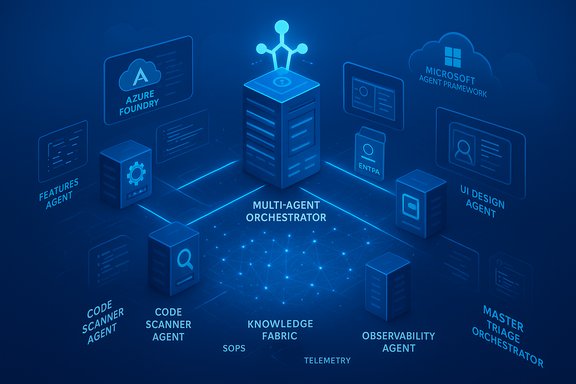
Tata Consultancy Services (TCS) has unveiled a pair of agentic AI solutions built for Microsoft Azure — TCS Agentic SDLC on Microsoft Azure and TCS Autonomous Operations on Microsoft Azure — plus a Microsoft-integrated managed detection and response offering, TCS MXDR Services with Microsoft, all positioned as enterprise-grade ways to accelerate cloud-native development, modernize applications, and bring autonomy to IT operations while keeping governance and existing toolchains intact. These offerings lean heavily on Microsoft’s evolving agent stack — Azure AI Foundry, the Microsoft Agent Framework (and its predecessors Semantic Kernel and AutoGen), GitHub Copilot integration, and Entra-based agent identity — and are being promoted by TCS as pragmatic, enterprise-focused extensions that aim to reduce rework, speed developer productivity, and lower incident resolution time while augmenting existing AIOps investments rather than replacing them.
Background
Why "agentic" AI matters for enterprise Azure customers
Agentic AI — multi-agent systems where agents are given specific tools, stateful memory, and the ability to call services or execute orchestrated flows — has moved from research prototypes into production-ready platforms. Microsoft’s Foundry (Azure AI Foundry / Foundry Agent Service) and the newly introduced Microsoft Agent Framework consolidate the tooling that lets enterprises design, host, secure, and observe multi-agent solutions at scale. These platform advances include agent identity, observability, tool integration (Model Context Protocol), and a richer runtime for multi-agent orchestration that bridges research frameworks with enterprise needs. Microsoft’s Foundry emphasizes governance, Entra-integrated agent identities, and one-click deployment surfaces for Teams and Microsoft 365, aiming to make agentic applications enterprise-friendly. TCS has taken this platform evolution as the foundation for packaged solutions that combine domain knowledge, curated agent recipes, and integration patterns for large-scale Azure customers. The vendor argument is straightforward: enterprises need purpose-built, governed agents that understand corporate patterns, SOPs, code standards, and runbooks — not generic agents that improve an individual developer’s prompt-to-code loop but create divergence from an organization’s architecture and security posture. TCS positions its solutions to enforce enterprise standards through agent-led scaffolding, code generation, impact analysis, and operational playbooks.What TCS announced
TCS Agentic SDLC on Microsoft Azure — productized agentic development
TCS Agentic SDLC is presented as a multi-agent suite for application modernization and cloud-native development, integrating GitHub Copilot-style developer productivity features with enterprise governance, pattern enforcement, and documentation automation. The solution claims to use an enterprise’s design patterns, coding standards, and archetype templates to produce code that conforms to corporate rules from the outset — reducing downstream rework and accelerating time-to-production. TCS describes the bundle as including specialty agents such as Features Agent, UI Design Agent, UI Build Agent, Documentation Agent, Solution Agent, Code Scanner Agent, and Impact Analysis Agent. The stated intent is to raise the baseline of delivered artifacts so they require less manual realignment to enterprise standards. Key vendor claims include:- Agents that automate legacy code documentation, impact analysis, and modernization for predefined archetypes.
- Built-in adherence to enterprise coding standards and design patterns.
- Productivity improvements by minimizing rework and standardizing output (TCS has publicly cited large percentage reductions in rework and incremental productivity gains when describing the approach).
TCS Autonomous Operations on Microsoft Azure — agentic AIOps
TCS Autonomous Operations aims to inject agentic AI into platform and application operations. The offering integrates with existing ITSM systems, observability stacks, and runbooks to triage alerts, propose or execute remediation steps, and maintain a “knowledge fabric” that combines SOPs, incident logs, code context, telemetry, and runbook artifacts. TCS says the solution uses prebuilt agents — including Observability Agent, Issue Analysis Agent, Master Triage Orchestrator Agent, File Surfer Agent, Coder Agent, and ITSM Agent — and offers a framework to create custom agents and curated recipes for proactive remediation. The company positions this as an augmentation layer over existing AIOps and automation tools, not a rip-and-replace. Vendor-stated operational impacts include:- Reduced ticket volumes and reduced mean time to recovery (MTTR) through proactive remediation.
- Documented reductions in ticket resolution and documentation time claimed in vendor briefings.
- A knowledge fabric that allows agents to act with organizational context and reduce manual diagnosis.
TCS MXDR Services with Microsoft — securing AI and cloud transformation
TCS also announced TCS MXDR Services with Microsoft, a managed extended detection and response service that integrates TCS’s AI frameworks with Microsoft Sentinel, Defender XDR, and Purview. The goal is to provide “perpetual cyber resilience” through unified SOC workflows, AI-enhanced detection, and zero-trust alignment. The solution maps to an industry trend: combine platform-native detection (Microsoft's telemetry and signals) with managed, domain-aware analytics and response playbooks.Technical foundation: how these solutions map to Microsoft’s agent stack
Azure AI Foundry and Foundry Agent Service
Azure AI Foundry (sometimes referred to as Foundry Agent Service) is Microsoft’s enterprise platform for designing, deploying, and operating AI agents. Its key capabilities include multi-agent orchestration, integrations to enterprise connectors (Logic Apps, SharePoint, Fabric), Entra-based Agent ID and lifecycle, built-in memory, and observability features such as OpenTelemetry tracing and dashboards. Foundry is explicitly designed to host long-running, durable agents with enterprise guardrails. TCS’s solutions are built on these capabilities to gain Entra-based identity, centralized governance, and Foundry-hosted agent lifecycles.Microsoft Agent Framework, Semantic Kernel and AutoGen
Microsoft’s Agent Framework is a newer, open-source orchestration engine that unifies prior efforts like Semantic Kernel and AutoGen. It provides a consistent API and runtime for agent orchestration, thread management, tool registration, and migration paths from earlier libraries. The framework aims to make it straightforward to scale agents from experiments to enterprise production while maintaining observability and enterprise approval hooks. TCS references the Agent Framework and acknowledges the interplay with Semantic Kernel and AutoGen as the orchestration substrate for its prebuilt agents and recipes.GitHub Copilot and developer tooling
TCS Agentic SDLC augments developer productivity primitives such as GitHub Copilot by embedding enterprise patterns and archetype templates in the generation pipeline. The combined approach is meant to produce code that not only compiles but also conforms to organization-specific design and security rules, reducing the need for later remediation. This model aligns with industry guidance: Copilot and similar tools are designed to speed individual productivity, but additional governance layers are required to scale them in large organizations.Independent verification and what is verifiable
- The technical building blocks TCS cites — Azure AI Foundry / Foundry Agent Service, Microsoft Agent Framework, Semantic Kernel, AutoGen, GitHub Copilot, and Entra Agent ID — are publicly documented and described in Microsoft’s product documentation and devblogs. These platform capabilities support multi-agent orchestration, governance, identity, and integration points that TCS claims to leverage. This technical fact is independently verifiable.
- TCS’s product pages and Microsoft Ignite/partner materials explicitly describe TCS Agentic SDLC and TCS Autonomous Operations on Microsoft Azure, including the agent concepts, recipe-driven approaches, and integration posture with ITSM and observability tools. The TCS pages corroborate the solution descriptions and agent enumerations that were quoted in industry coverage. These product descriptions are independently verifiable on TCS’s website.
- Vendor-declared impact numbers (for example, statements such as “minimizes rework by almost 90–95%” or “15–30% additional developer productivity,” or percentages for ticket reductions and MTTR improvements) appear in executive quotes and press materials. These are vendor claims and should be treated as expected/target outcomes rather than independently proven benchmarks unless accompanied by third-party case studies or telemetry data. Public TCS pages list generalized efficiency improvements in case-study style language for industries, but independent, audited, third-party benchmarks to corroborate specific percentage reductions are not publicly provided by TCS at the time of this reporting. These performance claims therefore require validation in pilot deployments and should be considered prognostic rather than proven.
Critical analysis — strengths
1. Enterprise-first integration and governance posture
TCS’s approach intentionally builds governance and enterprise patterns into agent outputs, which addresses a common enterprise barrier to large-scale adoption of GenAI: drift from established standards. By surfacing design patterns, coding standards, and archetypes as first-class inputs, the solution reduces the “last-mile” work of reconciling generated artifacts with organizational rules. Using Foundry’s Entra Agent ID, observability, and guardrail features further strengthens the governance story. This is an advantage for regulated industries or large SIs managing many development teams.2. Incremental adoption path — augment, not replace
TCS is positioning Autonomous Operations as an augmenting layer that works with existing AIOps tooling and ITSM platforms. That reduces migration risk and preserves existing investments while adding agentic orchestration and a knowledge fabric. For organizations wary of wholesale platform replacement, this incremental model lowers adoption friction.3. Knowledge fabric and runbook synthesis
Building a knowledge graph/fabric that ties SOPs, incident history, code context, and telemetry is a pragmatic move. Agents that operate with contextualized enterprise knowledge can perform safer, more targeted remediation and reduce false positive actions. This capability is essential for autonomous or semi-autonomous operations where context is everything.4. Alignment with Microsoft’s investments
By aligning with Microsoft’s stack (Foundry, Agent Framework, GitHub Copilot), TCS both reduces technical friction for Azure customers and benefits from Microsoft's investments in agent governance, observability, and identity. Customers committed to Azure stand to gain a smoother path to production-grade agentic applications.Critical analysis — risks and open questions
1. Performance claims need independent validation
Vendor-provided percentages on rework reduction, developer productivity gains, and incident-resolution time improvements are compelling but require independent verification. Benchmarks depend heavily on the starting state of a customer’s codebase, team maturity, observability fidelity, and existing automation. Enterprises should require pilot metrics, success criteria, and rollback plans before accepting high-level efficiency claims as contractual expectations.2. Security, lateral movement, and secrets management
Agentic systems with tool execution and UI automation capabilities (for example, Foundry’s Computer Use tool and long-running agents with system access) introduce additional attack surfaces. Microsoft’s guidance on such tools recommends isolated execution contexts, strict allowlists, human approvals for privileged categories, and avoidance of production secrets in agent environments. Enterprises must ensure TCS solutions — particularly any that use computer-level automation or code execution — are configured with these mitigations and integrated with secret management and least-privilege controls.3. Drift, hallucination, and governance over time
Even with initial guardrails, maintaining alignment as agents evolve, models are updated, and agents are composed dynamically is non-trivial. Continuous validation, red-teaming, and operational monitoring are required to detect semantic drift in agent behavior and to prevent unsafe or noncompliant actions. Microsoft's Agent Framework and Foundry provide observability tools, but organizational MLOps and governance processes must be institutionally baked.4. Integration complexity with heterogeneous toolchains
Large enterprises often run heterogeneous observability and ITSM stacks (vendor APMs, on-prem ticketing, custom runbooks). TCS’s integration promise is credible, but practical work to map connectors, permissions, logging, and remediation playbooks is often substantial. Expect nontrivial engineering and change-management work in the pilot-to-scale transition.5. Workforce and operating model changes
While TCS and Microsoft emphasize human-plus-agent collaboration, agentic automation will change the nature of day-to-day roles. Lower-end tasks may be automated, requiring reskilling and new oversight roles (agent ops, model ops, prompt engineering, safety engineering). Organizations should prepare a change management plan to retain institutional knowledge and adapt job families.Practical recommendations for Azure customers considering TCS agentic offerings
- Start with targeted pilots, not enterprise-wide rollouts.
- Choose a bounded, high-business-impact use case (a set of legacy services for SDLC modernization or a non-critical SRE domain for Autonomous Operations).
- Define success metrics up front (e.g., % reduction in manual triage steps, MTTR baseline and target, defect backlog reduction).
- Validate the knowledge fabric.
- Confirm that SOPs, incident history, runbooks, and code metadata are correctly ingested, linked, and queryable.
- Test agent decisions against historical incidents for fidelity.
- Enforce agent identity and least privilege.
- Use Entra Agent ID, scoped role assignments, and secrets stores for any tooling that executes actions.
- Require human approval gates for risky categories (production database changes, certificate operations, admin console updates).
- Monitor and observability-first.
- Enable OpenTelemetry tracing, comprehensive auditing, and alerting on agent actions.
- Implement red-team tests and routine drift detection checks.
- Require transparent explainability and rollback.
- Agents must produce human-readable rationales and actionable rollback steps for any automated remediation.
- Validate the quality of generated documentation and impact analysis outputs.
- Plan for workforce transition.
- Create new roles (agentops, prompt engineering reviewers) and training pathways to shift human effort to higher-value tasks.
- Contractual SLAs and proof points.
- Negotiate pilot-based SLAs and success-based pricing where vendor claims are material to TCO commitments.
Use cases and industry scenarios
- Banking and regulated finance: standardized coding patterns and enforced compliance in generated artifacts make Agentic SDLC attractive for modernization of customer-facing and back-office systems. The knowledge fabric connected to audit trails can be a differentiator in regulated audits.
- Large SaaS providers and platform teams: SRE-agent patterns for automated remediation, combined with canary gating and automated rollback, can reduce toil and increase reliability when integrated with robust observability. TCS’s curated recipes may speed reproducible playbooks across units.
- Retail and supply chain: cloud-native refactors and API-led designs produced by agentic SDLC can accelerate platformization initiatives and reduce the time needed to convert monolith capabilities to microservices. TCS materials point to industry examples of supply chain improvements tied to modernization, though specifics require validation.
Governance and compliance checklist (brief)
- Enforce Entra Agent ID and lifecycle controls.
- Isolate agent execution for UIs or desktop automation into low-privilege VMs.
- Maintain an allowlist for tool actions (no implicit admin privileges).
- Integrate audit logs with Sentinel and centralized SOC for visibility.
- Red-team agent behaviors and validate provenance for generated code and remediation steps.
- Maintain human-in-the-loop approvals for high-risk actions and privileged changes.
Conclusion
TCS’s new Azure-native agentic offerings are a clear, pragmatic response to an enterprise problem: how to scale agentic AI beyond individual productivity gains into governed, repeatable, enterprise outcomes. By packaging agent recipes, knowledge fabrics, and integration scaffolding on top of Microsoft’s Foundry and Agent Framework, TCS provides a lower-friction adoption pathway for Azure customers who want to modernize applications and automate operations without abandoning existing investments.The technical building blocks are real and mature enough for pilot-grade production use — Foundry provides identity, observability, and governance; the Agent Framework offers a migration path from earlier libraries to a stable orchestration layer; and GitHub Copilot and other developer tools supply the generative base for code synthesis. However, the most consequential claims — large percentage reductions in rework or MTTR — come from vendor briefings and must be validated through carefully instrumented pilots before being used as a basis for broad procurement decisions. Security, identity, governance, drift management, and integration complexity remain the top practical risks; they require disciplined MLOps, SRE involvement, and SOC integration.
Well-run pilots that measure outcomes against clear baselines and incorporate strict guardrails will determine whether the promise of agentic SDLC and autonomous operations translates into reliable, scalable productivity gains for large enterprises on Azure. For organizations committed to the Microsoft stack, TCS’s offerings present a well-integrated option — but success depends on rigorous validation, strong governance, and readiness to evolve operating models as agents move from assistant to co-pilot to action-oriented executor.
Source: CRN Magazine TCS Introduces New Agentic AI Solutions For Microsoft Azure
