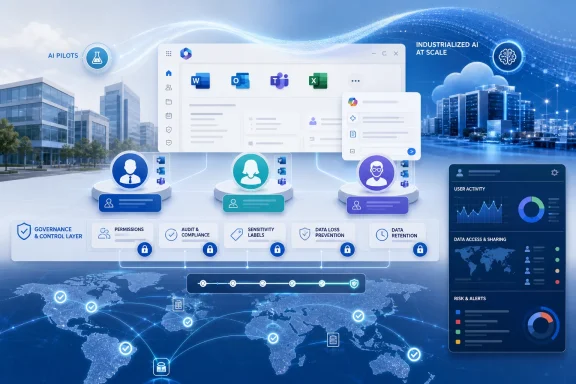
On June 3, 2026, Microsoft said Tata Consultancy Services, Infosys, and Wipro had each scaled Microsoft 365 Copilot to more than 100,000 employees, pushing the three Indian IT services giants beyond 300,000 seats in less than six months across their global workforces. The number matters less as a licensing milestone than as a public marker of where enterprise AI has moved: out of the demo room and into the operating model. For Windows-heavy organizations, this is the clearest sign yet that Copilot is becoming not just a feature of Microsoft 365, but a test of corporate discipline. The winners will not be the companies that buy the most AI seats; they will be the ones that turn those seats into governed, measurable work.
The Indian IT services sector has always been an early warning system for enterprise technology. TCS, Infosys, and Wipro do not merely consume tools; they package them, operationalize them, train armies around them, and sell the resulting discipline back to global clients. When all three move past 100,000 Microsoft 365 Copilot users apiece, the signal is not that knowledge workers have found a better autocomplete box. It is that generative AI is being industrialized.
That is why this rollout deserves more attention than the usual “AI adoption accelerates” headline. Copilot is not a sidecar chatbot sitting outside the business. It lives in the same productivity estate where employees write proposals, summarize meetings, search mailboxes, draft code-adjacent documentation, and handle client material. At this scale, every useful prompt is also a governance event.
Microsoft’s announcement also serves Microsoft’s own narrative. The company wants Copilot to be seen as the natural AI layer for enterprises already standardized on Microsoft 365, Teams, Outlook, SharePoint, OneDrive, and Entra. Indian IT firms are ideal proof points because they are both large internal users and influential systems integrators. If they can make Copilot work across hundreds of thousands of employees, Microsoft can argue that the product is ready for the mainstream enterprise.
But proof of deployment is not proof of value. A license can be assigned in a procurement system long before it changes the economics of delivery. The hard part begins after the press release, when managers must decide who gets access, what data the tool can see, which workflows deserve automation, and how to distinguish real productivity from the familiar enterprise trick of doing old work in a new interface.
That matters because Microsoft 365 Copilot is most powerful where enterprise sprawl is worst. The modern IT services employee lives across email threads, Teams chats, spreadsheets, slide decks, ticket histories, code repositories, knowledge bases, and delivery documents. A tool that can summarize, retrieve, draft, compare, and reason across that estate has obvious appeal, especially in firms whose business model depends on converting employee time into billable output.
The economic logic is straightforward. If Copilot reduces the time required to prepare status reports, parse long client threads, create first-draft documentation, or find internal expertise, the savings compound across a very large workforce. Even small time savings become material when multiplied by hundreds of thousands of people. That is the math behind the enthusiasm.
The catch is that enterprise productivity tools often produce diffuse benefits and very visible costs. Licensing is immediate. Training takes time. Governance consumes scarce security and platform engineering capacity. The gains, meanwhile, arrive unevenly: a proposal team may save hours a week, while another group barely changes its habits. The finance department sees a line item; the productivity uplift shows up as anecdotes unless the company builds measurement into the rollout.
For Indian IT services firms, the bet is doubly strategic. They are not only trying to improve internal efficiency; they are trying to build credibility with clients who are asking the same questions. A services firm that cannot govern AI internally will struggle to advise a bank, insurer, manufacturer, or retailer on how to do it safely. The internal rollout is therefore also a sales credential.
For decades, Microsoft’s enterprise advantage has been integration. Windows, Office, Active Directory, Exchange, SharePoint, Teams, Intune, Defender, and Azure did not dominate because each component was always best in class. They dominated because they formed a manageable estate. CIOs like innovation, but they love things that can be licensed, audited, secured, deployed, and blamed through a single vendor relationship.
Copilot extends that logic into generative AI. Instead of letting employees paste client text into unknown web tools, a company can route much of that demand into a sanctioned assistant tied to existing identity, permissions, compliance controls, and administrative tooling. That is not a guarantee of safety, but it is a governance starting point that consumer AI tools cannot offer.
This is why the Indian deployments are so useful to Microsoft. They show Copilot not as a novelty but as an enterprise layer. If a global services firm can put it in front of more than 100,000 employees, the implied message to cautious CIOs is simple: the technology has crossed the threshold from interesting to manageable.
Yet “manageable” is doing a lot of work here. Copilot inherits the strengths and weaknesses of the Microsoft 365 tenant beneath it. If SharePoint permissions are messy, if old Teams channels are overexposed, if sensitive client documents are stored in the wrong places, AI can make those old governance failures newly visible. The assistant does not create every data problem, but it can surface them faster and at greater scale.
The top-down model has obvious attractions. Leadership selects approved tools, security teams vet the data flows, procurement negotiates the licenses, and compliance teams define permitted usage. This is how large regulated organizations prefer to buy technology. It creates accountability.
But top-down AI programs can become slow and theatrical. A company may spend heavily on sanctioned tools while employees quietly keep using whatever gets the job done faster. If the approved assistant is poorly trained, blocked from useful data, or buried under policy warnings, workers will route around it. That is how shadow IT grows.
The bottom-up model has the opposite problem. Employees discover tools, automate pain points, share prompts, and invent workflows management never planned. This can produce real innovation, especially in delivery organizations where frontline teams understand the work better than central committees. But it can also turn into a quiet data leakage machine.
The emerging compromise is governed autonomy. Employees get room to use AI, but inside visible boundaries. The company provides approved tools, monitors usage patterns, classifies sensitive data, trains workers on prohibited behavior, and builds escalation paths for risky use cases. In theory, this preserves speed without surrendering control.
In practice, governed autonomy is difficult. It requires more than a policy PDF and a training module. It needs identity management, data classification, logging, retention rules, model access controls, prompt and response monitoring where appropriate, and a culture in which employees understand why the restrictions exist. The firms that master this will treat AI governance as an operational muscle, not a legal disclaimer.
A worker using an unapproved project management tool may expose metadata. A worker pasting client data, source code, contract language, customer records, or internal strategy into an unvetted AI system may expose the substance of the business. The risk is not always malicious. Most employees are trying to save time, not leak data. That is precisely why the problem is hard.
For Indian IT firms, this is especially sensitive. Their clients include global banks, healthcare organizations, telecom operators, retailers, manufacturers, and governments. These clients outsource work with strict contractual controls over data handling. An employee’s AI shortcut can become a breach of client trust even before regulators enter the picture.
Copilot’s appeal is that it offers a sanctioned alternative. If employees are going to use AI anyway, the enterprise has an incentive to provide a tool integrated with corporate identity and permission structures. The question is whether that sanctioned tool is good enough, available enough, and trusted enough to displace the unsanctioned ones.
This is where user experience becomes a security control. If employees find Copilot genuinely useful in Outlook, Teams, Word, Excel, and SharePoint, they have fewer reasons to paste material into random browser-based assistants. If Copilot is expensive, inconsistently deployed, or blocked from the data workers actually need, shadow AI will keep growing around it.
The law’s practical effect is to make AI governance a boardroom concern. A large IT services company handling personal data cannot plausibly treat employee AI use as an informal productivity experiment. If personal data is processed through unauthorized tools or exposed through weak controls, the issue can quickly move from IT operations to legal, compliance, and investor relations.
This matters because generative AI blurs traditional boundaries around data processing. An employee may not think of a meeting transcript, support ticket, spreadsheet, or test dataset as regulated material. But if it contains identifiable personal information, the compliance implications can be real. AI tools are hungry for context, and context is often where sensitive data hides.
For TCS, Infosys, and Wipro, the risk is not limited to Indian personal data. These firms operate globally and serve clients under multiple privacy regimes, including the GDPR and sector-specific rules in the United States and elsewhere. The DPDP Act adds another layer to an already complex compliance map.
The most mature response is not to ban AI. Blanket bans rarely survive contact with business incentives. The better response is to define what classes of data can be used with which tools, under what controls, with what logging, and for which business purposes. That is less dramatic than a moratorium, but more likely to work.
For IT services firms, margins depend on utilization, billing rates, delivery efficiency, attrition, wage pressure, subcontracting costs, pricing power, and the mix of fixed-price versus time-and-material contracts. AI can influence several of these variables, but not automatically. A developer saving 20 minutes on a routine task does not improve margins unless the company captures that time in delivery economics.
There are several ways the value could show up. Firms may complete projects with smaller teams, reduce rework, accelerate documentation, improve proposal throughput, or create AI-assisted service offerings that command better pricing. They may also use Copilot internally to reduce administrative drag across HR, finance, sales, legal, and delivery management.
But there are also ways the value can disappear. Clients may demand that productivity gains be passed through as lower prices. Employees may use saved time for higher-quality work rather than lower-cost delivery. Licensing and governance costs may offset early productivity gains. Some use cases may produce impressive demos but little measurable operational change.
That is why investors should listen carefully to quarterly commentary. “AI adoption” is not the same as “AI-led revenue growth.” “Productivity improvement” is not the same as “margin expansion.” The most meaningful disclosures will connect AI usage to contract wins, delivery metrics, utilization changes, reduced cycle times, or improved pricing.
The danger is that AI becomes an arms race in which every services firm must spend to look credible, even before the returns are clear. In that scenario, Copilot licensing is table stakes, not differentiation. The companies that win will be those that convert AI from a vendor bill into a repeatable delivery advantage.
That shift favors firms like TCS, Infosys, and Wipro. Their business is not to invent the next foundation model. It is to make technology usable inside messy enterprises. The money is in workflow redesign, data readiness, compliance, change management, and integration with legacy systems. Those are not glamorous, but they are where enterprise AI projects succeed or fail.
Fine-tuning, retrieval-augmented generation, domain-specific agents, and workflow automation are more plausible profit pools than building giant proprietary models from scratch. A bank does not necessarily want a custom model that can write poems and pass benchmarks. It wants an assistant that understands its policies, respects access controls, drafts compliant reports, and does not leak customer data.
Copilot fits this pragmatic turn because it is embedded in existing Microsoft estates. It may not be the only AI interface a company uses, and it may not be the deepest tool for every technical workflow. But it provides a common layer for knowledge work, and that common layer is valuable when organizations are trying to scale adoption without creating chaos.
The services opportunity sits around that layer. Clients will need help cleaning permissions, classifying data, designing usage policies, measuring productivity, training employees, building custom agents, and deciding where Copilot is enough versus where specialized AI systems are needed. The internal deployments by Indian IT firms are therefore also laboratories for future consulting playbooks.
The near-term enterprise impact will be felt less through the Windows desktop shell and more through the Microsoft 365 work graph. Outlook summaries, Teams recaps, Word drafts, Excel assistance, PowerPoint generation, SharePoint retrieval, and enterprise search are where many employees will first experience AI as part of their regular workday. Windows remains the endpoint, but Microsoft 365 is the workplace.
That said, endpoint management still matters. If AI becomes embedded in daily productivity, administrators will need to think about device compliance, identity posture, browser controls, data loss prevention, sensitivity labels, and conditional access as part of the AI architecture. Copilot is not just a cloud feature floating above the endpoint. It depends on the trustworthiness of the environment around it.
Sysadmins should also expect more pressure from business leaders who have seen these large deployments and now want similar capabilities. The conversation will not begin with a neatly scoped requirements document. It will begin with executives asking why employees cannot have the same AI assistance they read about in competitors’ rollouts. IT will then have to translate enthusiasm into readiness.
That readiness work is unglamorous but essential. Tenants need permission hygiene. Sensitive data needs labels. External sharing policies need review. Legacy content repositories need cleanup. Employees need training that goes beyond prompt tips and addresses what not to put into AI tools. Without that foundation, Copilot can amplify old problems.
These tasks are not trivial. They are the connective tissue of services delivery. They consume time, create friction, and often determine whether distributed teams stay aligned. If AI can reduce the burden of these tasks while preserving quality and compliance, the impact across a firm like TCS, Infosys, or Wipro could be substantial.
But middle-layer productivity is hard to measure. Nobody wants to admit that highly paid employees spend vast amounts of time reconstructing context from old emails and meetings. Yet every large organization does. Copilot’s promise is that it can compress that context-gathering cycle.
The risk is that companies mistake output volume for productivity. AI can generate more documents, more summaries, more slides, and more messages. That is not automatically progress. In badly governed organizations, AI may accelerate the production of corporate sludge: plausible text that adds little clarity and creates more material for others to summarize later.
The metric that matters is not whether employees produce more artifacts. It is whether decisions move faster, delivery defects fall, client responsiveness improves, and skilled workers spend less time on avoidable administrative drag. That is a tougher bar than counting prompts, but it is the only bar that matters.
The honest answer is likely uneven. In the short term, firms may use AI to improve throughput rather than cut headcount. They can absorb demand, improve delivery speed, and redeploy employees into higher-value work. That is the politically and operationally easier story.
Over time, however, clients will ask why AI-assisted work should be priced like traditional labor-intensive work. Fixed-price contracts may allow firms to capture efficiency gains, while time-and-material contracts may expose them to pricing pressure. If AI reduces the need for junior-heavy task execution, the classic pyramid model of offshore delivery could face stress.
This does not mean mass displacement is imminent. Enterprise work changes slowly, and AI systems still require human review, domain expertise, and accountability. But the direction is clear enough: routine knowledge work is being compressed, and services firms must decide whether to protect old staffing models or redesign them.
The firms that handle this well will invest heavily in reskilling. Employees who can supervise AI outputs, understand client domains, manage data quality, design workflows, and validate compliance will become more valuable. Employees whose work is limited to repeatable drafting, summarization, or mechanical transformation will face pressure.
This is another reason the Copilot seat count is strategically important. A broad deployment can normalize AI literacy across the workforce. It can also expose skill gaps. The companies that treat Copilot as a training ground for new work patterns will gain more than those that treat it as a perk.
The first governance challenge is data access. Copilot can only respect permissions if permissions are meaningful. Many enterprises have years of accumulated oversharing in SharePoint sites, Teams channels, shared drives, and document libraries. AI-assisted search makes that oversharing harder to ignore. If employees can suddenly discover sensitive material they technically had access to but never would have found manually, the problem is not the search tool alone. It is the access model.
The second challenge is usage policy. Employees need clear rules on client data, personal data, source code, confidential strategy, regulated information, and generated outputs. Vague warnings will not do. People need scenario-based guidance that fits their work.
The third challenge is observability. Companies need to know which teams are using AI, for what categories of tasks, and where risky patterns emerge. This does not mean turning every prompt into a surveillance drama. It means having enough telemetry to manage adoption, detect misuse, and prove compliance when clients or regulators ask.
The fourth challenge is cost control. Generative AI licensing can sprawl quickly when enthusiasm outruns evidence. Large firms will need tiering, renewal discipline, usage analytics, and a willingness to reallocate seats away from low-value use cases. The politics of taking AI access away may become as difficult as granting it.
Governance is often described as a brake on innovation. In enterprise AI, it is more like the suspension system. Without it, the vehicle can move fast only on perfect roads. With it, the organization can travel over rough terrain without shaking itself apart.
The right lesson is that AI adoption has crossed into the phase where deployment must be tied to operating discipline. Buying seats is easy compared with preparing data, training employees, defining controls, measuring outcomes, and changing workflows. The Indian IT firms have the scale and incentive to treat this as an institutional transformation. Smaller companies need not imitate the size of the rollout, but they should imitate the seriousness.
A useful Copilot program starts with work, not technology. Which tasks consume the most avoidable time? Which workflows rely on scattered context? Which documents are repeatedly recreated from scratch? Which teams are drowning in meetings? Which support processes depend on tribal knowledge? Those are better starting points than a blanket license assignment.
Companies should also resist the fantasy that AI adoption is either centralized or organic. It has to be both. Central teams provide guardrails, approved tooling, security architecture, and measurement. Business units provide use cases, feedback, and process change. If either side dominates, the program will fail in a familiar way: either safe and unused, or popular and unsafe.
For Windows and Microsoft 365 administrators, this creates an opportunity to regain strategic relevance. The AI conversation is not only about model quality. It is about identity, data architecture, endpoint trust, policy enforcement, and user enablement. Those are core IT disciplines, newly promoted to board-level importance.
For investors, customers, and IT leaders watching this wave, the scorecard should be concrete rather than theatrical.
 India’s IT Giants Just Made Copilot a Board-Level Experiment
The Indian IT services sector has always been an early warning system for enterprise technology. TCS, Infosys, and Wipro do not merely consume tools; they package them, operationalize them, train armies around them, and sell the resulting discipline back to global clients. When all three move past 100,000 Microsoft 365 Copilot users apiece, the signal is not that knowledge workers have found a better autocomplete box. It is that generative AI is being industrialized.That is why this rollout deserves more attention than the usual “AI adoption accelerates” headline. Copilot is not a sidecar chatbot sitting outside the business. It lives in the same productivity estate where employees write proposals, summarize meetings, search mailboxes, draft code-adjacent documentation, and handle client material. At this scale, every useful prompt is also a governance event.
Microsoft’s announcement also serves Microsoft’s own narrative. The company wants Copilot to be seen as the natural AI layer for enterprises already standardized on Microsoft 365, Teams, Outlook, SharePoint, OneDrive, and Entra. Indian IT firms are ideal proof points because they are both large internal users and influential systems integrators. If they can make Copilot work across hundreds of thousands of employees, Microsoft can argue that the product is ready for the mainstream enterprise.
But proof of deployment is not proof of value. A license can be assigned in a procurement system long before it changes the economics of delivery. The hard part begins after the press release, when managers must decide who gets access, what data the tool can see, which workflows deserve automation, and how to distinguish real productivity from the familiar enterprise trick of doing old work in a new interface.
The Seat Count Is a Proxy for a Bigger Platform Bet
A 300,000-seat commitment is not a conventional software rollout. It is closer to a platform bet on the future shape of white-collar work. TCS, Infosys, and Wipro are effectively saying that AI assistance should sit inside the default work surface rather than remain the domain of specialist teams and experimental labs.That matters because Microsoft 365 Copilot is most powerful where enterprise sprawl is worst. The modern IT services employee lives across email threads, Teams chats, spreadsheets, slide decks, ticket histories, code repositories, knowledge bases, and delivery documents. A tool that can summarize, retrieve, draft, compare, and reason across that estate has obvious appeal, especially in firms whose business model depends on converting employee time into billable output.
The economic logic is straightforward. If Copilot reduces the time required to prepare status reports, parse long client threads, create first-draft documentation, or find internal expertise, the savings compound across a very large workforce. Even small time savings become material when multiplied by hundreds of thousands of people. That is the math behind the enthusiasm.
The catch is that enterprise productivity tools often produce diffuse benefits and very visible costs. Licensing is immediate. Training takes time. Governance consumes scarce security and platform engineering capacity. The gains, meanwhile, arrive unevenly: a proposal team may save hours a week, while another group barely changes its habits. The finance department sees a line item; the productivity uplift shows up as anecdotes unless the company builds measurement into the rollout.
For Indian IT services firms, the bet is doubly strategic. They are not only trying to improve internal efficiency; they are trying to build credibility with clients who are asking the same questions. A services firm that cannot govern AI internally will struggle to advise a bank, insurer, manufacturer, or retailer on how to do it safely. The internal rollout is therefore also a sales credential.
Microsoft Wins When AI Becomes Boring Infrastructure
Microsoft’s strongest argument for Copilot is not that it is the flashiest AI product. It is that it is already where enterprise work happens. That is a very Windows-era argument: the platform wins by becoming the default place where employees spend their day.For decades, Microsoft’s enterprise advantage has been integration. Windows, Office, Active Directory, Exchange, SharePoint, Teams, Intune, Defender, and Azure did not dominate because each component was always best in class. They dominated because they formed a manageable estate. CIOs like innovation, but they love things that can be licensed, audited, secured, deployed, and blamed through a single vendor relationship.
Copilot extends that logic into generative AI. Instead of letting employees paste client text into unknown web tools, a company can route much of that demand into a sanctioned assistant tied to existing identity, permissions, compliance controls, and administrative tooling. That is not a guarantee of safety, but it is a governance starting point that consumer AI tools cannot offer.
This is why the Indian deployments are so useful to Microsoft. They show Copilot not as a novelty but as an enterprise layer. If a global services firm can put it in front of more than 100,000 employees, the implied message to cautious CIOs is simple: the technology has crossed the threshold from interesting to manageable.
Yet “manageable” is doing a lot of work here. Copilot inherits the strengths and weaknesses of the Microsoft 365 tenant beneath it. If SharePoint permissions are messy, if old Teams channels are overexposed, if sensitive client documents are stored in the wrong places, AI can make those old governance failures newly visible. The assistant does not create every data problem, but it can surface them faster and at greater scale.
The Real Fight Is Not Human Versus AI, but Control Versus Velocity
The standard AI workplace debate is usually framed as whether employees will be replaced. In the near term, the more practical fight is between corporate control and employee velocity. Every large company now faces the same uncomfortable choice: lock AI down so tightly that users work around it, or allow enough freedom that risk becomes difficult to see.The top-down model has obvious attractions. Leadership selects approved tools, security teams vet the data flows, procurement negotiates the licenses, and compliance teams define permitted usage. This is how large regulated organizations prefer to buy technology. It creates accountability.
But top-down AI programs can become slow and theatrical. A company may spend heavily on sanctioned tools while employees quietly keep using whatever gets the job done faster. If the approved assistant is poorly trained, blocked from useful data, or buried under policy warnings, workers will route around it. That is how shadow IT grows.
The bottom-up model has the opposite problem. Employees discover tools, automate pain points, share prompts, and invent workflows management never planned. This can produce real innovation, especially in delivery organizations where frontline teams understand the work better than central committees. But it can also turn into a quiet data leakage machine.
The emerging compromise is governed autonomy. Employees get room to use AI, but inside visible boundaries. The company provides approved tools, monitors usage patterns, classifies sensitive data, trains workers on prohibited behavior, and builds escalation paths for risky use cases. In theory, this preserves speed without surrendering control.
In practice, governed autonomy is difficult. It requires more than a policy PDF and a training module. It needs identity management, data classification, logging, retention rules, model access controls, prompt and response monitoring where appropriate, and a culture in which employees understand why the restrictions exist. The firms that master this will treat AI governance as an operational muscle, not a legal disclaimer.
Shadow AI Is the New Shadow IT, Only Faster
IT departments have fought shadow IT for years. Employees adopted unsanctioned SaaS tools because the official tools were too slow, too limited, or too painful. Generative AI makes that old problem more dangerous because the input is often the asset.A worker using an unapproved project management tool may expose metadata. A worker pasting client data, source code, contract language, customer records, or internal strategy into an unvetted AI system may expose the substance of the business. The risk is not always malicious. Most employees are trying to save time, not leak data. That is precisely why the problem is hard.
For Indian IT firms, this is especially sensitive. Their clients include global banks, healthcare organizations, telecom operators, retailers, manufacturers, and governments. These clients outsource work with strict contractual controls over data handling. An employee’s AI shortcut can become a breach of client trust even before regulators enter the picture.
Copilot’s appeal is that it offers a sanctioned alternative. If employees are going to use AI anyway, the enterprise has an incentive to provide a tool integrated with corporate identity and permission structures. The question is whether that sanctioned tool is good enough, available enough, and trusted enough to displace the unsanctioned ones.
This is where user experience becomes a security control. If employees find Copilot genuinely useful in Outlook, Teams, Word, Excel, and SharePoint, they have fewer reasons to paste material into random browser-based assistants. If Copilot is expensive, inconsistently deployed, or blocked from the data workers actually need, shadow AI will keep growing around it.
The DPDP Act Turns AI Governance Into a Financial Issue
India’s Digital Personal Data Protection Act changes the temperature of this discussion. Data protection is no longer merely a matter of client contracts and reputational risk. It is a statutory compliance problem with potentially significant financial penalties for failures around personal data safeguards and breach notification.The law’s practical effect is to make AI governance a boardroom concern. A large IT services company handling personal data cannot plausibly treat employee AI use as an informal productivity experiment. If personal data is processed through unauthorized tools or exposed through weak controls, the issue can quickly move from IT operations to legal, compliance, and investor relations.
This matters because generative AI blurs traditional boundaries around data processing. An employee may not think of a meeting transcript, support ticket, spreadsheet, or test dataset as regulated material. But if it contains identifiable personal information, the compliance implications can be real. AI tools are hungry for context, and context is often where sensitive data hides.
For TCS, Infosys, and Wipro, the risk is not limited to Indian personal data. These firms operate globally and serve clients under multiple privacy regimes, including the GDPR and sector-specific rules in the United States and elsewhere. The DPDP Act adds another layer to an already complex compliance map.
The most mature response is not to ban AI. Blanket bans rarely survive contact with business incentives. The better response is to define what classes of data can be used with which tools, under what controls, with what logging, and for which business purposes. That is less dramatic than a moratorium, but more likely to work.
Investors Should Treat AI Spend as Margin Pressure Until Proven Otherwise
The market wants a simple story: AI investment leads to productivity, productivity leads to margin expansion, and margin expansion leads to higher valuations. That story may prove true over time. But investors should resist treating large Copilot rollouts as immediate evidence of operating leverage.For IT services firms, margins depend on utilization, billing rates, delivery efficiency, attrition, wage pressure, subcontracting costs, pricing power, and the mix of fixed-price versus time-and-material contracts. AI can influence several of these variables, but not automatically. A developer saving 20 minutes on a routine task does not improve margins unless the company captures that time in delivery economics.
There are several ways the value could show up. Firms may complete projects with smaller teams, reduce rework, accelerate documentation, improve proposal throughput, or create AI-assisted service offerings that command better pricing. They may also use Copilot internally to reduce administrative drag across HR, finance, sales, legal, and delivery management.
But there are also ways the value can disappear. Clients may demand that productivity gains be passed through as lower prices. Employees may use saved time for higher-quality work rather than lower-cost delivery. Licensing and governance costs may offset early productivity gains. Some use cases may produce impressive demos but little measurable operational change.
That is why investors should listen carefully to quarterly commentary. “AI adoption” is not the same as “AI-led revenue growth.” “Productivity improvement” is not the same as “margin expansion.” The most meaningful disclosures will connect AI usage to contract wins, delivery metrics, utilization changes, reduced cycle times, or improved pricing.
The danger is that AI becomes an arms race in which every services firm must spend to look credible, even before the returns are clear. In that scenario, Copilot licensing is table stakes, not differentiation. The companies that win will be those that convert AI from a vendor bill into a repeatable delivery advantage.
The Proprietary Model Dream Is Giving Way to Pragmatism
A year ago, every large technology company seemed tempted to talk as if it needed its own large language model strategy. The more practical enterprise view is now taking hold: most companies do not need to build frontier models. They need to apply, tune, govern, and integrate models into real workflows.That shift favors firms like TCS, Infosys, and Wipro. Their business is not to invent the next foundation model. It is to make technology usable inside messy enterprises. The money is in workflow redesign, data readiness, compliance, change management, and integration with legacy systems. Those are not glamorous, but they are where enterprise AI projects succeed or fail.
Fine-tuning, retrieval-augmented generation, domain-specific agents, and workflow automation are more plausible profit pools than building giant proprietary models from scratch. A bank does not necessarily want a custom model that can write poems and pass benchmarks. It wants an assistant that understands its policies, respects access controls, drafts compliant reports, and does not leak customer data.
Copilot fits this pragmatic turn because it is embedded in existing Microsoft estates. It may not be the only AI interface a company uses, and it may not be the deepest tool for every technical workflow. But it provides a common layer for knowledge work, and that common layer is valuable when organizations are trying to scale adoption without creating chaos.
The services opportunity sits around that layer. Clients will need help cleaning permissions, classifying data, designing usage policies, measuring productivity, training employees, building custom agents, and deciding where Copilot is enough versus where specialized AI systems are needed. The internal deployments by Indian IT firms are therefore also laboratories for future consulting playbooks.
Windows Shops Will Feel This Through Microsoft 365 Before They Feel It Through Windows
For WindowsForum readers, the Copilot story can be confusing because Microsoft uses the name across multiple products. There is Copilot in Windows, Copilot in Microsoft 365, Copilot in GitHub, Copilot Studio, Security Copilot, and a growing family of agentic features across the Microsoft stack. The Indian IT deployments are specifically about Microsoft 365 Copilot, and that distinction matters.The near-term enterprise impact will be felt less through the Windows desktop shell and more through the Microsoft 365 work graph. Outlook summaries, Teams recaps, Word drafts, Excel assistance, PowerPoint generation, SharePoint retrieval, and enterprise search are where many employees will first experience AI as part of their regular workday. Windows remains the endpoint, but Microsoft 365 is the workplace.
That said, endpoint management still matters. If AI becomes embedded in daily productivity, administrators will need to think about device compliance, identity posture, browser controls, data loss prevention, sensitivity labels, and conditional access as part of the AI architecture. Copilot is not just a cloud feature floating above the endpoint. It depends on the trustworthiness of the environment around it.
Sysadmins should also expect more pressure from business leaders who have seen these large deployments and now want similar capabilities. The conversation will not begin with a neatly scoped requirements document. It will begin with executives asking why employees cannot have the same AI assistance they read about in competitors’ rollouts. IT will then have to translate enthusiasm into readiness.
That readiness work is unglamorous but essential. Tenants need permission hygiene. Sensitive data needs labels. External sharing policies need review. Legacy content repositories need cleanup. Employees need training that goes beyond prompt tips and addresses what not to put into AI tools. Without that foundation, Copilot can amplify old problems.
The Productivity Story Will Be Won in the Middle Layers
The most interesting Copilot gains may not come from superstar employees doing spectacular things. They may come from the middle layers of enterprise work: the status update, the first draft, the meeting summary, the knowledge search, the policy comparison, the handover note, the RFP response, the test plan, the implementation checklist.These tasks are not trivial. They are the connective tissue of services delivery. They consume time, create friction, and often determine whether distributed teams stay aligned. If AI can reduce the burden of these tasks while preserving quality and compliance, the impact across a firm like TCS, Infosys, or Wipro could be substantial.
But middle-layer productivity is hard to measure. Nobody wants to admit that highly paid employees spend vast amounts of time reconstructing context from old emails and meetings. Yet every large organization does. Copilot’s promise is that it can compress that context-gathering cycle.
The risk is that companies mistake output volume for productivity. AI can generate more documents, more summaries, more slides, and more messages. That is not automatically progress. In badly governed organizations, AI may accelerate the production of corporate sludge: plausible text that adds little clarity and creates more material for others to summarize later.
The metric that matters is not whether employees produce more artifacts. It is whether decisions move faster, delivery defects fall, client responsiveness improves, and skilled workers spend less time on avoidable administrative drag. That is a tougher bar than counting prompts, but it is the only bar that matters.
The Labor Question Is Still There, Even If Nobody Wants to Lead With It
Indian IT services firms employ huge numbers of engineers, analysts, testers, consultants, and support staff. Any serious productivity shift raises an uncomfortable labor question: if AI reduces the time required for routine work, what happens to staffing models built around that work?The honest answer is likely uneven. In the short term, firms may use AI to improve throughput rather than cut headcount. They can absorb demand, improve delivery speed, and redeploy employees into higher-value work. That is the politically and operationally easier story.
Over time, however, clients will ask why AI-assisted work should be priced like traditional labor-intensive work. Fixed-price contracts may allow firms to capture efficiency gains, while time-and-material contracts may expose them to pricing pressure. If AI reduces the need for junior-heavy task execution, the classic pyramid model of offshore delivery could face stress.
This does not mean mass displacement is imminent. Enterprise work changes slowly, and AI systems still require human review, domain expertise, and accountability. But the direction is clear enough: routine knowledge work is being compressed, and services firms must decide whether to protect old staffing models or redesign them.
The firms that handle this well will invest heavily in reskilling. Employees who can supervise AI outputs, understand client domains, manage data quality, design workflows, and validate compliance will become more valuable. Employees whose work is limited to repeatable drafting, summarization, or mechanical transformation will face pressure.
This is another reason the Copilot seat count is strategically important. A broad deployment can normalize AI literacy across the workforce. It can also expose skill gaps. The companies that treat Copilot as a training ground for new work patterns will gain more than those that treat it as a perk.
Governance Will Decide Whether Copilot Becomes a Moat or a Mess
At 300,000-plus seats, governance is not an accessory. It is the product. The same tool can be a productivity multiplier in one organization and a compliance nightmare in another, depending on the controls beneath it.The first governance challenge is data access. Copilot can only respect permissions if permissions are meaningful. Many enterprises have years of accumulated oversharing in SharePoint sites, Teams channels, shared drives, and document libraries. AI-assisted search makes that oversharing harder to ignore. If employees can suddenly discover sensitive material they technically had access to but never would have found manually, the problem is not the search tool alone. It is the access model.
The second challenge is usage policy. Employees need clear rules on client data, personal data, source code, confidential strategy, regulated information, and generated outputs. Vague warnings will not do. People need scenario-based guidance that fits their work.
The third challenge is observability. Companies need to know which teams are using AI, for what categories of tasks, and where risky patterns emerge. This does not mean turning every prompt into a surveillance drama. It means having enough telemetry to manage adoption, detect misuse, and prove compliance when clients or regulators ask.
The fourth challenge is cost control. Generative AI licensing can sprawl quickly when enthusiasm outruns evidence. Large firms will need tiering, renewal discipline, usage analytics, and a willingness to reallocate seats away from low-value use cases. The politics of taking AI access away may become as difficult as granting it.
Governance is often described as a brake on innovation. In enterprise AI, it is more like the suspension system. Without it, the vehicle can move fast only on perfect roads. With it, the organization can travel over rough terrain without shaking itself apart.
The 300,000-Seat Lesson for CIOs Is Discipline, Not Imitation
The temptation for other enterprises will be to copy the headline number in miniature. If TCS, Infosys, and Wipro can scale Copilot to more than 100,000 employees each, a bank with 20,000 staff or a manufacturer with 8,000 office workers may feel behind. That is the wrong lesson.The right lesson is that AI adoption has crossed into the phase where deployment must be tied to operating discipline. Buying seats is easy compared with preparing data, training employees, defining controls, measuring outcomes, and changing workflows. The Indian IT firms have the scale and incentive to treat this as an institutional transformation. Smaller companies need not imitate the size of the rollout, but they should imitate the seriousness.
A useful Copilot program starts with work, not technology. Which tasks consume the most avoidable time? Which workflows rely on scattered context? Which documents are repeatedly recreated from scratch? Which teams are drowning in meetings? Which support processes depend on tribal knowledge? Those are better starting points than a blanket license assignment.
Companies should also resist the fantasy that AI adoption is either centralized or organic. It has to be both. Central teams provide guardrails, approved tooling, security architecture, and measurement. Business units provide use cases, feedback, and process change. If either side dominates, the program will fail in a familiar way: either safe and unused, or popular and unsafe.
For Windows and Microsoft 365 administrators, this creates an opportunity to regain strategic relevance. The AI conversation is not only about model quality. It is about identity, data architecture, endpoint trust, policy enforcement, and user enablement. Those are core IT disciplines, newly promoted to board-level importance.
The Practical Scorecard Is Narrower Than the Hype
The Copilot surge across TCS, Infosys, and Wipro gives the enterprise market a useful test case, but it should also make buyers more demanding. The question is no longer whether large companies can assign AI licenses. They can. The question is whether they can extract durable value without creating new risk.For investors, customers, and IT leaders watching this wave, the scorecard should be concrete rather than theatrical.
- The most important evidence will be whether AI-assisted delivery produces measurable improvements in cycle time, quality, utilization, or pricing power.
- Copilot licensing should be judged against actual usage and workflow impact, not against the number of employees assigned a seat.
- Data governance, permission hygiene, and privacy controls will determine whether sanctioned AI reduces shadow AI or merely coexists with it.
- The DPDP Act makes careless AI use a compliance and financial risk, especially where personal data or client-controlled information enters prompts and outputs.
- The strongest services opportunity is likely to come from integrating and governing existing AI platforms, not from every firm attempting to build its own frontier model.
- Windows and Microsoft 365 administrators will be central to AI readiness because identity, endpoints, data access, and compliance controls are now part of the productivity stack.
References
- Primary source: Whalesbook
Published: 2026-06-24T01:51:25.753776
TCS, Infosys, Wipro Lead AI Shift With 300,000+ Copilot Licenses
Indian IT giants like TCS, Infosys, and Wipro are scaling AI with 300,000+ Copilot licenses. Here is what this means for margins, security, and growth. www.whalesbook.com
- Official source: news.microsoft.com
- Related coverage: moneycontrol.com
TCS, Infosys, Wipro took over 300,000 Microsoft Copilot licences in 6 months
The expansion follows the 50,000-seat deployments announced by the three companies in December 2025www.moneycontrol.com - Related coverage: techgig.com
Infosys, TCS, Wipro expand Microsoft 365 Copilot to over 300,000 employees
Infosys, TCS, and Wipro have each increased their Microsoft 365 Copilot deployments to over 100,000 employees, collectively surpassing 300,000 licenses in six months. This trend reflects the growing integration of AI tools in India's IT services sector.techgig.com
- Related coverage: financialexpress.com
Infosys, TCS and Wipro cross 300,000 Microsoft Copilot licences as AI adoption accelerates - Business News | The Financial Express
Infosys, TCS and Wipro have each deployed Microsoft 365 Copilot to more than 100,000 employees as enterprise AI adoption moves beyond pilot projects.www.financialexpress.com - Related coverage: newindianexpress.com
Infosys, TCS and Wipro deploy over 300,000 Microsoft Copilot licences in six months
The latest expansion follows deployments of around 50,000 licences at each company announced in December 2025, reflecting a sharp increase in the use of generatwww.newindianexpress.com

- Related coverage: windowsforum.com
TCS, Infosys and Wipro Scale Microsoft 365 Copilot to 300,000 Users | Windows Forum
India’s TCS, Infosys, and Wipro have each expanded Microsoft 365 Copilot deployments beyond 100,000 employees as of June 3, 2026, taking their combined...windowsforum.com - Related coverage: fortuneindia.com
Infosys, TCS and Wipro cross 300,000 Microsoft Copilot seats as India’s IT giants deepen enterprise AI push
Infosys, TCS and Wipro have each deployed over 100,000 Microsoft 365 Copilot seats, crossing 300,000 licences in one of Microsoft’s largest enterprise AI rollouts. Discover how India’s IT giants are embedding AI agents into daily workflows, driving productivity gains, and reshaping global...www.fortuneindia.com - Related coverage: infosys.com